
Economics
The Long and Winding Road to Mental Health Care for Your Kid


For several months last spring and summer, my teen daughter, Caroline, experienced near-daily bouts of depression and debilitating panic attacks. During those episodes, she became extremely agitated, sobbing uncontrollably and aggressively rebuffing my attempts to comfort or reason with her.
My daughter was in a dark place, and I was worried.
But I have excellent health insurance, and I thought that would help me find a good therapist.
I dutifully dialed everyone on my health plan’s list. Some of them even called me back — only to say they weren’t taking new patients, or couldn’t see Caroline for three months, or didn’t have the training to match her symptoms.
I ultimately found a great therapist who isn’t in my health plan’s network — and after many months of weekly sessions, Caroline is doing much better.
I’m luckier than most parents, because my health plan covers a significant portion of Caroline’s out-of-network therapy. I pay only $45 per session, while some parents shell out north of $200 every week.
Think about how perverse this is. Mental health professionals say that with children, early intervention is crucial to avoid more severe and costly problems later on. Yet even parents with good insurance struggle to find care for their children.

The U.S. faces a growing shortage of mental health professionals trained to work with young people — at a time when depression and anxiety are on the rise. Suicide was the No. 2 cause of death for children and young adults from age 10 to 24 in 2017, after accidents.
There is only one practicing child and adolescent psychiatrist in the U.S. for about every 1,800 children who need one, according to data from the American Academy of Child & Adolescent Psychiatry.
Not only is it hard to get appointments with psychiatrists and therapists, but the ones who are available often don’t accept insurance.
“This country currently lacks the capacity to provide the mental health support that young people need,” says Dr. Steven Adelsheim, director of the Stanford University psychiatry department’s Center for Youth Mental Health and Wellbeing.
Alison Bloeser, of Seal Beach, Calif., has struggled for nearly a decade to find effective care for her now 15-year old son’s obsessive-compulsive disorder and attention deficit hyperactivity disorder, known as ADHD. In that time, Bloeser says, she has taken him to more than 20 therapists and had him on medication — spending more than $20,000 along the way.
“We have a growing number of young people in this country crying out for help at a young age,” Bloeser says. “Why are we not addressing that full force?”
There’s no one-size-fits-all solution because people’s financial and personal situations vary widely.
So let me begin with tips for all parents, even those with skimpy insurance or none at all. A good place to start is the pediatrician’s office — whether it’s a private practice or a low-cost community clinic.
“When your children reach adolescence, you should be asking their pediatricians to screen for both anxiety and depression,” advises Dr. Bhavana Arora, chief medical officer of the Children’s Hospital Los Angeles Health Network.
If your finances are constrained, try a community health clinic that offers mental health services regardless of a family’s ability to pay.
For instance, Los Angeles-based AltaMed (www.altamed.org) has 12 clinics in L.A. and Orange counties where children and teens with mild to moderate mental health disorders can get short-term therapy. Medi-Cal picks up the tab for most of those kids. For kids not on Medi-Cal, the clinics charge on a sliding scale.
One way to find a community clinic near you is to search https://findahealthcenter.hrsa.gov/.
Your child’s school is another place to seek help.
Faith-based organizations are increasingly engaged in mental health care. Saddleback Church, with numerous locations around Southern California, offers support groups and counseling. Jewish Family Service agencies nationwide provide counseling on a sliding scale. Muslims can try the Khalil Center, which has branches in Chicago, L.A., the San Francisco Bay Area, New York and Toronto.
If you, like me, have insurance and find a good therapist who is not in your network, try to make it work — if you can possibly afford it.
Start by checking whether you have coverage for out-of-network providers. If not, or if it’s not enough, ask if your health plan is willing to treat the therapist as an in-network provider just for your child — an arrangement known as a single-case agreement.
The therapist likely will have to agree to a lower payment.
For many parents, the most productive thing is meeting others who are experiencing similar problems.
If you need help and peer support, check with the National Alliance on Mental Illness. It offers a six-week course, “NAMI Basics,” which educates parents and puts them in touch with others in the same boat. Go to www.nami.org to find the chapter in your area.













To enlarge your view of this issue, use the slider, magnifying glass icon or full page icon in the lower right corner of the browser window.


To enlarge your view of this issue, use the slider, magnifying glass icon or full page icon in the lower right corner of the browser window.
Activism
Oakland Post: Week of September 30 – October 6, 2026
The printed Weekly Edition of the Oakland Post: Week of September 30 – October 6, 2026


To enlarge your view of this issue, use the slider, magnifying glass icon or full page icon in the lower right corner of the browser window.



Mayor Barbara Lee Holds Special State of the City Address in Deep East Oakland

Practitioners of African Traditional Spirituality Offer Ancestral Reverence Ritual Oct. 31

It’s Time to Lose Weight Before the Holidays

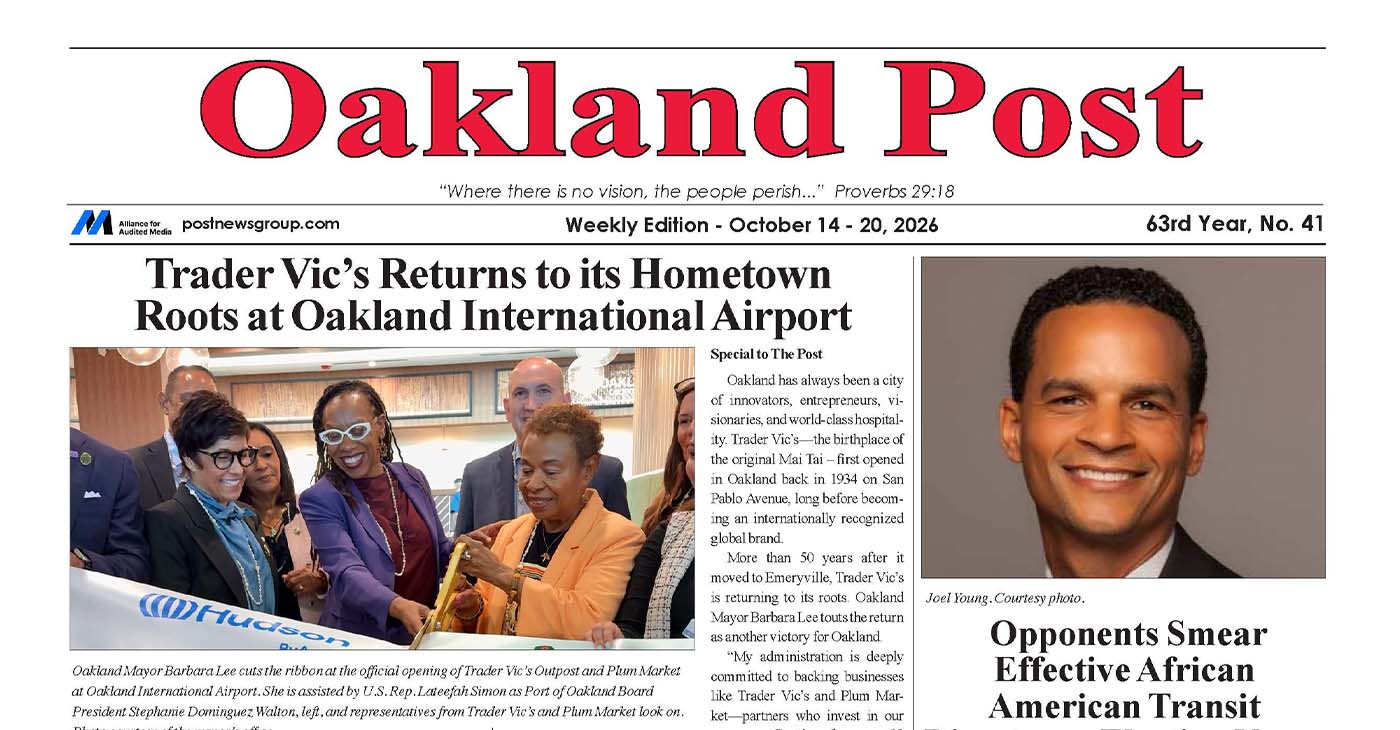
Trader Vic’s Returns to Its Oakland Roots

Oakland Coal Terminal Backed by Trump Would Be Bigger, Dirtier Than Promised, Says Report

Opponents Smear Effective African American Transit Director as Election Nears

Oakland Post: Week of October 14 – 20, 2026

OP-ED: The Black Church Writes AI’s Next Chapter

OP-ED: The Black Church Writes AI’s Next Chapter

WCCUSD Joins Statewide Organic School Food Purchasing Cooperative

Democrats, Community Groups Back Measure EE to Change How Oakland Is Governed

Four Tips to Help You Plan a Holiday “Staycation”

Veterans Housing Project Proposed for South Richmond
PRESS ROOM: Transformative Justice Coalition 2026 Voting Rights Champion Awards Reception ‘Yesterday Is Today: The Battle For Voting Rights

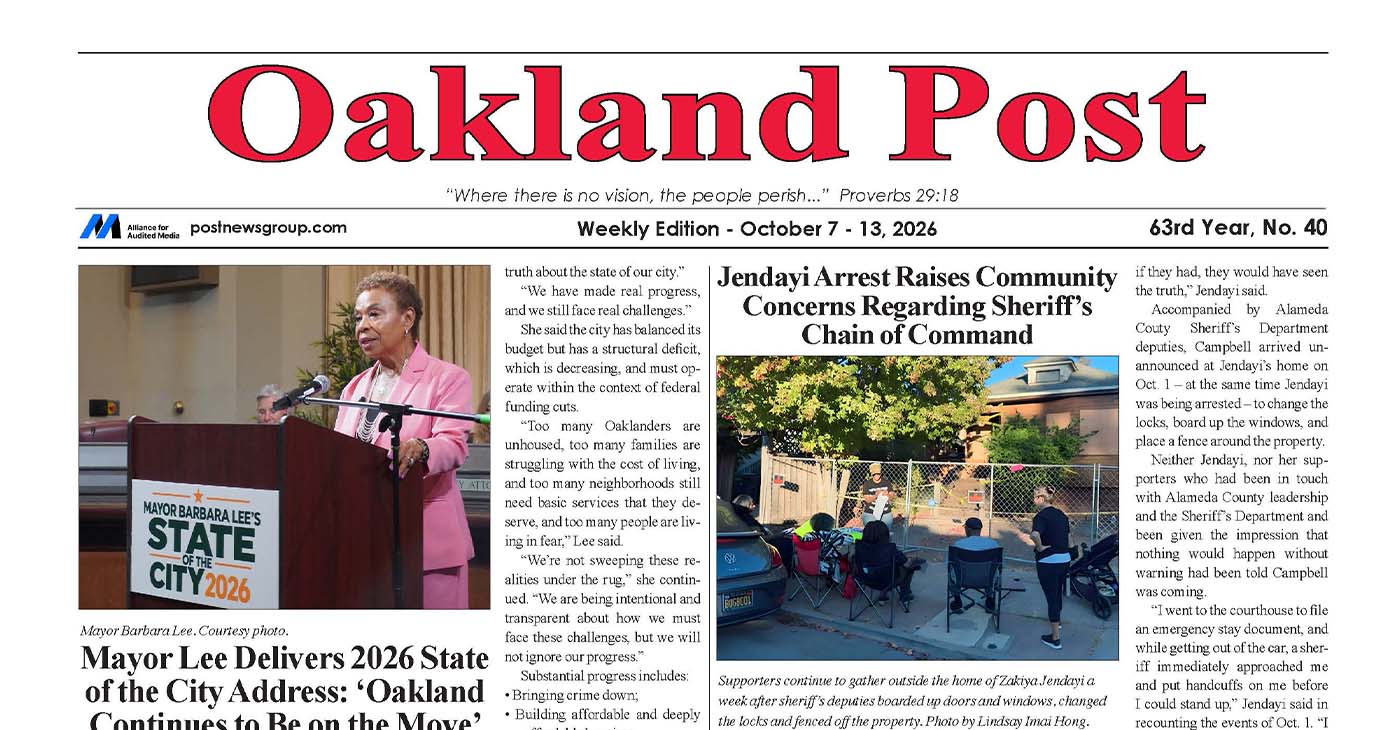
Mayor Lee Delivers 2026 State of the City Address: ‘Oakland Continues to Be on the Move’

Misnamed ‘Parent’ PAC Seeks to Influence Oakland School Board Elections

Poll: Becerra Widens His Lead Over Hilton; Californians Split on Wealth Tax

Listening as a Lifeline: A Doula’s Witness to Black Maternal Health

Oakland Post: Week of September 9 – 15, 2026

County Office of Education Says OUSD Finances Are Getting Healthier, Materially Stronger

Richmond Tiny House Village Farm & Garden Set to Open Gates on Sept. 26

Mayor Lee Announces $1 Million Kaiser Permanente Grant for Pilot Program to Address Homelessness, Clean Up Public Spaces throughout Oakland

Latest Massacre in Haiti Reveals Cruelty U.S. Deportations

Zakiya Jendayi Arrested, Locked Out of Home by Sheriff’s Deputies

OPINION: Nolan Wells’ Death One of Several Signifying Racial Terror Lives on in U.S. South

Doulas Are Helping Black California Moms Navigate Pregnancy–Even as High Mortality Rates Persist

BLACspace Cooperative Invites Bay Area to Experience Oakland’s Black Cultural Ecosystem Through a BLAC Map Tour + Party

Oakland Post: Week of September 16 – 22, 2026

Democratic Clubs Interview Candidates for Oakland School Board

Oakland People’s Arms Embargo Coalition Demands End to Military Shipments Thru Oakland

The Conversation With Al McFarlane 6/23/26

Media Monday 6/22/26

LIVE! ASK ALMA! — TUES. 6.23.26 7PM EST

Car Buying Secrets: 4 Hidden Checks Before You Sign!

Is This 550 HP Charger Worth YOUR Money? AutoNetwork Review

Celebrating Juneteenth – Frederick Douglass on education and resistance

LIVE! — ASK ALMA! — TUES. 6.19.26 7PM EST

Hyundai Ioniq 5 Parking, Safety, and 360 View #shorts

2025 Ioniq 5 New Wiper & Powerful Performance! #shorts

Electric SUV Range: Is 259 Miles Enough? #shorts

EV Charging: How Fast Can You Charge an Electric Vehicle? #shorts

Biometric Cooling… Messaging Seats…Come on! 2025 Infiniti QX80 Autograph 4WD

Charged Up: Witness the Magic of a Fully Electric Car! #shorts

Range Rover Sport PHEV Included…: See What’s Inside This Luxury SUV! #shorts

Invisible Hood View: Perfect Parking with X-Ray Vision! #shorts
-
 Economy4 weeks ago
Poll: Becerra Widens His Lead Over Hilton; Californians Split on Wealth Tax
-
 Black History3 weeks ago
Listening as a Lifeline: A Doula’s Witness to Black Maternal Health
-
 Business4 weeks ago
County Office of Education Says OUSD Finances Are Getting Healthier, Materially Stronger
-
 Lead Story3 weeks ago
Zakiya Jendayi Arrested, Locked Out of Home by Sheriff’s Deputies
-
 Black History4 weeks ago
Doulas Are Helping Black California Moms Navigate Pregnancy–Even as High Mortality Rates Persist
-
 Art4 weeks ago
BLACspace Cooperative Invites Bay Area to Experience Oakland’s Black Cultural Ecosystem Through a BLAC Map Tour + Party
-

 Business4 weeks ago
From Historic Memories to New Possibilities: Oakland Celebrates Coliseum 60
-
 Community4 weeks ago
Asm. Corey Jackson Announces Launch of 24-Hour Childcare in His District
