
Opinion
Opinion: Common Sense is Now Perilously Absent in Our Nation

With the government still partially shut down, partisan politics is generating more heat
President Donald Trump, in his unique blustery style, believes he can slander the Democratic leaders that he must negotiate with, burlesque their position and demand capitulation in return for simply allowing the government to run. When the Democratic-led House recently passed legislation that was approved by the Republican Senate in December to fund the government, Republican senators refuse even to put it on the floor.
House Speaker Nancy Pelosi delights in tweaking Donald Trump, suggesting that he should postpone his State of the Union address until the government is up and running. Trump retaliates by postponing Pelosi’s trip to see the troops in Afghanistan and leaking the schedule, violating basic security.
Lost in all this is common sense. And looking at where we are as a country suggests that common sense is now perilously absent.
The United States has the largest military budget by far, larger than Russia and China combined. Yet we are adding money to a Pentagon budget already bigger than it was in comparable dollars at the height of the Cold War. That doesn’t make sense.
The U.S. has the most powerful nuclear arsenal in the world. We have weapons that could literally destroy the world, unleashing a deadly nuclear winter. Yet President Barack Obama and now Trump committed to spending over a trillion dollars on another generation of nuclear weapons. That doesn’t make sense.
The U.S. has “locations” — bases — in over 160 countries. We are literally trying to police the world. That doesn’t make sense.
The U.S. suffers obscene and debilitating inequality. The three richest billionaires have as much wealth as half of all Americans combined. Yet the Republican Congress just passed a tax bill that will end up giving more than three-quarters of its benefits to the richest 1 percent. That doesn’t make sense
Virtually everyone agrees that education is essential if we are to rebuild a broad and vibrant middle class. Yet teachers are on strike across the country because cuts in education funding have left them with crowded classrooms, supply shortages and inadequate salaries. College debts that students are forced to assume now are higher than any other form of personal debt — including auto loans and credit card debt. That doesn’t make sense.
We spend nearly twice per capita on health care than any other advanced industrial country and yet have worse health care results. For the first time, life expectancy is declining, something that simply does not happen to advanced countries. Despite health care reform, 20 million people still go without insurance and tens of millions more are underinsured. Taxpayers pay for a good portion of all research on prescription drugs, yet we pay the highest prices in the world for our prescription drugs. That doesn’t make sense.
Trump demands $5.6 billion as a down payment for the wall he wants to build along the Mexican border, a wall that he promised Mexicans would pay for. He says it will stem the flow of drugs, but most of the drug trade comes already through legal ports of entry. He says we have a crisis on the border, but in fact undocumented immigration has been declining for years. So, even Republican legislators from the Texas border argue that Trump isn’t making sense.
This list can go on. Dr. Martin Luther King said he couldn’t follow the old “eye-for-an-eye philosophy” because “it ends up leaving everyone blind. He told the story of driving from Atlanta with his brother at night. For some reason the other drivers didn’t dim their high beams. Exasperated, his brother said, “I’m tired of this. The next car that comes refusing to dim its lights, I’m going to refuse to dim mine.”
“Don’t do that,” said Dr. King, “somebody has to have some sense on this highway.”
As a country, we are moving along a winding road toward freedom. There are curves and hills, potholes and perils. We are constantly tempted to retaliate against those who get in the way.
We get distracted by those who would divide us, those who foster fear and hate. We are constantly in danger of losing our bearings. But we’ve got to remember Dr. King’s admonition to his supporters in Birmingham, Ala., after the 1963 Ku Klux Klan terrorist bombing of the 16th Street Baptist Church that killed four innocent little girls.
“Wait a minute, Birmingham,” he taught. “Somebody’s got to have some sense in Birmingham.”









Activism
Oakland Post: Week of September 23 – 29, 2026
The printed Weekly Edition of the Oakland Post: Week of September 23 – 29, 2026


To enlarge your view of this issue, use the slider, magnifying glass icon or full page icon in the lower right corner of the browser window.

Activism
Oakland Post: Week of September 16 – 22, 2026
The printed Weekly Edition of the Oakland Post: Week of September 16 – 22, 2026

To enlarge your view of this issue, use the slider, magnifying glass icon or full page icon in the lower right corner of the browser window.
Activism
Oakland Post: Week of September 9 – 15, 2026
The printed Weekly Edition of the Oakland Post: Week of September 9 – 15, 2026

To enlarge your view of this issue, use the slider, magnifying glass icon or full page icon in the lower right corner of the browser window.


Asm. Corey Jackson Announces Launch of 24-Hour Childcare in His District

IN MEMORIAM: The Rev. Leon “Sonny” Clark, Longtime Orange County Pastor and Community Leader, Dies at 72

Poll: Becerra Widens His Lead Over Hilton; Californians Split on Wealth Tax

From Historic Memories to New Possibilities: Oakland Celebrates Coliseum 60

County Office of Education Says OUSD Finances Are Getting Healthier, Materially Stronger

LIVE FREE Sunday Dinner Brings Faith, Fellowship and Civic Conversation to Oakland

Remembering Chauncey Bailey as Student Journalists Face Threats to Truth-Telling

BLACspace Cooperative Invites Bay Area to Experience Oakland’s Black Cultural Ecosystem Through a BLAC Map Tour + Party

In Wake of Death on Doorstep, Williams Chapel Baptist Church Calls for Better Care, Funding for Unhoused

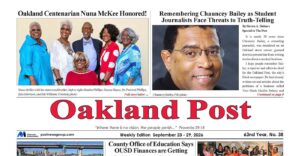
Oakland Centenarian Nuna McKee Honored!

Caribbean Nations Produce Action Plan Calling for UK Reparations Over Slavery

Oakland Post: Week of September 23 – 29, 2026

Doulas Are Helping Black California Moms Navigate Pregnancy–Even as High Mortality Rates Persist

Newsom Signs Addictive Social Media Law to Protect Kids

On Your November Ballot: Prop 38 Would Allocate $8.4 Billion to Immunology and Immunotherapy Funding

Standoff for Justice: Our Homes Are Worth Fighting For

Oakland Post: Week of August 26 – September 1, 2026

Frontier Airlines’ Return to Oakland Airport Brings Flights, Jobs and Opportunity

Gubernatorial Candidate Steve Hilton Blasts California New Tire Rules; Newsom Hits Back

Chef Sharon Lee Blends Culinary Excellence, Education and Empowerment

Jackie Wright Champions Bay Area Stories, Filmmakers and Cultural Institutions

Big City Mayors Ask for “Yes” Vote on Housing Bond Measure; Conservatives Say “No”

Oakland Coliseum Project Opens Door for Small Businesses to Build Bigger

Gov. Newsom’s Latest Appointees Include Sacramento Advocate for Formerly Incarcerated Students; State’s New Tech Chief

Misnamed ‘Parent’ PAC Seeks to Influence Oakland School Board Elections

Longtime BWOPA Member Brendalyn Goodall Appointed to California Workforce Development Board

Gov. Newsom Signs Law Shielding Immigration Aid Workers From Doxing Threats

Secretary of State Shirley N. Weber Urges Californians to Vote Early as Voter ID Battle Intensifies

From Palestine to Oakland: Seeds for Liberation Examines Shared Struggles for Freedom

IN MEMORIAM: Dolly Parton Dead at 80 — How She Built a Legacy of Love and Earned Her Place in Black Culture

The Conversation With Al McFarlane 6/23/26

Media Monday 6/22/26

LIVE! ASK ALMA! — TUES. 6.23.26 7PM EST

Car Buying Secrets: 4 Hidden Checks Before You Sign!

Is This 550 HP Charger Worth YOUR Money? AutoNetwork Review

Celebrating Juneteenth – Frederick Douglass on education and resistance

LIVE! — ASK ALMA! — TUES. 6.19.26 7PM EST

Hyundai Ioniq 5 Parking, Safety, and 360 View #shorts

2025 Ioniq 5 New Wiper & Powerful Performance! #shorts

Electric SUV Range: Is 259 Miles Enough? #shorts

EV Charging: How Fast Can You Charge an Electric Vehicle? #shorts

Biometric Cooling… Messaging Seats…Come on! 2025 Infiniti QX80 Autograph 4WD

Charged Up: Witness the Magic of a Fully Electric Car! #shorts

Range Rover Sport PHEV Included…: See What’s Inside This Luxury SUV! #shorts

Invisible Hood View: Perfect Parking with X-Ray Vision! #shorts
-
 Community2 weeks ago
Misnamed ‘Parent’ PAC Seeks to Influence Oakland School Board Elections
-

 Activism3 weeks ago
Oakland Post: Week of September 2 – 8, 2026
-

 Community2 weeks ago
Richmond Tiny House Village Farm & Garden Set to Open Gates on Sept. 26
-

 Black History2 weeks ago
Latest Massacre in Haiti Reveals Cruelty U.S. Deportations
-

 Black History2 weeks ago
OPINION: Nolan Wells’ Death One of Several Signifying Racial Terror Lives on in U.S. South
-

 Activism2 weeks ago
Oakland Post: Week of September 9 – 15, 2026
-

 Community2 weeks ago
Democratic Clubs Interview Candidates for Oakland School Board
-
 Featured2 weeks ago
‘Ready to See These Bills Become Law’: Sen. Weber’s Package of 15 Bills Advance to Gov. Newsom’s Desk
