
Books
Dennis-Benn’s novel of Jamaican immigrant is magnetic, wrenching
FLORIDA COURIER — In her new novel, Nicole Dennis-Benn contrasts the deep chasm between the American dream and immigrant reality, and the result is magnetic and wrenching. The story is a perfect fit for the author: Her first novel, “Here Comes the Sun,” laid bare the poster image of Jamaica as a tropical paradise, revealing the ugly truths behind the promises of sun, sand and sex.

By Connie Ogle
In America, anyone can be anything. That’s what the dream assures us, right?
We live in the land of opportunity for anyone willing to work hard. Unless of course you get here the wrong way. Then there’s little opportunity, few choices, constant unease, quick despair. You don’t belong.
In her new novel, Nicole Dennis-Benn contrasts the deep chasm between the American dream and immigrant reality, and the result is magnetic and wrenching.
The story is a perfect fit for the author: Her first novel, “Here Comes the Sun,” laid bare the poster image of Jamaica as a tropical paradise, revealing the ugly truths behind the promises of sun, sand and sex.

Another mirage
Now, in “Patsy,” she exposes another mirage, returning to themes she explored with insight and empathy — sexism, racism, colorism, homophobia, motherhood and poverty.
What must women sacrifice, Dennis-Benn asks, to become their true selves? It’s not just a question for the privileged. Patsy, a civil servant in Jamaica, knows her answer.
In a fair world, her affinity for math would lead her to a desirable job.
Accounting, maybe. But such work is impossible to find, because dark-skinned, poor women like Patsy have little value in her town.
So Patsy has invested the little money she has saved and spent it on a visa application. She is going to America, she tells her 5-year-old daughter Tru, to “mek t’ings bettah fah you. Fall all ah we.”
A new life
This is a lie. Patsy hopes to find a better job — after all, she has taken two courses at a community college and once solved 100 math problems in a row at school.
But she won’t return to Jamaica because Cicely is in America. Cicely, her beautiful friend who emigrated and married for a green card.
Patsy and Cicely loved each other once, and Cicely still writes hopeful letters to Patsy, encouraging her to come to New York. And so Patsy leaves Tru to build a new life. But America is less a paradise than a treacherous illusion.
Hard choices
A mother who abandons her child is a monster in most cultures, but Dennis-Benn’s deep compassion for Patsy — for all women facing unthinkable choices — forces you to reconsider your own preconceptions.
She urges you to think about this woman’s desperation, her fear, her past, her yearning for connection. She never wanted to be a mother, and Tru’s father, a married police officer, can provide a stable home for the girl.
That rationalization doesn’t soothe Patsy’s guilt, nor does it comfort Tru, who clings to her mother’s promise to return for as long as she can.
Eventually, though, Tru has to grow up and make hard choices of her own.
Two views
“Patsy” is told from both points of view, mother and daughter, the voices raw, honest and haunting. Patsy faces the irony that the only options open to her are nanny jobs, caring for the children of others.
She hates being labeled “illegal” and “can’t understand why she’s deemed a criminal for wanting more.” She wonders: “What am I good at?” and simply doesn’t know.
As a teenager, Tru begins to reject the role her culture has carved out for her (Dennis-Benn has a lot to say about how girls are raised in her native Jamaica).
Both women suffer depression, a battle all the harder to win when you don’t have the means to fight it.
But reinvention and redemption are possible. The story ends on a note of hope, though it comes at a price. What are you good at, Patsy? Loving. Learning. Living. The most human strengths of all.
This article originally appeared in the Florida Courier.









To enlarge your view of this issue, use the slider, magnifying glass icon or full page icon in the lower right corner of the browser window.

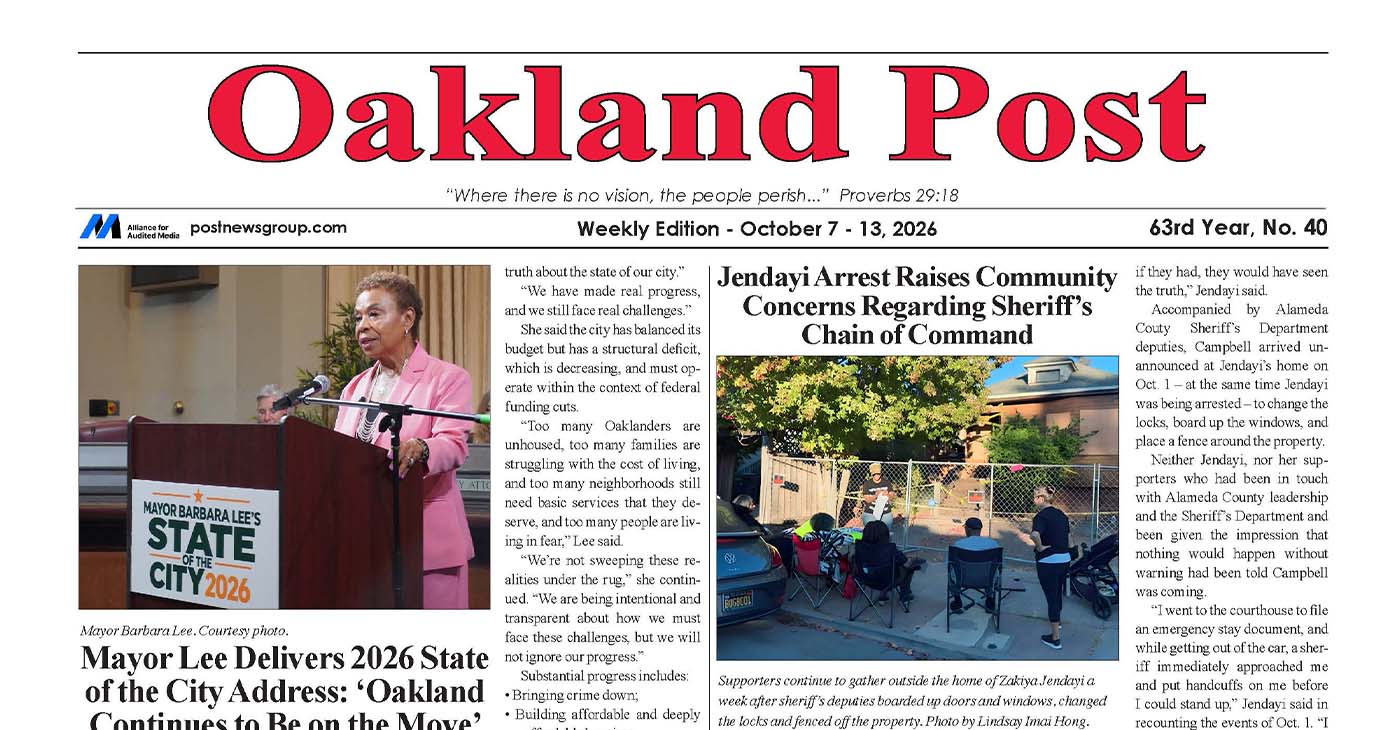
To enlarge your view of this issue, use the slider, magnifying glass icon or full page icon in the lower right corner of the browser window.
Activism
Oakland Post: Week of September 30 – October 6, 2026
The printed Weekly Edition of the Oakland Post: Week of September 30 – October 6, 2026

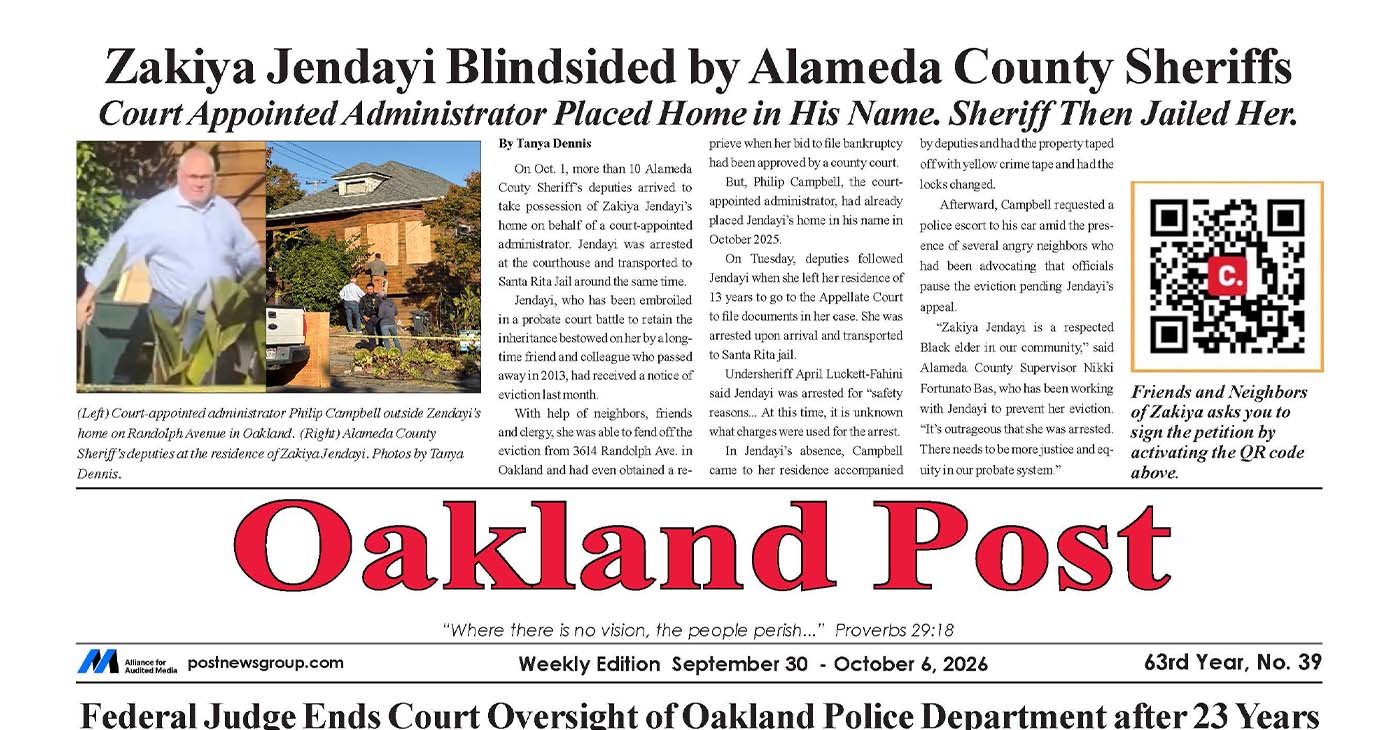
To enlarge your view of this issue, use the slider, magnifying glass icon or full page icon in the lower right corner of the browser window.


Mayor Barbara Lee Holds Special State of the City Address in Deep East Oakland

Practitioners of African Traditional Spirituality Offer Ancestral Reverence Ritual Oct. 31

It’s Time to Lose Weight Before the Holidays

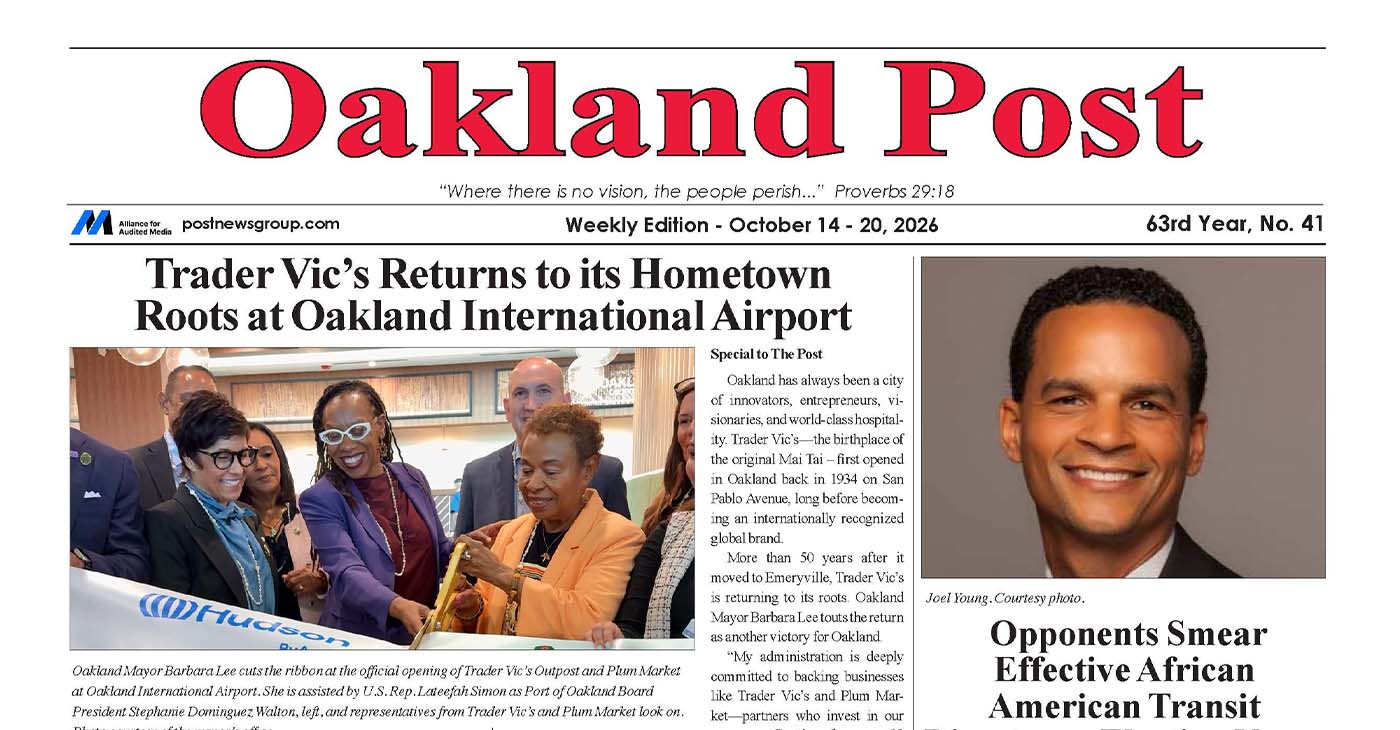
Trader Vic’s Returns to Its Oakland Roots

Oakland Coal Terminal Backed by Trump Would Be Bigger, Dirtier Than Promised, Says Report

Opponents Smear Effective African American Transit Director as Election Nears

Oakland Post: Week of October 14 – 20, 2026

OP-ED: The Black Church Writes AI’s Next Chapter

OP-ED: The Black Church Writes AI’s Next Chapter

WCCUSD Joins Statewide Organic School Food Purchasing Cooperative

Democrats, Community Groups Back Measure EE to Change How Oakland Is Governed

Four Tips to Help You Plan a Holiday “Staycation”

Veterans Housing Project Proposed for South Richmond
PRESS ROOM: Transformative Justice Coalition 2026 Voting Rights Champion Awards Reception ‘Yesterday Is Today: The Battle For Voting Rights

Mayor Lee Delivers 2026 State of the City Address: ‘Oakland Continues to Be on the Move’

Misnamed ‘Parent’ PAC Seeks to Influence Oakland School Board Elections

Listening as a Lifeline: A Doula’s Witness to Black Maternal Health

Poll: Becerra Widens His Lead Over Hilton; Californians Split on Wealth Tax

Oakland Post: Week of September 9 – 15, 2026

County Office of Education Says OUSD Finances Are Getting Healthier, Materially Stronger

Doulas Are Helping Black California Moms Navigate Pregnancy–Even as High Mortality Rates Persist

Richmond Tiny House Village Farm & Garden Set to Open Gates on Sept. 26

Mayor Lee Announces $1 Million Kaiser Permanente Grant for Pilot Program to Address Homelessness, Clean Up Public Spaces throughout Oakland

Zakiya Jendayi Arrested, Locked Out of Home by Sheriff’s Deputies

Latest Massacre in Haiti Reveals Cruelty U.S. Deportations

OPINION: Nolan Wells’ Death One of Several Signifying Racial Terror Lives on in U.S. South

BLACspace Cooperative Invites Bay Area to Experience Oakland’s Black Cultural Ecosystem Through a BLAC Map Tour + Party

Democratic Clubs Interview Candidates for Oakland School Board

Oakland Post: Week of September 16 – 22, 2026

Oakland People’s Arms Embargo Coalition Demands End to Military Shipments Thru Oakland

The Conversation With Al McFarlane 6/23/26

Media Monday 6/22/26

LIVE! ASK ALMA! — TUES. 6.23.26 7PM EST

Car Buying Secrets: 4 Hidden Checks Before You Sign!

Is This 550 HP Charger Worth YOUR Money? AutoNetwork Review

Celebrating Juneteenth – Frederick Douglass on education and resistance

LIVE! — ASK ALMA! — TUES. 6.19.26 7PM EST

Hyundai Ioniq 5 Parking, Safety, and 360 View #shorts

2025 Ioniq 5 New Wiper & Powerful Performance! #shorts

Electric SUV Range: Is 259 Miles Enough? #shorts

EV Charging: How Fast Can You Charge an Electric Vehicle? #shorts

Biometric Cooling… Messaging Seats…Come on! 2025 Infiniti QX80 Autograph 4WD

Charged Up: Witness the Magic of a Fully Electric Car! #shorts

Range Rover Sport PHEV Included…: See What’s Inside This Luxury SUV! #shorts

Invisible Hood View: Perfect Parking with X-Ray Vision! #shorts
-
 Black History3 weeks ago
Listening as a Lifeline: A Doula’s Witness to Black Maternal Health
-
 Economy4 weeks ago
Poll: Becerra Widens His Lead Over Hilton; Californians Split on Wealth Tax
-
 Business4 weeks ago
County Office of Education Says OUSD Finances Are Getting Healthier, Materially Stronger
-
 Lead Story3 weeks ago
Zakiya Jendayi Arrested, Locked Out of Home by Sheriff’s Deputies
-
 Art4 weeks ago
BLACspace Cooperative Invites Bay Area to Experience Oakland’s Black Cultural Ecosystem Through a BLAC Map Tour + Party
-
 Business4 weeks ago
From Historic Memories to New Possibilities: Oakland Celebrates Coliseum 60
-
 Community4 weeks ago
Asm. Corey Jackson Announces Launch of 24-Hour Childcare in His District
-

 Black History4 weeks ago
IN MEMORIAM: The Rev. Leon “Sonny” Clark, Longtime Orange County Pastor and Community Leader, Dies at 72
