
Government
Public Safety Committee Recommends Oakland Ban on Facial Recognition Software
OAKLAND POST — The Oakland City Council’s Public Safety Committee has recommended approval of Council President Rebeca Kaplan’s proposal to ban facial recognition technology, which a researcher with Microsoft has described as “toxic,” calling for it to “be banned for almost all practical purposes.”

The Oakland City Council’s Public Safety Committee has recommended approval of Council President Rebeca Kaplan’s proposal to ban facial recognition technology, which a researcher with Microsoft has described as “toxic,” calling for it to “be banned for almost all practical purposes.”

On June 25, on the same day as Council President Kaplan introduced the ban at Public Safety, the United Nations called for a moratorium on surveillance technology to end abuses.
Said David Kaye, United Nations Special Rapporteur on the Promotion and Protection to Freedom of Opinion and Expression, “Surveillance tools can interfere with human rights, from the right to privacy and freedom of expression to rights of association and assembly.”
Facial recognition systems rely on biased datasets with high levels of inaccuracy and lack standards around its use which has already lead to misidentification and manipulation of data, said Kaplan. The invasive nature of this technology has also resulted in government abuses including its use to persecute Muslims in China and police accountability activists in Baltimore.
“I welcome emerging technologies that improve our lives and facilitate city governance, but when multiple studies show a technology is flawed, biased, and is having unprecedented, chilling effects to our freedom of speech and religion, we have to take stand,” said Kaplan. “It is important to build trust and good relationships between community and police and to remedy racial bias, however this flawed technology could make those problems worse. The right to privacy and the right to equal protection are fundamental and we cannot surrender them.”
Said Brian Hofer, chair for the Oakland Privacy Advisory Commission, “President Kaplan and the Oakland Public Safety Committee again unanimously recognized and supported its citizen privacy commissioners and constituent concerns regarding invasive technology. Face surveillance is unlike any other technology seen in our lifetime. It is incompatible with a healthy democracy, and like San Francisco, we hope the full Oakland council draws a line in the sand that this level of intrusiveness is creepy and inappropriate for Oakland.”
Data shows that this technology disproportionately misidentifies darker skinned women. In a 2018 report by the MIT Media Lab, the study concluded that face recognition systems worked best on white males and failed most often with the combination of female and dark-skin individuals with error rates of up to 34.7 percent In another test by the ACLU, Amazon’s recognition face surveillance software misidentified 28 members of Congress as criminals.
The misuse and lack of guidelines around the use of this technology has also landed some police departments in hot water. In May 2019, Georgetown Law’s Center on Privacy and Technology (CPT) issued a report, detailing how some law enforcement agencies fed facial recognition software flawed data and warned that there are “no rules when it comes to what images police can submit to face recognition algorithms to generate investigative leads.”
“Facial recognition technology poses serious concerns, not only due to increased false positives correlating with the darkness of one’s skin, but also due to the chilling of free speech,” said Sameena Usman, Government Relations Coordinator for the SF Bay Area office of the Council on American-Islamic Relations (CAIR).
Said Nathan “Nash” Sheard, Electronic Frontier Foundation, “It is encouraging to see Oakland lawmakers anticipating the surveillance problems on the horizon and taking this proactive step toward banning the use of this particularly pernicious form of surveillance. The very real impact this would have on Oakland residents safety, and ability to exercise our most fundamental freedoms greatly overshadows any potential benefits.”
Henry Gage III, Privacy commissioner, said, “Facial recognition technology is oppressive, coercive, and easily abused. We don’t need it to keep Oakland safe. Thanks to Council President Kaplan, Oakland is drawing a line in the sand, and standing up for Oaklanders’ privacy rights.”
On May 2nd at the Privacy Advisory Commission, Chairperson Brian Hofer introduced the amendment that categorically prohibits the use of facial recognition technology. The amendment passed unanimously.







Business
OP-ED: Proposition 44 Would Put a Price on Trust
The danger in Proposition 44 is not only its 90 percent figure. It is that the meaning of “qualifying” spending will be worked out later. A clinic preparing a budget today may not know whether a navigator, health educator, transportation program, outreach worker, technology upgrade, or other patient-support service will be counted the way it expects. Yet the financial consequence of getting it wrong could be immediate.



Business
OP-ED: Proposition 40: It’s Time to Play Chess, Not Checkers
Proposition 40 would impose a one-time 5 percent tax on the wealth of Californians with more than $1 billion in assets. Most of that money would go toward health care, with the remainder supporting food assistance and education-related programs.


Activism
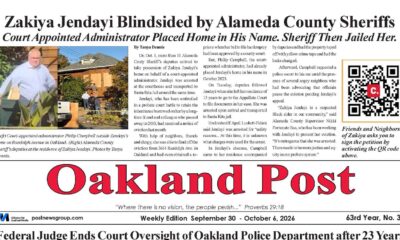
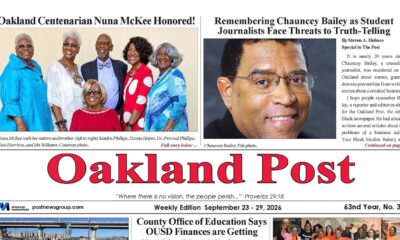
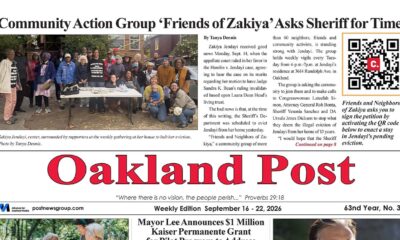
Oakland Post: Week of September 30 – October 6, 2026
The printed Weekly Edition of the Oakland Post: Week of September 30 – October 6, 2026

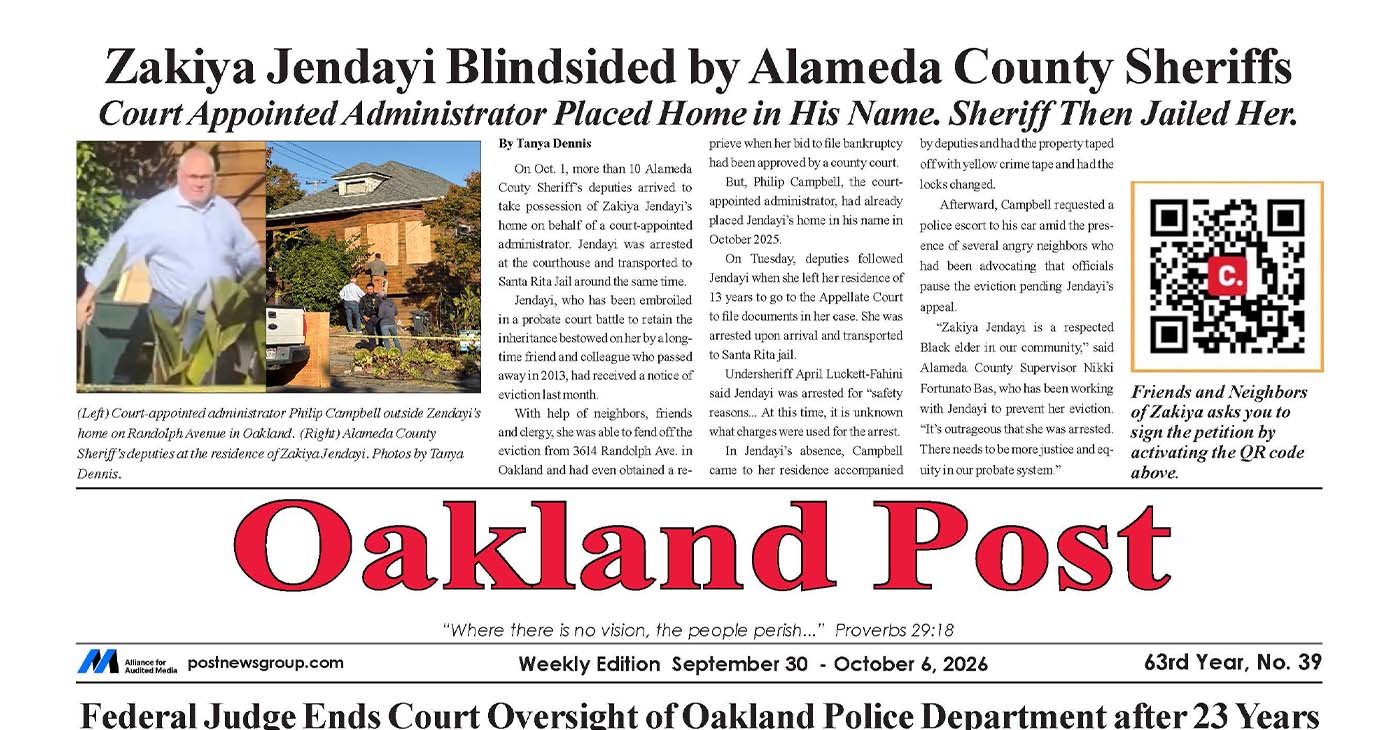
To enlarge your view of this issue, use the slider, magnifying glass icon or full page icon in the lower right corner of the browser window.



OP-ED: Proposition 44 Would Put a Price on Trust

OP-ED: Proposition 40: It’s Time to Play Chess, Not Checkers

Listening as a Lifeline: A Doula’s Witness to Black Maternal Health

New Protections for Ticket Buyers: Gov. Newsom Signs Assemblymember Isaac Bryan’s Bill

‘We Don’t Talk Trash — We Pick Up Trash!’

Zakiya Jendayi Arrested, Locked Out of Home by Sheriff’s Deputies

Oakland Post: Week of September 30 – October 6, 2026

Asm. Corey Jackson Announces Launch of 24-Hour Childcare in His District

IN MEMORIAM: The Rev. Leon “Sonny” Clark, Longtime Orange County Pastor and Community Leader, Dies at 72

Poll: Becerra Widens His Lead Over Hilton; Californians Split on Wealth Tax

From Historic Memories to New Possibilities: Oakland Celebrates Coliseum 60

County Office of Education Says OUSD Finances Are Getting Healthier, Materially Stronger

LIVE FREE Sunday Dinner Brings Faith, Fellowship and Civic Conversation to Oakland

Remembering Chauncey Bailey as Student Journalists Face Threats to Truth-Telling

BLACspace Cooperative Invites Bay Area to Experience Oakland’s Black Cultural Ecosystem Through a BLAC Map Tour + Party

Standoff for Justice: Our Homes Are Worth Fighting For

Oakland Post: Week of August 26 – September 1, 2026

Frontier Airlines’ Return to Oakland Airport Brings Flights, Jobs and Opportunity

Gubernatorial Candidate Steve Hilton Blasts California New Tire Rules; Newsom Hits Back

Chef Sharon Lee Blends Culinary Excellence, Education and Empowerment

Jackie Wright Champions Bay Area Stories, Filmmakers and Cultural Institutions

Misnamed ‘Parent’ PAC Seeks to Influence Oakland School Board Elections

Oakland Coliseum Project Opens Door for Small Businesses to Build Bigger

Big City Mayors Ask for “Yes” Vote on Housing Bond Measure; Conservatives Say “No”

Gov. Newsom’s Latest Appointees Include Sacramento Advocate for Formerly Incarcerated Students; State’s New Tech Chief

Longtime BWOPA Member Brendalyn Goodall Appointed to California Workforce Development Board

Gov. Newsom Signs Law Shielding Immigration Aid Workers From Doxing Threats

Secretary of State Shirley N. Weber Urges Californians to Vote Early as Voter ID Battle Intensifies

Oakland Post: Week of September 2 – 8, 2026

IN MEMORIAM: Dolly Parton Dead at 80 — How She Built a Legacy of Love and Earned Her Place in Black Culture

The Conversation With Al McFarlane 6/23/26

Media Monday 6/22/26

LIVE! ASK ALMA! — TUES. 6.23.26 7PM EST

Car Buying Secrets: 4 Hidden Checks Before You Sign!

Is This 550 HP Charger Worth YOUR Money? AutoNetwork Review

Celebrating Juneteenth – Frederick Douglass on education and resistance

LIVE! — ASK ALMA! — TUES. 6.19.26 7PM EST

Hyundai Ioniq 5 Parking, Safety, and 360 View #shorts

2025 Ioniq 5 New Wiper & Powerful Performance! #shorts

Electric SUV Range: Is 259 Miles Enough? #shorts

EV Charging: How Fast Can You Charge an Electric Vehicle? #shorts

Biometric Cooling… Messaging Seats…Come on! 2025 Infiniti QX80 Autograph 4WD

Charged Up: Witness the Magic of a Fully Electric Car! #shorts

Range Rover Sport PHEV Included…: See What’s Inside This Luxury SUV! #shorts

Invisible Hood View: Perfect Parking with X-Ray Vision! #shorts
-
 Community3 weeks ago
Misnamed ‘Parent’ PAC Seeks to Influence Oakland School Board Elections
-
 Activism4 weeks ago
Oakland Post: Week of September 2 – 8, 2026
-

 Activism3 weeks ago
Oakland Post: Week of September 9 – 15, 2026
-

 Community3 weeks ago
Richmond Tiny House Village Farm & Garden Set to Open Gates on Sept. 26
-

 Black History3 weeks ago
Latest Massacre in Haiti Reveals Cruelty U.S. Deportations
-

 Black History3 weeks ago
OPINION: Nolan Wells’ Death One of Several Signifying Racial Terror Lives on in U.S. South
-

 Business2 weeks ago
Mayor Lee Announces $1 Million Kaiser Permanente Grant for Pilot Program to Address Homelessness, Clean Up Public Spaces throughout Oakland
-

 Community3 weeks ago
Democratic Clubs Interview Candidates for Oakland School Board

1 Comment