
Politics
Stacey Abrams Talks Candidly on Race, Political Power in U.S.
WASHINGTON INFORMER — Stacey Abrams, 45, made history last November in her effort to become the nation’s first African-American female governor.

By D. Kevin McNeir
Stacey Abrams, 45, made history last November in her effort to become the nation’s first African-American female governor — a race that she lost by the slimmest of margins and whose results — that is the validity of the outcome — remain “questionable” to many Americans — Black and white. Her campaign initiated a new national conversation about the importance of voting rights by shining a light on voter suppression efforts in Georgia. As a result, there is a new focus on ending what Abrams calls “systematic disenfranchisement” of African-American voters and other voters of color in America.
As she indicated during a provocative conversation held on Feb. 15 at the Brookings Institution in Northwest, a public policy think tank founded in 1916, her defeat and scurrilous conditions and circumstances behind her loss, have only served as an impetus for her to become even more involved in leading the charge against voter suppression. Joined by Jelani Cobb, she discussed the increasing political power of African Americans after the 2018 elections and the tensions that may arise as the African-American electorate and candidates claim more political space.
“I was raised to understand that the process of voting is directly tied to the kinds of policies we want to see, so voter suppression is more than saying ‘you can’t vote,’” she said. “Voter suppression is physical activity and psychic events that tell you not to use it — done in three ways — the Georgia ‘trifecta.’”
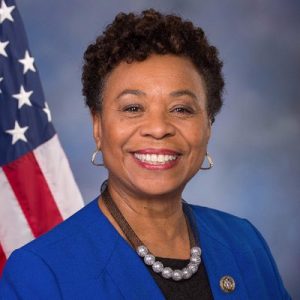
“First, there’s registration and impediments like it being hard to get on rolls, making it difficult for you to use a third party, the requirement that your name has to exactly match (ID and the voter’s registration card/data base) — something that impacted 53,000 voters in Georgia who were denied their right to vote by the employ of this law, 93 percent of whom were people of color and the requirement in Georgia that immigrants had to use their alien number — a violation of federal law,” she said.
“Also, some states still have ‘use it or lose it’ laws, something that was addressed in a recent lawsuit in Ohio, that allows states to remove voters from the rolls if they haven’t voted in a certain amount of time.”
“Second, ballot access, if voters did not request an absentee ballot in Georgia. Of 300 precincts in the state, 214 were shut down, making it more difficult, if not impossible for those with transportation to get to their closest polling location.”
Third, counting the ballots. Voters could not be sure that their vote was counted as some counties in the state threw away ballots due to “discrepancies” with their signature or for simple things like voters putting the date in the wrong place. Collectively, these are the ways that voter suppression works.
Cobb: How can these anti-democratic, racist practices continue to persist?
Abrams: They were never removed. They have just been perfected. It wasn’t until the 20th century that Native Americans were allowed to vote. One way to deny certain people the right to vote, specifically millennials, people of color and immigrants, and to therefore maintain control over public policy, is voter suppression. The insidiousness of voter suppression is that the laws allowed things to proceed in the GA election — what was done was perfectly legal — but could not be considered ethical or moral. Remedies remain limited you have people to change the policies — so, it’s a vicious cycle.
“The crisis of our day is we live in a nation where those in power use the law to undermine the very lawmaking process we both desire and deserve,” she said.
Abrams’ ‘Fair Fight’ Initiative
Abrams recalls that while on Nov. 6, the race remained too close to call, she began receiving a host of cries and calls for her concede. She says she couldn’t.
“We kept getting calls and calls about those who’d had difficulty exercising their right to vote,” she said. “In places where the majority of voters were Black, many reported being forced to stand in line for up to four hours. Some could not afford to stay in line that long because they had to return to work. Students at the AU Center were denied provisional ballots because polling places ran out of paper.”
“The night of the election, I demanded that every vote be counted because I understood that my campaign was premised on being a vote for people who had not been seen or heard. It wasn’t about the outcome. Still, we filed lawsuits and made incremental progress vs. the other side that had allegedly been destroying ballots. By Nov. 16, we were able to show that voter suppression was real. We got 50,000 calls. But imagine how many did not call or didn’t know they could call.”
“My campaign wasn’t the only one to face this — I was just the one getting the most attention. I chose not to respond with anger or sorrow but rather with action. I was raised not to just identify problems but to look for ways to solve them. ‘Fair fight’ has become something I’ve chosen to address — this should not happen to anyone else.
Cobb: Are there really 500,000 unregistered Black voters in Georgia? Are they really there? They didn’t come out for Obama so I’ve been skeptical about that number. What goes into mobilizing these electorates? Is this applicable to progressives and people of color running in the South?
Abrams: I am partisan so my advice probably isn’t applicable for those who aren’t Democrats. That said, you have to start early. I had been laying the groundwork for seven years while a member of the Georgia Assembly. You have to send people out to community with cultural competence. You have to train people to do the work so that later they can be hired to work on other campaigns. and then be able to be hired by campaigns.
We were aware of and met with those representing multi-racial, multi-ethnic, religious or sexual orientations differences. We met with Black-owned newspapers and inquired how to get into their media. We held roundtables with LGBTQ communities, with African Americans and with Asians. Pundits criticized us for investing in reaching out to voters rather than spending our money with the mainstream media. But I’ve never believed in turnout models so I refused to spend time or money only with those historically proven as more likely to vote.
Abrams said, when asked about Donald Trump and his decision to declare a national emergency in order to secure funding for the building of his wall, “He hopes to gain political clout after having failed in the actual process but the judicial system will deal with that. But we cannot turn this into a 24-hour circus over why or why or how doesn’t understand how American politics work. We have to ignore him.”
As for her plans to run for U.S. Senate, she replied, “I do not know.”
“But I can say that being the first Black female candidate for governor in the U.S. was an eye-opener,” she said. “We tend to take for granted those things or people that have proven most reliable. Black women are among the highest demographic of consistent voters. And like our car, which we assume will always start, it’s been assumed that Black women will always vote and will vote in certain ways. But we need to really understand more acutely the consequences of our actions. A car needs consistent care — Black women require care as well, particularly given our long history of reliability when voting.”
“Running a campaign is hard, expensive and mean. In fact, those who were meanest to me said things like ‘I really believe you’re the best candidate.’ Then they whispered to me, ‘but you’re a Black woman,’” she said.
“We can ill-afford to hold pity parties by saying that voter suppression remains alive and well in the U.S. and that it negatively impacted the results of my run for governor. We have to talk about voter suppression every day, with every political pundit, with every reporter — every day.”
“As for the Democratic Party, they need to decide what issues are most important. They need to be authentic and tell the truth all the time. They need to be clear about what their vision is for America. As for those who say they don’t see color or decry identity of their constituency, they don’t deserve to be president.”
Abrams’ newest book, “Lead from the Outside,” is slated for release March 2019.
This article originally appeared in the Washington Informer.












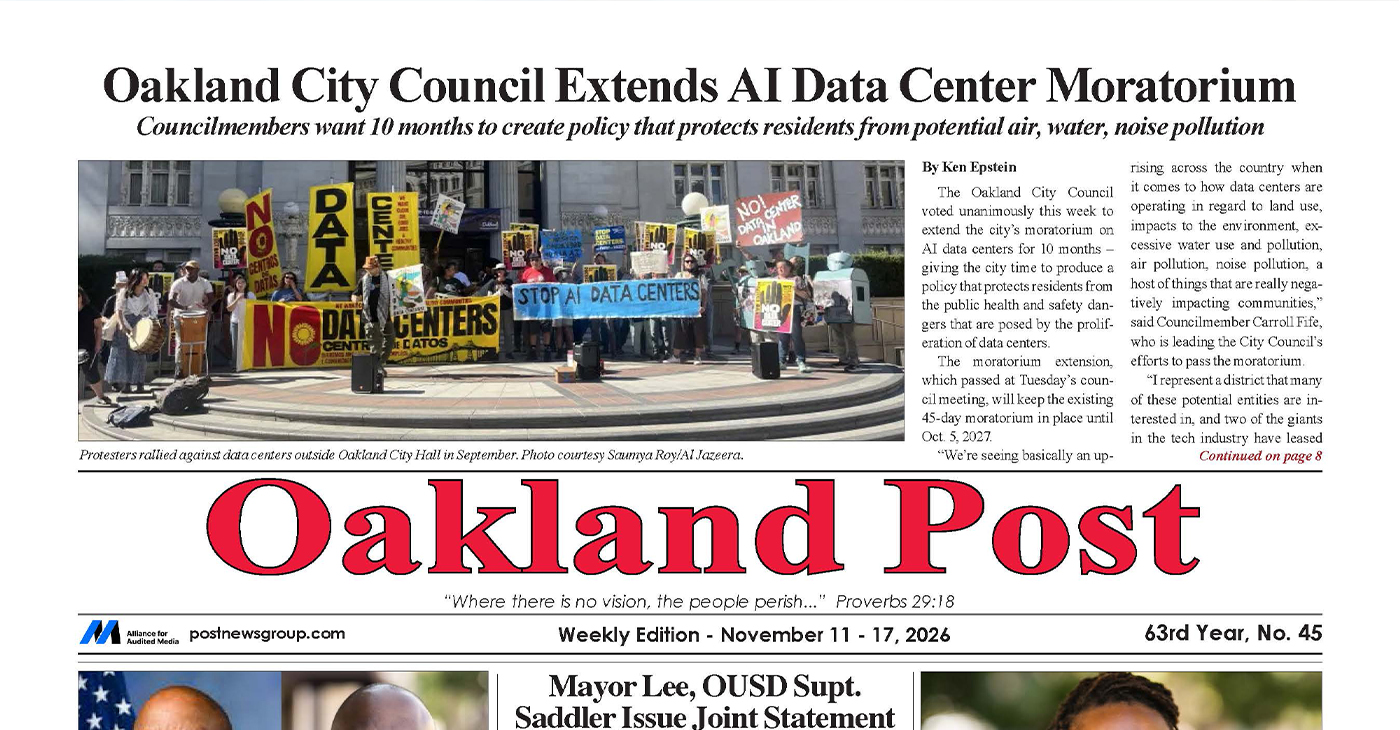
To enlarge your view of this issue, use the slider, magnifying glass icon or full page icon in the lower right corner of the browser window.
Community
Alameda County Supervisor Miley to Propose Illegal Dumping Ordinance
POST NEWS GROUP — The proposed ordinance would add Chapter 6.121 to the County’s General Ordinance Code, establishing an administrative enforcement process that would allow the County to hold more parties accountable without relying solely on criminal prosecution.

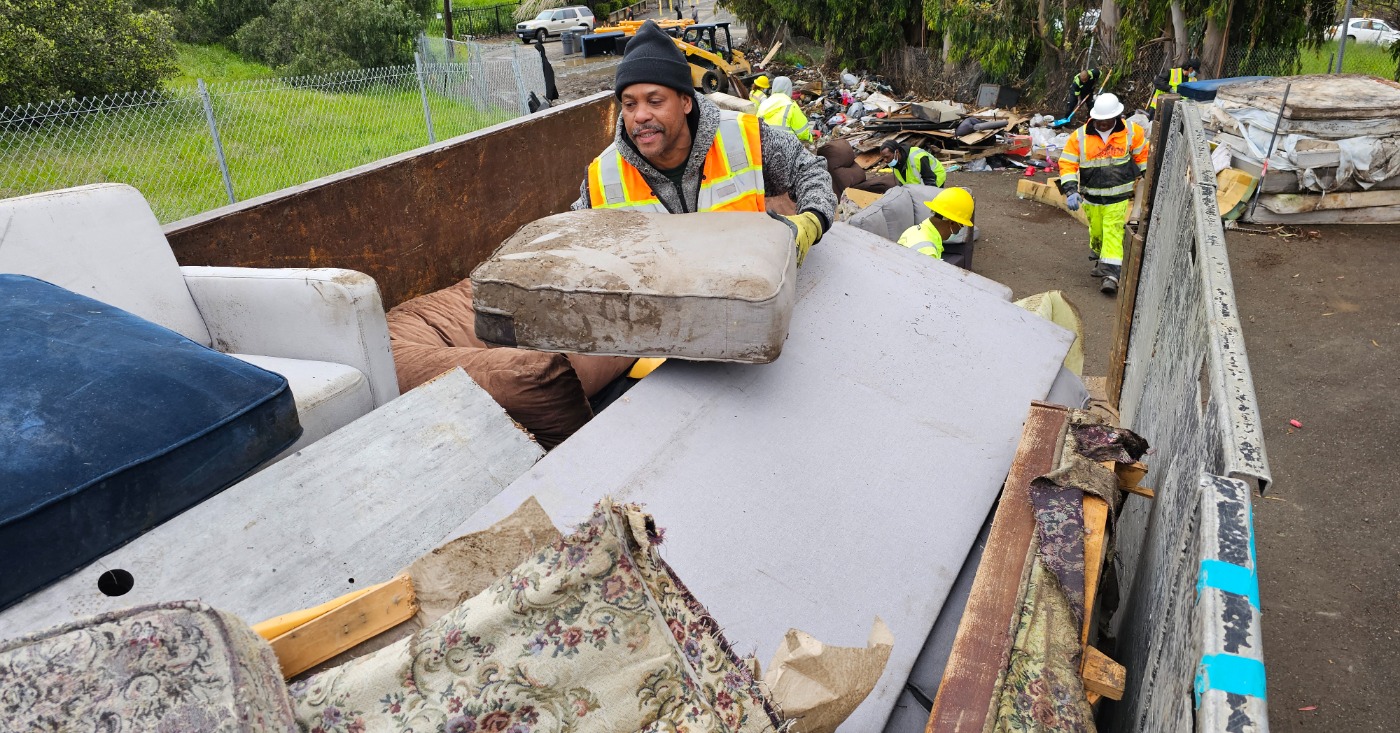
Proposal expands accountability, establishes administrative penalties, and ties fines to cleanup costs
On Tuesday, Nov. 17, the Alameda County Board of Supervisors is scheduled to consider the first reading of an ordinance proposed by Supervisor Nate Miley to strengthen enforcement against illegal dumping in unincorporated Alameda County, including Ashland, Cherryland, Castro Valley, San Lorenzo and Fairview.
Illegal dumping places a significant financial burden on residents and taxpayers. In 2024, Alameda County spent $3.8 million addressing 1,483 illegal dumping incidents, an average of approximately $2,562 per incident. Yet no illegal dumping cases from the unincorporated county were charged that year.
The proposed ordinance would add Chapter 6.121 to the County’s General Ordinance Code, establishing an administrative enforcement process that would allow the County to hold more parties accountable without relying solely on criminal prosecution.
Key provisions include:
- Expanded accountability: Penalties could apply to individuals who dump waste, those who provide waste to unlicensed haulers who illegally dispose of it, and vehicle owners who knowingly consent to their vehicles being used for illegal dumping.
- Administrative enforcement: Authorized County personnel could issue penalties and abatement orders, with opportunities for administrative hearings and judicial review.
- Penalties tied to cleanup costs: Fines would start at $2,500 for a first violation, increase to $5,000 for a second and $10,000 for a third. Enhanced penalties of up to $10,000 per violation could apply to large-scale dumping, hazardous waste, or dumping near sensitive locations such as creeks, schools and storm drains.
The ordinance includes safeguards for people acting in good faith. Residents and businesses using licensed haulers would be exempt from waste-generator liability, while vehicle owners whose vehicles were used without their consent and property owners unaware of dumping on their land would also be protected.
Cited individuals could request community service in lieu of penalties, with ability to pay among the factors considered. The proposal would also allow property owners, business improvement districts and community groups to pursue recovery of cleanup costs and authorize the Board to establish a reward fund for tips identifying illegal dumpers.
“Every mattress and every truckload of construction debris dumped in Ashland, Cherryland and Castro Valley gets paid for by the people who live there, and right now the people responsible almost never face a consequence,” Miley said. “This ordinance closes the loopholes that let people hand off their waste and walk away. It gives the County a fair and swift way to hold dumpers accountable, protects people who do the right thing, and makes the penalty match what it costs us to clean up after them.”
Modeled on Santa Cruz County’s illegal dumping ordinance, which took effect in July 2025, the proposal was recommended for approval by the Board’s Unincorporated Services Committee.
Miley is also urging cities and counties throughout the region to adopt similar standards. His office has released a Model Illegal Dumping Enforcement Ordinance developed through the Alameda County Illegal Dumping (ACID) Task Force to support coordinated regional enforcement.
If the Board conducts the first reading on Nov. 17, the ordinance will return for adoption at a subsequent meeting and take effect 30 days after adoption.
Paul Sanftner is the director of communications and special projects for the office of Alameda County Supervisor Nate Miley.

Community
On Veterans Day, U.S. Rep. Simon Demands Answers on Status of Veterans Affairs Clinic, Columbarium Project
POST NEWS GROUP — “Our veterans have served our nation with dignity and sacrificed so much for our nation – they deserve the best care and benefits possible, close to home. That’s why it is abhorrent that the Trump Administration has canceled the planned construction of a new clinic and columbarium at Alameda Point, despite years of planning and more than $395 million in federal funding already invested in the project.

On Veterans Day, Congresswoman Lateefah Simon (D-CA-12) once again called on the Trump administration to provide answers on the status of the Alameda Point Veterans Affairs Clinic and Columbarium Project. Her statement is provided below.
“Our veterans have served our nation with dignity and sacrificed so much for our nation – they deserve the best care and benefits possible, close to home. That’s why it is abhorrent that the Trump Administration has canceled the planned construction of a new clinic and columbarium at Alameda Point, despite years of planning and more than $395 million in federal funding already invested in the project.
“Last year, I demanded answers from the Secretary of Veterans Affairs, Douglas Collins, about the decision and received no response.
That’s why, earlier this year, I worked with my colleagues Speaker Emerita Nancy Pelosi and Rep. Kevin Mullin to successfully fight for and secure report language in the Fiscal Year 2027 Military Construction, Veterans Affairs, and Related Agencies Appropriations bill that would require the Trump administration to provide answers on the status of the project.
“As the Senate considers the Fiscal Year 2027 Military Construction, Veterans Affairs (MilCon-VA), and Related Agencies Appropriations bill, the report language we secured in the House must be included in any final MilCon-VA appropriations bill, so that the 27,000 veterans in my district get the answers they deserve.
“I will not stand idly by as this administration unfairly reels back healthcare services and access for our veterans, and I will continue to hold this administration’s feet to the fire and fight for our district’s previously allocated resources.”
U.S. Rep. Lateefah Simon’s media relations office is the source of this report.


Oakland Post: Week of November 11 -17, 2026

Alameda County Supervisor Miley to Propose Illegal Dumping Ordinance

Oakland City Council Extends AI Data Center Moratorium for 10 Months.

On Veterans Day, U.S. Rep. Simon Demands Answers on Status of Veterans Affairs Clinic, Columbarium Project

OPINION: Mario Juarez’s Courtroom Admissions Raise Questions About Allegations That Fueled Recall of Pamela Price

Hutchinson Concedes: Ballots Still Being Counted in Oakland Board Elections

Mayor Lee and Schools’ Supt. Saddler Issue Joint Statement on Recent ICE Activity in Oakland

Mississippi Congressman Bennie Thompson Congratulates Scott Colom on Historic Victory

Farms to Grow, Inc. Hosts the 8th Annual Sweet Potato Pie Tasting Contest

Oakland Post: Week of November 4 – 10, 2026

How the Sandwich Generation Can Help Protect Aging Parents’ Finances

As Progressive Democrats Celebrate ‘Blue Tsunami,’ Oakland Counts Victories

Golden State Valkyries Become Bay Area Legends Winning WNBA Championship on Halloween Night

IN MEMORIAM: Marcia Ann Gillespie, Editor of Essence and Ms. Magazines, Dies at 82

U.S. Rep. John Garamendi Honors local ‘Women of the Year’ at Annual Awards Ceremony

COMMENTARY: Valarie Bachelor and Jennifer Brouhard are Excellent School Board Members and Deserve to Be Reelected

Listening as a Lifeline: A Doula’s Witness to Black Maternal Health

OUSD Receives State Review of District Finances; Outlines Progress Since January

HISTORY MADE: Keisha Lance Bottoms Becomes First Black Woman Elected Governor in American History

Zakiya Jendayi Arrested, Locked Out of Home by Sheriff’s Deputies

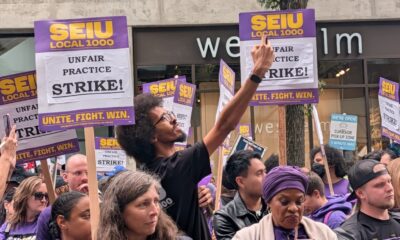
SEIU Local 1000 and State of California Will Continue to Negotiate New Labor Contract
Golden State Valkyries Become Bay Area Legends Winning WNBA Championship on Halloween Night

COMMENTARY: Your California Living Trust Could Be Next: When Evidence Isn’t Enough

Fate of Bay Area Public Transit Hinges on Regional Transit Measure

Oakland Post: Week of September 30 – October 6, 2026

It’s Time to Lose Weight Before the Holidays

Mayor Barbara Lee Holds Special State of the City Address in Deep East Oakland

Democrats, Community Groups Back Measure EE to Change How Oakland Is Governed

Chase Launches Fraud & Scam Prevention Month

Oakland Awarded More than $14 Million in State Funding

The Conversation With Al McFarlane 6/23/26

Media Monday 6/22/26

LIVE! ASK ALMA! — TUES. 6.23.26 7PM EST

Car Buying Secrets: 4 Hidden Checks Before You Sign!

Is This 550 HP Charger Worth YOUR Money? AutoNetwork Review

Celebrating Juneteenth – Frederick Douglass on education and resistance

LIVE! — ASK ALMA! — TUES. 6.19.26 7PM EST

Hyundai Ioniq 5 Parking, Safety, and 360 View #shorts

2025 Ioniq 5 New Wiper & Powerful Performance! #shorts

Electric SUV Range: Is 259 Miles Enough? #shorts

EV Charging: How Fast Can You Charge an Electric Vehicle? #shorts

Biometric Cooling… Messaging Seats…Come on! 2025 Infiniti QX80 Autograph 4WD

Charged Up: Witness the Magic of a Fully Electric Car! #shorts

Range Rover Sport PHEV Included…: See What’s Inside This Luxury SUV! #shorts

Invisible Hood View: Perfect Parking with X-Ray Vision! #shorts
-
 Commentary2 weeks ago
COMMENTARY: Valarie Bachelor and Jennifer Brouhard are Excellent School Board Members and Deserve to Be Reelected
-
 Education2 weeks ago
OUSD Receives State Review of District Finances; Outlines Progress Since January
-
 Black History2 weeks ago
HISTORY MADE: Keisha Lance Bottoms Becomes First Black Woman Elected Governor in American History
-
 Business2 weeks ago
SEIU Local 1000 and State of California Will Continue to Negotiate New Labor Contract
-
 Community1 week ago
Golden State Valkyries Become Bay Area Legends Winning WNBA Championship on Halloween Night
-
 Business2 weeks ago
COMMENTARY: Your California Living Trust Could Be Next: When Evidence Isn’t Enough
-
 Business3 weeks ago
Fate of Bay Area Public Transit Hinges on Regional Transit Measure
-
 Community4 weeks ago
It’s Time to Lose Weight Before the Holidays
