
City Government
Council Puts a Wrap on Trash Conflict

The Oakland City Council declared a victory and a truce this week in the month-long garbage conflict with Texas-based Waste Management, the nation’s largest trash hauler, which was determined to force the city back into a billion dollar contact that the company had lost to a small local firm.
As a result of the council decision, which divides the contract between Waste Management (WM) and the local company, California Waste Solution (CWS), WM has agreed to drop its lawsuits against the city and to halt its divisive referendum campaign to force a special election to overturn the council’s decision.
WM has committed to implementing most of the terms of the city’s agreement with CWS and to reimburse the city and CWS for their legal fees and other damages.
The council is celebrating the settlement, which many say is good for Oakland residents, a much better deal than the city would have won if it had not stood up to WM.
“When you get all that you want at the price that you want, it’s time to declare a victory,” said Councilmember Lynette McElhaney, who has been a leader on this issue on the council, along with Rebecca Kaplan and Dan Kalb.

“Because this council stood firm, we were able to get even Waste Management, based in Houston, to hear us loud and clear. And they sent their team back to the drawing board to figure out how they could better serve the residents of this community – because CWS was willing to stay in the fight,” said McElhaney at Monday night’s council meeting.
Agreeing, Mayor Jean Quan said, “I particularly want to thank Waste Management and California Waste Solutions. Over the last few weeks, both moved a long way. This is the best win for the citizens of Oakland – they get a better rate, (and) we’ll be one of the greenest city’s of the country in terms of our garbage disposal.”
Others, however, remain angry that the city has come to an agreement with a company that tried to beat Oakland and CWS in submission with bullying and threatening tactics.
WM’s actions put the city and CWS in a position where the company might not be able to obtain financing to purchase equipment and be up and running by July 1, thereby jeopardizing the standing of the company and threatening the city with no garbage pickup next year.
Ending the dispute, Mayor Quan announced on Thursday she had negotiated a memorandum of understanding between WM and CWS and that CWS had signed a memorandum of understanding to give up most of the franchise it had won, settling for taking over 100 percent of the city’s recycling.
Whether this agreement adds up to a win for Oakland depends an examination of the choices the City Council faced back in May.
At that time, when the council was wrestling with the new trash agreement, city staff was championing what was called “Option 1,” which would have shut out California Waste Solutions (CWS) – giving 100 percent of the contract to Waste Management (WM) – and raised rates by 50 percent.
“It is recommended that the City Council authorize the City Administrator to accept the Option 1,” according to the May 16 staff report.
Emphasizing that she did not support that staff recommendation and that she had nothing to do with negotiations up the that point, Mayor Quan said: “I have consistently supported sharing the contracts between California Waste Solutions and Waste Management.
Under the current agreement that expires next July, CWS has been handling half of the city’s recycling.
The proposal backed by the mayor’s staff would have allowed WM to lock out its employees without penalty. The proposal did not include councilmembers’ key concerns: promoting Civicorps, which handles green waste and creates jobs for Oakland youth, restarting a local call center that was shut down and outsourced by WM and partnering with East Bay Municipal Utility District to utilize a “digester” to turn green garbage into electrical energy, which will help the city reach its zero waste goals.
But these were all parts of an agreement the council felt were fundamental and necessary for Oakland residents – along with lower rate increases.
WM declined to renegotiate rates and services on the deal the City Council wanted, a modified version of “Option 2,” which would have divided the contract between WM and CWS.
As a result, the council in July voted unanimously to turn to what was called “Option 3,” handing the whole contract to CWS, the smaller, local company that was willing to meet the city’s needs at lower rates.
Under the two ordinances passed at Monday’s council meeting, the council was able to preserve most of what it had voted for in the agreement with CWS. These victories came as a result of the council’s insistence and were not specified in what the mayor had negotiated last week, said Councilmember Kaplan.
This has not been a done deal,” said Kaplan, speaking at the meeting. “As recently as (a few hours before the meeting), the key provisions that the community fought for were not in the deal before us. (Now) I am pleased to see the language on Civicorps … and EBMUD, the call center and the protections for the workers (are included).”
Under Quan’s negotiated agreement, rates for residential customers will remain the same as what CWS had negotiated, but commercial and multi-family rates will increase, though less than WM had originally asked for.
Councilmember Kalb said he was pleased with the final agreement, though he was still concerned about how WM treated the city.
“The council’s steadfastness has led to a lower increase than we would otherwise have had,” Kalb said.
“There’s always the gut desire not to give into the pressure tactics that have existed over the past few weeks – I share that gut feeling,” he added.”(But) if we were not to make these changes, I fear that the referendum would succeed, (and there would be) costly delays and unanswered questions about what would happen next July and beyond when it comes time to pick up the garbage.”
CWS owner David Duong said, “We can do the job. But then came the two lawsuits and the referendum. This is a lot of costs for us and the city.”
David Tucker of Waste Management of Alameda County promised a good working relationship in the future and apologized for the company’s tactics. “This has been a difficult process for all involved,” he said. “We understand we have stressed relationships with the City Council and the city, and we are fully committed to repair and improve that relationship.”
“When we were told that even a single signature gatherer got the message wrong, we took immediate action,” said Tucker.
Responding to Tucker was another speaker, Ken Houston, a community leader and candidate for mayor, who organized the CWS campaign to pass out literature to counter WM’s petition gatherers.
“I have police reports here,” said Houston, saying that someone paid by WM spit on one young woman and another pulled a gun on a woman and her daughter.
“I do not accept your apology. I’ve seen what happened to people out there. The only way I can accept your apology is if you do something for the people who have been spit on, the people that’s gotten threatened.”
Councilmember Desley Brooks condemned WM’s tactics as a failure of honesty and truthfulness that demonstrate a lack of concern for Oakland residents.
“You took a small local company, and you treated them like trash,” she said. “They were disposable to you – to get your ends. What can you say to the people of Oakland to make us believe that we can trust in you for the next 20 years, that you are not going to bully us?”
The purpose of WM’’s referendum and lawsuits “was to mess up CWS’ ability to get financing,” she said. “We all know how the game is played.”
Though the negotiated a settlement was announced Thursday, three days later, Brooks said, WM people were stilling gathering signatures in front of a grocery store. “So, where’s the good faith?” she asked.
“I will not be voting for this,” concluded Brooks, who abstained on the council vote, which passed 6-0.
Mayor Quan was silent on WM’s tactics.








Activism
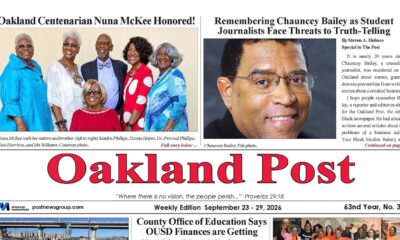
Oakland Post: Week of September 23 – 29, 2026
The printed Weekly Edition of the Oakland Post: Week of September 23 – 29, 2026

To enlarge your view of this issue, use the slider, magnifying glass icon or full page icon in the lower right corner of the browser window.
Activism
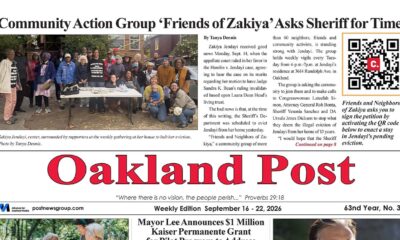
Oakland Post: Week of September 16 – 22, 2026
The printed Weekly Edition of the Oakland Post: Week of September 16 – 22, 2026

To enlarge your view of this issue, use the slider, magnifying glass icon or full page icon in the lower right corner of the browser window.
Activism
Oakland Post: Week of September 9 – 15, 2026
The printed Weekly Edition of the Oakland Post: Week of September 9 – 15, 2026

To enlarge your view of this issue, use the slider, magnifying glass icon or full page icon in the lower right corner of the browser window.



Asm. Corey Jackson Announces Launch of 24-Hour Childcare in His District

IN MEMORIAM: The Rev. Leon “Sonny” Clark, Longtime Orange County Pastor and Community Leader, Dies at 72

Poll: Becerra Widens His Lead Over Hilton; Californians Split on Wealth Tax

From Historic Memories to New Possibilities: Oakland Celebrates Coliseum 60

County Office of Education Says OUSD Finances Are Getting Healthier, Materially Stronger

LIVE FREE Sunday Dinner Brings Faith, Fellowship and Civic Conversation to Oakland

Remembering Chauncey Bailey as Student Journalists Face Threats to Truth-Telling

BLACspace Cooperative Invites Bay Area to Experience Oakland’s Black Cultural Ecosystem Through a BLAC Map Tour + Party

In Wake of Death on Doorstep, Williams Chapel Baptist Church Calls for Better Care, Funding for Unhoused

Oakland Centenarian Nuna McKee Honored!

Caribbean Nations Produce Action Plan Calling for UK Reparations Over Slavery

Oakland Post: Week of September 23 – 29, 2026

Doulas Are Helping Black California Moms Navigate Pregnancy–Even as High Mortality Rates Persist

Newsom Signs Addictive Social Media Law to Protect Kids

On Your November Ballot: Prop 38 Would Allocate $8.4 Billion to Immunology and Immunotherapy Funding

Less Affluent School Districts, Including Sacramento City, Face Threat of State Takeover

ESSAY: California Can Close Its Colorectal Cancer Gap

California Hispanic Chambers of Commerce Unveils: ‘Powering the Future’ Theme for 47th Annual Statewide Convention

Four Candidates, Including Incumbent Barbara Lee, Qualify for Oakland Mayor’s Race

Oakland Post: Week of August 12 – 18, 2026

From Blueprint to Breakthrough: Tackling Affordable Housing in Oakland

Oakland Observes Black August with Block Parties, Film Showings, Workshops

COMMENTARY: Why Local School Tax Measure G1 Will Not Be on the November Ballot

Standoff for Justice: Our Homes Are Worth Fighting For

Returning to Its Roots, the Oakland Black-Eyed Pea Festival Partners with the Freedom Farmers Market Sept. 12

Oakland Post: Week of August 26 – September 1, 2026

NPRC Scores First Advocacy Victory: David Shaw Finally Gets His Wish to ‘Go Home’

Frontier Airlines’ Return to Oakland Airport Brings Flights, Jobs and Opportunity

Gubernatorial Candidate Steve Hilton Blasts California New Tire Rules; Newsom Hits Back

Chef Sharon Lee Blends Culinary Excellence, Education and Empowerment

The Conversation With Al McFarlane 6/23/26

Media Monday 6/22/26

LIVE! ASK ALMA! — TUES. 6.23.26 7PM EST

Car Buying Secrets: 4 Hidden Checks Before You Sign!

Is This 550 HP Charger Worth YOUR Money? AutoNetwork Review

Celebrating Juneteenth – Frederick Douglass on education and resistance

LIVE! — ASK ALMA! — TUES. 6.19.26 7PM EST

Hyundai Ioniq 5 Parking, Safety, and 360 View #shorts

2025 Ioniq 5 New Wiper & Powerful Performance! #shorts

Electric SUV Range: Is 259 Miles Enough? #shorts

EV Charging: How Fast Can You Charge an Electric Vehicle? #shorts

Biometric Cooling… Messaging Seats…Come on! 2025 Infiniti QX80 Autograph 4WD

Charged Up: Witness the Magic of a Fully Electric Car! #shorts

Range Rover Sport PHEV Included…: See What’s Inside This Luxury SUV! #shorts

Invisible Hood View: Perfect Parking with X-Ray Vision! #shorts
-
 Commentary4 weeks ago
Standoff for Justice: Our Homes Are Worth Fighting For
-
 Activism4 weeks ago
Oakland Post: Week of August 26 – September 1, 2026
-
 Business4 weeks ago
Frontier Airlines’ Return to Oakland Airport Brings Flights, Jobs and Opportunity
-
 Business4 weeks ago
Gubernatorial Candidate Steve Hilton Blasts California New Tire Rules; Newsom Hits Back
-
 Business4 weeks ago
Chef Sharon Lee Blends Culinary Excellence, Education and Empowerment
-

 Community4 weeks ago
Big City Mayors Ask for “Yes” Vote on Housing Bond Measure; Conservatives Say “No”
-

 Black History4 weeks ago
Jackie Wright Champions Bay Area Stories, Filmmakers and Cultural Institutions
-

 Education4 weeks ago
Gov. Newsom’s Latest Appointees Include Sacramento Advocate for Formerly Incarcerated Students; State’s New Tech Chief
