
Business
PRESS ROOM: Rep. Maxine Waters to Receive NAACP Chairman’s Award
NNPA NEWSWIRE — Leon W. Russell, Chairman of the NAACP National Board of Directors, will present Congresswoman Waters with the award at the 50th NAACP Image Awards on March 30, 2019 live at 9pm/8c on TV One.

By Stacy M. Brown, NNPA Newswire Correspondent
@StacyBrownMedia
The NAACP announced that Congresswoman Maxine Waters (D-California) will be honored with the prestigious NAACP Chairman’s Award which is bestowed in recognition of individuals who demonstrate exemplary public service and use their distinct platforms to create agents of change.
Leon W. Russell, Chairman of the NAACP National Board of Directors, will present Congresswoman Waters with the award at the 50th NAACP Image Awards on March 30, 2019 live at 9pm/8c on TV One.
“I am honored to present the Chairman’s Award to Congresswoman Waters, considered to be one of the most powerful women in American politics today and an inspiration to many,” Russell said in a news release announcing the award.
“Her 43 years of public service, first in the California State Assembly and then in the U.S. House of Representatives, have benefited countless Americans,” Russell said.
“As both a queen and a warrior, Congresswoman Waters has stood the test of time in her refusal to stand idle in the face of the relentless assaults on the humanity of African Americans and people of color. We salute her and her amazing legacy,” he said.
Past honorees of the NAACP Chairman’s Award include William Lucy, Tyler Perry, Ruby Dee, The Neville Brothers, Bono, Danny Glover, Former Vice President Al Gore and Dr. Wangari Muta Maathai, then-Senator Barack Obama, Former Surgeon General Regina Benjamin, TV One Founder and Chairman Cathy Hughes, U.S. Navy Vice Admiral Michele Howard, Brittany “Bree” Newsome, Justice League NYC, University of Missouri Concerned Student 1950 Collective, University of Mississippi NAACP College Chapter, Rev. Dr. Otis Moss III, Rev. Dr. Howard-John Wesley, Rev. Dr. Jamal Harrison Bryant, Jussie Smollett, and Dr. Charles J. Ogletree, Jr.
Throughout her many years of public service, Waters has been on the cutting edge, tackling difficult and often controversial issues, the NAACP said in the release. She has combined her strong legislative and public policy acumen and high visibility in Democratic Party activities with an unusual ability to do grassroots organizing.
Following the Los Angeles civil unrest in 1992, Congresswoman Waters faced the nation’s media and public to interpret the hopelessness and despair in cities across America.
Over the years, she has brought many government officials and policy makers to her South-Central L.A. district to appeal for more resources.
She has used her skill to shape public policy and deliver the goods: $10 billion in Section 108 loan guarantees to cities for economic and infrastructure development, housing and small business expansion; $50 million appropriation for “Youth Fair Chance” program which established an intensive job and life skills training program for unskilled, unemployed youth; expanded U.S. debt relief for Africa and other developing nations; creating a “Center for Women Veterans,” among others.
She is a co-founder of Black Women’s Forum, a nonprofit organization of over 1,200 African American women in the Los Angeles area.
In the mid-80s, she also founded Project Build, working with young people in Los Angeles housing developments on job training and placement.
As she confronts the issues such as poverty, economic development, equal justice under the law and other issues of concern to people of color, women, children, and poor people, Rep. Waters enjoys a broad cross section of support from diverse communities across the nation.
Throughout her career, Congresswoman Waters has been an advocate for international peace, justice, and human rights.
Before her election to Congress, she was a leader in the movement to end Apartheid and establish democracy in South Africa.
She opposed the 2004 Haitian coup d’etat, which overthrew the democratically-elected government of Jean-Bertrand Aristide in Haiti and defends the rights of political prisoners in Haiti’s prisons.
Waters leads congressional efforts to cancel the debts that poor countries in Africa and Latin America owe to wealthy institutions like the World Bank and free poor countries from the burden of international debts.
Expanding access to health care services is another of Congresswoman Waters’ priorities.
She spearheaded the development of the Minority AIDS Initiative in 1998 to address the alarming spread of HIV/AIDS among African Americans, Hispanics and other minorities.
Under her continuing leadership, funding for the Minority AIDS Initiative has increased from the initial appropriation of $156 million in fiscal year 1999 to approximately $400 million per year today.
Waters is also the author of legislation to expand health services for patients with diabetes, cancer and Alzheimer’s disease.
She is lauded by African American entrepreneurs for her work to expand contracting and procurement opportunities and to strengthen businesses.
Long active in the women’s movement, Rep. Waters has given encouragement and financial support to women seeking public office.
Many young people, including those in the hip-hop music community, praise her for her support and understanding of young people and their efforts at self-expression, according to the release.
“One testament to her work is the Maxine Waters Employment Preparation Center, a multimillion-dollar campus providing education and employment opportunities to residents of the Watts area,” Russell said.













Business
Starting This Summer, California Car Buyers Can Get an Instant $3500 Off the Cost of Electric Vehicles
OAKLAND POST — Beginning later this summer, eligible Californians can receive a $3,500 rebate on new zero-emission vehicles with a manufacturer’s suggested retail price of up to $50,000. Buyers purchasing qualifying used electric vehicles priced at up to $25,000 can receive a $1,750 rebate. The rebate will be applied directly at participating dealerships, allowing buyers to receive the discount immediately instead of waiting for reimbursement.


California residents purchasing their first zero-emission vehicle will soon be eligible for an instant rebate of up to $3,500 under a new state program aimed at making electric vehicles more affordable.
Gov. Gavin Newsom signed Senate Bill (SB) 168 on July 16, creating the MyFirstEV program as part of California’s 2026-27 state budget. The initiative dedicates $135.5 million in state funding for point-of-sale rebates, which participating automakers will match dollar for dollar. State officials said the combined investment will provide $270 million in savings for first-time electric vehicle buyers.
Beginning later this summer, eligible Californians can receive a $3,500 rebate on new zero-emission vehicles with a manufacturer’s suggested retail price of up to $50,000. Buyers purchasing qualifying used electric vehicles priced at up to $25,000 can receive a $1,750 rebate. The rebate will be applied directly at participating dealerships, allowing buyers to receive the discount immediately instead of waiting for reimbursement.
“With our new instant rebate program for electric vehicles, we’re making it easier for families to drive clean, breathe clean, and keep more money in their pockets,” Newsom said in a statement.

The MyFirstEV program is part of a broader $600 million investment in California’s clean transportation economy included in the state budget. The funding package also provides $150 million for the Community Air Protection Program, $19.8 million for the Clean Cars 4 All program for lower-income residents, $35 million for clean off-road equipment through the Air Quality Improvement Program, $135.5 million for the Clean Truck and Bus Voucher Incentive Project, and $130 million for the Carl Moyer Program to replace older heavy-duty engines with cleaner alternatives.
According to the governor’s office, the transportation investments are funded through Cap-and-Invest revenue and smog-abatement fees while maintaining a balanced state budget.
California continues to expand its zero-emission transportation network. The state surpassed 2.5 million cumulative zero-emission vehicle sales earlier this year, exceeding its original goal of 1.5 million sales by 2025. Officials also reported that California has more than 200,000 public and shared electric vehicle charging plugs statewide, in addition to an estimated 800,000 home charging stations.

Business
Surveillance Pricing Fight: State Senate Debates Bill Banning Retailers from Using AI to Set Prices Based on a Buyer’s Profile
OAKLAND POST — Currently, there is no precise public data quantifying how many Black residents in California are actively affected by surveillance pricing. However, because the practice leans heavily on ZIP codes and localized demographic tracking, algorithmic pricing models frequently result in higher costs for Black and non-white communities compared to others, according to the Electronic Frontier Foundation (EFF), a leading nonprofit organization defending civil liberties in the digital space

Surveillance pricing—the algorithmic practice of using personal data to determine individualized costs for goods and services—is widespread in California, according to Assemblymember Chris Ward (D-San Diego). He warns that this system is actively impacting consumers across the state, and Black Californians could be specifically targeted.
Ward’s Assembly Bill (AB) 2564, the Surveillance Pricing Act, aims to prohibit businesses from using this practice.
“Surveillance pricing is a growing phenomenon that a lot of people don’t realize is already happening,” Ward told California Black Media (CBM) at the State Capitol on June 29.
On June 22, the bill passed out of the Senate Privacy, Digital Technologies, and Consumer Protection Committee with a 5-2 vote and was re-referred to the Committee on Judiciary for consideration. On May 27, the Assembly voted to advance AB 2564 with a 42-21 vote.
Currently, there is no precise public data quantifying how many Black residents in California are actively affected by surveillance pricing. However, because the practice leans heavily on ZIP codes and localized demographic tracking, algorithmic pricing models frequently result in higher costs for Black and non-white communities compared to others, according to the Electronic Frontier Foundation (EFF), a leading nonprofit organization defending civil liberties in the digital space.

Justin Brookman, a public-interest lawyer, supports AB 2564. His organization is an official sponsor of the bill. He advocates on behalf of Consumer Reports.
“We found that people shopping for the exact same item at the exact same time, and the exact same store, were getting different prices. In some cases, up to 23% higher,” Brookman said. “So, one person looking at a jar of Skippy peanut butter, it was $2.99. Another person, same exact time, it was $3.69.”
AB 2564 is primarily opposed by a coalition of corporations and technology industry associations. They argue that the bill’s language is overly broad, outlaws common consumer-friendly discounts, and creates costly litigation risks for small businesses.
Chamber of Progress – a tech industry association that lobbies for public policies that expand digital commerce and technological advances – says that banning data-driven personalization would wipe away targeted digital coupons that families count on to prolong their budgets.
In a March 18 written letter to the Assembly Committee on Privacy and Consumer Protection, Robert Singleton, senior director of Policy and Public Affairs for California and the U.S. West at the Chamber of Progress, urged the body to oppose AB 2564.
“We share the legislature’s concern about affordability,” Singleton wrote. “The cost of living is the top issue facing American families, and we understand the impulse to ensure consumers are getting a fair deal. But this bill risks backfiring on the families it aims to help.
Assemblymember Lori Wilson (D-Suisun City) supported and voted for the bill in the Assembly on May 27, but she still has questions about a “litigation risk” that could be costly.
“Every business or retailer that is spending their time battling courts is spending resources, which drives the cost up for everyone,” said Wilson, a member of the California Legislative Black Caucus (CLBC).
Business
Oakland Children’s Hospital Workers and Patients Rally for Pediatric Medical Care
OAKLAND POST — “Children who go through a bone marrow transplant are immunocompromised, meaning that their immune system has been wiped out,” and having to take public transport to San Francisco exposes patients to the risk of getting a dangerous infection, said Paola Portillo, a social worker.
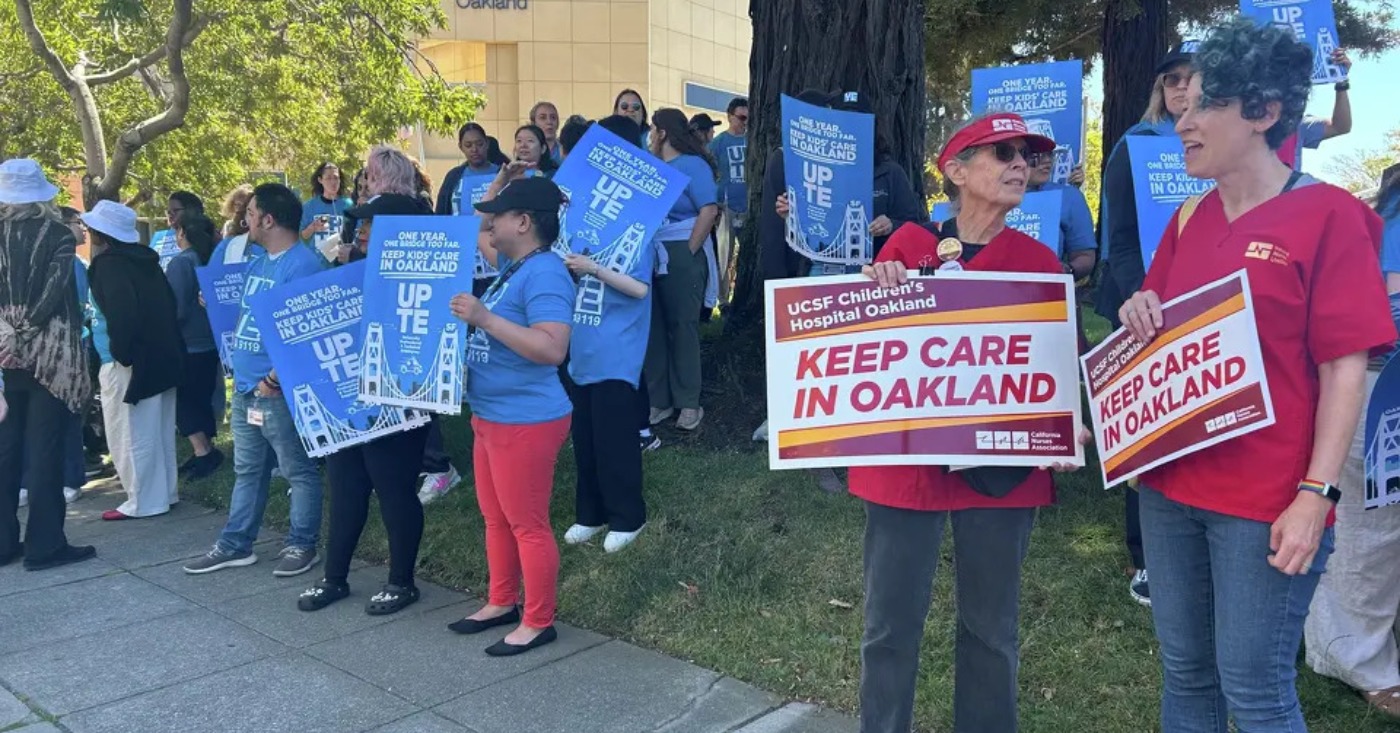
Staff, patients’ families, and supporters held a rally recently at UCSF Benioff Children’s Hospital in Oakland to protest the hospital’s decision to relocate specialized treatment clinics to San Francisco.
Protesters said the move is creating barriers for patients to access care and raised concerns over whether the hospital was appropriately using funds partially designated for pediatric services.
In response, hospital officials say they are concentrating resources for highly specialized procedures so patients can receive the highest quality of care.
One of the speakers at the rally, Paola Portillo, a social worker, said the hospital started transferring the clinics a year ago when UCSF Health integrated with the Children’s Hospital Oakland, located at 747 52nd St. in North Oakland.
According to Portillo, patients who need bone marrow treatments and interventional radiology are forced to travel to UCSF Benioff Children’s Hospital in San Francisco, which can be dangerous, she said.
“Children who go through a bone marrow transplant are immunocompromised, meaning that their immune system has been wiped out,” and having to take public transport to San Francisco exposes patients to the risk of getting a dangerous infection, she said.
UCSF spokesperson Kristen Bole says the move improves the hospital’s quality of care, giving bone marrow treatment (BMT) as an example.
“Inpatient BMT is a highly complex service where patient volume, specialized infrastructure, faculty coverage and 24/7 support are essential,” she said in a statement. “Concentrating non-gene therapy inpatient BMT care at Mission Bay allows us to provide the safest and most sustainable model for patients and families.”
Hospital officials also emphasized that moving care was not a one-way street. Beginning this month, patients admitted for rehabilitative treatment have been directed to the children’s hospital in Oakland, Bole said.
Speakers at the rally also claimed UCSF has not been transparent about how it has allocated funding from 2020’s Measure C, a measure that created a half-percent sales tax that partially funded pediatric health care at the children’s hospital.
“The community fought so hard for Measure C because every child deserves access to lifesaving, pediatric, high-quality care right here in Oakland,” said Agnes Cho, a policy advisor speaking on behalf of Alameda County Supervisor Nikki Fortunato Bas. “The funding should go towards strengthening care for children right here in Oakland.”
Protesters also said UCSF’s $3.3 billion endowment has been misused. Last October, the University Professional & Technical Employees union published a report on the University of California’s spending, which highlighted projects such as the $4.3 billion UCSF Helen Diller Medical Center at Parnassus Heights.
“What I have a problem with is saying the kids from the East Bay have to go to San Francisco to get care, so that UC can build a fancy hospital for its richest patients in San Francisco,” said union President Dan Russell.
The UCSF spokesperson said UCSF has been investing in its Oakland campus, explaining that upgrades that are expected to be completed in 2030 at a cost of $1.6 billion.
“Oakland is central to our pediatric health system, and we are making the largest investment in the campus’ history,” the spokeswoman said. “We do not make investments of this scale in a campus, workforce or community we plan to leave behind.”
This article includes coverage from Bay City News Service and media releases.

WORK FROM HOME
Home-based business with potential monthly income of $10K+ per month. A proven training system and website provided to maximize business effectiveness. Perfect job to earn side and primary income. Contact Lynne for more details: Lynne4npusa@gmail.com 800-334-0540


Starting This Summer, California Car Buyers Can Get an Instant $3500 Off the Cost of Electric Vehicles

Surveillance Pricing Fight: State Senate Debates Bill Banning Retailers from Using AI to Set Prices Based on a Buyer’s Profile

Oakland Children’s Hospital Workers and Patients Rally for Pediatric Medical Care

Opinion: When Politicians Start Sanitizing One Chapter of History, They’re Coming After The Whole Book

Beyond Politics: California Legislators Across Party Lines Celebrate Lori Wilson at 50

NPRC to Meet with California Attorney General’s Office on to Urge Guardianship Reform

Mount Zion MBC, Church of Jesus Christ of Latter-day Saints Partner to Bring 29,000 Meals to Alameda County

Councilmember Houston Helps Deter Trend to Award Contracts to Suburban Companies

Rep. Garamendi, House Democrats Demand Trump Administration Abandon Illegal Plans to Dismantle Civil Rights, Special Ed Offices

Council Gives Approval for $125 Million Oakland Coliseum Sale to AASEG

Job Readiness, Housing Resources Among Services Provided at Coliseum Job Fair

Free Back-to-School Summer Family and Community Event Is Coming to Richmond

New State Law Limits Student’s Cell Phone Use During School Hours

Why Trade Show Success Depends On Standing Out (Not Just Showing Up)

Gov. Gavin Newsom Signs Law Streamlining Affordable Housing Rules
Mount Zion MBC, Church of Jesus Christ of Latter-day Saints Partner to Bring 29,000 Meals to Alameda County
Oakland Children’s Hospital Workers and Patients Rally for Pediatric Medical Care

Saving Black Mothers Starts Outside the Hospital

IN MEMORIAM: Oakland Dance Legend Reginald Ray-Savage, 67
Gov. Gavin Newsom Signs Law Streamlining Affordable Housing Rules

Oakland Celebrates $125 Million Coliseum Sale


NPRC Heads to Washington to Elevate Adult Guardianship Reform at National Whistleblower Summit

The Part of Buying a Home That No Real Estate Show Ever Prepares You For

Oakland Post: Week of June 17 – 23, 2026

Agricultural Engineer Effie Gant Plans Bay Area Farmers Market Initiative

Ferry Fares to Increase July 1 as Ridership Hits Record Highs

NCBW-OBAC Champions Black Women Entrepreneurs at Business en Blaque Expo

UC Berkeley Named Top Public University in the U.S. and No. 7 in the World by ‘U.S. News’

Oakland Post: Week of July 1 – 7, 2026

The Conversation With Al McFarlane 6/23/26

Media Monday 6/22/26

LIVE! ASK ALMA! — TUES. 6.23.26 7PM EST

Car Buying Secrets: 4 Hidden Checks Before You Sign!

Is This 550 HP Charger Worth YOUR Money? AutoNetwork Review

Celebrating Juneteenth – Frederick Douglass on education and resistance

LIVE! — ASK ALMA! — TUES. 6.19.26 7PM EST

Hyundai Ioniq 5 Parking, Safety, and 360 View #shorts

2025 Ioniq 5 New Wiper & Powerful Performance! #shorts

Electric SUV Range: Is 259 Miles Enough? #shorts

EV Charging: How Fast Can You Charge an Electric Vehicle? #shorts

Biometric Cooling… Messaging Seats…Come on! 2025 Infiniti QX80 Autograph 4WD

Charged Up: Witness the Magic of a Fully Electric Car! #shorts

Range Rover Sport PHEV Included…: See What’s Inside This Luxury SUV! #shorts

Invisible Hood View: Perfect Parking with X-Ray Vision! #shorts
-
 Business13 hours ago
Mount Zion MBC, Church of Jesus Christ of Latter-day Saints Partner to Bring 29,000 Meals to Alameda County
-
 Business12 hours ago
Oakland Children’s Hospital Workers and Patients Rally for Pediatric Medical Care
-
 Black History4 days ago
Saving Black Mothers Starts Outside the Hospital
-
 Business3 days ago
Gov. Gavin Newsom Signs Law Streamlining Affordable Housing Rules
-
 Black History1 week ago
Oakland Celebrates $125 Million Coliseum Sale
-
 Community1 week ago
NPRC Heads to Washington to Elevate Adult Guardianship Reform at National Whistleblower Summit
-
 Business4 days ago
The Part of Buying a Home That No Real Estate Show Ever Prepares You For
-
 Activism1 week ago
Agricultural Engineer Effie Gant Plans Bay Area Farmers Market Initiative
