
Politics
Obama’s Record Budget: Tax the Rich, Help Middle Class


ANDREW TAYLOR, Associated Press
WASHINGTON (AP) — Promising to help America’s middle class, President Barack Obama on Monday sent Congress a record $4 trillion budget that would hammer corporate profits overseas and raise taxes on the wealthy while boosting tax credits for families and the working poor.
Obama’s budget also would steer hundreds of billions of dollars to the nation’s crumbling infrastructure of roads and bridges, help provide two years of free community college and reverse the across-the-board, automatic budget cuts that have slammed the Pentagon and nearly every government department.
In the face of certain opposition from Republicans, an optimistic Obama hailed a “breakthrough year for America” of new jobs, lower unemployment and shrinking deficits after the great recession of 2008, and he called for moving past years of “mindless austerity.” The blueprint for the 2016 budget year that begins Oct. 1 represents a 6.4 percent increase over estimated spending this year, projecting that the deficit will decline to $474 billion.
However, Obama’s plan ignores the new balance of power in Washington, with Republicans running both the House and Senate. The GOP found plenty to criticize in his proposed tax hikes that would total about $1.5 trillion.
Republicans cited the nation’s $18 trillion debt and assailed what they call Obama’s tax-and-spend policies for failing to address the spiraling growth of benefit programs such as Social Security and Medicare.
“Today President Obama laid out a plan for more taxes, more spending, and more of the Washington gridlock that has failed middle class families,” said House Speaker John Boehner, R-Ohio. “This plan never balances — ever.”
Republicans aren’t offering specifics yet but will respond this spring with their own plan, a balanced-budget outline promising to get rid of “Obamacare,” ease the burdens of the national debt on future generations, curb the explosive growth of expensive benefit programs and reform a loophole-cluttered tax code in hopes of promoting economic growth.
While Obama’s plan was rejected out of hand on budget day, proposals to ease automatic cuts and boost transportation funding are likely to return later in the year and require extensive negotiation.
“These proposals are practical, not partisan,” Obama said of his overall plans. “They’ll help working families feel more secure with paychecks that go further, help American workers upgrade their skills so they can compete for higher-paying jobs, and help create the conditions for our businesses to keep generating good new jobs for our workers to fill.”
Some people would pay more. Many wealthy Americans would only be able to take tax deductions at a 28 percent rate even though their incomes were taxed at 39.6 percent, and some would also see an increase in their maximum capital gains rate.
However, a couple earning up to $120,000 a year would qualify for a new “second earner” tax credit of up to $500 as well as a maximum $3,000 per-child tax credit for child care for up to two children, triple the current credit of $1,000.
Obama’s initiatives to tax the wealthy and to welcome an influx of immigrants into the United States are going nowhere in the new GOP-run Congress.
But there is a bipartisan desire to ease automatic spending cuts that are the product of Washington’s failures to cut deficits beyond an initial round in 2011. Both Republicans and Democrats are howling that such broad cuts savage the Pentagon. Obama said he won’t give more money to the Pentagon without receiving domestic funds he wants.
“It would be bad for our security and bad for our growth,” Obama said Monday at the Department of Homeland Security.
The centerpiece of the president’s tax plan is an increase in the capital gains rate on couples making more than $500,000 per year. The rate would climb from 24.2 percent to the Reagan-era top rate of 28 percent. Obama also wants to require estates to pay capital gains taxes that reflect the increase in value of assets like homes and stocks prior to death instead of after inheritance. And he is trying to impose a 0.07 percent fee on the roughly 100 U.S. financial companies with assets of more than $50 billion, raising $112 billion over 10 years.
All told, Obama proposes higher receipts of about $2 trillion though his budget: about $1.5 trillion from tax increases and almost $500 billion from fresh revenue as immigration reform lifts the economy and provides new workers.
His proposals would boost federal spending by $74 billion — divided between the military and domestic programs — and would result in a spending increase of $362 billion over the remaining six years the spending caps were to have been in place.
The deficit would remain under $500 billion a year through 2018, but would rise to $687 billion by 2025, according to administration projections — though levels of red ink could still be considered manageable when measured against the size of the economy.
But the cost of financing the government’s debt would spiral as the debt grows to more than $25 trillion by 2025 and interest rates rise. According to the projections. Interest costs would jump from $229 billion this year to $785 billion in 2025.
A principal theme this year is infrastructure — the budget books’ cover photo is the deteriorating Tappan Zee bridge over the Hudson River — and the plan includes a six-year, $478 billion transportation and infrastructure plan. Gasoline tax revenues would cover only half the cost, so Obama proposes a 14 percent tax on overseas corporate profits to bring in $238 billion. The combination would permit about a one-third increase in spending, with transit programs being the biggest winners.
Obama’s plan contains a lengthy roster of proposals that have been repeatedly rejected by lawmakers: $600 billion in additional revenue over a decade by limiting tax deductions for upper bracket earners; $95 billion from nearly doubling the cigarette tax to $1.95 a pack, and $35 billion through a minimum 30 percent tax rate on million-dollar incomes.
He wants to increase the security fee paid on air travel from $5.60 to $7.50 per one-way ticket. And there’s a new 10-year, $2.5 billion proposal to limit the deductibility of gifts that boosters of college teams give to earn the right to buy basketball and football tickets.
The White House claims $1.8 trillion in deficit savings over 10 years but does so by taking liberties such as ignoring the cost of preventing Medicare cuts to doctors’ fees and extending refundable tax credits for the working poor and couples with children that expire in 2017.
___
Associated Press writers Martin Crutsinger and Jim Kuhnhenn contributed to this report.
Copyright 2015 The Associated Press. All rights reserved. This material may not be published, broadcast, rewritten or redistributed.












Business
OP-ED: Proposition 44 Would Put a Price on Trust
The danger in Proposition 44 is not only its 90 percent figure. It is that the meaning of “qualifying” spending will be worked out later. A clinic preparing a budget today may not know whether a navigator, health educator, transportation program, outreach worker, technology upgrade, or other patient-support service will be counted the way it expects. Yet the financial consequence of getting it wrong could be immediate.




Business
OP-ED: Proposition 40: It’s Time to Play Chess, Not Checkers
Proposition 40 would impose a one-time 5 percent tax on the wealth of Californians with more than $1 billion in assets. Most of that money would go toward health care, with the remainder supporting food assistance and education-related programs.
Activism
Oakland Post: Week of September 30 – October 6, 2026
The printed Weekly Edition of the Oakland Post: Week of September 30 – October 6, 2026
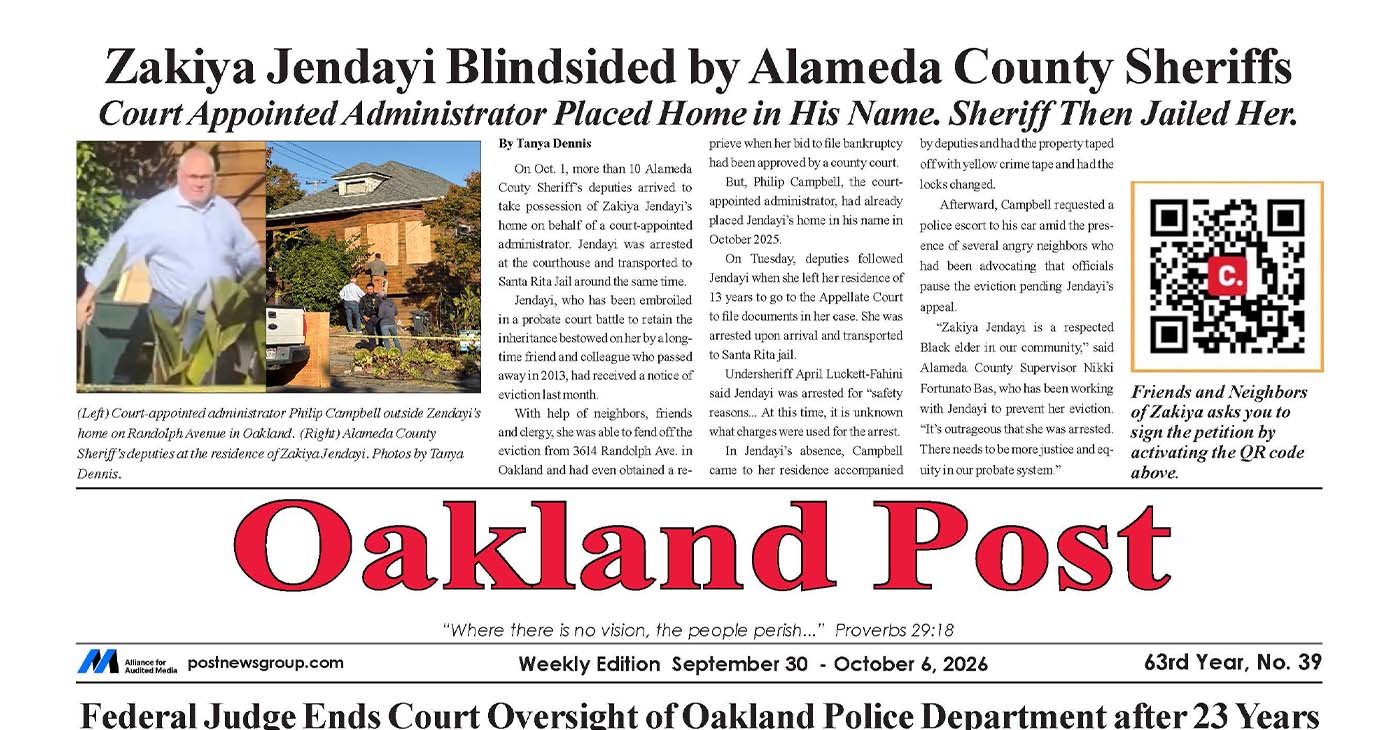
To enlarge your view of this issue, use the slider, magnifying glass icon or full page icon in the lower right corner of the browser window.


OP-ED: Proposition 44 Would Put a Price on Trust

OP-ED: Proposition 40: It’s Time to Play Chess, Not Checkers

Listening as a Lifeline: A Doula’s Witness to Black Maternal Health

New Protections for Ticket Buyers: Gov. Newsom Signs Assemblymember Isaac Bryan’s Bill

‘We Don’t Talk Trash — We Pick Up Trash!’

Zakiya Jendayi Arrested, Locked Out of Home by Sheriff’s Deputies

Oakland Post: Week of September 30 – October 6, 2026

Asm. Corey Jackson Announces Launch of 24-Hour Childcare in His District

IN MEMORIAM: The Rev. Leon “Sonny” Clark, Longtime Orange County Pastor and Community Leader, Dies at 72

Poll: Becerra Widens His Lead Over Hilton; Californians Split on Wealth Tax

From Historic Memories to New Possibilities: Oakland Celebrates Coliseum 60

County Office of Education Says OUSD Finances Are Getting Healthier, Materially Stronger

LIVE FREE Sunday Dinner Brings Faith, Fellowship and Civic Conversation to Oakland

Remembering Chauncey Bailey as Student Journalists Face Threats to Truth-Telling

BLACspace Cooperative Invites Bay Area to Experience Oakland’s Black Cultural Ecosystem Through a BLAC Map Tour + Party

Standoff for Justice: Our Homes Are Worth Fighting For

Oakland Post: Week of August 26 – September 1, 2026

Frontier Airlines’ Return to Oakland Airport Brings Flights, Jobs and Opportunity

Gubernatorial Candidate Steve Hilton Blasts California New Tire Rules; Newsom Hits Back

Chef Sharon Lee Blends Culinary Excellence, Education and Empowerment

Jackie Wright Champions Bay Area Stories, Filmmakers and Cultural Institutions

Misnamed ‘Parent’ PAC Seeks to Influence Oakland School Board Elections

Oakland Coliseum Project Opens Door for Small Businesses to Build Bigger

Big City Mayors Ask for “Yes” Vote on Housing Bond Measure; Conservatives Say “No”

Gov. Newsom’s Latest Appointees Include Sacramento Advocate for Formerly Incarcerated Students; State’s New Tech Chief

Longtime BWOPA Member Brendalyn Goodall Appointed to California Workforce Development Board

Gov. Newsom Signs Law Shielding Immigration Aid Workers From Doxing Threats

Oakland Post: Week of September 2 – 8, 2026

Secretary of State Shirley N. Weber Urges Californians to Vote Early as Voter ID Battle Intensifies

IN MEMORIAM: Dolly Parton Dead at 80 — How She Built a Legacy of Love and Earned Her Place in Black Culture

The Conversation With Al McFarlane 6/23/26

Media Monday 6/22/26

LIVE! ASK ALMA! — TUES. 6.23.26 7PM EST

Car Buying Secrets: 4 Hidden Checks Before You Sign!

Is This 550 HP Charger Worth YOUR Money? AutoNetwork Review

Celebrating Juneteenth – Frederick Douglass on education and resistance

LIVE! — ASK ALMA! — TUES. 6.19.26 7PM EST

Hyundai Ioniq 5 Parking, Safety, and 360 View #shorts

2025 Ioniq 5 New Wiper & Powerful Performance! #shorts

Electric SUV Range: Is 259 Miles Enough? #shorts

EV Charging: How Fast Can You Charge an Electric Vehicle? #shorts

Biometric Cooling… Messaging Seats…Come on! 2025 Infiniti QX80 Autograph 4WD

Charged Up: Witness the Magic of a Fully Electric Car! #shorts

Range Rover Sport PHEV Included…: See What’s Inside This Luxury SUV! #shorts

Invisible Hood View: Perfect Parking with X-Ray Vision! #shorts
-
 Community3 weeks ago
Misnamed ‘Parent’ PAC Seeks to Influence Oakland School Board Elections
-
 Activism4 weeks ago
Oakland Post: Week of September 2 – 8, 2026
-

 Activism3 weeks ago
Oakland Post: Week of September 9 – 15, 2026
-

 Community3 weeks ago
Richmond Tiny House Village Farm & Garden Set to Open Gates on Sept. 26
-

 Black History3 weeks ago
Latest Massacre in Haiti Reveals Cruelty U.S. Deportations
-

 Black History3 weeks ago
OPINION: Nolan Wells’ Death One of Several Signifying Racial Terror Lives on in U.S. South
-

 Business2 weeks ago
Mayor Lee Announces $1 Million Kaiser Permanente Grant for Pilot Program to Address Homelessness, Clean Up Public Spaces throughout Oakland
-

 Community3 weeks ago
Democratic Clubs Interview Candidates for Oakland School Board
