
Bay Area
2024 Local Elections: Q&A for Oakland Unified School Candidates, District 3
The Post reached out to the eight candidates across Districts 1, 3, 5, and 7 to see what their views are on various topics concerning the OUSD community. Below are questions and answers from District 3 candidates Dwayne Aikens Jr and VanCendric Williams.


By Magaly Muñoz
In a few weeks, Oakland residents will vote for new school board directors in four separate districts across the city.
The Post reached out to the eight candidates across Districts 1, 3, 5, and 7 to see what their views are on various topics concerning the OUSD community. Below are questions and answers from District 3 candidates Dwayne Aikens Jr and VanCendric Williams.
Responses have been edited for length and clarity.
Q1: What do you think the biggest challenge will be to address while on the board?
Aikens: One of the biggest things to address while being on the board, we’re definitely making sure that we’re being structurally creative and smart about the resources that’s coming into OUSD, so that after we get out of state receivership, that we can stand on our own and just be able to function as a large school district.
Williams: The biggest challenge is the sustainability of our overall school district. We’ve been under state oversight for 20 years, and our district has lost 15,000 students to charter schools, significantly impacting our public school budget. Year after year, we face more school cuts and budget adjustments while trying to redesign school closures to ensure stability. Still, inevitably, we continue to balance the budget on the backs of our Black students.

Furthermore, to address our public schools’ inequities, we must prioritize resource allocation and ensure that schools in underserved areas receive adequate funding and resources to provide a quality education.
Retaining qualified teachers and classified support professionals by enhancing their professional growth will benefit our student’s academic outcomes, especially in schools with higher stress levels and fewer resources.
Q2: Given the large financial debt OUSD has and the looming threat of school closures, how will you ensure that funding for essential resources remain for students? What ideas do you have that do not include closing down schools?
Aikens: The ideas that I have around not closing down schools is really leveraging being here in Silicon Valley and the Bay Area and partnering more with entities that are Fortune 500 companies, as well as some of the tech companies. I think we need to do more of that to make sure that we’re not just depending on tax revenue to solve the problems.
I don’t think that we need to close down any schools. I think that we need to invest in the schools that we have, make sure that they’re all performing up to a level to make them attractive for people that live in the community to send their kids to instead of sending them to Berkeley and other school districts outside of OUSD.
Williams: Addressing the financial challenges of OUSD, while ensuring essential resources remain available for students, is a complex task. We must be intentional about efficient resource allocation, conducting a thorough budget audit of current expenditures to identify and eliminate inefficiencies.
Second, a key strategy in our proposal is to establish and strengthen community partnerships. We can secure additional funding and resources by forging alliances with local businesses, non-profits, and community organizations.
Third, we can organize district-wide fundraising campaigns and events to generate additional revenue. We can also explore opportunities to share services and resources with neighboring schools.
Finally, a crucial part of our proposal is to advocate for increased education funding at the state and federal levels.
Q3: Students have reported feeling as though there is not enough inclusivity amongst their peers, often feeling a divide with those of other race and ethnic backgrounds. What do you think is the best way to foster an environment where students are not feeling excluded because of their background and differences to peers?
Aikens: We definitely have to figure out better ways to deal with tough situations and conversations when it comes to race, gender and just differences. We also need to teach compassion through learning.
We should bring in an expert that studies multiple backgrounds to have tough conversations, so our biases as the adult and the leader won’t overshadow the conversation or shut down some of the conversation that a young person or another staff member may have.
Williams: We must foster a culture that encourages more student-led initiatives, clubs, and activities that promote diversity and inclusion. Creating restorative circles and safe spaces for open dialogue about race, ethnicity, and students with disabilities can help students express their feelings and learn from each other, further fueling their motivation.
Another way to foster an inclusive environment is to organize events and activities celebrating different cultures and backgrounds. These can build community, appreciation for diversity, and connections across various backgrounds.
Finally, we can provide cultural competency training for teachers and staff, which can help them address the diverse needs of their students. Implementing a culturally relevant curriculum can also help students see themselves reflected in their education and learn about different cultures and experiences.








Activism
Oakland Post: Week of September 16 – 22, 2026
The printed Weekly Edition of the Oakland Post: Week of September 16 – 22, 2026


To enlarge your view of this issue, use the slider, magnifying glass icon or full page icon in the lower right corner of the browser window.

Activism
Oakland Post: Week of September 9 – 15, 2026
The printed Weekly Edition of the Oakland Post: Week of September 9 – 15, 2026

To enlarge your view of this issue, use the slider, magnifying glass icon or full page icon in the lower right corner of the browser window.
Activism
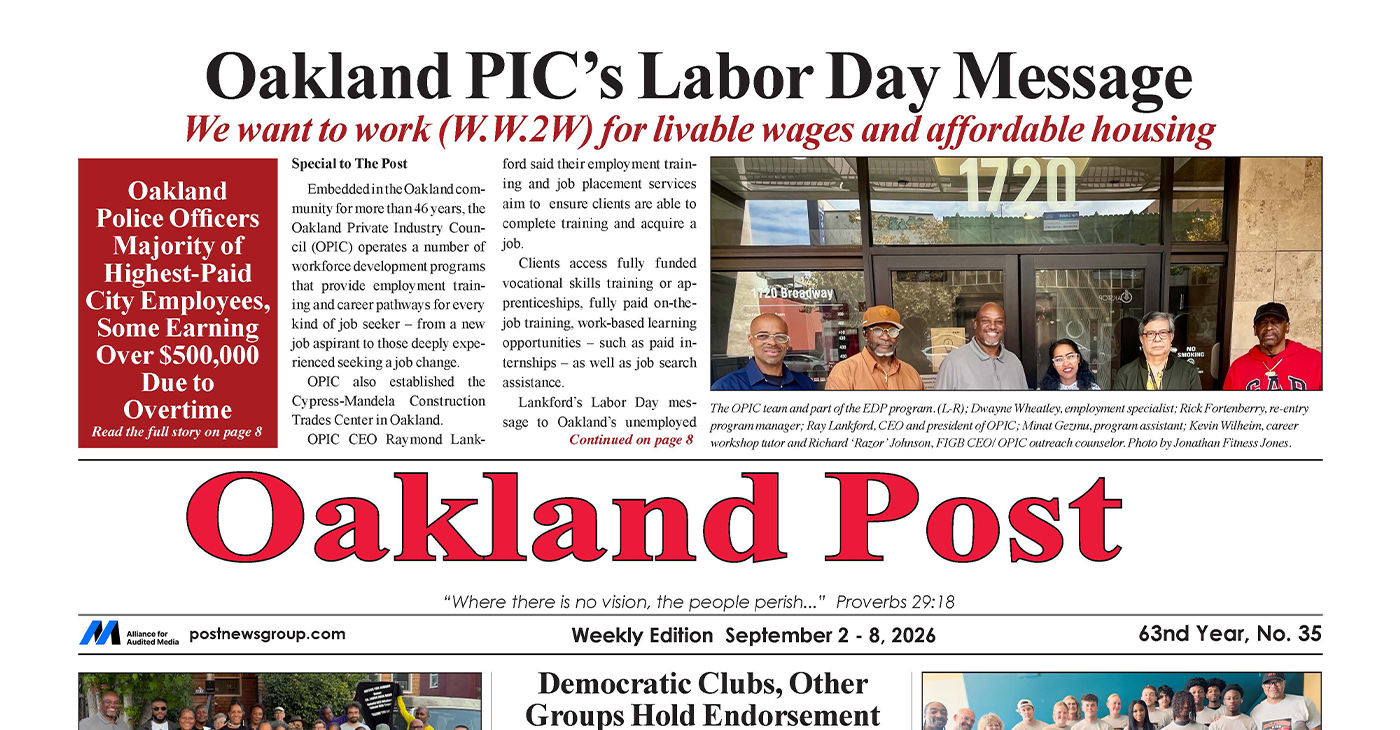
Oakland Post: Week of September 2 – 8, 2026
The printed Weekly Edition of the Oakland Post: Week of September 2 – 8, 2026
To enlarge your view of this issue, use the slider, magnifying glass icon or full page icon in the lower right corner of the browser window.



Doulas Are Helping Black California Moms Navigate Pregnancy–Even as High Mortality Rates Persist

Newsom Signs Addictive Social Media Law to Protect Kids

On Your November Ballot: Prop 38 Would Allocate $8.4 Billion to Immunology and Immunotherapy Funding

Ask California: Golden State Releases New AI Chatbot

Asm. Isaac Bryan’s Bill Banning California Police From ICE Side Jobs Reaches Newsom’s Desk

Assemblymember LaShae Sharp-Collins’s Bill Would Pause Law Enforcement’s Use of Shock Gloves Pending Study

BOOK REVIEW: ‘Laws of Solomon’ Reveals Tender Heart of Former Child Soldier

OPINION: The New American Fear – From 9-11 to AI

Passing for White, Fighting for Black America: The Courage of Walter White

Oakland People’s Arms Embargo Coalition Demands End to Military Shipments Thru Oakland

Barbara Lee Mourns Gloria Steinem, Remembers a Friendship Rooted in Equality

Event Preview: ‘Fashion v. Fascism’ – A Runway Revolution Is Coming to the Bay Area

Two Looming Threats Every Alameda County Elder Should Know About

Oakland Mayor Reads to Children at Bookout Block Party at Marcus Books Store

Tradition Comes to the Streets in 11th Annual Black-Eyed Pea Festival at the Freedom Farmers Market

Less Affluent School Districts, Including Sacramento City, Face Threat of State Takeover

ESSAY: California Can Close Its Colorectal Cancer Gap

California Hispanic Chambers of Commerce Unveils: ‘Powering the Future’ Theme for 47th Annual Statewide Convention

Four Candidates, Including Incumbent Barbara Lee, Qualify for Oakland Mayor’s Race

Oakland Post: Week of August 12 – 18, 2026

From Blueprint to Breakthrough: Tackling Affordable Housing in Oakland

Oakland Observes Black August with Block Parties, Film Showings, Workshops

COMMENTARY: Why Local School Tax Measure G1 Will Not Be on the November Ballot

Standoff for Justice: Our Homes Are Worth Fighting For

Returning to Its Roots, the Oakland Black-Eyed Pea Festival Partners with the Freedom Farmers Market Sept. 12

NPRC Scores First Advocacy Victory: David Shaw Finally Gets His Wish to ‘Go Home’

Oakland Post: Week of August 26 – September 1, 2026

Frontier Airlines’ Return to Oakland Airport Brings Flights, Jobs and Opportunity

Gubernatorial Candidate Steve Hilton Blasts California New Tire Rules; Newsom Hits Back

Chef Sharon Lee Blends Culinary Excellence, Education and Empowerment

The Conversation With Al McFarlane 6/23/26

Media Monday 6/22/26

LIVE! ASK ALMA! — TUES. 6.23.26 7PM EST

Car Buying Secrets: 4 Hidden Checks Before You Sign!

Is This 550 HP Charger Worth YOUR Money? AutoNetwork Review

Celebrating Juneteenth – Frederick Douglass on education and resistance

LIVE! — ASK ALMA! — TUES. 6.19.26 7PM EST

Hyundai Ioniq 5 Parking, Safety, and 360 View #shorts

2025 Ioniq 5 New Wiper & Powerful Performance! #shorts

Electric SUV Range: Is 259 Miles Enough? #shorts

EV Charging: How Fast Can You Charge an Electric Vehicle? #shorts

Biometric Cooling… Messaging Seats…Come on! 2025 Infiniti QX80 Autograph 4WD

Charged Up: Witness the Magic of a Fully Electric Car! #shorts

Range Rover Sport PHEV Included…: See What’s Inside This Luxury SUV! #shorts

Invisible Hood View: Perfect Parking with X-Ray Vision! #shorts
-
 Commentary4 weeks ago
Standoff for Justice: Our Homes Are Worth Fighting For
-
 Activism4 weeks ago
Oakland Post: Week of August 26 – September 1, 2026
-
 Business4 weeks ago
Frontier Airlines’ Return to Oakland Airport Brings Flights, Jobs and Opportunity
-
 Business4 weeks ago
Gubernatorial Candidate Steve Hilton Blasts California New Tire Rules; Newsom Hits Back
-
 Business4 weeks ago
Chef Sharon Lee Blends Culinary Excellence, Education and Empowerment
-

 Education4 weeks ago
Gov. Newsom’s Latest Appointees Include Sacramento Advocate for Formerly Incarcerated Students; State’s New Tech Chief
-

 Community4 weeks ago
Big City Mayors Ask for “Yes” Vote on Housing Bond Measure; Conservatives Say “No”
-

 Business4 weeks ago
Oakland Coliseum Project Opens Door for Small Businesses to Build Bigger
