Connect with us

Bay Area

Over 1500 Oakland Hotel Rooms Sit Empty as COVID-19 Pandemic Spreads

Published

on

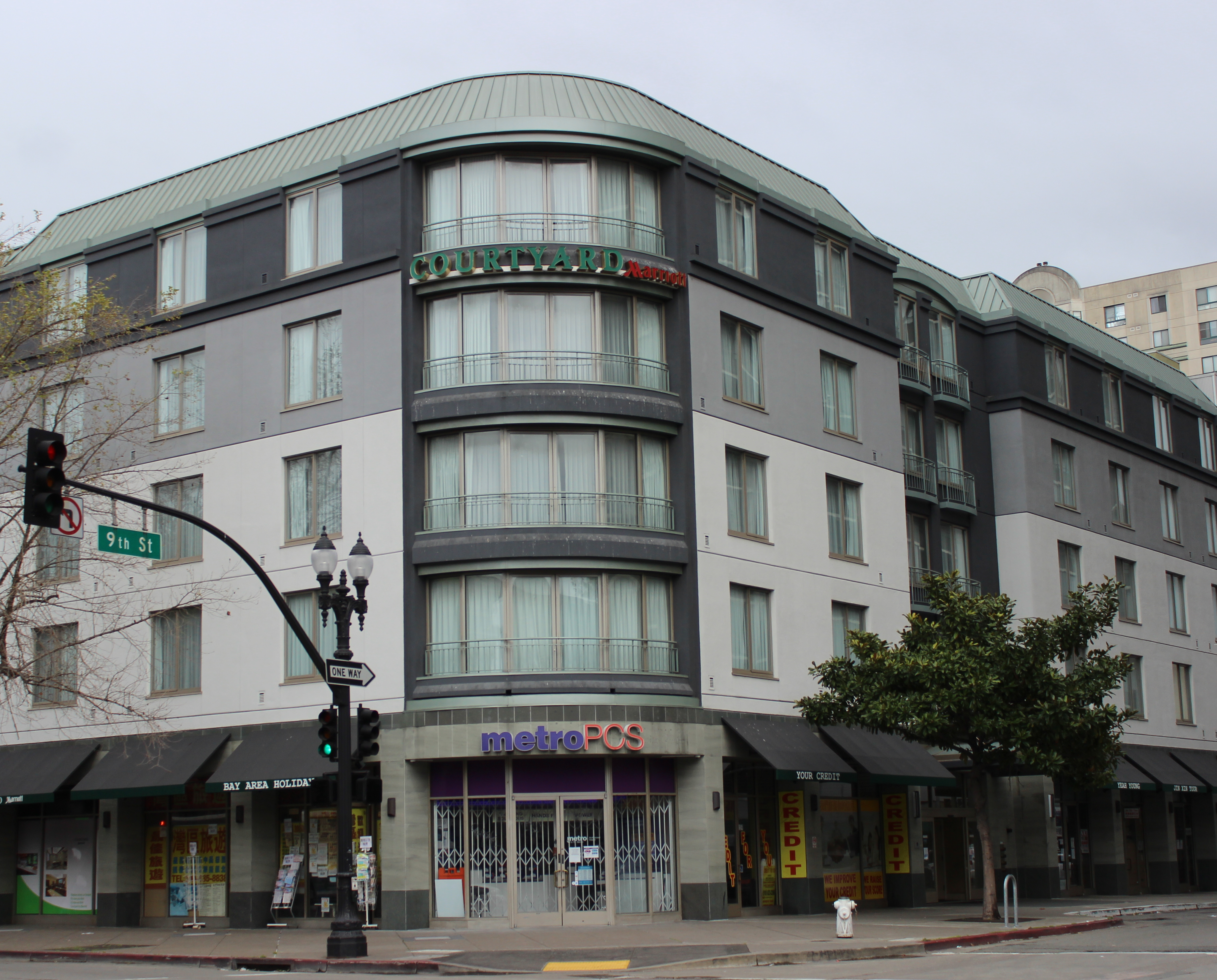
The Courtyard by Marriott Hotel in Downtown Oakland is one of the many hotels in Oakland which has seen a decrease in business since the COVID-19 pandemic began. The hotel has shut down its third, forth and fifth floors. Rooms on the second floor remain open. Photo by Zack Haber.

 After calling to inquire at 30 different Oakland hotels and motels, The Oakland Post has identified approximately 1,625 rooms that sat vacant on April 5 and 6. Unhoused residents, housing activists, and some local politicians have called for these rooms to be used to shelter those currently living on the streets to slow the spread of COVID-19.

“We should be using hotel rooms rather than big shared spaces in order to prevent the spread of disease,” said Oakland’s City Council President Rebecca Kaplan.

Seven of the 30 hotels the Oakland Post contacted refused to say how many rooms were empty, and two hotels never answered the phone after multiple calls.

While the state of California has helped secure 393 rooms in two Oakland hotels for the purpose of sheltering unhoused residents during the pandemic, the vast majority of these rooms still sit empty as the county of Alameda, which controls access to these rooms, won’t admit those who have not tested positive for the virus, shown COVID-19 symptoms, or been knowingly exposed to COVID-19.

In addition to those living on the streets, unhoused residents and their advocates worry about the crowded conditions within Bay Area shelters that make it impossible to follow six feet social distancing recommendations, especially as 70 unhoused residents in shelters in San Francisco have recently tested positive for the virus.

 Kaplan says she’s encouraged Governor Gavin Newsom and county leaders to make use of empty rooms.

“We should be using hotel rooms already, immediately, and not wait until people are sick,” said Kaplan.

Those who have studied COVID-19 insist that while the virus is fatal for some, others who have the virus and can transmit it to others show no symptoms.

 “We now know from recent studies that a significant portion of individuals with coronavirus lack symptoms and that even those who eventually develop symptoms can transmit the virus to others before showing symptoms,” says a recent recommendation on the Center of Disease Control’s (CDC) website, which lists eight studies to support its claim.

Iceland, which has tested about 5% of its population for COVID-19, has reported that 50% of those who’ve tested positive say they felt no symptoms.

In order for more of the 393 currently available Oakland hotel rooms to be filled, the county of Alameda would have to ease its requirements for who’s allowed to live in them.

Governor Newsom has the power to open the 1,625 rooms that The Oakland Post has identified as currently sitting empty — to unhoused residents. He also has the power to open over 4,000 rooms to unhoused residents, some of which are vacant and some of which are occupied, that the county of Alameda has identified throughout the East Bay.

Newsom declared a state of emergency on March 4. Chapter 7 and article 3 of California’s Emergency Services Act allows him to “commandeer or utilize any private property or personnel deemed by him necessary.”

While the article also requires that the state “pay the reasonable value” of utilized private property, it does not define what “reasonable value” means.

It is unclear what the reasonable value would be to use a room in the Ramada INN  which reported that all 64 of its rooms were empty on April 6, to help in a public health emergency. Nor is it clear what the reasonable value would be for the state to use one of the over 120 rooms that sit empty at Courtyard by Marriott, in downtown Oakland, who’s reported that it has closed its 3rd, 4th, and 5th floors and is only currently renting out rooms on its 2nd floor.

California and Alameda County are currently sharing the cost of 186$ per day to rent rooms the 393 rooms at The Radisson and The Comfort INN and Suites, but that price matches the most expensive highest quality room at The Radisson. The county and the state are overpaying for standard rooms, which make up the vast majority of rooms they’re leasing and typically cost $85–$160 per day.

The City of Oakland’s communications team says “we are currently exploring opening one or more additional hotel to respond to COVID-19, with an emphasis on hotels that could be acquired and permanently used as homeless programs in the future,” but did not offer a timeframe for acquiring them.


Activism

Medi-Cal Cares for You and Your Baby Every Step of the Way

Across California, including Alameda and San Francisco counties,  Medi-Cal is working to address those concerns by expanding and coordinating maternal health services so pregnant and postpartum people receive care that is respectful, comprehensive, and easier to navigate. From the first prenatal visit through a child’s first birthday, Medi-Cal provides coverage and support designed to protect both parent and baby.

Published

on

Shuttterstock.
Shuttterstock.

Advertorial

For many pregnant people, pregnancy brings a mix of both joy and uncertainty. Alongside excitement, there are questions about finding the right doctor, understanding what care is covered, and knowing where to turn for support after the baby arrives. For Black families in Alameda and San Francisco counties those questions are often compounded by long-standing disparities in maternal health outcomes.

Across California, including Alameda and San Francisco counties,  Medi-Cal is working to address those concerns by expanding and coordinating maternal health services so pregnant and postpartum people receive care that is respectful, comprehensive, and easier to navigate. From the first prenatal visit through a child’s first birthday, Medi-Cal provides coverage and support designed to protect both parent and baby.

These services are available to people who qualify for Medi-Cal. In California, eligibility is based primarily on income, household size, age, pregnancy status, disability, or other qualifying circumstances. Pregnant people qualify at higher income levels than non-pregnant adults and remain eligible through pregnancy and for 12 months after the pregnancy ends.

Importantly, pregnant people who qualify for Medi-Cal are eligible for full-scope coverage regardless of immigration status, including medical, behavioral health, dental, and vision services during pregnancy and the postpartum year.

A Clearer Path Through Pregnancy: The Birthing Care Pathway

The Birthing Care Pathway helps pregnant people understand what care they should receive and when, while supporting providers in delivering coordinated, culturally responsive services. It outlines key steps during pregnancy, including prenatal screenings, behavioral health check-ins, nutrition support, and preparation for labor and delivery.

For Black pregnant and postpartum people in Alameda and San Francisco counties the pathway emphasizes early prenatal care, shared decision-making, and connections to community-based programs that address medical needs and social drivers of health.

Doula Services: Support Before, During, and After Birth

Medi-Cal covers doula services for pregnant and postpartum members who qualify. Doulas provide non-medical emotional support, education, and advocacy during pregnancy, labor and delivery, and postpartum recovery. Research shows doula care is associated with reduced stress, improved birth outcomes, and increased breastfeeding success.

Covered doula services include prenatal visits, support during labor and delivery, and postpartum follow-up visits, in accordance with Medi-Cal benefit guidelines.

Care That Continues After Birth: The Postpartum Pathway

More than half of pregnancy-related deaths in California occur after childbirth, with Black families facing the greatest risks. The Postpartum Pathway defines the care pregnant and postpartum people who qualify for Medi-Cal should receive during the first year after birth.

The Pathway promotes a comprehensive postpartum visit within 12 weeks, ongoing primary care through 12 months postpartum, screening and treatment for postpartum depression and anxiety, breastfeeding support, chronic condition management, and referrals to community-based services.

Mental Health, Dental, and Vision Care Included

Medi-Cal covers perinatal behavioral health services for eligible members, including screening, therapy, counseling, and medication management when medically necessary. Services may be provided in person or through telehealth.

Pregnant and postpartum people who qualify for Medi-Cal also receive full dental benefits, including exams, cleanings, and medically necessary treatment, as well as vision care such as eye exams and eyeglasses.

Community Supports Through CalAIM

CalAIM (California Advancing and Innovating Medi-Cal) is a statewide initiative that strengthens Medi-Cal by improving care coordination and addressing health-related social needs.

Through CalAIM, eligible Medi-Cal members in Alameda and San Francisco counties may receive Community Supports such as transitional housing assistance, medically tailored meals, and help navigating social services.

How to Contact Medi-Cal in Alameda and San Francisco Counties

Pregnant and postpartum people who meet Medi-Cal eligibility requirements can get help enrolling, choosing a health plan, finding providers, or accessing doula and postpartum services by contacting the Alameda County Medi-Cal office at (510) 795-2428 or the San Francisco Medi-Cal office at (855) 355-5757 or calling the number on their Medi-Cal card.

Support at Every Step

Pregnancy and postpartum care should be clear, compassionate, and complete. Through the Birthing Care Pathway, Postpartum Pathway, doula services, behavioral health care, Black Infant Health, and Community Supports, Medi-Cal is working to ensure that eligible families in Alameda and San Francisco counties — especially Black Californians — receive the care and support they need to stay healthy and give their babies a strong start.

Ready to Learn More or Get Started?

Pregnant and postpartum people in Alameda and San Francisco counties can learn more about Medi-Cal benefits, enroll in coverage, or get help finding providers by contacting the Alameda County Medi-Cal office or San Francisco County Medi-Cal office or calling the number on their Medi-Cal card. Trained representatives can explain eligibility, available services, and next steps.

Continue Reading

Activism

Life Expectancy in Marin City, a Black Community, Is 15-17 Years Less than the Rest of Marin County

 “Marin City residents have been fighting for years just to stay here. Residents live with the fear of being forced out, public housing torn down and rebuilt for the wealthy. Due to ongoing issues continually being ignored, residents feel they must be empowered to make their own decisions for the future survival and protection of their community,” said Terrie Green, a lifelong resident and executive director of Marin City Climate Resilience (MCCR).

Published

on

Marin City community leaders (l.-r.): Terrie Green, executive director of Marin City Climate Resilience (MCCR); Wambua Musyoki, Stanford University; Khamil Callahan, Santa Rosa Junior College; Serenity Allen, Xavier University; and Chinaka Green, MCCR associate director.

By Ken Epstein

People may be aware of the existence of Marin City and know a little about its history as a center of U.S. resistance to fascism in the World War II. But fewer know of the community’s ongoing struggles to survive potential displacement while facing severe toxic health and environmental conditions on a daily basis.

These conditions cause chronic disease and premature death, dramatically shown in the sharp difference in life expectancy between Black and white people living in households only a few miles apart.

A historically African American enclave, Marin City, occupies a 0.5-square mile area between Mill Valley and Sausalito with its own freeway exit near the Golden Gate Bridge. In contrast, the rest of Marin County rates among the healthiest, wealthiest, and most environmentally friendly counties in the country. However, it is one of the least racially equitable counties in California, with Black residents being the most impacted, according to the Advancement Project, a civil rights organization,.

The community owes its continued existence to the World War II generation that came to the Bay Area from the South to work in the shipyards and to the resiliency of its residents. Despite often facing discriminatory practices, such as redlining and a segregated school district, Marin City residents have continually created a strong community rich in culture, spirituality, and community values.

The current statistics are brutal. At present, Marin City residents face more than a 17-year difference in life expectancy compared to neighboring cities and towns.  Contributing to these conditions are a lack of investment in public housing and infrastructure: unsafe drinking water, air pollution caused by proximity to the U.S. 101 freeway, unsanitary stormwater drainage that produces mold and mildew, as well as old and broken lead pipes and sewage in homes.

As an unincorporated community, Marin City residents must rely primarily on the elected Marin County Board of Supervisors, Department of Public Works, Transportation Authority of Marin and Caltrans for the decisions and investments that impact their lives.

“Marin City residents have been fighting for years just to stay here. Residents live with the fear of being forced out, public housing torn down and rebuilt for the wealthy. Due to ongoing issues continually being ignored, residents feel they must be empowered to make their own decisions for the future survival and protection of their community,” said Terrie Green, a lifelong resident and executive director of Marin City Climate Resilience (MCCR).

MCCR’s focus is on environmental justice. Its purpose is to empower and advocate for individuals to embrace sustainable living, envision a future free of environmental harm and collectively work towards a better Marin City.  MCCR’s motto is “Forever Marin City.”

MCCR has created a unique team of Marin City Youth Environmentalists who have studied and researched environmental issues impacting the health of the community.

Serenity Allen is an MCCR Youth Coordinator/Young Environmentalist studying to be a medical social worker at Xavier University. She has been working in the community for six years. “I strongly believe that where you live should not determine how long you are able to live,” she said.

Allen referred to the work done by former Marin County Public Health Officer Dr. Matt Willis, who stated that Marin City has a 17-year life expectancy difference between residents of Marin City (77 years) and more affluent areas like Ross (94 years).

“The research shows this gap is heavily correlated with race and socioeconomic status. Sausalito, which is not even two miles outside of Marin City, has a life expectancy of 92 years,” Allen said.

“Many elements contribute to this gap,” she said. “A major factor may be the 12 acres of toxic flood waters that pour down off the highway into low-lying Marin City.

In addition, “We do not have a barrier wall protecting us along our highway; the rest of Marin County has 16 barrier walls to protect from noise and air pollution. Marin City has been fighting for a barrier wall since 2008,” she said.

Octavien Green, an MCCR high school environmentalist, spoke about the impact of the absence of recreational facilities on health and wellness, particularly for youth.

“Lack of investment in our recreational facilities means we have fewer spaces and opportunities for physical activity, which contribute to serious health problems like heart disease, diabetes, weak bones and low energy, especially for kids.  We are presently involved in an ongoing struggle just to rebuild a sports ball field for the community that’s been unusable for the last 15 years.”

“Marin City is the center of Black culture for all of Marin County,” said Green. “Historically, though, the county has not invested in the community, and you see it in the life expectancy, the highest chronic disease and disability rates and eight times the amount of asthma.  In the last six weeks, we’ve had three young people in their 40s and 50s die from heart attacks.  This is alarming and must be addressed.”

Looking toward next steps, she said, “The way forward is through incorporation,” which would mean that Marin City would have its own elected leadership to find solutions that determine the future of the community.

This is the first in a series of articles on Marin City, examining conditions in the community and interviewing both community members and public officials.

Continue Reading

Activism

Oakland Post: Week of January 28, 2025 – February 3, 2026

The printed Weekly Edition of the Oakland Post: Week of January 28, 2025 – February 3, 2026

Published

on

To enlarge your view of this issue, use the slider, magnifying glass icon or full page icon in the lower right corner of the browser window.

Continue Reading

Subscribe to receive news and updates from the Oakland Post

* indicates required

CHECK OUT THE LATEST ISSUE OF THE OAKLAND POST

ADVERTISEMENT

WORK FROM HOME

Home-based business with potential monthly income of $10K+ per month. A proven training system and website provided to maximize business effectiveness. Perfect job to earn side and primary income. Contact Lynne for more details: Lynne4npusa@gmail.com 800-334-0540

Facebook

Bishop Joseph Simmons, Senior Pastor, Greater St. Paul Baptist Church, Oakland
Activism1 month ago

OP-ED: AB 1349 Puts Corporate Power Over Community

A rendering of Alfred L. Cralle’s ice cream scoop. Public domain.
Black History1 month ago

Alfred Cralle: Inventor of the Ice Cream Scoop

Costco. Courtesy image.
Activism1 month ago

First 5 Alameda County Distributes Over $8 Million in First Wave of Critical Relief Funds for Historically Underpaid Caregivers

Activism1 month ago

Oakland Post: Week of December 31, 2025 – January 6, 2026

Assemblymember Lori D. Wilson (D-Suisun City). File photo.
Activism1 month ago

2025 in Review: Seven Questions for Assemblymember Lori Wilson — Advocate for Equity, the Environment, and More

Nikki Helms is a midwife and full-spectrum birthing care advocate.
Activism4 weeks ago

Why Peace on Earth Begins with Birth, a Q&A with Midwife Nikki Helms

From top left: Pastor David Hall asking the children what they want to be when they grow up. Worship team Jake Monaghan, Ruby Friedman, and Keri Carpenter. Children lining up to receive their presents. Photos by Godfrey Lee.
Activism1 month ago

Big God Ministry Gives Away Toys in Marin City

Gnae Dismuske and her children.
Activism4 weeks ago

Protecting California’s Black Moms and Babies: Policies and Programs Struggle to Fix Deep-Rooted Maternal Health Inequities

Assemblymember Tina McKinnor (D-Inglewood). File photo.
Activism1 month ago

2025 in Review: Seven Questions for Assemblymember Tina McKinnor, Champion of Reparations, Housing and Workers’ Rights

Book cover of Let Me Be Real With You and author Arshay Cooper. Courtesy of HarperOne.
Advice1 month ago

BOOK REVIEW: Let Me Be Real With You

Sen. Laura Richardson (D-San Pedro). File photo.
Activism1 month ago

2025 in Review: Seven Questions for Sen. Laura Richardson, Who Made Legislative History This Year

Sen. Lola Smallwood-Cuevas (D-Los Angeles). File photo.
Activism1 month ago

2025 in Review: Seven Questions for Sen. Lola Smallwood-Cuevas – an Advocate for Jobs and Justice

#NNPA BlackPress4 weeks ago

Jefferson County (AL) Democrats Open Qualifying for 2026 Primary Elections

#NNPA BlackPress4 weeks ago

COMMENTARY: With Gratitude and Praise for 2026

#NNPA BlackPress4 weeks ago

Skater Emmanuel Savary Sharpens Routines for the 2026 U.S. Championships

Trending

Copyright ©2021 Post News Group, Inc. All Rights Reserved.