
Business
Waters Outlines Agenda in First Policy Speech as Committee Chairwoman
NNPA NEWSWIRE — “…Millions of families that rely on HUD rental assistance programs are perilously close to losing their homes due to projected lapses in funding. What’s more, it was recently reported that HUD, under Secretary Carson’s leadership, has failed to follow its own contingency plan, and as a result 1,150 project-based rental assistance contracts have expired, with hundreds more hanging in the balance if this shutdown does not end.”

WASHINGTON — Congresswoman Maxine Waters (D-CA), Chairwoman of the House Committee on Financial Services, delivered the following remarks during her first policy speech in the 116th Congress:
As Prepared for Delivery
Thank you for the very warm welcome, and to the Center for American Progress for holding this event. CAP’s research and policy work are highly respected and a valued resource for Members of Congress and our staffs. I am very pleased to be here with you today to discuss the new Congress and my priorities as Chairwoman of the House Financial Services Committee.
I am deeply honored to have been selected by my colleagues to become the first woman and the first African American to serve as Chair of the Financial Services Committee. I have served on the Committee since 1991, and since 1995, I have served as Ranking Member or Chairwoman of every Subcommittee under the Committee’s jurisdiction, and have taken on important issues on behalf of consumers, investors, and vulnerable families.
So, I consider it a privilege to hold the gavel, and I am looking forward to working with my colleagues on the Committee on the many critical issues we are responsible for.
Trump Shutdown
Now, given the current circumstances in Washington, I would first like to address the shutdown and its impact on the important programs under the Financial Services Committee’s jurisdiction. We are now in the midst of the longest government shutdown in history – all because this President is throwing a tantrum about a senseless border wall.
The Trump shutdown is harming hardworking Americans and our financial markets. The shutdown has all but closed the doors of the Securities and Exchange Commission (SEC), which is Wall Street’s cop on the block. As a result of the shutdown, the SEC is unable to carry out most enforcement actions against bad actors. Businesses planning to enter the stock market for the first time through an Initial Public Offering (IPO) may also be delayed because the SEC cannot approve their documents, harming American entrepreneurs and job creation.
The shutdown also has a serious impact on critical housing programs. 95% of the Department of Housing and Urban Development’s staff has been furloughed. Millions of families that rely on HUD rental assistance programs are perilously close to losing their homes due to projected lapses in funding. What’s more, it was recently reported that HUD, under Secretary Carson’s leadership, has failed to follow its own contingency plan, and as a result 1,150 project-based rental assistance contracts have expired, with hundreds more hanging in the balance if this shutdown does not end.
Families aspiring to the American dream of homeownership may have their Federal Housing Administration (FHA) or rural housing loans delayed or be unable to close on their loans during the shutdown.
And in rural communities, very low-income, elderly homeowners who rely on HUD grants and loans to address health and safety hazards may not receive disbursements and as a result, may be forced to live in dangerous conditions.
These are just a few examples of the serious ways that this shutdown is harming American families and businesses. This shutdown must end immediately. I call on Republicans in Congress to join with us and put a stop to it and open the government so that we can put an end to all of the harm that this shutdown is causing.
The Consumer Financial Protection Bureau and Financial Regulation
An ongoing priority for me is ensuring that we have a strong Consumer Financial Protection Bureau and strong financial regulation that protects consumers, investors and our economy.
Let’s talk about why the Consumer Bureau is so important. We all remember how devastating the financial crisis was: 11 million Americans lost their homes, $13 trillion in wealth was lost, nearly 9 million Americans lost their jobs, and the unemployment rate hit 10 percent. It was catastrophic for communities across the country. The crisis was a result of Wall Street running amok, with abusive institutions peddling toxic products like no-doc loans, interest-only mortgages, and other predatory products, with no agency responsible for prioritizing consumer protection. Ultimately, the economy was sent tumbling into the abyss.
In response, Democrats crafted the Dodd-Frank Wall Street Reform and Consumer Protection Act, to improve accountability in the financial system and protect consumers, investors, and the economy from abusive Wall Street practices. As the centerpiece of that law, we created the Consumer Financial Protection Bureau, which is the only federal agency solely dedicated to protecting consumers from being ripped off by financial firms.
Under former Director Richard Cordray, the Consumer Bureau returned $12 billion to more than 30 million harmed consumers; handled over 1.3 million consumer complaints about financial institutions; implemented much needed rules on mortgages, prepaid cards, payday loans, and auto title loans; required clear disclosures from financial institutions; and, provided consumers with easy-to-understand materials to empower them to make the best decisions.
But Congressional Republicans and the Trump Administration have been determined to undermine and destroy the Consumer Bureau. Trump installed Mick Mulvaney, his budget director, to serve as Acting Director of the Consumer Bureau, and during his tenure, Mulvaney made it a priority to dismantle the Consumer Bureau from within. To name just a few of his actions, Mulvaney fired all members of the Consumer Advisory Board and requested zero dollars in operating funds for the Consumer Bureau from the Federal Reserve. He also created an Office of Cost Benefit Analysis as a way to internally block important regulations under the guise of cost benefit analysis.
He also moved to strip the Consumer Bureau’s Office of Fair Lending and Equal Opportunity of its enforcement and supervisory authority. But that’s not all. Mulvaney closed the Office of Students and Young Consumers at a time when 44 million student borrowers collectively carry over $1.5 trillion in student loan debt. He also helped out payday lenders. For example, he withdrew a lawsuit against a group of deceptive payday lenders who allegedly failed to disclose the true cost of loans, which carried interest rates as high as 950 percent a year.
Now, Kathy Kraninger was confirmed as the new Director in December, and we will see what she does. Mulvaney has since moved on to become this President’s Acting Chief of Staff. But I’ve written to Mr. Mulvaney to inform him that while his time running the Consumer Bureau may be over, the time for accountability for his actions is about to begin.
This Congress, I am going to be working diligently to undo the damage that Mulvaney has wrought during his time at the Consumer Bureau. I have a bill, the Consumers First Act, that reverses many of his known harmful actions, which I will soon be reintroducing.
But it’s not just Mick Mulvaney who I will be paying attention to. I will be keeping a watchful eye on all of the financial regulators to make sure that they are carrying out their statutory duties, including holding bad actors accountable, and promoting financial stability.
As we saw during the 2008 financial crisis, large Wall Street banks that aren’t subject to strong oversight and safeguards to protect our economy can do a lot of damage, and so in Dodd-Frank we put in place robust reforms for our largest and most complex financial institutions, including increased capital, reduced leverage, improved liquidity, vigorous stress testing, and thorough living wills, all designed to improve financial stability. Dodd-Frank established the Financial Stability Oversight Council to eliminate regulatory gaps and improve oversight of the entire financial system, including shadow banking. Dodd-Frank also established the Volcker Rule to ensure that big banks don’t gamble away their customers’ deposits. All of these reforms were designed to help prevent a future financial crisis. The Committee will be paying close attention to whether financial regulators try to weaken these important reforms, and keeping an eye on the big banks and their activities, including by holding many hearings.
Regulators also need to address the evolving financial marketplace appropriately. One emerging area the Financial Services Committee will be paying very close attention to is the growth of financial technology, or so-called “fintech” firms. As Americans are banking and accessing credit in new ways, it is important that we encourage responsible innovation with the appropriate safeguards in place to protect consumers and without displacing community banks and credit unions. I have great hopes that fintech firms can open up opportunities for those who have been excluded from access to responsible credit, but I strongly believe that there must be strong protections for consumers of these financial products, and that abusive payday lending practices must not be allowed. As the fintech sector grows, there are opportunities for unmet credit needs to be addressed, as well as risks that minority communities may be preyed upon or discriminated against by some of these companies. So we will be closely examining these issues in Committee to make sure that our regulators eliminate the risks, and meet the opportunities.
Credit reporting is another issue I will be scrutinizing. In the wake of the Equifax data breach, it’s absolutely critical for Congress to reform the nation’s credit reporting system. We need to shift the burden of removing mistakes from credit reports onto the credit bureaus and furnishers, and away from consumers. We also need to place limits on credit checks for employment purposes, reduce the time period that negative items stay on credit reports, and make other reforms to fix the serious problems with the credit reporting sector. For the sake of consumers across the country, credit reporting needs a comprehensive overhaul.
Housing
A very important issue we will be bringing renewed attention to in the Financial Services Committee is housing.
This country is experiencing a housing affordability and homelessness crisis. Today, there are over half a million people experiencing homelessness here in the richest country in the world, over one-fifth of whom are children. This includes veterans who we failed to support when they returned home after serving our country, women fleeing domestic violence, people who have left prison after serving their debt to society, and people who have simply fallen on hard times. It is simply shameful, and Congress has a responsibility to act.
To tackle the homelessness crisis, Congress needs to provide a surge of funding and resources. Just as Congress puts billions of dollars into defense spending, we must provide the funding necessary to ensure that all Americans have access to safe, decent and affordable housing.
So I will soon be reintroducing my bill, the Ending Homelessness Act, which would help to ensure that every American has a safe, decent, and affordable place to call home. The bill provides $13.27 billion in new funding over five years to federal programs and initiatives to prevent homelessness.
In addition, we will be holding Committee hearings on homelessness and important housing issues that have gone ignored during the last Congress, in order to elevate housing issues into a national discussion and present proactive solutions and remedies.
The Committee also has a responsibility to look at our housing finance system and address the fates of Fannie Mae and Freddie Mac, the government sponsored enterprises. The GSEs have been in government conservatorship for more than a decade.
Contrary to Republican claims, Fannie Mae and Freddie Mac did not cause the financial crisis. The Financial Crisis Inquiry Commission and others have made that clear. The financial crisis was driven by predatory lending, the private market packaging those toxic, risky loans into securities and then selling those securities to unsuspecting investors. Fannie and Freddie did not drive those actions, but the events that transpired during the crisis made clear the need for their reform. When it comes to housing finance reform, I have advocated for core principles that I believe should be part of legislative efforts to address the future of housing finance reform. The principles include:
- maintaining access to the 30-year fixed rate mortgage;
- ensuring sufficient private capital is in place to protect taxpayers;
- providing stability and liquidity so that we can withstand any future financial crisis;
- ensuring a smooth transition to a new finance system;
- requiring transparency and standardization in a way that ensures a level playing field for all financial institutions, especially credit unions and community banks;
- maintaining access for all qualified borrowers that can sustain homeownership and serving homeowners of the future; and
- ensuring access to affordable rental housing.
It is particularly important to ensure that underserved borrowers and communities are not overlooked. This means housing finance reform will need to include a comprehensive strategy around access to affordable mortgage credit, as well as access to affordable rental housing.
Also important for housing access is the rigorous enforcement of our fair housing laws. Unfortunately, our fight to make progress on fair housing has become much more challenging under the Trump Administration. Let’s not forget that President Trump himself was sued by the government for serious violations of the Fair Housing Act. Under Trump’s leadership, the affirmatively furthering fair housing mandate under the Fair Housing Act was badly undercut when Secretary Carson halted implementation of the Obama administration’s affirmatively furthering fair housing rule. In fact, Secretary Carson once likened the rule to a “failed social experiment.” Secretary Carson has also reportedly proposed taking the words “free from discrimination” out of HUD’s mission statement. He also reportedly halted several fair housing investigations, and sidelined top advisors in HUD’s Office of Fair Housing Enforcement. These are unprecedented attacks on fair housing that we will not stand for.
To that end, in addition to conducting robust oversight of the Trump Administration’s activities at HUD, I will be reintroducing the Restoring Fair Housing Protections Act, my bill to reverse the harmful steps taken by Secretary Carson and the Trump Administration to undermine fair housing. I promise to continue to stand up for fair housing opportunities for all people.
Diversity and Inclusion
Another very important issue that I am going to continue to work on as Chairwoman is diversity and inclusion. As a nation, we are becoming increasingly diverse, racially and ethnically. The U.S. Census Bureau estimates that more than half of all Americans will belong to a minority group by the year 2044. At the same time, there is a growing body of research showing a connection between the level of diversity at a company and the strength of its financial performance. Despite these facts, the Government Accountability Office (GAO) has found a continued trend of low representation of minorities and women in the financial services industry.
Minorities and women have particularly low representation at the senior management levels within the financial services industry. This needs to change. Diverse representation in these institutions, and particularly at the management level, is essential to ensure that all consumers have fair access to credit, capital and banking and financial services.
Now, as many of you know, I believe that it is essential to promote better workforce and supplier diversity. I am one of the proud authors of Section 1116 of the Housing and Economic Recovery Act and Section 342 of the Dodd-Frank Act. Together, these provisions direct most of the federal financial services agencies to create Offices of Minority and Women Inclusion, which we refer to as “OMWIs.” OMWIs have the important responsibility of overseeing all diversity matters in management, employment, and business activities at their agencies. The creation of these offices was a major step forward. But, we all know that laws that promote racial, ethnic, and gender equality are only as strong as the implementation and enforcement of those laws. And congressional oversight is essential to ensure that implementation and enforcement are strong.
So I am very pleased and very proud to announce that I will be creating a Subcommittee on Diversity and Inclusion. The Subcommittee will be the first in its kind in Congress, dedicated to looking at diversity and inclusion issues under the Committee’s jurisdiction.
International Affairs
Turning to the international jurisdiction of the Committee, I plan to focus on the important work of the World Bank and the regional development banks in ending global poverty. We have in the past worked in a bipartisan fashion to support the International Monetary Fund or IMF in times of crisis, at the same time that we pressed the Fund to pay more attention to the social dimension of problems when decisions about economic assistance are made. While the spirit of cooperation on issues related to global economic governance in Congress has been lacking, I am optimistic that this Congress will see renewed bipartisan attention.
Under my leadership, the Financial Services Committee will ensure that accountability and effectiveness at the international financial institutions remain strong, that broad public debate about the IMF’s and the multilateral development banks’ policies remains active, and that the international interests of poverty alleviation, growth, and economic stability continue to be advanced.
Sanctions
Another area that I hope will be bipartisan is the issue of protecting American interests and democratic institutions from assault both internally and from abroad. This brings me to the issue of U.S. sanctions against Russia for its hostile actions and its efforts to undermine the U.S. presidential election.
I believe the Administration’s approach to Russia sanctions has been haphazard and weak, as well as inconsistent with its approach to sanctions imposed on other countries, such as Iran.
I am very concerned about the Treasury Department’s recent actions to lift sanctions on businesses connected to Oleg Deripaska. Deripaska is a Russian oligarch with close ties to Vladimir Putin, who also has a history with Paul Manafort, former Trump campaign chairman who has been convicted of serious financial crimes uncovered as a result of Special Counsel Mueller’s investigation into Russian interference in the last presidential election.
What’s more, Deripaska has faced numerous allegations of criminal activity and was cited by the Treasury Department in April as saying he does not separate himself from the Russian state.
I believe the delisting agreement for Deripaska’s companies is too favorable to Deripaska, including by allowing him to benefit from potentially tens of millions of dollars in debt forgiveness by transferring some of his shares to a Russian bank to satisfy debts that Deripaska owes that bank. I also don’t believe Deripaska should be allowed to retain any influence or level of control over these companies.
I look forward to working with my colleagues in both chambers and across the aisle to closely monitor all further developments on Russia sanctions, to hold the Administration accountable for its actions in this area, and to ensure that the strongest possible sanctions against Russia are implemented and remain in place.
Bipartisanship
I would like to take a few minutes to address how I will approach working with my colleagues on the other side of the aisle as Chairwoman. Throughout my career, I have looked for opportunities to build consensus and work across the aisle on commonsense solutions to benefit hardworking Americans.
As Chairwoman I will continue to find areas where we can all work together. Ranking Member McHenry and I have a relationship, and just last Congress we worked together on several bills: the Fix Crowdfunding Act, to boost crowdfunding and enhance investor protections, and the Supporting America’s Innovators Act, to make it easier for more angel investors to finance startup companies and small businesses. The Supporting America’s Innovators Act became law.
Previously, we also worked together on the Promoting Transparent Standards for Corporate Insiders Act, a bill to limit the ability of corporate insiders to illegally trade on non-public information. I am very pleased to announce that Ranking Member McHenry and I are reintroducing the Promoting Transparent Standards for Corporate Insiders Act together.
So I am very hopeful that we will be able to get some good bipartisan work done in Committee. Some of the big issues we are going to try to work on a bipartisan basis include long-term reauthorization and reform of the National Flood Insurance Program (NFIP), Terrorism Risk Insurance (TRIA), and the reauthorization of the job-creating Export-Import Bank.
And so, it is a new day in Congress and for the Financial Services Committee.
As Chairwoman, I will continue to work every day to create opportunities for hardworking Americans, ensure fairness, and protect the economic wellbeing of all Americans. I will also continue to hold this Administration and its appointees accountable.
Thank you again to the Center for American Progress for having me today!

Black History
Listening as a Lifeline: A Doula’s Witness to Black Maternal Health
OAKLAND POST — Maternal mortality and pregnancy-related mortality use different time frames and methods and are not interchangeable. Finalized 2024 CDC data recorded 649 maternal deaths nationally. The overall rate was 17.9 deaths per 100,000 live births, but for non-Hispanic Black women it was 44.8, compared with 14.2 for White women and 12.1 for Hispanic women.


Word Count: 1058
Note: Client A, B & C, names are withheld for privacy; these accounts reflect my recollections as their Doula.
Client A rocked her hips on a birthing ball, surrounded by pale wood and warm textiles in a softly lit Scandinavian-style office. I was her doula through a Southern California maternal health company combining nurse-led care, technology, and wraparound support.
She was a healthy Black woman in her thirties. Her baby girl was doing well; her partner took notes as we discussed labor and advocacy.
Then we turned to their chosen hospital. I knew it well—and remembered a phrase from another client’s experience: “Policy of Sovereignty.”
Client B had been told she needed a repeat cesarean as a precaution, though the reasoning was unclear. Her obstetrician, who performed her first cesarean two years earlier, had assured her throughout pregnancy that she was healthy, healed, and ready for a vaginal birth. We asked staff to review her chart, consult her obstetrician, and reconsider immediate surgery. Instead, they invoked the “Policy of Sovereignty.”
The physician on duty, we were told, had final authority, regardless of her established care plan. I asked whether an ultrasound or reassessing the baby’s position could offer clarity. Cesareans can be lifesaving. But were Client B’s history, informed consent, and circumstances guiding this decision—or was routine overriding individualized care? We kept asking for her obstetrician. Beneath every request was a deeper question: Was she being heard?
The Numbers Behind the Stories
Statistics arrive in clean columns. The experiences behind them do not.
Maternal mortality and pregnancy-related mortality use different time frames and methods and are not interchangeable. Finalized 2024 CDC data recorded 649 maternal deaths nationally. The overall rate was 17.9 deaths per 100,000 live births, but for non-Hispanic Black women it was 44.8, compared with 14.2 for White women and 12.1 for Hispanic women.
In California, Black birthing people experienced 56.5 pregnancy-related deaths per 100,000 live births during 2020–2022—3.8 times the White rate and four times the Asian rate.
As a doula serving Los Angeles and San Bernardino Counties, I see faces behind those numbers. I remember concerns raised softly, then firmly, then desperately. I am tired of watching Black families enter spaces meant to protect them, only to discover they must defend themselves while laboring, bleeding, trembling, or recovering.
Returning to Client A
Client A’s labor stretched nearly 48 hours. As her condition worsened, she, her partner, and I asked whether a cesarean should happen sooner. A provider questioned my place as a doula, then said she was next.
Six more hours passed.
She entered surgery visibly ill with a serious uterine infection, her baby malpositioned and stuck. Her partner later recalled the provider saying, “This baby would never have made it through the birth canal.”
Those words landed like a blow. Our urgency had been treated as ignorance. With Client B, we questioned why surgery was inevitable. With Client A, why it was delayed. Doula advocacy is not about one kind of birth. It is about informed consent, individualized care, and timely action. Hospital routine should never outweigh the person carrying the risk.
Survival Cannot Be the Standard
The Black maternal health crisis includes unequal care, untreated conditions, racial bias, delayed referrals, poor communication, and inadequate postpartum support. It is about birth plans respected only until a hospital becomes less busy and postpartum care that asks whether a mother survived, not whether she has what she needs to recover.
Survival cannot be the standard. Technology can support care, but it cannot replace human connection. An algorithm cannot detect fear in a patient’s eyes, and a mission statement alone cannot ensure adequate staffing or culturally responsive care.
The Story of Client C
Before I arrived, I heard the chaos through Client C’s phone. Staff struggled to locate her baby’s heartbeat on an external monitor as her fear and blood pressure rose. I pleaded for an internal electrode before surgery.
“There’s not enough time,” a nurse said.
“I would like to wait for my doula,” Client C called out.
But she was medicated, hurried through consent, and wheeled away while I listened.
In the operating room, after a shift change, another nurse placed an internal electrode and said, “The previous monitor wasn’t working.”
No one responded.
According to her father, the obstetrician avoided eye contact: “We need to move forward.”
Surgery may still have been necessary; that was not mine to determine. But if faulty equipment helped create the emergency, the family deserved acknowledgment and explanation—not silence. No family should have to wonder whether major surgery followed an unavoidable crisis or a machine failure no one recognized in time.
From Prevention to Accountability
After supporting nearly 100 families, I have learned that danger often begins before admission. I have urged clients to seek care—and heard why they feared returning: dismissed pain, harsh words, shame for asking questions.
Care cannot be holistic where Black families do not feel safe enough to speak or return. Representation matters, but providers of color cannot repair inequity alone. They need adequate staffing, mentorship, culturally responsive training, reliable equipment, and colleagues that are reflective of all the aforementioned. It’s not the Black providers job to care for just the Black patients, everyone should have the same goal.
The Momnibus Act, California’s Medi-Cal doula benefit, the Transforming Maternal Health Model and the Perinatal Equity Initiative require more than promises; they need sustained funding, reliable reimbursement and accountable implementation.
Birth should be sacred. Yet too many Black birthing people arrive carrying the burden of proving their pain is real. A doula can listen, educate, comfort, and advocate—but cannot repair a system that refuses to listen. The true measure of progress is what happens when a Black birthing person says, “Something is wrong.”
Are they believed? When equipment fails, is that failure acknowledged? Do families leave not merely alive, but safe, respected, supported, and whole?
Until those answers are consistently yes, California’s maternal health success story remains unfinished.
About the Author
Antoinette Stewart-Eneh is a mother of two, holistic maternal wellness advocate, and birth and postpartum doula who has supported families since 2019. She serves as program operations coordinator for Frontline Doulas, a volunteer client coordinator with the Joy in Birthing Foundation and a childbirth educator in South Los Angeles. She is studying to become a midwife and lactation educator.

Activism
Oakland Post: Week of September 30 – October 6, 2026
The printed Weekly Edition of the Oakland Post: Week of September 30 – October 6, 2026

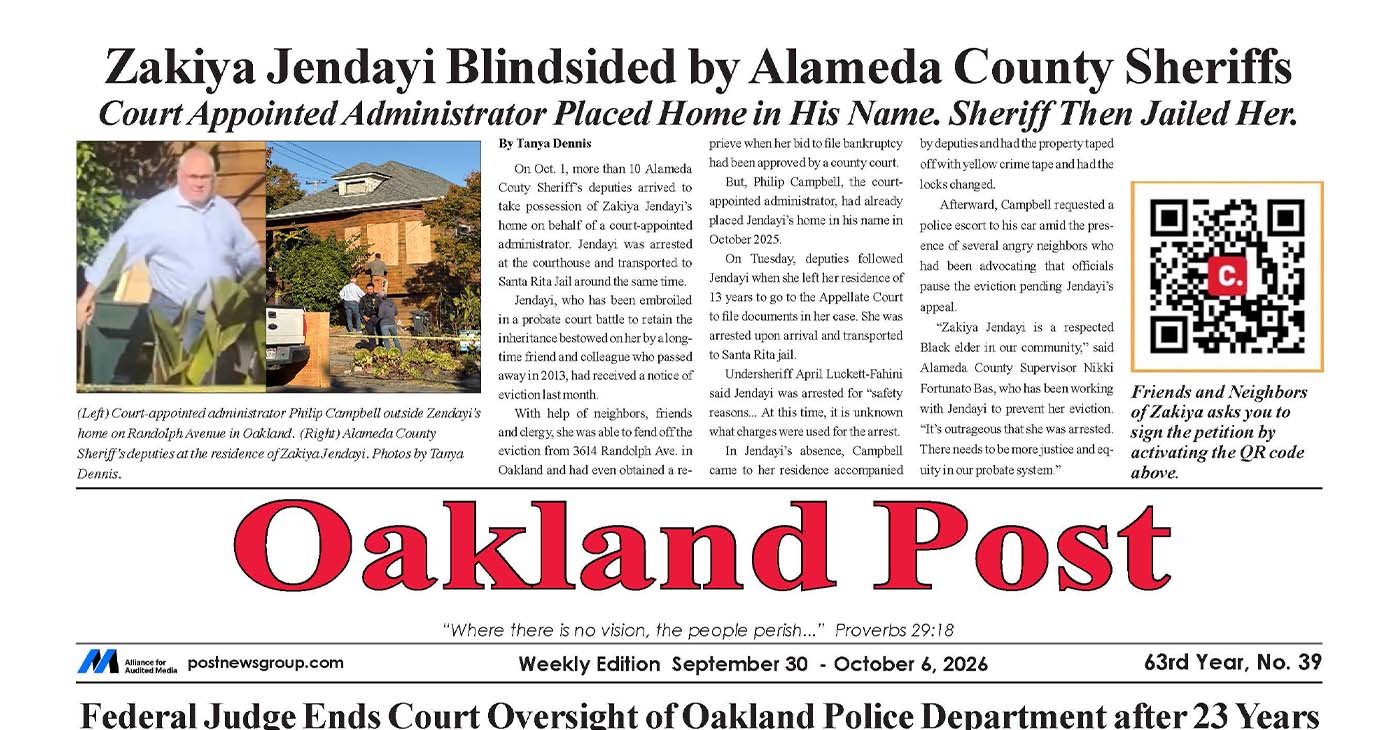
To enlarge your view of this issue, use the slider, magnifying glass icon or full page icon in the lower right corner of the browser window.

Business
From Historic Memories to New Possibilities: Oakland Celebrates Coliseum 60
More than 75 people gathered at Youth UpRising in East Oakland on Friday, September 18, for Coliseum 60, an event marking six decades of sports, entertainment, employment, and community memories at the Oakland-Alameda County Coliseum Complex. Held 60 years to the day after the Coliseum first opened, the celebration featured cultural performances and a mini-documentary highlighting its history. Speakers reflected on the venue’s significant role in the community and its future possibilities. Read more to learn about the individuals and stories honored during this special event.
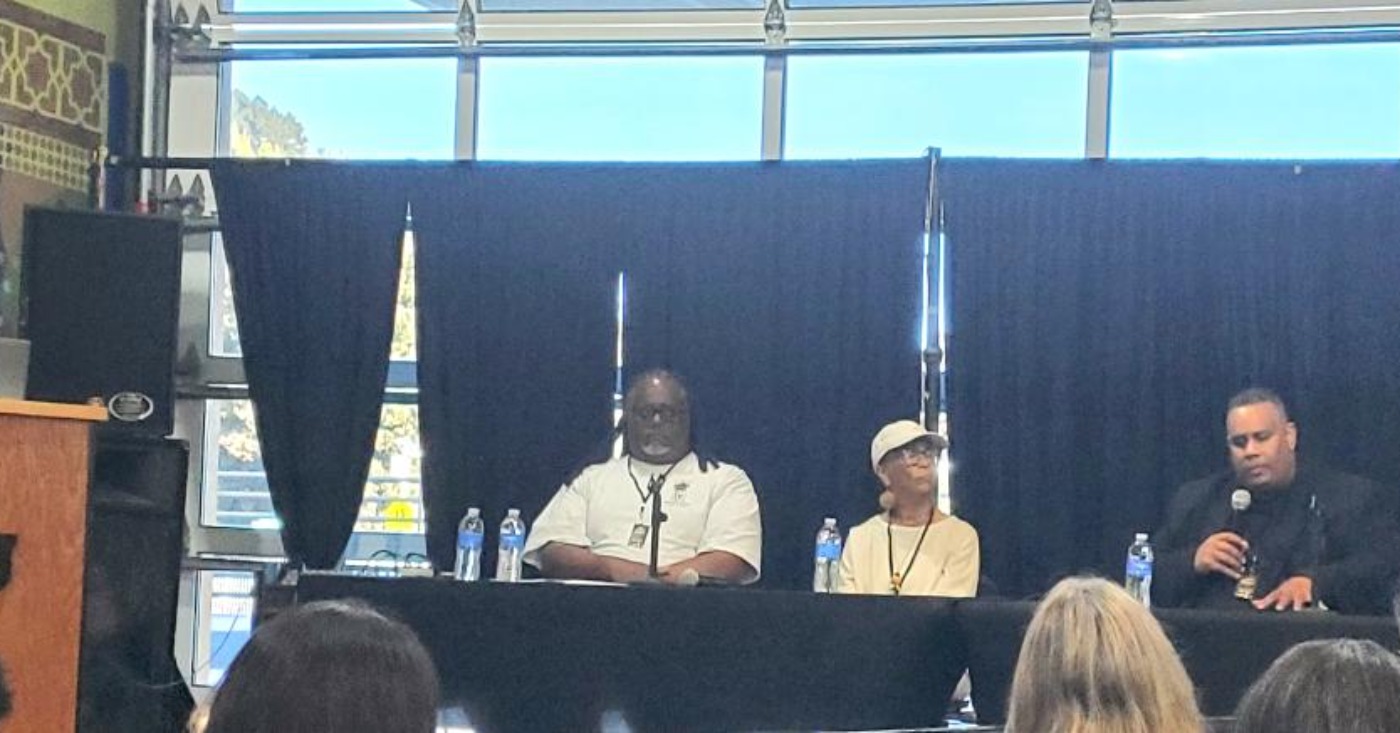

More than 75 people gathered at Youth UpRising in East Oakland on Friday, Sept. 18, for Coliseum 60, a celebration honoring six decades of sports, entertainment, employment and community memories connected to the Oakland-Alameda County Coliseum Complex.
Held 60 years to the day after the Coliseum opened, the event carried the theme, “One Community. One Legacy. One Future. Forward Together.”
The celebration opened with the national anthem performed by sisters Anese Jade, Amina Benjamin and Zaza Benjamin. Diamano Coura West African Dance Company contributed African dance and drumming, bringing movement, rhythm and cultural expression to the program.
A mini documentary highlighted the Coliseum’s sports history and its broader role as an entertainment destination. Archival material recalled performances by Prince and Tina Turner, along with memorable games featuring the Warriors, Oakland A’s and Raiders.
“The Coliseum 60 is about much more than celebrating a building or looking back at 60 years of history,” said event organizer Quixote Atkins of VillageGIVE.
“It’s about the people who made that history possible: the families, workers, athletes, artists, community leaders, fans and generations who gathered there and created memories together.”

A panel exploring that history featured author, historian and former Black Panther Party member Tareka Lewis; stagehand and union representative Keith Brown; and Ray Bobbitt, president of the African American Sports and Entertainment Group AASEG. Lewis described her family as fourth-generation Bay Area pioneers.
“My family and Black families who arrived even earlier helped build the Bay Area, grew businesses and established culture here,” Lewis said. “This should be taught in the public schools.”
Lewis recalled Oakland’s influence on sports, music and literature, from the Raiders’ beginnings at Laney College to stars such as The Pointer Sisters and Rickey Henderson who attended Oakland public schools. She also advocated for school museums, historical timelines, entrepreneurship training and investments benefiting corridors such as Bancroft Avenue and High Street.
Keith Brown, a member of Local 107 of the International Alliance of Theater and Stage Employees (IATSE) who began working at the Coliseum in 2011, remembered the Ringling Bros. and Barnum & Bailey Circus, the Ice Capades, baseball bat giveaways and Nelson Mandela’s 1990 appearance.
“The special events are amazing, but it’s the workers that make the memories real for everyone,” Brown said. “They make the magic happen at the Coliseum.”
The program recognized longtime workers, including beer-stand manager Robert Preston, who served for 40 years, and Kenyatta Gentry, who worked as a vendor for 24 years and used her earnings to purchase her first apartment. Union workers Jose Gonzales and Carmen Sandoval were also honored. Speakers emphasized that Coliseum employment provided generations of residents with union wages and benefits.
Dr. Denise Saddler, the superintendent of the Oakland Unified School District (OUSD) was also honored. Saddler shared her family’s history of working at the Coliseum.
District 7 Oakland City Councilmember Ken Houston discussed the complex ownership arrangements involving the city, county and private interests.
“This was the most complex deal of its kind in the country,” Houston said.
Prior to moving from the East Coast, Alameda County Supervisor and Coliseum Joint Powers Authority Chair Nate Miley recalled learning about Oakland through its three professional sports teams. As an elected official and public servant, Miley fought hard to keep the Golden State Warriors, Oakland As, and the Raiders, but he is hopeful for the future.
“The story is not over for the Coliseum,” Miley said. “We’re entering a new chapter.”
Bobbitt said the departure of three teams had once seemed unimaginable, but he maintained that Oakland’s future remains bright.
“Oakland is a cultural superpower worldwide,” Bobbitt said. “We’re going to write the future where we participate and drive the redevelopment.”
Bobbitt highlighted AASEG’s four-year partnership with Castlemont High School’s architecture program, which engages students in reimagining and creating redevelopment concepts for the Coliseum property. “The youth will always move us forward. They are the future.”
In closing, Atkins said, “September 18 is the celebration, but what we build together afterward is the legacy.”


Listening as a Lifeline: A Doula’s Witness to Black Maternal Health

New Protections for Ticket Buyers: Gov. Newsom Signs Assemblymember Isaac Bryan’s Bill

‘We Don’t Talk Trash — We Pick Up Trash!’

Zakiya Jendayi Arrested, Locked Out of Home by Sheriff’s Deputies

Oakland Post: Week of September 30 – October 6, 2026

Asm. Corey Jackson Announces Launch of 24-Hour Childcare in His District

IN MEMORIAM: The Rev. Leon “Sonny” Clark, Longtime Orange County Pastor and Community Leader, Dies at 72

Poll: Becerra Widens His Lead Over Hilton; Californians Split on Wealth Tax

From Historic Memories to New Possibilities: Oakland Celebrates Coliseum 60

County Office of Education Says OUSD Finances Are Getting Healthier, Materially Stronger

LIVE FREE Sunday Dinner Brings Faith, Fellowship and Civic Conversation to Oakland

Remembering Chauncey Bailey as Student Journalists Face Threats to Truth-Telling

BLACspace Cooperative Invites Bay Area to Experience Oakland’s Black Cultural Ecosystem Through a BLAC Map Tour + Party

In Wake of Death on Doorstep, Williams Chapel Baptist Church Calls for Better Care, Funding for Unhoused

Oakland Centenarian Nuna McKee Honored!

Standoff for Justice: Our Homes Are Worth Fighting For

Oakland Post: Week of August 26 – September 1, 2026

Frontier Airlines’ Return to Oakland Airport Brings Flights, Jobs and Opportunity

Gubernatorial Candidate Steve Hilton Blasts California New Tire Rules; Newsom Hits Back

Chef Sharon Lee Blends Culinary Excellence, Education and Empowerment

Jackie Wright Champions Bay Area Stories, Filmmakers and Cultural Institutions

Misnamed ‘Parent’ PAC Seeks to Influence Oakland School Board Elections

Oakland Coliseum Project Opens Door for Small Businesses to Build Bigger

Big City Mayors Ask for “Yes” Vote on Housing Bond Measure; Conservatives Say “No”

Gov. Newsom’s Latest Appointees Include Sacramento Advocate for Formerly Incarcerated Students; State’s New Tech Chief

Longtime BWOPA Member Brendalyn Goodall Appointed to California Workforce Development Board

Gov. Newsom Signs Law Shielding Immigration Aid Workers From Doxing Threats

Secretary of State Shirley N. Weber Urges Californians to Vote Early as Voter ID Battle Intensifies

Oakland Post: Week of September 2 – 8, 2026

IN MEMORIAM: Dolly Parton Dead at 80 — How She Built a Legacy of Love and Earned Her Place in Black Culture

The Conversation With Al McFarlane 6/23/26

Media Monday 6/22/26

LIVE! ASK ALMA! — TUES. 6.23.26 7PM EST

Car Buying Secrets: 4 Hidden Checks Before You Sign!

Is This 550 HP Charger Worth YOUR Money? AutoNetwork Review

Celebrating Juneteenth – Frederick Douglass on education and resistance

LIVE! — ASK ALMA! — TUES. 6.19.26 7PM EST

Hyundai Ioniq 5 Parking, Safety, and 360 View #shorts

2025 Ioniq 5 New Wiper & Powerful Performance! #shorts

Electric SUV Range: Is 259 Miles Enough? #shorts

EV Charging: How Fast Can You Charge an Electric Vehicle? #shorts

Biometric Cooling… Messaging Seats…Come on! 2025 Infiniti QX80 Autograph 4WD

Charged Up: Witness the Magic of a Fully Electric Car! #shorts

Range Rover Sport PHEV Included…: See What’s Inside This Luxury SUV! #shorts

Invisible Hood View: Perfect Parking with X-Ray Vision! #shorts
-
 Community3 weeks ago
Misnamed ‘Parent’ PAC Seeks to Influence Oakland School Board Elections
-
 Activism4 weeks ago
Oakland Post: Week of September 2 – 8, 2026
-

 Community3 weeks ago
Richmond Tiny House Village Farm & Garden Set to Open Gates on Sept. 26
-

 Activism3 weeks ago
Oakland Post: Week of September 9 – 15, 2026
-

 Black History3 weeks ago
Latest Massacre in Haiti Reveals Cruelty U.S. Deportations
-

 Black History3 weeks ago
OPINION: Nolan Wells’ Death One of Several Signifying Racial Terror Lives on in U.S. South
-

 Business2 weeks ago
Mayor Lee Announces $1 Million Kaiser Permanente Grant for Pilot Program to Address Homelessness, Clean Up Public Spaces throughout Oakland
-

 Community3 weeks ago
Democratic Clubs Interview Candidates for Oakland School Board

3 Comments