
Politics
Top City Hall Contenders Play the Plaza Mariachi
THE TENNESSEE TRIBUNE — On Monday three of the four top candidates for Mayor answered questions from Nashville’s refugee and immigrant population at the Plaza Mariachi. The plaza has a food court and performance space in the middle of a strip mall on Nolensville Rd.

NASHVILLE, TN – On Monday three of the four top candidates for Mayor answered questions from Nashville’s refugee and immigrant population at the Plaza Mariachi. The plaza has a food court and performance space in the middle of a strip mall on Nolensville Rd.

There are 13 eateries with different kinds of food, two Spanish language radio stations, a Dominican Barber Shop, a Dubai Jewelry store, a Latin American clothing store, Latin American grocery store, an international calling and money transfer business. There are also regular outlets for H&R Block, GameStop, and Sprint. It’s not like the new Bellevue Mall or Opry Mills but has bits of both.
Some 2019 events at the plaza were Noche de Carnaval, Bollywood Night, Arabian Night, St. Patrick’s Day, Easter Celebration, African Roots, and Chinese New Year. The plaza hosts a bi-lingual story time on weekday mornings for kids.
Last Monday evening Mayor David Briley, Representative John Ray Clemmons, and At Large Councilman John Cooper were the headliners. Carol Swain told the Tribune she wanted to attend but had a prior commitment.
Like the At Large candidates, the mayoral candidates were asked questions about workers’ rights, immigration enforcement, affordable housing, criminal justice, access to services, the economy, and neighborhoods. Each candidate had a short time to answer each question. There was no debating between candidates. Briley spoke about immigration enforcement.
“At this moment in our country our President everyday seeks to divide us. Our state legislature is anti-immigrant, and the last line of defense for folks in our community is city government. And I am running to make sure that your city stands up for folks who have moved here one week, one year, or ten generations ago. That is what is most important to this city,” said Briley.
On the question of workers’ rights and wage theft, John Cooper said people need to report safety issues and that Metro must begin to treat wage theft as a crime. “The first way to address it and the big stick that Metro has is “we’re not doing business with anybody who has that record,” he said.
Cooper also said the city needs to stop measuring police output by the number of traffic stops and instead commit to a community policing plan where the point of contact between law enforcement and the community is a positive one.
“That lack of trust that exists in some places needs to be replaced by reliability, communication, and hard work, and it can happen,” Cooper said.
Alex Macias of Conexion Americas asked, “As mayor, how would you support immigrant-owned businesses to launch, to survive, and to thrive in Nashville’s economy?
“We should be showing our small businesses just as much love as these big corporations we’re trying to recruit to Nashville,” said Rep. John Ray Clemmons. The audience applauded.
“To help launch small businesses we need to make the business process and the permitting processes more friendly. We need to make the government work for the people and help facilitate the overwhelming number of immigrants who start their own business.
We need to facilitate and encourage more 504 loans with the Small Business Administration so more small businesses can get loans to buy real estate and buy their own buildings so they are not beholden to landlords,” Clemmons said. Again, the audience applauded.
He said Metro needs to make serious investments in the infrastructure throughout the city and that the Nolensville corridor is a rich corridor of diversity and culture.
“We need to make sure that people can get to it. We don’t need to be making cuts to our public transportation system. We need to be investing in sidewalks and we need to be making this an opening and welcoming district,” Clemmons said.
Clemmons was the most polished speaker on the stage. Briley acknowledged problems but defended his record and noted his accomplishments as any incumbent would. Cooper answered questions with brief but surprising answers. For example, he challenged the premise behind the question about developing the Nolensville corridor.
“The future comes when we realize that Nolensville Rd is not a corridor, it is a destination,” Cooper said. He said all of Nashville deserves investment, not just downtown.
“We almost completely ignore small business downtown. If you look at the lists of abatements and incentives, this is all very large corporations usually employing people who are not here now. You have to change that. You have to focus on small business. You have to focus on jobs that can come to people who are living here now,” he said.
In the forums the Tribune has covered, Clemmons has been the crowd favorite. Mayor Briley and Councilman Cooper are the other liberal alternatives. However, Cooper is a fiscal conservative like Carol Swain, a Republican.
The candidates have just released their first TV spots and it is too early to talk about the smart money in the Mayor’s race. But as the incumbent and supported by the Chamber of Commerce, Briley has a distinct advantage. His machine in City Hall pumps out new initiatives and photo Ops every other day and the TV stations dutifully cover them.
The one thing nobody is talking about much is the Swain factor. Her last challenge to Briley didn’t force a runoff in May 2018. She got 23% of the votes but Briley won that special election with 54% of the total votes cast. With two smart and able liberal politicians challenging Briley now, the conservative Swain could poll well enough to force a runoff after the election on August 1.
You can see the candidates’ forum held Monday at the Plaza Mariachi here: https://www.facebook.com/tnimmigrant/videos/2567091839990997/
This article originally appeared in The Tennessee Tribune.









Business
OP-ED: Proposition 44 Would Put a Price on Trust
The danger in Proposition 44 is not only its 90 percent figure. It is that the meaning of “qualifying” spending will be worked out later. A clinic preparing a budget today may not know whether a navigator, health educator, transportation program, outreach worker, technology upgrade, or other patient-support service will be counted the way it expects. Yet the financial consequence of getting it wrong could be immediate.



Business
OP-ED: Proposition 40: It’s Time to Play Chess, Not Checkers
Proposition 40 would impose a one-time 5 percent tax on the wealth of Californians with more than $1 billion in assets. Most of that money would go toward health care, with the remainder supporting food assistance and education-related programs.

Activism
Oakland Post: Week of September 30 – October 6, 2026
The printed Weekly Edition of the Oakland Post: Week of September 30 – October 6, 2026

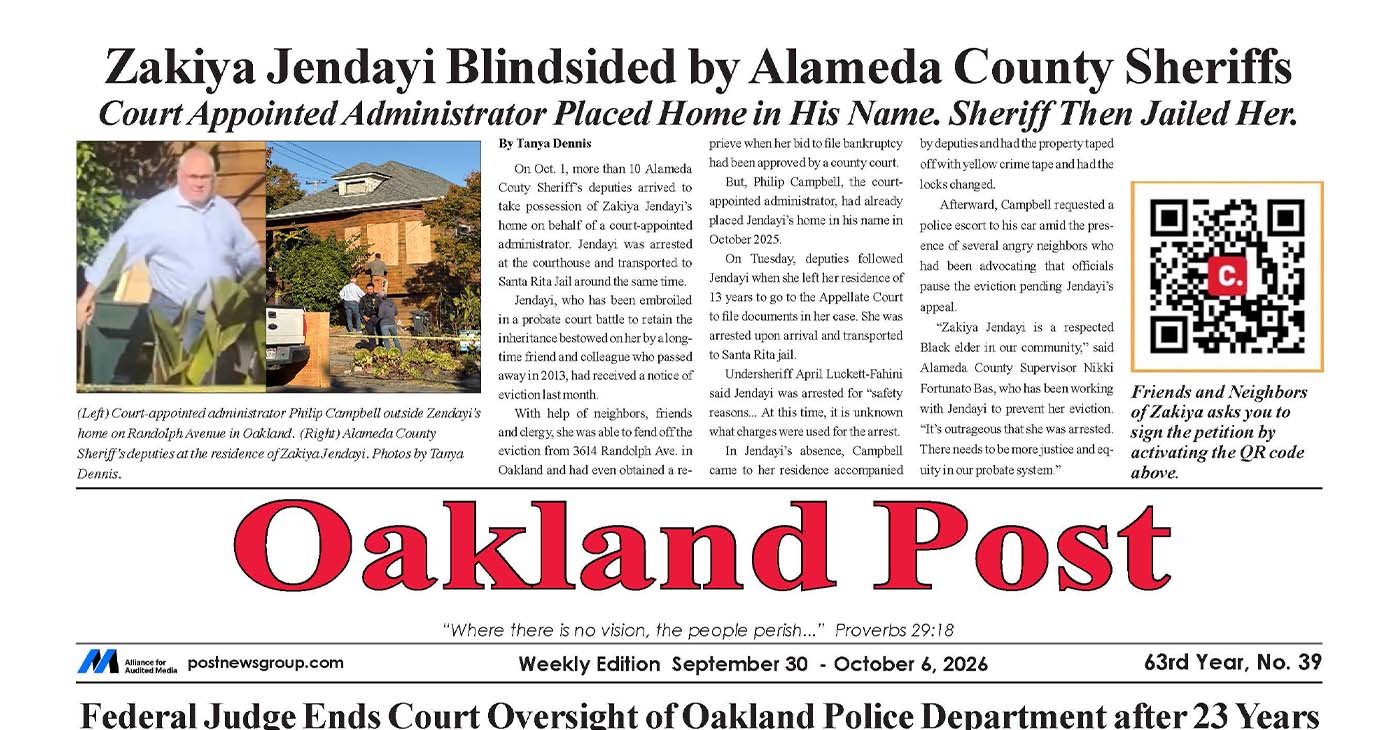
To enlarge your view of this issue, use the slider, magnifying glass icon or full page icon in the lower right corner of the browser window.



OP-ED: Proposition 44 Would Put a Price on Trust

OP-ED: Proposition 40: It’s Time to Play Chess, Not Checkers

Listening as a Lifeline: A Doula’s Witness to Black Maternal Health

New Protections for Ticket Buyers: Gov. Newsom Signs Assemblymember Isaac Bryan’s Bill

‘We Don’t Talk Trash — We Pick Up Trash!’

Zakiya Jendayi Arrested, Locked Out of Home by Sheriff’s Deputies

Oakland Post: Week of September 30 – October 6, 2026

Asm. Corey Jackson Announces Launch of 24-Hour Childcare in His District

IN MEMORIAM: The Rev. Leon “Sonny” Clark, Longtime Orange County Pastor and Community Leader, Dies at 72

Poll: Becerra Widens His Lead Over Hilton; Californians Split on Wealth Tax

From Historic Memories to New Possibilities: Oakland Celebrates Coliseum 60

County Office of Education Says OUSD Finances Are Getting Healthier, Materially Stronger

LIVE FREE Sunday Dinner Brings Faith, Fellowship and Civic Conversation to Oakland

Remembering Chauncey Bailey as Student Journalists Face Threats to Truth-Telling

BLACspace Cooperative Invites Bay Area to Experience Oakland’s Black Cultural Ecosystem Through a BLAC Map Tour + Party

Standoff for Justice: Our Homes Are Worth Fighting For

Oakland Post: Week of August 26 – September 1, 2026

Frontier Airlines’ Return to Oakland Airport Brings Flights, Jobs and Opportunity

Gubernatorial Candidate Steve Hilton Blasts California New Tire Rules; Newsom Hits Back

Chef Sharon Lee Blends Culinary Excellence, Education and Empowerment

Jackie Wright Champions Bay Area Stories, Filmmakers and Cultural Institutions

Misnamed ‘Parent’ PAC Seeks to Influence Oakland School Board Elections

Oakland Coliseum Project Opens Door for Small Businesses to Build Bigger

Gov. Newsom’s Latest Appointees Include Sacramento Advocate for Formerly Incarcerated Students; State’s New Tech Chief

Big City Mayors Ask for “Yes” Vote on Housing Bond Measure; Conservatives Say “No”

Longtime BWOPA Member Brendalyn Goodall Appointed to California Workforce Development Board

Oakland Post: Week of September 2 – 8, 2026

Gov. Newsom Signs Law Shielding Immigration Aid Workers From Doxing Threats

Secretary of State Shirley N. Weber Urges Californians to Vote Early as Voter ID Battle Intensifies

IN MEMORIAM: Dolly Parton Dead at 80 — How She Built a Legacy of Love and Earned Her Place in Black Culture

The Conversation With Al McFarlane 6/23/26

Media Monday 6/22/26

LIVE! ASK ALMA! — TUES. 6.23.26 7PM EST

Car Buying Secrets: 4 Hidden Checks Before You Sign!

Is This 550 HP Charger Worth YOUR Money? AutoNetwork Review

Celebrating Juneteenth – Frederick Douglass on education and resistance

LIVE! — ASK ALMA! — TUES. 6.19.26 7PM EST

Hyundai Ioniq 5 Parking, Safety, and 360 View #shorts

2025 Ioniq 5 New Wiper & Powerful Performance! #shorts

Electric SUV Range: Is 259 Miles Enough? #shorts

EV Charging: How Fast Can You Charge an Electric Vehicle? #shorts

Biometric Cooling… Messaging Seats…Come on! 2025 Infiniti QX80 Autograph 4WD

Charged Up: Witness the Magic of a Fully Electric Car! #shorts

Range Rover Sport PHEV Included…: See What’s Inside This Luxury SUV! #shorts

Invisible Hood View: Perfect Parking with X-Ray Vision! #shorts
-
 Community4 weeks ago
Misnamed ‘Parent’ PAC Seeks to Influence Oakland School Board Elections
-

 Activism4 weeks ago
Oakland Post: Week of September 9 – 15, 2026
-

 Community4 weeks ago
Richmond Tiny House Village Farm & Garden Set to Open Gates on Sept. 26
-

 Black History4 weeks ago
Latest Massacre in Haiti Reveals Cruelty U.S. Deportations
-

 Black History4 weeks ago
OPINION: Nolan Wells’ Death One of Several Signifying Racial Terror Lives on in U.S. South
-

 Business2 weeks ago
Mayor Lee Announces $1 Million Kaiser Permanente Grant for Pilot Program to Address Homelessness, Clean Up Public Spaces throughout Oakland
-

 Community4 weeks ago
Democratic Clubs Interview Candidates for Oakland School Board
-
 Uncategorized2 weeks ago
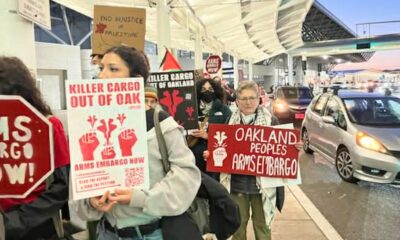
Oakland People’s Arms Embargo Coalition Demands End to Military Shipments Thru Oakland
