
Activism
Tony Thurmond Starts Second Term as State Addresses Educational Inequity
“We’re offering scholarships for anyone who wants to become a teacher. $20,000,” State Superintendent of Public Instruction (SPI) Tony Thurmond told California Black Media. “I sponsored a bill, HB 520, that was focused on how we get more male educators of color. And that bill turned into funding in the state budget. That now means our residency programs can be used to help have male educators of color as part of the beneficiaries of that program.”

By Max Elramsisy | California Black Media
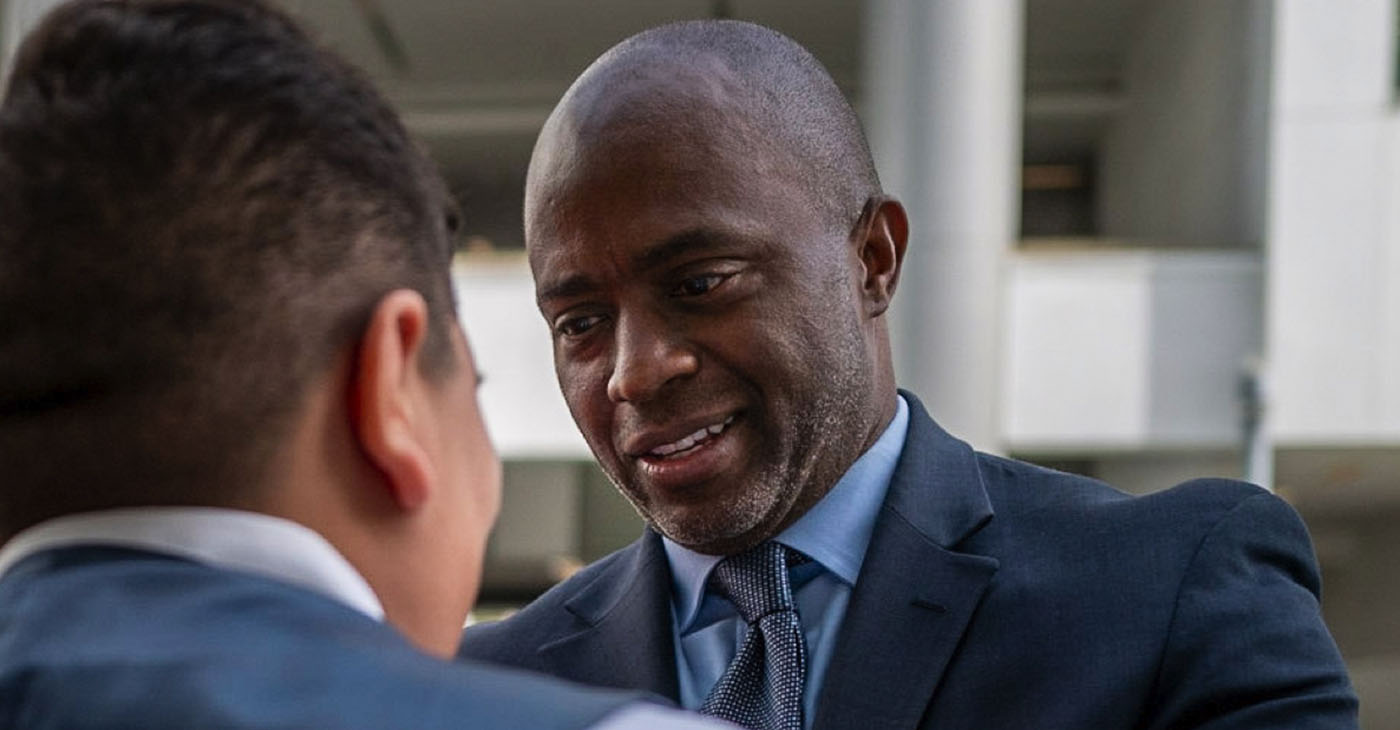
State Superintendent of Public Instruction (SPI) Tony Thurmond took the oath of office to begin his second term on Jan. 7 at a ceremony conducted at Robert F. Kennedy Community Schools in Los Angeles.
Thurmond oversees the education of 6 million PreK-12 students in over 1,000 public school districts across California.
Although SPI is a non-partisan office, Thurmond drew support from many of the state’s top Democrats in his bid for re-election, including from Gov. Gavin Newsom, Los Angeles Mayor Karen Bass and several members of the California Legislative Black Caucus. He was also endorsed by unions across the state, including the California Federation of Teachers and California Teachers Association.
U.S. Secretary of Education Miguel Cardona performed the ceremonial swearing in of Thurmond, who then reflected on his path to the office. The son of a Panamanian immigrant mother and Vietnam veteran father who did not return to his family after the war, Thurmond and his brother were raised by their cousin and relied on public assistance programs and public schools to make it out of poverty.
“I am standing on the shoulders of those relatives who struggle and sacrifice so that we could have a better life,” Thurmond said after he was sworn in. “It was the sacrifices of teachers and classified staff and childcare workers and school administrators who make it possible for me to stand here today as your public servant fighting for 6 million students in the great state of California.”

Thurmond’s first term coincided with one of the most tumultuous periods in California’s history — a time, he says, that brought with it many unforeseen challenges.
“We all watched it together. The lives lost and impacted and disrupted by the pandemic,” Thurmond said before naming other cultural, social and political developments the country endured as the COVID-19 crisis intensified.
“The killing of George Floyd, fighting hate against the Asian American Pacific Islander community, racism targeted directly to African American families, anti-Semitism, the mistreatment of Latino families, immigrant families, we have seen so much hate all in such a short period of time that we would move into a pandemic and find out that, in a state with all the wealth that we have in California, that a million students could be without a computer,” Thurmond added. “That is the most important thing that they needed to be connected to in those early days through remote learning.”
Thurmond says his administration stepped up to address challenges presented by the pandemic.
“We know that the impact this has had clearly affected student proficiency levels where they are now compared to where they were a few years before the pandemic and of course, a deep, deep impact on the mental health of our students and our families,” he said.
“We’ve seen a dramatic increase in depression and anxiety and hospitalizations for children and it has been difficult for them,” Thurmond continued. “But our children are more than the sum of their circumstances. They’ve demonstrated their resiliency, and they’re on the path to recovery, and we’re going to help them with that because we just secured enough money to recruit 10,000 counselors for our schools in the state of California.”
The addition of counselors is good news for teachers across the state seeking resources to help their students recover and develop in areas outside of academics where school also plays a crucial role for many students.
“I was very excited when Superintendent Thurman said that there would be 10,000 counselors coming to the school sites because we need that,” said Bridgette Donald-Blue, an elementary school math teacher and California Teacher of the Year award recipient. “The emotional health of our students, that is important, that is very important.”
The SPI does not have any legislative role. But Thurmond, who served in the California State Assembly for two terms, sponsored or endorsed several legislative initiatives that may have a profound effect on the future of education in California and the role that schools play to meet the social and emotional needs of students to provide a positive learning environment.
Thurmond says, beginning in the 2022–23 school year, the California Universal School Meal Program will help all students to reach their full academic potential by providing a nutritiously adequate breakfast and lunch at no charge for all children each school day regardless of individual eligibility.
Thurmond also has initiatives to combat inequities in the school system including universal preschool for 4-year-olds regardless of background, race, zip code, immigration status, or income level. He also launched the Black Student Achievement Taskforce to help quantify the impacts systemic and institutional racism have had on Black students in California.
Thurmond points out that he sponsored legislation to increase funding to the lowest-performing students, ban suspension and expulsions in preschools, and secured $90 million for suspensions and chronic absenteeism programming.
“I know the impacts of what happens when our students don’t learn to read by third grade. Sadly, they end up dropping out in many cases and in the criminal justice system, and we’re going to change the narrative and flip the script. We’re going to educate, not incarcerate our kids.” Thurmond repeated a pledge for today’s kindergarteners to be able to “read by third grade.”
Recently, some education advocates pointed out that there has been a reported wave of retirements and disincentives that have led to an unprecedented teacher shortage across the nation.
In response, Thurmond says he is creating new incentives to draw qualified people into the school system to help students, especially those who are of color.
“We’re offering scholarships for anyone who wants to become a teacher. $20,000,” Thurmond told California Black Media. “I sponsored a bill, HB 520, that was focused on how we get more male educators of color. And that bill turned into funding in the state budget. That now means our residency programs can be used to help have male educators of color as part of the beneficiaries of that program.”












Activism
Oakland Post: Week of September 16 – 22, 2026
The printed Weekly Edition of the Oakland Post: Week of September 16 – 22, 2026

To enlarge your view of this issue, use the slider, magnifying glass icon or full page icon in the lower right corner of the browser window.
Activism
Oakland Post: Week of September 9 – 15, 2026
The printed Weekly Edition of the Oakland Post: Week of September 9 – 15, 2026

To enlarge your view of this issue, use the slider, magnifying glass icon or full page icon in the lower right corner of the browser window.
Activism
Oakland Post: Week of September 2 – 8, 2026
The printed Weekly Edition of the Oakland Post: Week of September 2 – 8, 2026

To enlarge your view of this issue, use the slider, magnifying glass icon or full page icon in the lower right corner of the browser window.



Doulas Are Helping Black California Moms Navigate Pregnancy–Even as High Mortality Rates Persist

Newsom Signs Addictive Social Media Law to Protect Kids

On Your November Ballot: Prop 38 Would Allocate $8.4 Billion to Immunology and Immunotherapy Funding

Ask California: Golden State Releases New AI Chatbot

Asm. Isaac Bryan’s Bill Banning California Police From ICE Side Jobs Reaches Newsom’s Desk

Assemblymember LaShae Sharp-Collins’s Bill Would Pause Law Enforcement’s Use of Shock Gloves Pending Study

BOOK REVIEW: ‘Laws of Solomon’ Reveals Tender Heart of Former Child Soldier

OPINION: The New American Fear – From 9-11 to AI

Passing for White, Fighting for Black America: The Courage of Walter White

Oakland People’s Arms Embargo Coalition Demands End to Military Shipments Thru Oakland

Barbara Lee Mourns Gloria Steinem, Remembers a Friendship Rooted in Equality

Event Preview: ‘Fashion v. Fascism’ – A Runway Revolution Is Coming to the Bay Area

Two Looming Threats Every Alameda County Elder Should Know About

Oakland Mayor Reads to Children at Bookout Block Party at Marcus Books Store

Tradition Comes to the Streets in 11th Annual Black-Eyed Pea Festival at the Freedom Farmers Market

Less Affluent School Districts, Including Sacramento City, Face Threat of State Takeover

ESSAY: California Can Close Its Colorectal Cancer Gap

California Hispanic Chambers of Commerce Unveils: ‘Powering the Future’ Theme for 47th Annual Statewide Convention

Four Candidates, Including Incumbent Barbara Lee, Qualify for Oakland Mayor’s Race

Oakland Post: Week of August 12 – 18, 2026

From Blueprint to Breakthrough: Tackling Affordable Housing in Oakland

Oakland Observes Black August with Block Parties, Film Showings, Workshops

COMMENTARY: Why Local School Tax Measure G1 Will Not Be on the November Ballot

Standoff for Justice: Our Homes Are Worth Fighting For

Returning to Its Roots, the Oakland Black-Eyed Pea Festival Partners with the Freedom Farmers Market Sept. 12

Oakland Post: Week of August 26 – September 1, 2026

NPRC Scores First Advocacy Victory: David Shaw Finally Gets His Wish to ‘Go Home’

Frontier Airlines’ Return to Oakland Airport Brings Flights, Jobs and Opportunity

Gubernatorial Candidate Steve Hilton Blasts California New Tire Rules; Newsom Hits Back

Chef Sharon Lee Blends Culinary Excellence, Education and Empowerment

The Conversation With Al McFarlane 6/23/26

Media Monday 6/22/26

LIVE! ASK ALMA! — TUES. 6.23.26 7PM EST

Car Buying Secrets: 4 Hidden Checks Before You Sign!

Is This 550 HP Charger Worth YOUR Money? AutoNetwork Review

Celebrating Juneteenth – Frederick Douglass on education and resistance

LIVE! — ASK ALMA! — TUES. 6.19.26 7PM EST

Hyundai Ioniq 5 Parking, Safety, and 360 View #shorts

2025 Ioniq 5 New Wiper & Powerful Performance! #shorts

Electric SUV Range: Is 259 Miles Enough? #shorts

EV Charging: How Fast Can You Charge an Electric Vehicle? #shorts

Biometric Cooling… Messaging Seats…Come on! 2025 Infiniti QX80 Autograph 4WD

Charged Up: Witness the Magic of a Fully Electric Car! #shorts

Range Rover Sport PHEV Included…: See What’s Inside This Luxury SUV! #shorts

Invisible Hood View: Perfect Parking with X-Ray Vision! #shorts
-
 Commentary4 weeks ago
Standoff for Justice: Our Homes Are Worth Fighting For
-
 Activism4 weeks ago
Oakland Post: Week of August 26 – September 1, 2026
-
 Business4 weeks ago
Frontier Airlines’ Return to Oakland Airport Brings Flights, Jobs and Opportunity
-
 Business4 weeks ago
Gubernatorial Candidate Steve Hilton Blasts California New Tire Rules; Newsom Hits Back
-
 Business4 weeks ago
Chef Sharon Lee Blends Culinary Excellence, Education and Empowerment
-

 Community4 weeks ago
Big City Mayors Ask for “Yes” Vote on Housing Bond Measure; Conservatives Say “No”
-

 Black History4 weeks ago
Jackie Wright Champions Bay Area Stories, Filmmakers and Cultural Institutions
-

 Education4 weeks ago
Gov. Newsom’s Latest Appointees Include Sacramento Advocate for Formerly Incarcerated Students; State’s New Tech Chief
