
Bay Area
The Waiting Begins, Oakland Passes Budget With Uncertainty of Coliseum Funds Coming to Save Them
After 12 hours of deliberation over two days, the Oakland City Council passed their mid-cycle budget Tuesday afternoon. This budget is contingent on the city receiving $105 million from the sale of the Coliseum stadium. Oakland is currently in the process of selling their half of the 112-acre stadium complex, where the A’s are playing their last season before heading to Sacramento, to the African American Sports and Entertainment Group (AASEG) as part of Mayor Sheng Thao’s plan to eliminate the over $100 million shortfall for this year’s budget.


By Magaly Muñoz
After 12 hours of deliberation over two days, the Oakland City Council passed their mid-cycle budget Tuesday afternoon. This budget is contingent on the city receiving $105 million from the sale of the Coliseum stadium.
Oakland is currently in the process of selling their half of the 112-acre stadium complex, where the A’s are playing their last season before heading to Sacramento, to the African American Sports and Entertainment Group (AASEG) as part of Mayor Sheng Thao’s plan to eliminate the over $100 million shortfall for this year’s budget.
Many residents and even a few council members strongly urged the city to not depend on the sale of the stadium to balance the budget, saying that the sale was uncertain and could fall through at any moment.
Councilmembers Treva Reid and Janani Ramachandran criticized Thao and the city administrator for not allowing enough time for the council to review all budget possibilities in order to make the right decision for Oakland.
“This year’s budget process has been an insult to the people of Oakland,” Ramachandran said in a video on her Instagram. “I made the deep mistake of putting my trust in the mayor and the city administrator in their strong belief that the sale of the Coliseum would happen in time before our budget was passed.”

Noel Gallo, who also opposed using the sale as a fallback, asked over multiple meetings whether the city had a written guarantee that the developers were going to buy the site and had the money to cover the sale. Gallo received no definitive answer.
The council also received an alternative version of the budget, which would immediately cut funding to public safety but could be restored if the Coliseum money came in at a later date. Layoffs were not included in either option.
In order to avoid major cuts and possible layoffs, $63 million from the sale would need to come in by September 1.
Should the funds not come in, sworn police positions would drop from 678 to 600, fire stations across the city would have to temporarily shut down, two police academies would close, and several other cuts in many departments would have to be made to make up for the lost money.
Vice President of the Oakland Police Officers Association, Tim Dolan, said in a statement that the passing of this budget with the sale contingency puts the city and its residents in danger.
“These cuts would impact our response for availability to render service calls, directly impairing our ability to protect and serve. With fewer officers, response times will be slower, and our capacity to meet the community’s needs will be drastically diminished,” Dolan said.
Despite the widespread concern from many across the city, Thao praised the council for passing the budget.
“The City has just adopted a budget that invests in the future of Oakland. We must remain disciplined and address our deficit responsibly while maintaining our focus on the issues that matter most to Oaklanders, public safety and clean streets. This budget achieves that goal,” Thao said in a statement.
Programs like Ceasefire, the Film Attraction Initiative, and services to youth and elderly will continue to be funded under this passed budget.
Even if the one-time sale funds come through before the September deadline, Oakland will still have a shortfall of $175 million to deal with next year. But, city staff warned the council that there is no viable way to completely close this gap without cuts to public safety.














Activism
Oakland Post: Week of September 16 – 22, 2026
The printed Weekly Edition of the Oakland Post: Week of September 16 – 22, 2026

To enlarge your view of this issue, use the slider, magnifying glass icon or full page icon in the lower right corner of the browser window.
Activism
Oakland Post: Week of September 9 – 15, 2026
The printed Weekly Edition of the Oakland Post: Week of September 9 – 15, 2026

To enlarge your view of this issue, use the slider, magnifying glass icon or full page icon in the lower right corner of the browser window.
Activism
Oakland Post: Week of September 2 – 8, 2026
The printed Weekly Edition of the Oakland Post: Week of September 2 – 8, 2026
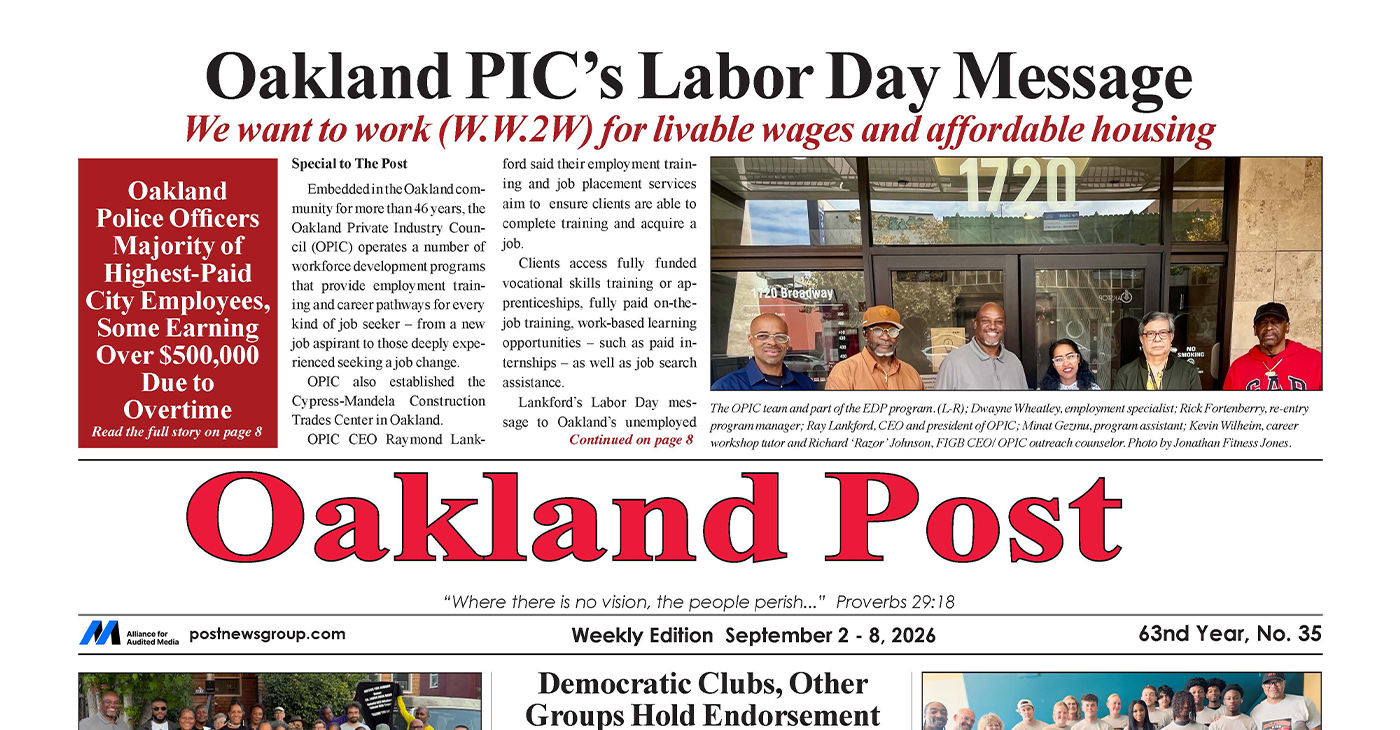
To enlarge your view of this issue, use the slider, magnifying glass icon or full page icon in the lower right corner of the browser window.



Doulas Are Helping Black California Moms Navigate Pregnancy–Even as High Mortality Rates Persist

Newsom Signs Addictive Social Media Law to Protect Kids

On Your November Ballot: Prop 38 Would Allocate $8.4 Billion to Immunology and Immunotherapy Funding

Ask California: Golden State Releases New AI Chatbot

Asm. Isaac Bryan’s Bill Banning California Police From ICE Side Jobs Reaches Newsom’s Desk

Assemblymember LaShae Sharp-Collins’s Bill Would Pause Law Enforcement’s Use of Shock Gloves Pending Study

BOOK REVIEW: ‘Laws of Solomon’ Reveals Tender Heart of Former Child Soldier

OPINION: The New American Fear – From 9-11 to AI

Passing for White, Fighting for Black America: The Courage of Walter White

Oakland People’s Arms Embargo Coalition Demands End to Military Shipments Thru Oakland

Barbara Lee Mourns Gloria Steinem, Remembers a Friendship Rooted in Equality

Event Preview: ‘Fashion v. Fascism’ – A Runway Revolution Is Coming to the Bay Area

Two Looming Threats Every Alameda County Elder Should Know About

Oakland Mayor Reads to Children at Bookout Block Party at Marcus Books Store

Tradition Comes to the Streets in 11th Annual Black-Eyed Pea Festival at the Freedom Farmers Market

Less Affluent School Districts, Including Sacramento City, Face Threat of State Takeover

ESSAY: California Can Close Its Colorectal Cancer Gap

California Hispanic Chambers of Commerce Unveils: ‘Powering the Future’ Theme for 47th Annual Statewide Convention

Four Candidates, Including Incumbent Barbara Lee, Qualify for Oakland Mayor’s Race

Oakland Post: Week of August 12 – 18, 2026

From Blueprint to Breakthrough: Tackling Affordable Housing in Oakland

Oakland Observes Black August with Block Parties, Film Showings, Workshops

COMMENTARY: Why Local School Tax Measure G1 Will Not Be on the November Ballot

Standoff for Justice: Our Homes Are Worth Fighting For

Returning to Its Roots, the Oakland Black-Eyed Pea Festival Partners with the Freedom Farmers Market Sept. 12

NPRC Scores First Advocacy Victory: David Shaw Finally Gets His Wish to ‘Go Home’

Oakland Post: Week of August 26 – September 1, 2026

Frontier Airlines’ Return to Oakland Airport Brings Flights, Jobs and Opportunity

Gubernatorial Candidate Steve Hilton Blasts California New Tire Rules; Newsom Hits Back

Chef Sharon Lee Blends Culinary Excellence, Education and Empowerment

The Conversation With Al McFarlane 6/23/26

Media Monday 6/22/26

LIVE! ASK ALMA! — TUES. 6.23.26 7PM EST

Car Buying Secrets: 4 Hidden Checks Before You Sign!

Is This 550 HP Charger Worth YOUR Money? AutoNetwork Review

Celebrating Juneteenth – Frederick Douglass on education and resistance

LIVE! — ASK ALMA! — TUES. 6.19.26 7PM EST

Hyundai Ioniq 5 Parking, Safety, and 360 View #shorts

2025 Ioniq 5 New Wiper & Powerful Performance! #shorts

Electric SUV Range: Is 259 Miles Enough? #shorts

EV Charging: How Fast Can You Charge an Electric Vehicle? #shorts

Biometric Cooling… Messaging Seats…Come on! 2025 Infiniti QX80 Autograph 4WD

Charged Up: Witness the Magic of a Fully Electric Car! #shorts

Range Rover Sport PHEV Included…: See What’s Inside This Luxury SUV! #shorts

Invisible Hood View: Perfect Parking with X-Ray Vision! #shorts
-
 Commentary4 weeks ago
Standoff for Justice: Our Homes Are Worth Fighting For
-
 Activism4 weeks ago
Oakland Post: Week of August 26 – September 1, 2026
-
 Business4 weeks ago
Frontier Airlines’ Return to Oakland Airport Brings Flights, Jobs and Opportunity
-
 Business4 weeks ago
Gubernatorial Candidate Steve Hilton Blasts California New Tire Rules; Newsom Hits Back
-
 Business4 weeks ago
Chef Sharon Lee Blends Culinary Excellence, Education and Empowerment
-

 Education4 weeks ago
Gov. Newsom’s Latest Appointees Include Sacramento Advocate for Formerly Incarcerated Students; State’s New Tech Chief
-

 Community4 weeks ago
Big City Mayors Ask for “Yes” Vote on Housing Bond Measure; Conservatives Say “No”
-

 Business4 weeks ago
Oakland Coliseum Project Opens Door for Small Businesses to Build Bigger
