
Bay Area
The Virus, Vaccines and New Variants: Weighing the Threat of a Mutant COVID Strain
“It is based on a pop-up model. We mobilize with local folks who go door-to-door, hand-to-hand, face-to-face, peer-to-peer, asking questions about COVID. As we moved into the vaccination phase, the Alameda Public Health Department recognized that as a major asset. They knew we could reach people, they couldn’t.”

Health care specialists, including several medical doctors, are keeping their eyes on coronavirus variants that some fear could lead to new strains of COVID-19 that could possibly undermine global efforts to vaccinate people and stem the global crisis.
According to the Centers of Disease Control, the B117 variant (first detected in the U.K.), the most threatening because of its prevalence, is the cause of 20% of new infections in the United States – and 30% of new infections in Florida.
Dr. Nirav Shah, Senior Scholar at Stanford University’s School of Medicine and chief medical officer of Sharecare, a health data services firm, says there are currently four different variants of COVID-19. He said the virus is adapting because “of evolution and natural selection.”
“The more virus particles there are, the more chances that a single virus particle may be a little different than the rest of them,” said Shah. “One or more virus particles is all you need to have a slight change. Maybe these spike protein changes – just a little – and it can attach to cells better than all the other particles.”
Shah said the virus is adapting as it encounters new hosts. But scientists are in a race to get everyone inoculated before the level of the disease in a community gets too high.
The B117 strain, he says, is 50% more infectious than the original strain of the coronavirus and it could lead to up to a 60% to 70% higher rate of death, according to a paper published in the journal Nature.
Shah said some of the COVID-19 virus variants could reinfect people who have contracted the disease before. The good news, he says, is that the B117 is susceptible to existing vaccine therapies, although other variants like 1351 (first detected in South Africa) and P1 (first detected in Brazil), could reduce the effectiveness of the COVID shots in patients.
Fortunately, to date, scientists studying COVID-19 have not identified any variants that have been designated ‘Variants of High Consequence.’ Those in that category “cause more disease and more hospitalizations, and they have been shown to defeat medical countermeasures, like vaccines, anti-viral drugs and mono-clonal antibodies,” says Shah.
Shah was speaking at a recent news briefing on COVID-19 virus variants organized by Ethnic Media Services. Other panelists on the Zoom teleconference were: Dr. Daniel Turner Lloveras, a member of the Latino Coalition Against COVID-19; Dr. Dali Fan, a U.C. Davis Health Science clinical professor and Dr. Kim Rhoads, an African American physician and associate professor of Epidemiology & Biostatistics at U.C. San Francisco School of Medicine.
Although the average citizen may be surprised at how COVID-19 is changing, Fan, said the virus’ adaption and mutation are much like other diseases.
He also presented some statistics from the Center for Disease Control about the coronavirus vaccines and their development. He said the vaccines were tested before they were released to the public.
“All three vaccines are very effective against symptomatic COVID-19,” said Fan. He said there are differences in the content of the vaccines and how they are stored. Fan said the Johnson & Johnson vaccine, which requires one dose, is easier to transport and is perfect for pop-up clinics and rural areas.
“It may be a better option for people who want to get fully vaccinated quickly,” he said.
Turner-Lloveras said that one of the issues overlooked during the coronavirus pandemic is the impact of the digital divide. Black and Latino communities often lag in vaccination rates because they don’t have access to high-speed Internet to discover information and arrange for their vaccination appointments.
“Internet access is a civil rights issue, at this stage,” said Turner-Lloveras. “All of the resources that are provided to people are online.”
He also said more than 20 million seniors don’t have broadband access. “This is a group that needs to be vaccinated, but they don’t have access to the Internet,” he said.
He’s trying to solve this problem with a group called the Digital Companeros, who meet with senior citizens and help them walk through online registration and information. The organization also has a WhatsApp group to target people who access the Internet through their cell phones.
According to Rhoads, some of these reports about Black hesitancy and under-vaccination may not be accurate. She talked about her experiences serving a predominantly African American population in San Francisco through Umoja Health, a coalition of community health organizations that joined their efforts to increase COVID-19 awareness, testing, and vaccinations in Black communities in the Bay Area.
The organization held a mass testing event in the Sunnydale and Bayview Hunters Point neighborhoods in San Francisco where they screened about 400 people, taking a community-based approach she calls “service in the name of public health.” No one came back positive for the coronavirus at a time when there was a 2 % positivity rate in all of San Francisco. She said the people, who were tested by community members, were also eager to get the vaccines. However, she attributes their willingness and openness to their confidence in Umoja Health.
“The community developed rapid trust in us. I was very surprised by this and they called out to us when one community member tested positive,” she said. “We saw neighbors going door to door, knocking telling people to come out and get tested.
“What we recognized from that mass-testing site was that it was not going to work for the African American community,” said Rhoads. “But something more intimate would.”
Rhoads said when African Americans know and trust the health care workers, there is more participation. Because of the organization’s successful testing effort, Alameda County has now entrusted it to provide vaccines in Oakland and areas across Alameda County with African American populations.
“It is based on a pop-up model. We mobilize with local folks who go door-to-door, hand-to-hand, face-to-face, peer-to-peer, asking questions about COVID. As we moved into the vaccination phase, the Alameda Public Health Department recognized that as a major asset. They knew we could reach people, they couldn’t.”









Activism
Oakland Post: Week of March 18 – 24, 2026
The printed Weekly Edition of the Oakland Post: Week of March 18 – 24, 2026

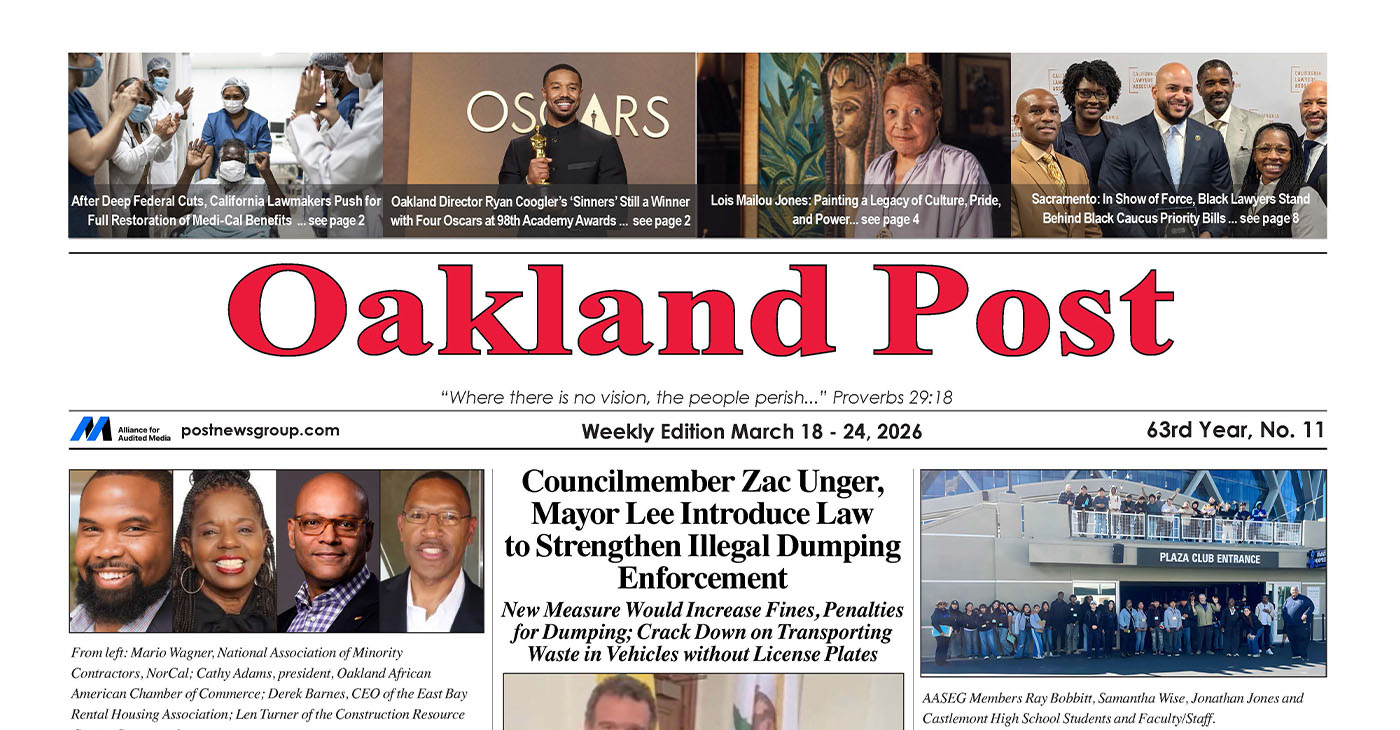
To enlarge your view of this issue, use the slider, magnifying glass icon or full page icon in the lower right corner of the browser window.

Activism
Oakland Post: Week of March 11 -17, 2026
The printed Weekly Edition of the Oakland Post: Week of March 11 – 17, 2026
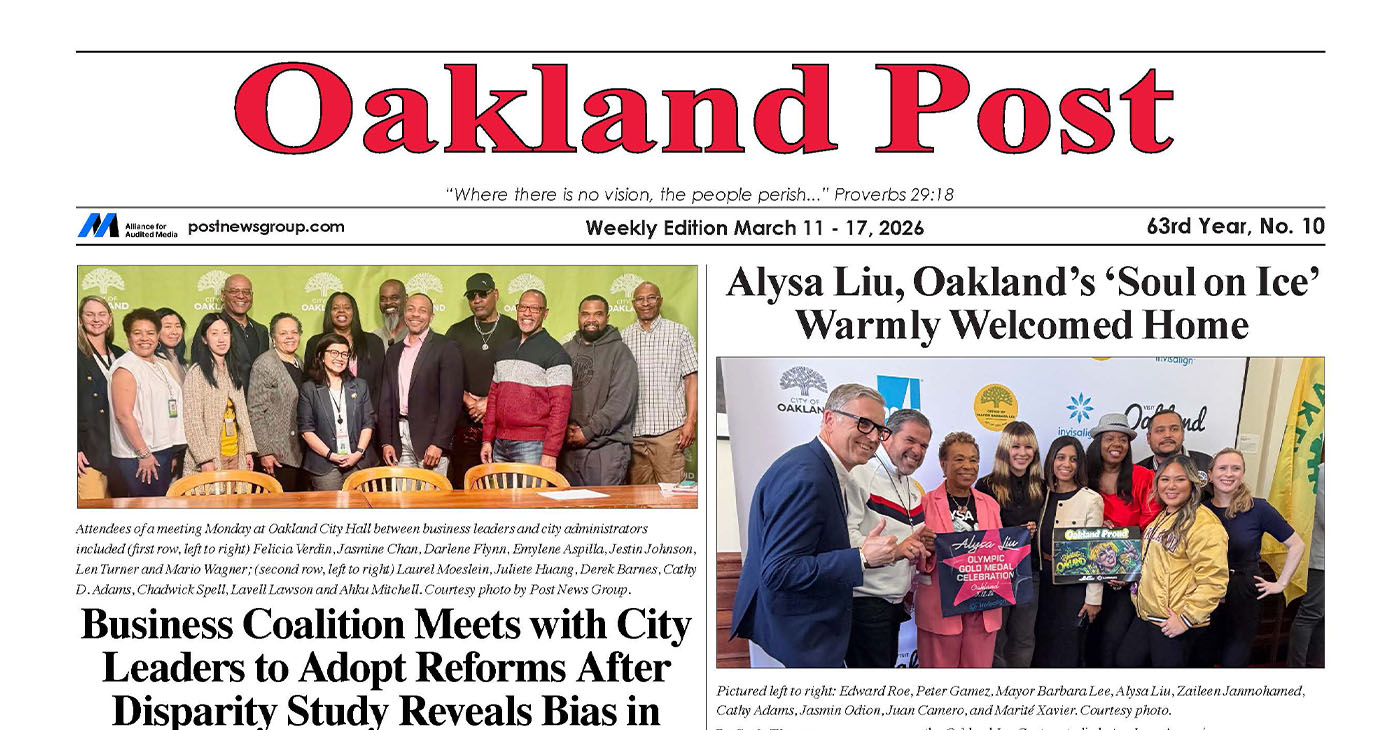
To enlarge your view of this issue, use the slider, magnifying glass icon or full page icon in the lower right corner of the browser window.
Activism
Oakland Post: Week of March 4 – 10, 2026
The printed Weekly Edition of the Oakland Post: Week of March 4 – 10, 2026
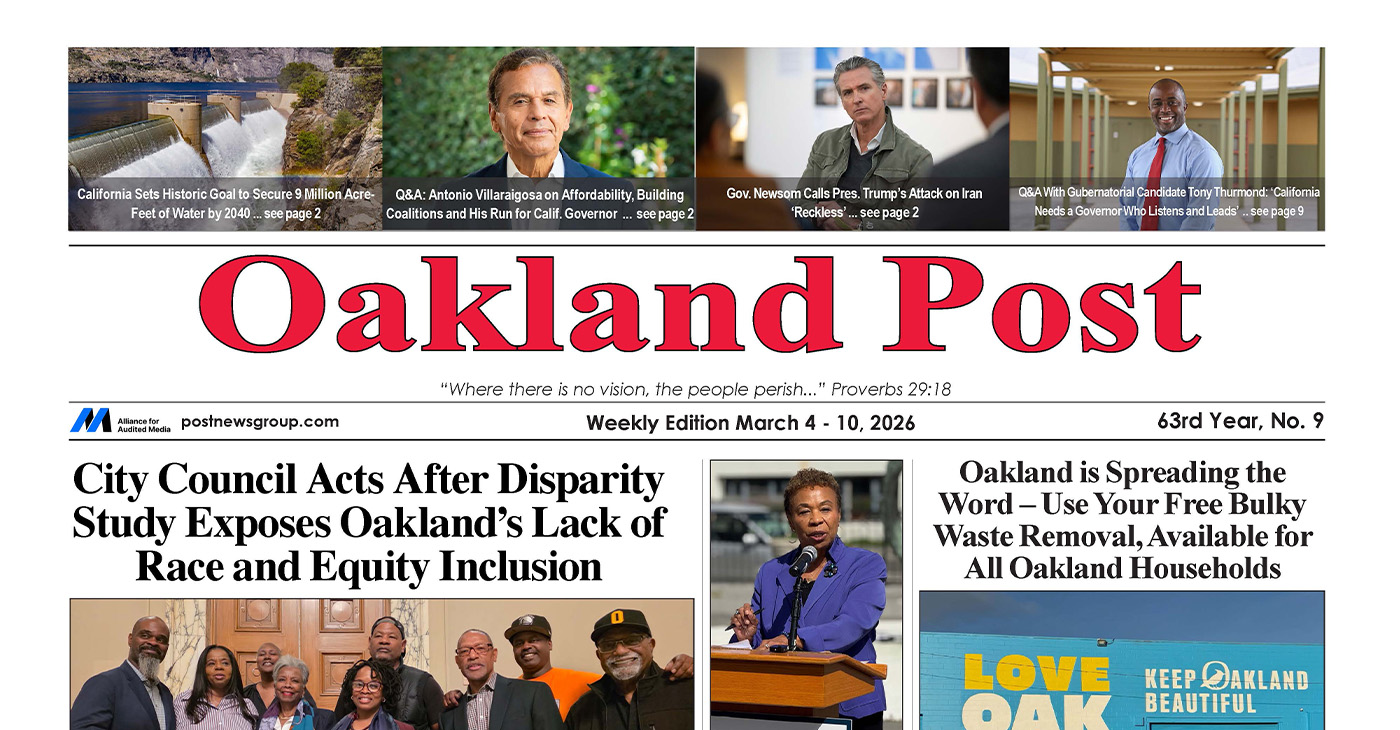
To enlarge your view of this issue, use the slider, magnifying glass icon or full page icon in the lower right corner of the browser window.


WORK FROM HOME
Home-based business with potential monthly income of $10K+ per month. A proven training system and website provided to maximize business effectiveness. Perfect job to earn side and primary income. Contact Lynne for more details: Lynne4npusa@gmail.com 800-334-0540


Black Artists in America, Installation Three Wraps at the Dixon Gallery and Gardens

Grief, Advocacy, and Education: A Counselor Reflects on Black Maternal Health

Future of Florida’s Black History Museum in Limbo

New Research Shows the Many Benefits of Early Learning

South Hampton K-8 Students Among Top 10 Finalists for Samsung’s ‘Solve for Tomorrow’ Competition

Cuba: No Negotiation with US on the President or Political System

Brooklyn Academy of Music Names Jamaican-Born Tamara McCaw as President

Trinidad & Tobego – U.S. Launches WhatsApp Channel for American Citizens in the Country

Oakland Post: Week of March 18 – 24, 2026

AI Innovation vs. Ethics and Environmental Impact

AI, Web3, and Digital Reparations

What If You Owned Your AI Agent?

Season 7, Episode 3 – January Reporter’s Roundtable 📱

Season 7, Episode 3 – January Reporter’s Roundtable

AI, Media, and Power | Part 2, Real-World Impacts and Tradeoffs

Discrimination in City Contracts

Oakland Post: Week of February 11 – 17, 2026

Reflecting on Black History Milestones in Birmingham AL

Rising Optimism Among Small And Middle Market Business Leaders Suggests Growth for California

CITY OF SAN LEANDRO STATE OF CALIFORNIA PUBLIC WORKS DEPARTMENT ENGINEERING DIVISION NOTICE TO BIDDERS FOR ANNUAL STREET OVERLAY/REHABILITATION 2019-21 – PHASE III

Oakland Post: Week of February 18 – 24, 2026

PRESS ROOM: NBA Hall of Fame Nominee Terry Cummings Joins 100 Black Men of DeKalb County to Launch Victory & Values Initiative

Oakland Post: Week of February 25 – March 3, 2026

U.S. manufacturing rebounds – how foundry services are adapting to rising demand

Trump’s MAGA Allies are Creating Executive Order Plan to Steal the 2026 Midterms

OP-ED: One Hundred Years of Black Workers Telling the Truth

Advancements in solar technology that are changing the way we power the world

Chase Oakland Community Center Hosts Alley-Oop Accelerator Building Community and Opportunity for Bay Area Entrepreneurs

PRESS ROOM: Civil Rights TV Launches in Selma as the World’s First 24/7 Civil Rights Television Network

Poll Shows Support for Policies That Help Families Afford Child Care

Hyundai Ioniq 5 Parking, Safety, and 360 View #shorts

2025 Ioniq 5 New Wiper & Powerful Performance! #shorts

Electric SUV Range: Is 259 Miles Enough? #shorts

EV Charging: How Fast Can You Charge an Electric Vehicle? #shorts

Biometric Cooling… Messaging Seats…Come on! 2025 Infiniti QX80 Autograph 4WD

Charged Up: Witness the Magic of a Fully Electric Car! #shorts

Range Rover Sport PHEV Included…: See What’s Inside This Luxury SUV! #shorts

Invisible Hood View: Perfect Parking with X-Ray Vision! #shorts

AI Is Reshaping Black Healthcare: Promise, Peril, and the Push for Improved Results in California

ESSAY: Technology and Medicine, a Primary Care Point of View

Sanctuary Cities

The RESISTANCE – FREEDOM NOW

STATE OF THE PEOPLE: Freddie

ECONOMIC BOYCOTT DAY!!!!!

I told You So
-
 #NNPA BlackPress4 weeks ago
Reflecting on Black History Milestones in Birmingham AL
-
 #NNPA BlackPress4 weeks ago
PRESS ROOM: NBA Hall of Fame Nominee Terry Cummings Joins 100 Black Men of DeKalb County to Launch Victory & Values Initiative
-
 Activism4 weeks ago
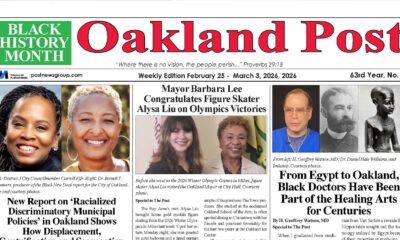
Oakland Post: Week of February 25 – March 3, 2026
-
 #NNPA BlackPress4 weeks ago
Trump’s MAGA Allies are Creating Executive Order Plan to Steal the 2026 Midterms
-
 #NNPA BlackPress4 weeks ago
OP-ED: One Hundred Years of Black Workers Telling the Truth
-
 #NNPA BlackPress4 weeks ago
Poll Shows Support for Policies That Help Families Afford Child Care
-

 Activism3 weeks ago
Oakland Post: Week of March 4 – 10, 2026
-

 #NNPA BlackPress3 weeks ago
Woman’s Search for Family’s Roots Leads to Ancestor John T. Ward – A Successful Entrepreneur and Conductor on the Underground Railroad
