
Bay Area
The Case Against Probate Part 2 – The Dr. Laura Dean Head Case
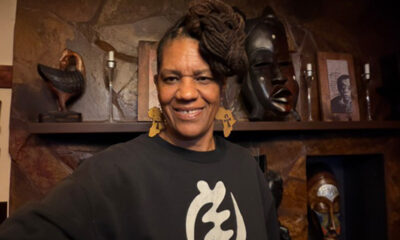
Zakiya Folami Jendayi says, “Dr. Laura Dean Head had two sisters but was estranged from them the entire 28 years we were friends.”Despite that fact, Head’s sisters, Della Hamlin and Helaine Head, questioned Head’s trust three times after Head transitioned, attempting to acquire Head’s estate, and three different attorneys told them they didn’t have standing. Dr. Head did not include either of her sisters in her trust or will. Dr. Head’s Trust included a disinheritance and no contest clause regarding her sisters.


By Tanya Dennis
Dr. Laura Dean Head, a Black Studies professor at San Francisco State University for 35 years, transitioned on June 19, 2013. Aware of her imminent demise, Dr. Head appointed former student and friend for 28 years, Zakiya Folami Jendayi as trustee, executor, and sole beneficiary of her estate in front of several credible witnesses and a notary. Head also gave Jendayi power of attorney and appointed Jendayi as her advanced healthcare agent.
Jendayi says, “Laura had two sisters but was estranged from them the entire 28 years we were friends.”Despite that fact, Head’s sisters, Della Hamlin and Helaine Head, questioned Head’s trust three times after Head transitioned, attempting to acquire Head’s estate, and three different attorneys told them they didn’t have standing. Dr. Head did not include either of her sisters in her trust or will. Dr. Head’s Trust included a disinheritance and no contest clause regarding her sisters.
In 2020, Dr. Head’s deceased mother’s abandoned property for over 20 years sold, entitling Head’s estate to one-third of the proceeds. Jendayi filed a petition for distribution rights on behalf of Dr. Head’s estate. Head’s sisters responded, filing a lawsuit against Jendayi to invalidate Head’s trust, claiming Jendayi used undue influence and forgery, citing Head’s lack of capacity to make business decisions.

During trial, Della testified she had not seen Head since 1997 or 1998, and Helaine could not identify Dr. Head in a photo during her trial testimony. Head’s physician, Dr. Stephen Sarafian, wrote a letter and testified that Dr. Head lacked mental capacity, and her mental state rendered her unable to manage her own financial resources and/or to resist fraud or undue influence.
His letter had the wrong day, month, year and identified Dr. Head as a male. Jendayi filed a complaint against Sarafian with Kaiser’s grievance department and the Medical Board of California. Both agencies denounced Sarafian’s false letter.
When Jendayi subpoenaed Sarafian to testify a second time, Sarafian testified he had not performed a mental assessment on Dr. Head, had not diagnosed Dr. Head’s lack mental capacity, and had not determined if she could manage her own financial resources and/or resist fraud or undue influence,
During the 18-day trial, the sisters’ attorney, Daniel Leahy, stated that Jendayi named herself Head’s beneficiary. No one testified to that claim, nor was there any evidence. When Jendayi objected during the trial, Judge Sandra Bean stated, “it’s only argument.”
However, Bean accepted the “only argument” lie from Leahy, a court attorney who never met Dr. Head, over Dr. Head’s attorney, Elaine Lee, who testified that Dr. Head named Jendayi as her beneficiary after she met with Dr. Head privately. Bean ruled that Jendayi named herself beneficiary and unduly influenced Dr. Head.
Zendayi says “Trial transcripts show Bean’s extreme bias and discrimination against me, how Bean lawyered from the bench, abused her discretion, changed a witness testimony on the record and exhibited blatant racism.”
The Appellate Court upheld Bean’s ruling, They also ruled that Jendayi named herself beneficiary and relied on Sarafian’s invalid letter three times to uphold Bean’s ruling.
Jendayi then petitioned to the Supreme Court of California for justice, but the Court denied hearing her case. Jendayi is now headed to the Supreme Court of the United States seeking justice. Judge Bean has been contacted for comment, but thus far there has been no response.








Activism
Oakland Post: Week of September 16 – 22, 2026
The printed Weekly Edition of the Oakland Post: Week of September 16 – 22, 2026
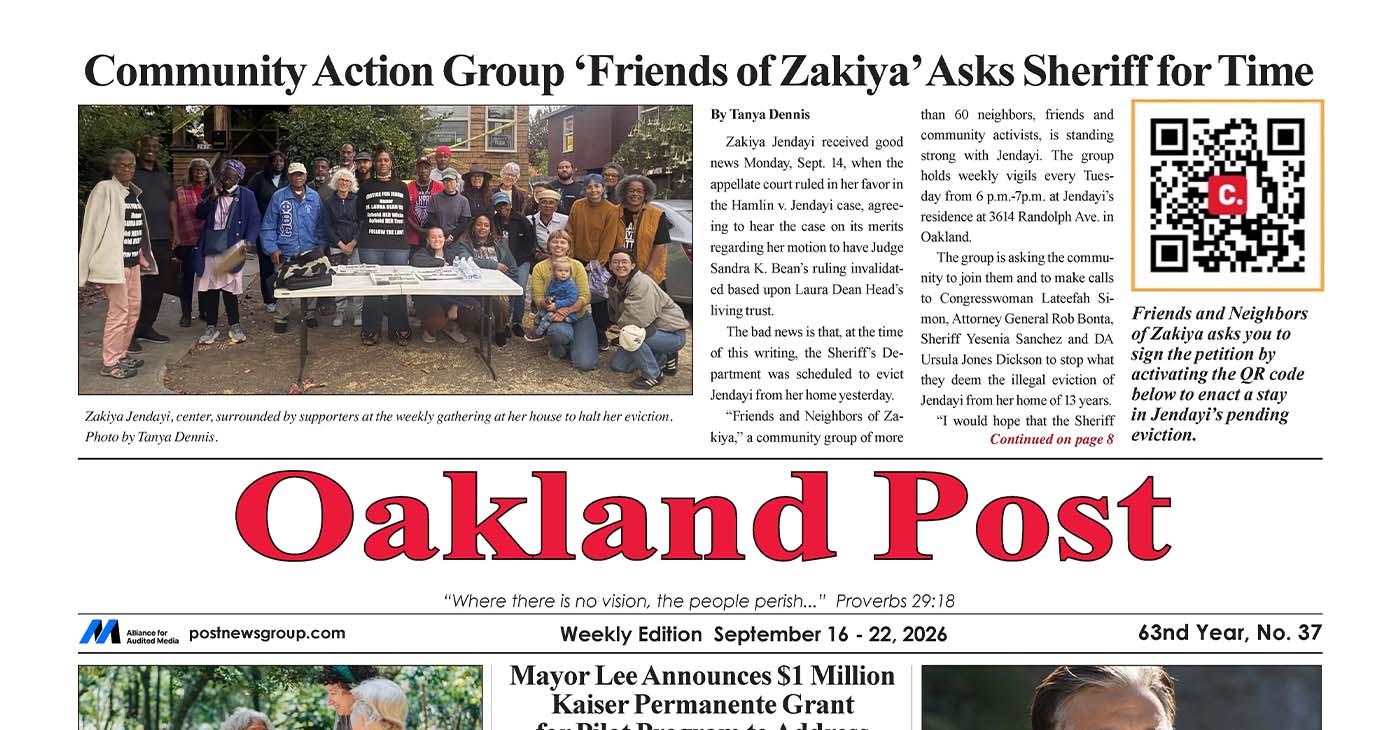
To enlarge your view of this issue, use the slider, magnifying glass icon or full page icon in the lower right corner of the browser window.
Activism
Oakland Post: Week of September 9 – 15, 2026
The printed Weekly Edition of the Oakland Post: Week of September 9 – 15, 2026

To enlarge your view of this issue, use the slider, magnifying glass icon or full page icon in the lower right corner of the browser window.
Activism
Oakland Post: Week of September 2 – 8, 2026
The printed Weekly Edition of the Oakland Post: Week of September 2 – 8, 2026
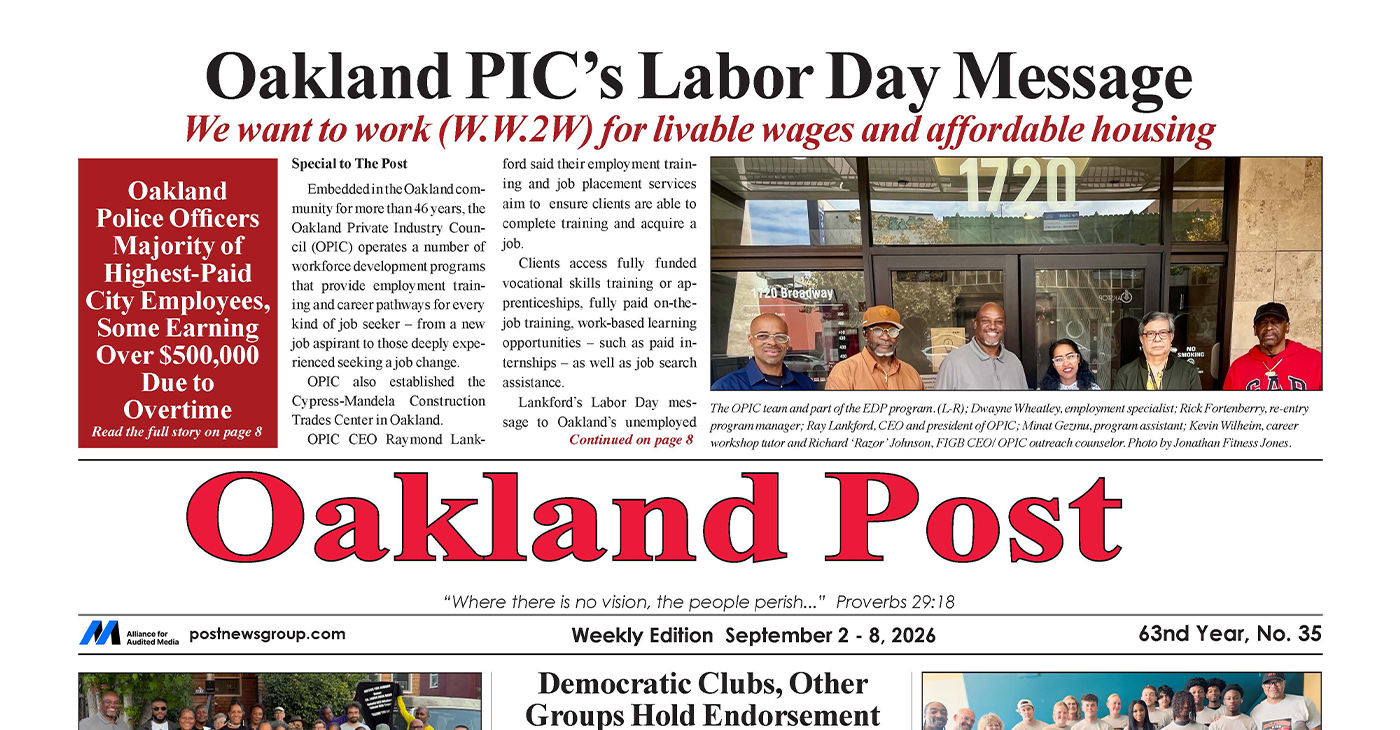
To enlarge your view of this issue, use the slider, magnifying glass icon or full page icon in the lower right corner of the browser window.



Doulas Are Helping Black California Moms Navigate Pregnancy–Even as High Mortality Rates Persist

Newsom Signs Addictive Social Media Law to Protect Kids

On Your November Ballot: Prop 38 Would Allocate $8.4 Billion to Immunology and Immunotherapy Funding

Ask California: Golden State Releases New AI Chatbot

Asm. Isaac Bryan’s Bill Banning California Police From ICE Side Jobs Reaches Newsom’s Desk

Assemblymember LaShae Sharp-Collins’s Bill Would Pause Law Enforcement’s Use of Shock Gloves Pending Study

BOOK REVIEW: ‘Laws of Solomon’ Reveals Tender Heart of Former Child Soldier

OPINION: The New American Fear – From 9-11 to AI

Passing for White, Fighting for Black America: The Courage of Walter White

Oakland People’s Arms Embargo Coalition Demands End to Military Shipments Thru Oakland

Barbara Lee Mourns Gloria Steinem, Remembers a Friendship Rooted in Equality

Event Preview: ‘Fashion v. Fascism’ – A Runway Revolution Is Coming to the Bay Area

Two Looming Threats Every Alameda County Elder Should Know About

Oakland Mayor Reads to Children at Bookout Block Party at Marcus Books Store

Tradition Comes to the Streets in 11th Annual Black-Eyed Pea Festival at the Freedom Farmers Market

Less Affluent School Districts, Including Sacramento City, Face Threat of State Takeover

ESSAY: California Can Close Its Colorectal Cancer Gap

California Hispanic Chambers of Commerce Unveils: ‘Powering the Future’ Theme for 47th Annual Statewide Convention

Four Candidates, Including Incumbent Barbara Lee, Qualify for Oakland Mayor’s Race

Oakland Post: Week of August 12 – 18, 2026

From Blueprint to Breakthrough: Tackling Affordable Housing in Oakland

Oakland Observes Black August with Block Parties, Film Showings, Workshops

COMMENTARY: Why Local School Tax Measure G1 Will Not Be on the November Ballot

Standoff for Justice: Our Homes Are Worth Fighting For

Returning to Its Roots, the Oakland Black-Eyed Pea Festival Partners with the Freedom Farmers Market Sept. 12

NPRC Scores First Advocacy Victory: David Shaw Finally Gets His Wish to ‘Go Home’

Oakland Post: Week of August 26 – September 1, 2026

Frontier Airlines’ Return to Oakland Airport Brings Flights, Jobs and Opportunity

Gubernatorial Candidate Steve Hilton Blasts California New Tire Rules; Newsom Hits Back

Chef Sharon Lee Blends Culinary Excellence, Education and Empowerment

The Conversation With Al McFarlane 6/23/26

Media Monday 6/22/26

LIVE! ASK ALMA! — TUES. 6.23.26 7PM EST

Car Buying Secrets: 4 Hidden Checks Before You Sign!

Is This 550 HP Charger Worth YOUR Money? AutoNetwork Review

Celebrating Juneteenth – Frederick Douglass on education and resistance

LIVE! — ASK ALMA! — TUES. 6.19.26 7PM EST

Hyundai Ioniq 5 Parking, Safety, and 360 View #shorts

2025 Ioniq 5 New Wiper & Powerful Performance! #shorts

Electric SUV Range: Is 259 Miles Enough? #shorts

EV Charging: How Fast Can You Charge an Electric Vehicle? #shorts

Biometric Cooling… Messaging Seats…Come on! 2025 Infiniti QX80 Autograph 4WD

Charged Up: Witness the Magic of a Fully Electric Car! #shorts

Range Rover Sport PHEV Included…: See What’s Inside This Luxury SUV! #shorts

Invisible Hood View: Perfect Parking with X-Ray Vision! #shorts
-
 Commentary4 weeks ago
Standoff for Justice: Our Homes Are Worth Fighting For
-
 Activism4 weeks ago
Oakland Post: Week of August 26 – September 1, 2026
-
 Business4 weeks ago
Frontier Airlines’ Return to Oakland Airport Brings Flights, Jobs and Opportunity
-
 Business4 weeks ago
Gubernatorial Candidate Steve Hilton Blasts California New Tire Rules; Newsom Hits Back
-
 Business4 weeks ago
Chef Sharon Lee Blends Culinary Excellence, Education and Empowerment
-

 Education4 weeks ago
Gov. Newsom’s Latest Appointees Include Sacramento Advocate for Formerly Incarcerated Students; State’s New Tech Chief
-

 Community4 weeks ago
Big City Mayors Ask for “Yes” Vote on Housing Bond Measure; Conservatives Say “No”
-

 Business4 weeks ago
Oakland Coliseum Project Opens Door for Small Businesses to Build Bigger
