
Activism
Tenants Protest Management Practices at New Oakland Veteran Housing
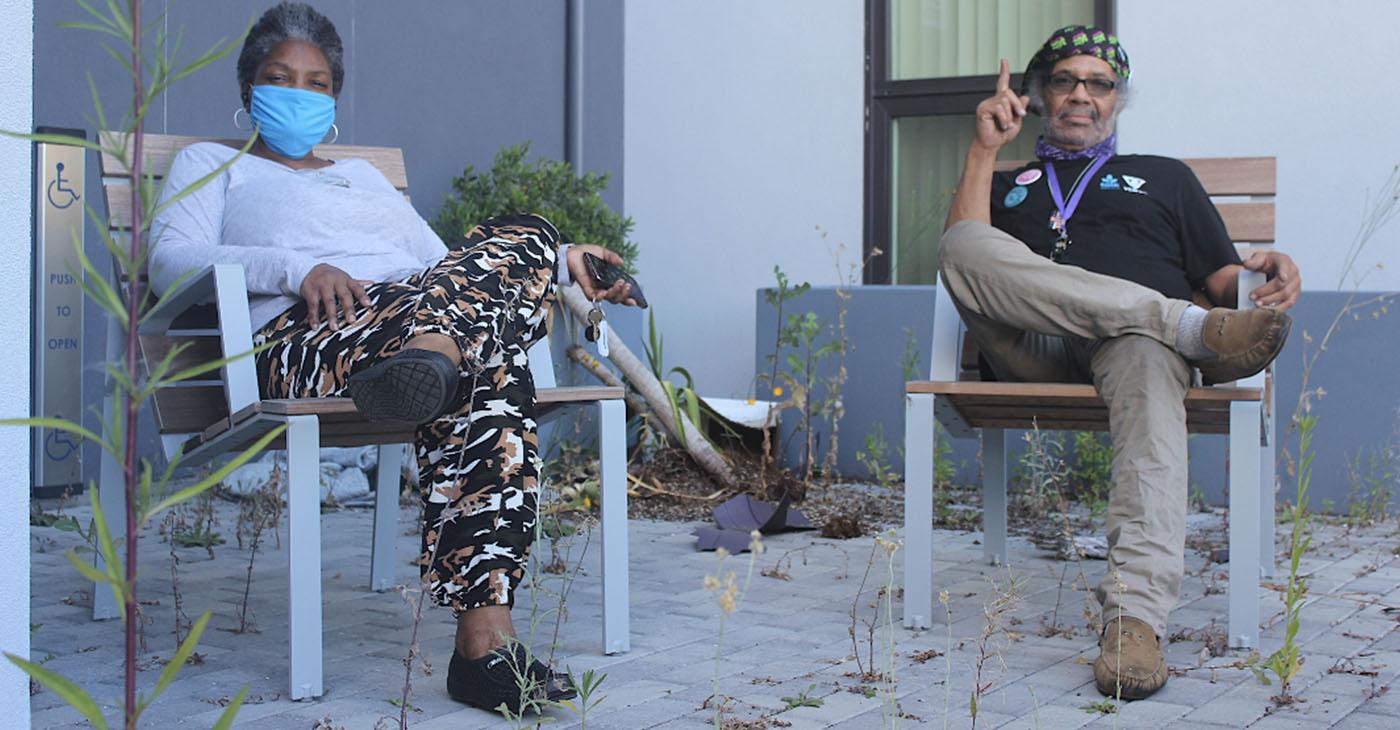
During visits this month, this reporter found the doors to common areas at Embark locked. When residents tried to open these doors, they were unsuccessful, with the exception of a second-floor balcony, which residents claim was recently reopened. That area was overgrown with weeds. Lyons stated the companies are now looking for a landscape vendor to clean up that area.

By Zack Haber
Since March of last year, tenants at Embark, an affordable apartment complex for veterans in Downtown Oakland, have been demanding that the companies that oversee and own their buildings address safety and habitability issues and provide residents with respectful management that is free of harassment.
“It’s such a nice building,” said tenant Deidre Robinson. “But they’re actively destroying it, and I don’t understand why.”
Robinson, along with most of her neighbors living in the 63-unit Veterans Affairs (VA) subsidized apartment complex that opened in early 2020, is a Black veteran. While Embark is publicly funded, it is privately owned and operated.
The San Francisco-based John Stewart Company, which oversees 372 buildings in California, serves as property manager while the Berkeley based non-profit, Resources for Community Development (RCD), owns the building. In addition to Embark, RCD owns 59 other affordable Bay Area properties.
After a period of homelessness and struggling with severe depression, Robinson has used VA services to secure stable employment and what she calls her “forever home” at Embark. Her new apartment made her “super happy” at first, but she no longer feels safe there.
She says she regularly encounters people who don’t live at Embark but enter the complex without permission.
“I take mace when I go to the laundry room,” said Robinson, “because I find hostile people there who don’t want to let me wash my clothes when they’re sleeping there.”
According to Robinson, she often finds human feces and urine in halls and stairways and her packages often go missing. She suspects people who break in are responsible for these problems and says management won’t investigate to find who is responsible, even though the complex contains security cameras in all common areas.
In an email representing a collaborative response from John Stewart Company and RCD, Communications and Marketing Director Lauren Lyons wrote that the companies “are aware of some incidents of loitering, package theft and public urination,” but that their staff “confront non-residents, monitor our security systems to prevent theft as much as possible, and have frequent janitorial/cleaning schedules.”
She also wrote they “provide footage to the local police whenever they conduct an investigation.”
During a tour of Embark that a tenant named Sergeant First Class (SFC) Rodney B Burton hosted on a weekday afternoon of this month, this reporter encountered food scraps on sticky dusty hallway floors while what appeared to be human feces lay in a stairway. A person walked through Embark’s unlocked front door who apologized and immediately left when SFC Burton confirmed he wasn’t a resident.
During nighttime visits, this reporter found a side fire exit door unlocked at Embark, allowing easy entrance to the building from the street.
In late 2020 and early 2021, Embark tenants began to organize to collectively address problems. They’ve sent two letters to John Stewart Company and RCD to express their grievances and list demands. In the first letter, sent in March 2021, they announced the formation of the Embark Veterans Tenants Association and wrote that “though our building is new…profit is being put before us tenants.”
They demanded that “all outstanding rent be zeroed out” due to the COVID-19 pandemic and asked that management regularly give rent and utility receipts to tenants so they can better keep track of their finances and hold the companies accountable for any errors. The demands related to finances came, in part, due to residents receiving notices they felt constituted harassment and intimidation.
“I’ve been harassed by managers” said SFC Burton, “and they intimidated some other veterans that constructively evicted themselves, even though there’s a moratorium on evictions.”
This reporter obtained two Notice to Pay Rent or Quit letters that John Stewart Company had sent to residents in August and July of 2020 which stated, “If you fail to either pay the total amount of rent due in full or return possession of the premises…you may be evicted.”
According to SFC Burton, a few of his neighbors felt intimidated and left after receiving such notices demanding payment that they couldn’t pay. At that time though, as well as now, an Oakland based eviction moratorium would have prevented John Stewart Company or RCD from winning any eviction case at Embark against a tenant for nonpayment of rent.
In an email to this reporter, Lyons, the companies’ spokesperson, wrote that in 2020 “Property managers sent notices to all RCD residents who had an unpaid balance on their account,” and also stated such notices included information about rental assistance. None of the notices from 2020 this reporter saw contained such info, but one notice from summer of last year listed contact info for agencies that help with rental assistance.
According to Oliver Yan, who worked as Resident Services Coordinator at Embark from its opening till fall of last year, the companies weren’t helping tenants’ efforts to secure rent relief during his tenure.
“I would actually argue they were working against those efforts,” Yan said.
Yan claims that the bulk of his job had been trying to get Embark tenants rent relief funds, but the process was “extremely frustrating,” in large part due to John Stewart Company’s “bad accounting practices.” Yan needed accurate accounting information to help tenants secure rent relief but often couldn’t obtain it due to the management and ownership’s resistance.
“John Stewart Company was actively fighting me,” he said, “and RCD was not helping.”
According to Embark tenants, accounting problems persist. On March 31, 24 members of Embark’s tenant union sent another letter of demands to the companies. Residents asked for full rent and utility receipts from March 2020 till the present time, which they say they still haven’t received. California Code of Civil Procedure requires any property owner to provide receipts to tenants for rent payments.
Additionally, Embark tenants objected in their March 31 letter to “community spaces,” such as shared social rooms and balconies, being “inaccessible for residents for the last two years,” even though they’d seen management using them.
According to Lyons “common areas are not currently closed” but had been closed “during the height of the pandemic.”
During visits this month, this reporter found the doors to common areas at Embark locked. When residents tried to open these doors, they were unsuccessful, with the exception of a second-floor balcony, which residents claim was recently reopened. That area was overgrown with weeds. Lyons stated the companies are now looking for a landscape vendor to clean up that area.
Tenants at Embark had formed their union in early 202, affiliating with Bay Area Tenants and Neighborhood Councils, a tenant union with over 500 members, also known as Bay Area TANC.
TANC and Embark residents held BBQs to help spread the word about tenant organizing. According to SFC Burton, over 40 people are now meeting every month to organize about Embark tenant issues, and they’ve had success getting rent and utility relief for many Embark residents.
“It’s been really fun to work with TANC, and efficient,” said SFC Burton. “Without organizing, I don’t even want to think about what would have happened.”
Juleon Robinson, a TANC member who has been organizing at the complex, feels he’s learned a lot from Embark tenants.
“I’ve learned about patience,” he said. “[SFC Burton] knows everyone in that building, and he’s checking in with them all the time. Relationships are so important for organizing.”
Embark is not the only John Stewart Company/RCD building where tenants have been organizing. Tenants at Fox Courts, a nearby complex with 80 apartments for low-income tenants, which John Stewart Company manages, and RCD owns, have also unionized, affiliating last year with TANC and forming the Fox Courts Tenant Council.
Fox Courts tenant Annie Coffin was motivated to organize because, while she had been happy when she moved into the then new complex in 2009, she thinks conditions at Fox Courts have worsened.
“When I first moved in this place was nice,” said Coffin. “But now you have to argue with management to get the base minimum of upkeep.”
Some of Coffin’s complaints about Fox Courts echo those at Embark. She says people break in and defecate or vomit in common areas. Packages go missing, and she says management and ownership don’t do anything to stop it. She’s also complained that management harassed her neighbors and those who visit her. In November 2021, Fox Court Tenant Council wrote a letter, which 36 tenants signed, demanding “regular maintenance of common space, immediate habitability repairs” and “accountable available and respectful management.” In April of this year, the union made 15 specific demands in another letter.
Unlike at Embark, John Stewart Company and RCD did formally respond to the Fox Courts letters. Lyons says the company has also “recently met with 23 [Fox Courts] households who attended a resident meeting.” According to Fox Court tenants, the companies have corrected some, but not all, of their concerns.
Meanwhile, at Embark, Deidre Robinson hopes John Stewart Company and RCD address the problems there and treat the complex “like the blessing that it is.”
“We just want someone who cares who comes in and out of the building,” she said, “and why they can’t open up the community rooms is beyond me. It’s almost like John Stewart Company is unaware this is a complex full of veterans.”







Activism
Oakland Post: Week of September 23 – 29, 2026
The printed Weekly Edition of the Oakland Post: Week of September 23 – 29, 2026

To enlarge your view of this issue, use the slider, magnifying glass icon or full page icon in the lower right corner of the browser window.
Activism
Oakland Post: Week of September 16 – 22, 2026
The printed Weekly Edition of the Oakland Post: Week of September 16 – 22, 2026

To enlarge your view of this issue, use the slider, magnifying glass icon or full page icon in the lower right corner of the browser window.
Activism
Oakland Post: Week of September 9 – 15, 2026
The printed Weekly Edition of the Oakland Post: Week of September 9 – 15, 2026

To enlarge your view of this issue, use the slider, magnifying glass icon or full page icon in the lower right corner of the browser window.



Asm. Corey Jackson Announces Launch of 24-Hour Childcare in His District

IN MEMORIAM: The Rev. Leon “Sonny” Clark, Longtime Orange County Pastor and Community Leader, Dies at 72

Poll: Becerra Widens His Lead Over Hilton; Californians Split on Wealth Tax

From Historic Memories to New Possibilities: Oakland Celebrates Coliseum 60

County Office of Education Says OUSD Finances Are Getting Healthier, Materially Stronger

LIVE FREE Sunday Dinner Brings Faith, Fellowship and Civic Conversation to Oakland

Remembering Chauncey Bailey as Student Journalists Face Threats to Truth-Telling

BLACspace Cooperative Invites Bay Area to Experience Oakland’s Black Cultural Ecosystem Through a BLAC Map Tour + Party

In Wake of Death on Doorstep, Williams Chapel Baptist Church Calls for Better Care, Funding for Unhoused

Oakland Centenarian Nuna McKee Honored!

Caribbean Nations Produce Action Plan Calling for UK Reparations Over Slavery

Oakland Post: Week of September 23 – 29, 2026

Doulas Are Helping Black California Moms Navigate Pregnancy–Even as High Mortality Rates Persist

Newsom Signs Addictive Social Media Law to Protect Kids

On Your November Ballot: Prop 38 Would Allocate $8.4 Billion to Immunology and Immunotherapy Funding

Standoff for Justice: Our Homes Are Worth Fighting For

Oakland Post: Week of August 26 – September 1, 2026

Frontier Airlines’ Return to Oakland Airport Brings Flights, Jobs and Opportunity

Gubernatorial Candidate Steve Hilton Blasts California New Tire Rules; Newsom Hits Back

Chef Sharon Lee Blends Culinary Excellence, Education and Empowerment

Jackie Wright Champions Bay Area Stories, Filmmakers and Cultural Institutions

Big City Mayors Ask for “Yes” Vote on Housing Bond Measure; Conservatives Say “No”

Oakland Coliseum Project Opens Door for Small Businesses to Build Bigger

Gov. Newsom’s Latest Appointees Include Sacramento Advocate for Formerly Incarcerated Students; State’s New Tech Chief

Misnamed ‘Parent’ PAC Seeks to Influence Oakland School Board Elections

Longtime BWOPA Member Brendalyn Goodall Appointed to California Workforce Development Board

Gov. Newsom Signs Law Shielding Immigration Aid Workers From Doxing Threats

Secretary of State Shirley N. Weber Urges Californians to Vote Early as Voter ID Battle Intensifies

From Palestine to Oakland: Seeds for Liberation Examines Shared Struggles for Freedom

IN MEMORIAM: Dolly Parton Dead at 80 — How She Built a Legacy of Love and Earned Her Place in Black Culture

The Conversation With Al McFarlane 6/23/26

Media Monday 6/22/26

LIVE! ASK ALMA! — TUES. 6.23.26 7PM EST

Car Buying Secrets: 4 Hidden Checks Before You Sign!

Is This 550 HP Charger Worth YOUR Money? AutoNetwork Review

Celebrating Juneteenth – Frederick Douglass on education and resistance

LIVE! — ASK ALMA! — TUES. 6.19.26 7PM EST

Hyundai Ioniq 5 Parking, Safety, and 360 View #shorts

2025 Ioniq 5 New Wiper & Powerful Performance! #shorts

Electric SUV Range: Is 259 Miles Enough? #shorts

EV Charging: How Fast Can You Charge an Electric Vehicle? #shorts

Biometric Cooling… Messaging Seats…Come on! 2025 Infiniti QX80 Autograph 4WD

Charged Up: Witness the Magic of a Fully Electric Car! #shorts

Range Rover Sport PHEV Included…: See What’s Inside This Luxury SUV! #shorts

Invisible Hood View: Perfect Parking with X-Ray Vision! #shorts
-
 Community3 weeks ago
Misnamed ‘Parent’ PAC Seeks to Influence Oakland School Board Elections
-

 Activism4 weeks ago
Oakland Post: Week of September 2 – 8, 2026
-

 Community3 weeks ago
Richmond Tiny House Village Farm & Garden Set to Open Gates on Sept. 26
-

 Activism3 weeks ago
Oakland Post: Week of September 9 – 15, 2026
-

 Black History3 weeks ago
Latest Massacre in Haiti Reveals Cruelty U.S. Deportations
-

 Black History3 weeks ago
OPINION: Nolan Wells’ Death One of Several Signifying Racial Terror Lives on in U.S. South
-

 Community3 weeks ago
Democratic Clubs Interview Candidates for Oakland School Board
-

 Business2 weeks ago
Mayor Lee Announces $1 Million Kaiser Permanente Grant for Pilot Program to Address Homelessness, Clean Up Public Spaces throughout Oakland
