
Activism
Teachers and Port of Oakland Workers Strike Friday Against School Closures and Billionaire Fisher’s Port Deal
The Oakland administration and school board have rushed to close schools ignoring its own policy and contract commitments to implement its commitments to confer with parents, teachers and the public about its proposals. Rather than “engage” with school communities, the school closures are being planned in concert with state leaders and their representatives, Alameda County Schools’ Supt. L.K. Monroe and the Fiscal Crisis Management and Assistance Team (FCMAT).

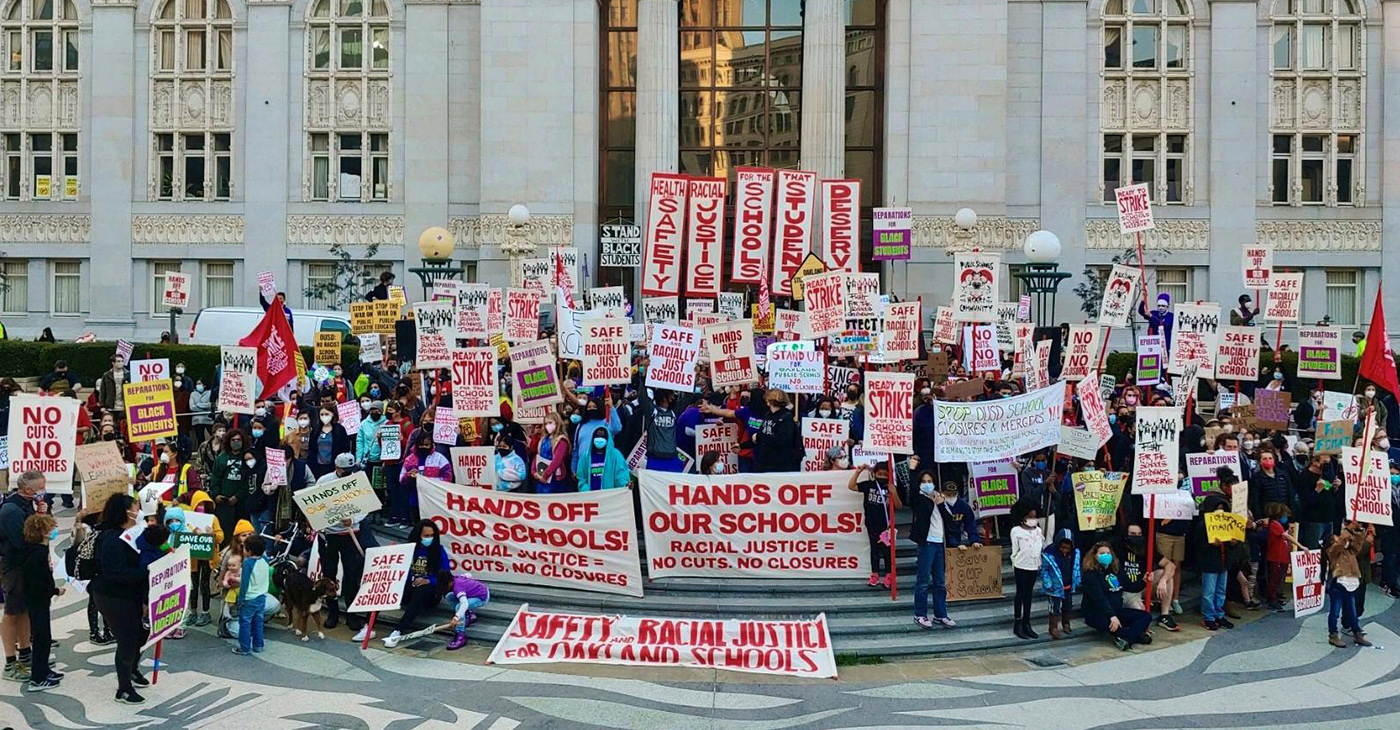
OUSD Supt. Johnson-Trammell says teacher strike is “illegal” but urges students to stay home on Friday
By Ken Epstein
Oakland educators and Port of Oakland longshore workers are holding simultaneous one-day strikes on Friday as a city-wide movement continues to grow in response to billionaires and gentrifiers backed by elected Democrats seeking to close as many as half of the city’s public schools and give away public funds and public land to build a $12-billion real estate deal and baseball stadium at the Port.
The strikes, as well as rallies and a march, were proposed by a new coalition, Schools and Labor Against Privatization (S.L.A.P.) composed of rank and file educators, members and leaders of ILWU Local and community members to oppose the privatization of public assets and the accelerated displacement of Oakland’s Black, Latino and working class residents.
Keith Brown, president of the Oakland Education Association (OEA), announced the educators’ work stoppage at a press conference on Tuesday. He said an overwhelming 75% of OEA voting members voted to authorize the one-day strike “because the Oakland Unified School District has unilaterally set aside its 2019 agreement with OEA to engage with families when considering school closures. OUSD has continued to ignore this important agreement despite the outcry from families to stop school closures.”
Trent Willis, past president International Longshore and Warehouse Union (ILWU) Local 10 said the union moved its annual May Day stop-work meeting from Sunday to Friday so both unions could join together to protest privatization of public resources.
Willis said that longshore workers and school communities are facing the same opponents.
“We have in common the same billionaire, John Fisher, also a funder of KIPP and Rocketship charter schools, who is trying to privatize our schools and our ports,” he said. “Howard Terminal is key to our Port infrastructure and crucial as an economic engine of the Bay Area. It is a nexus between the port cargo area, ILWU training area, and ship turn around. It is critical to keeping trucks off of the streets of West Oakland and is next to a fully functioning industrial railroad.
“Already the (public) price tag for building the luxury condos and A’s stadium is $1.3 million, (and) they want to close down Oakland’s public schools? Not on our watch,” he said.
Willis added, “The ILWU is really excited about this coalition, Schools and Labor Against Privatization — in fact SLAP is urging similar committees against privatization around the country.”
OEA President Brown said that the strike is taking place because educators are taking “the next step to stop school closures that will displace thousands of students and disproportionately impact Black students in Oakland. Educators say that they (have) had enough. We have authorized a one-day ULB (Unfair Labor Practices) strike to let the district know that the refusal to honor agreements and to have meaningful conversations about how these school closures will impact communities of color is unacceptable.”
“This plan to close schools in predominantly Black and Brown neighborhoods will accelerate charter growth and gentrification, leading to more educational segregation and a financial drain. That already costs Oakland Public Schools $57 million annually,” he said.
“We call on our elected officials to provide students and schools with the support that they need — instead of closing our schools — and stop the disruption and dislocation of our students. Closing schools does not save money. Our students need more, not less.”
He said that on April 29, teachers are picketing at all OUSD school sites at 6:30 a.m. Other actions that are taking place during the day include a rally at Oscar Grant Plaza at Oakland City Hall and a march to the OUSD headquarters at 1000 Broadway.
The Oakland administration and school board have rushed to close schools ignoring its own policy and contract commitments to implement its commitments to confer with parents, teachers and the public about its proposals. Rather than “engage” with school communities, the school closures are being planned in concert with state leaders and their representatives, Alameda County Schools’ Supt. L.K. Monroe and the Fiscal Crisis Management and Assistance Team (FCMAT).
OUSD has already closed about 20 schools since 2003. This year and next year, the district is planning to close about 12 more schools. Officials have said repeatedly that OUSD should ultimately shut down about half of its 80 public schools.
Joining in the strike are school workers in AFCME and SEIU 102. A representative of the Alameda Labor Council spoke at the OEA press conference, backing the unions.
OUSD Supt. Kyla Johnson Trammell denounced the strike as an “illegal” work stoppage and urged parents and guardians not to send their children to school on Friday.
“While school buildings will be open on Friday and all employees are still required to come to work, we do not believe that we’ll be able to cover the high number of expected staff absences with substitutes or reassigned central office staff,” she said. “Therefore, we are asking all families not to send their children to school on Friday. The absence will be excused, and no student will be adversely impacted by not attending school that day.”













Activism
Oakland Post: Week of September 23 – 29, 2026
The printed Weekly Edition of the Oakland Post: Week of September 23 – 29, 2026

To enlarge your view of this issue, use the slider, magnifying glass icon or full page icon in the lower right corner of the browser window.
Activism
Oakland Post: Week of September 16 – 22, 2026
The printed Weekly Edition of the Oakland Post: Week of September 16 – 22, 2026

To enlarge your view of this issue, use the slider, magnifying glass icon or full page icon in the lower right corner of the browser window.
Activism
Oakland Post: Week of September 9 – 15, 2026
The printed Weekly Edition of the Oakland Post: Week of September 9 – 15, 2026

To enlarge your view of this issue, use the slider, magnifying glass icon or full page icon in the lower right corner of the browser window.



Asm. Corey Jackson Announces Launch of 24-Hour Childcare in His District

IN MEMORIAM: The Rev. Leon “Sonny” Clark, Longtime Orange County Pastor and Community Leader, Dies at 72

Poll: Becerra Widens His Lead Over Hilton; Californians Split on Wealth Tax

From Historic Memories to New Possibilities: Oakland Celebrates Coliseum 60

County Office of Education Says OUSD Finances Are Getting Healthier, Materially Stronger

LIVE FREE Sunday Dinner Brings Faith, Fellowship and Civic Conversation to Oakland

Remembering Chauncey Bailey as Student Journalists Face Threats to Truth-Telling

BLACspace Cooperative Invites Bay Area to Experience Oakland’s Black Cultural Ecosystem Through a BLAC Map Tour + Party

In Wake of Death on Doorstep, Williams Chapel Baptist Church Calls for Better Care, Funding for Unhoused

Oakland Centenarian Nuna McKee Honored!

Caribbean Nations Produce Action Plan Calling for UK Reparations Over Slavery

Oakland Post: Week of September 23 – 29, 2026

Doulas Are Helping Black California Moms Navigate Pregnancy–Even as High Mortality Rates Persist

Newsom Signs Addictive Social Media Law to Protect Kids

On Your November Ballot: Prop 38 Would Allocate $8.4 Billion to Immunology and Immunotherapy Funding

Standoff for Justice: Our Homes Are Worth Fighting For

Oakland Post: Week of August 26 – September 1, 2026

Frontier Airlines’ Return to Oakland Airport Brings Flights, Jobs and Opportunity

Gubernatorial Candidate Steve Hilton Blasts California New Tire Rules; Newsom Hits Back

Chef Sharon Lee Blends Culinary Excellence, Education and Empowerment

Jackie Wright Champions Bay Area Stories, Filmmakers and Cultural Institutions

Big City Mayors Ask for “Yes” Vote on Housing Bond Measure; Conservatives Say “No”

Gov. Newsom’s Latest Appointees Include Sacramento Advocate for Formerly Incarcerated Students; State’s New Tech Chief

Oakland Coliseum Project Opens Door for Small Businesses to Build Bigger

Misnamed ‘Parent’ PAC Seeks to Influence Oakland School Board Elections

Longtime BWOPA Member Brendalyn Goodall Appointed to California Workforce Development Board

Gov. Newsom Signs Law Shielding Immigration Aid Workers From Doxing Threats

Secretary of State Shirley N. Weber Urges Californians to Vote Early as Voter ID Battle Intensifies

From Palestine to Oakland: Seeds for Liberation Examines Shared Struggles for Freedom

IN MEMORIAM: Dolly Parton Dead at 80 — How She Built a Legacy of Love and Earned Her Place in Black Culture

The Conversation With Al McFarlane 6/23/26

Media Monday 6/22/26

LIVE! ASK ALMA! — TUES. 6.23.26 7PM EST

Car Buying Secrets: 4 Hidden Checks Before You Sign!

Is This 550 HP Charger Worth YOUR Money? AutoNetwork Review

Celebrating Juneteenth – Frederick Douglass on education and resistance

LIVE! — ASK ALMA! — TUES. 6.19.26 7PM EST

Hyundai Ioniq 5 Parking, Safety, and 360 View #shorts

2025 Ioniq 5 New Wiper & Powerful Performance! #shorts

Electric SUV Range: Is 259 Miles Enough? #shorts

EV Charging: How Fast Can You Charge an Electric Vehicle? #shorts

Biometric Cooling… Messaging Seats…Come on! 2025 Infiniti QX80 Autograph 4WD

Charged Up: Witness the Magic of a Fully Electric Car! #shorts

Range Rover Sport PHEV Included…: See What’s Inside This Luxury SUV! #shorts

Invisible Hood View: Perfect Parking with X-Ray Vision! #shorts
-
 Community2 weeks ago
Misnamed ‘Parent’ PAC Seeks to Influence Oakland School Board Elections
-

 Activism3 weeks ago
Oakland Post: Week of September 2 – 8, 2026
-

 Community2 weeks ago
Richmond Tiny House Village Farm & Garden Set to Open Gates on Sept. 26
-

 Black History2 weeks ago
OPINION: Nolan Wells’ Death One of Several Signifying Racial Terror Lives on in U.S. South
-

 Black History2 weeks ago
Latest Massacre in Haiti Reveals Cruelty U.S. Deportations
-

 Activism2 weeks ago
Oakland Post: Week of September 9 – 15, 2026
-

 Community2 weeks ago
Democratic Clubs Interview Candidates for Oakland School Board
-

 Featured2 weeks ago
‘Ready to See These Bills Become Law’: Sen. Weber’s Package of 15 Bills Advance to Gov. Newsom’s Desk
