
Government
Supreme Court Hears Arguments on Maryland, North Carolina Redistrict Challenges
THE AFRO — For the second time in as many years, the Supreme Court heard arguments on partisan redistricting cases from Maryland and North Carolina Tuesday, but it remains unclear whether a constitutional standard for regulating the practice will be issued.

By Carolina Velloso
WASHINGTON – For the second time in as many years, the Supreme Court heard arguments on partisan redistricting cases from Maryland and North Carolina Tuesday, but it remains unclear whether a constitutional standard for regulating the practice will be issued.
North Carolina’s entire congressional map is being contested, which is currently made up of 10 Republicans and three Democrats despite the state being almost evenly split politically.
At issue in Maryland is the state’s 6th Congressional District. Democratic lawmakers are accused of moving Republican voters out of the district that covers most of the state’s rural Northwest and putting in large numbers of Democratic voters from the Washington suburbs in order to turn the district blue.
The justices seemed to be split evenly down philosophical lines, with the more liberal wing of the court encouraging the deliberation of a manageable standard to apply to future questions of gerrymandering, while the conservative wing seeming wary of intervening in a process left largely to the states.
The question, said Chief Justice John Roberts, is whether “any partisanship that has a consequence is impermissible.”
The conservative justices pointed out dozens of times that the Constitution does not require proportional representation — the idea that the percentage of seats awarded to any party should correspond with the percentage of votes it won in the states.
Michael A. Kimberly, attorney for the voters challenging Maryland’s 6th District, said that proportional consideration should be considered when debating a possible constitutional standard. He argued that “it is a legitimate state interest to pursue proportional representation in redistricting.”
Justice Samuel Alito wondered whether “the First Amendment might require or even tolerate the regulation of speech, and in this instance, the speech is the votes, for the purpose of providing a proportional representation of viewpoints.”
The justices repeatedly asked counsel for the appellees for a test that would appropriately determine which cases of gerrymandering were so extremely partisan that they crossed a constitutional line.
The conservative justices, however, did not seem to find a suitable measure that could determine when an innately political process became too political.
“Is another way…of putting the test: I know it when I see it?” Justice Neil Gorsuch asked derisively.
The court’s liberal justices pushed back, saying the problem of extreme partisan gerrymandering had gotten out of control and seemed willing to conceive of some sort of regulatory measure.
Justice Elena Kagan characterized “the court leaving this all to professional politicians who have an interest in redistricting according to their own partisan interests” as “dramatically wrong.”
Another concern expressed by the conservative justices was the possibility that the judicial branch would essentially become the arbiter of elections should the court get involved in setting a standard for redistricting.
The gerrymandering of Maryland’s 6th District, which was at issue in Lamone v. Benisek, was unique in that the map in question had been put to a referendum and was approved by 64 percent of voters.
Gorsuch still seemed hesitant to judicially intervene.
“So, in effect, you are asking the court, no matter how good the referendum might be, no matter how much the people themselves might approve these lines, this court has to tell them it — it’s unconstitutional?” Gorsuch asked counsel for the appellees.
Justice Stephen Breyer proposed a standard that would only catch the “extreme outliers,” so that not every single election would be judicially contested.
“What I’m trying to do is to figure out if there’s a way to catch real outliers,” he said, so that it would not “lead to every election contested and throw it all to the judges instead of the people.“
Breyer said he considers a scenario where a party wins a majority of the statewide vote but the minority party wins two-thirds of the state’s congressional seats to be “pretty extreme.”
Breyer thus proposed a mathematical standard whereby congressional election results would be re-examined if one party won a majority of the statewide vote but one-third or less of the congressional seats.
Steven M. Sullivan, the solicitor general of Maryland and representative of the appellant, seemed doubtful that a formula that would only catch extreme outliers for review is unrealistic.
“If you’re concerned about limiting the Court’s intervention to the extreme circumstance,” he said, “you would not be limiting it to extreme. You would be saying ‘get ready, Arkansas, Kansas, Massachusetts, Oklahoma, Alabama, Kentucky, Tennessee.’”
The court is expected to issue a decision on whether to keep the drawing of congressional district maps in the hands of the states by July.
This article originally appeared in The Afro.





Activism
Oakland Post: Week of April 1 – 7, 2026
The printed Weekly Edition of the Oakland Post: Week of April 1 – 7, 2026

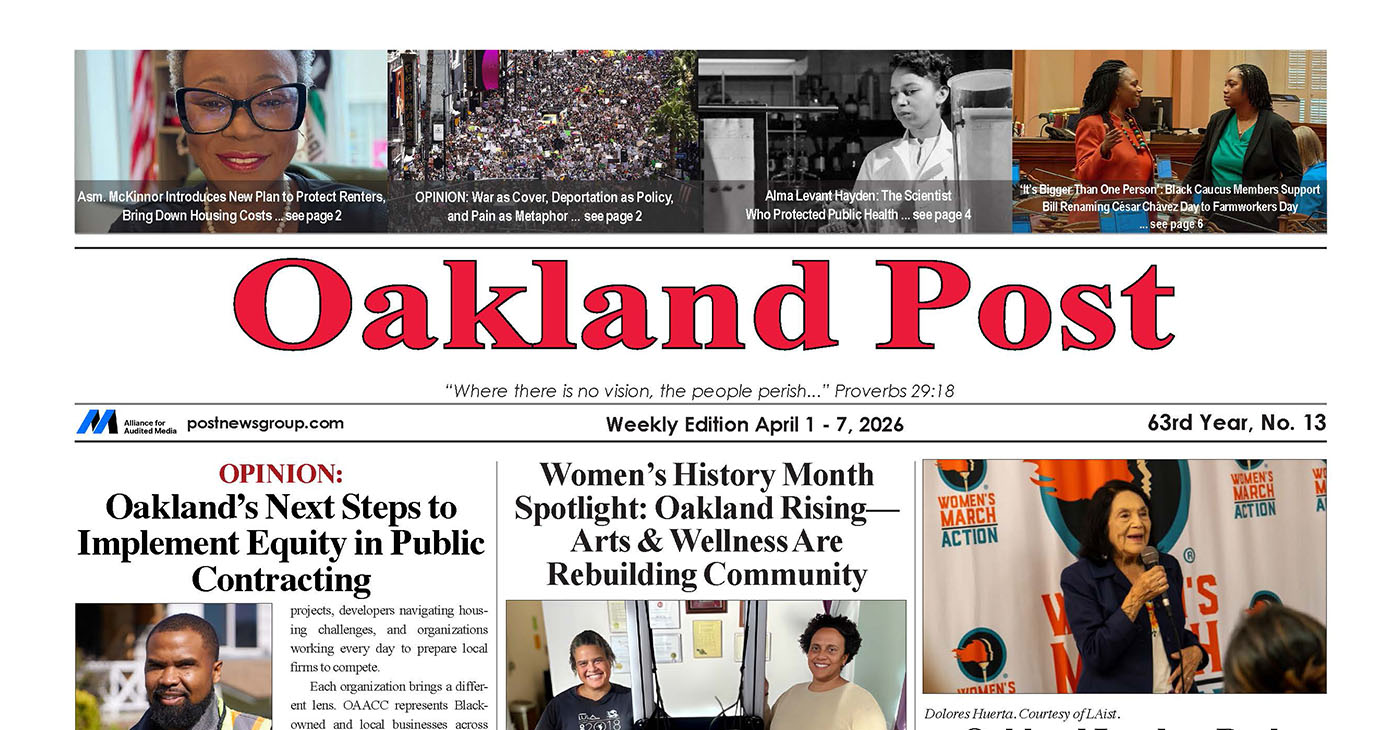
To enlarge your view of this issue, use the slider, magnifying glass icon or full page icon in the lower right corner of the browser window.

Activism
Oakland Post: Week of March 18 – 24, 2026
The printed Weekly Edition of the Oakland Post: Week of March 18 – 24, 2026

To enlarge your view of this issue, use the slider, magnifying glass icon or full page icon in the lower right corner of the browser window.
Activism
Oakland Post: Week of March 11 -17, 2026
The printed Weekly Edition of the Oakland Post: Week of March 11 – 17, 2026
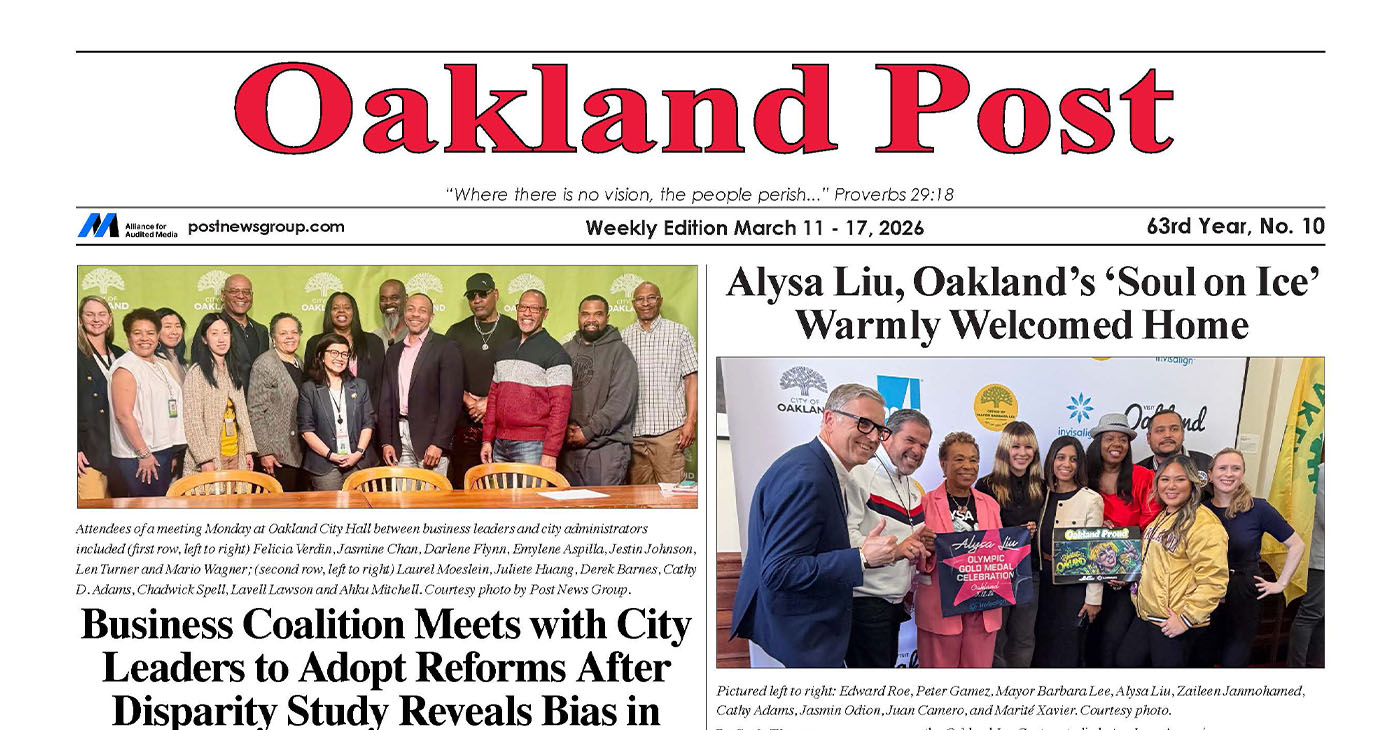
To enlarge your view of this issue, use the slider, magnifying glass icon or full page icon in the lower right corner of the browser window.


WORK FROM HOME
Home-based business with potential monthly income of $10K+ per month. A proven training system and website provided to maximize business effectiveness. Perfect job to earn side and primary income. Contact Lynne for more details: Lynne4npusa@gmail.com 800-334-0540


Oakland Post: Week of April 1 – 7, 2026

Black Artists in America, Installation Three Wraps at the Dixon Gallery and Gardens

Grief, Advocacy, and Education: A Counselor Reflects on Black Maternal Health

Future of Florida’s Black History Museum in Limbo

New Research Shows the Many Benefits of Early Learning

South Hampton K-8 Students Among Top 10 Finalists for Samsung’s ‘Solve for Tomorrow’ Competition

Cuba: No Negotiation with US on the President or Political System

Brooklyn Academy of Music Names Jamaican-Born Tamara McCaw as President

Trinidad & Tobego – U.S. Launches WhatsApp Channel for American Citizens in the Country

Oakland Post: Week of March 18 – 24, 2026

AI Innovation vs. Ethics and Environmental Impact

AI, Web3, and Digital Reparations

What If You Owned Your AI Agent?

Season 7, Episode 3 – January Reporter’s Roundtable 📱

Season 7, Episode 3 – January Reporter’s Roundtable

Reflecting on Black History Milestones in Birmingham AL

Oakland Post: Week of February 25 – March 3, 2026

PRESS ROOM: NBA Hall of Fame Nominee Terry Cummings Joins 100 Black Men of DeKalb County to Launch Victory & Values Initiative

Trump’s MAGA Allies are Creating Executive Order Plan to Steal the 2026 Midterms

Oakland Post: Week of March 4 – 10, 2026

U.S. manufacturing rebounds – how foundry services are adapting to rising demand

Poll Shows Support for Policies That Help Families Afford Child Care

OP-ED: One Hundred Years of Black Workers Telling the Truth

Advancements in solar technology that are changing the way we power the world

Oakland Post: Week of March 11 -17, 2026

Woman’s Search for Family’s Roots Leads to Ancestor John T. Ward – A Successful Entrepreneur and Conductor on the Underground Railroad
Oakland Post: Week of March 18 – 24, 2026

COMMENTARY: Women of Color Shape Our Past and Future

PRESS ROOM: Civil Rights TV Launches in Selma as the World’s First 24/7 Civil Rights Television Network

OP-ED: NNPA Launches 2026 “Leadership Matters” Video Series

Hyundai Ioniq 5 Parking, Safety, and 360 View #shorts

2025 Ioniq 5 New Wiper & Powerful Performance! #shorts

Electric SUV Range: Is 259 Miles Enough? #shorts

EV Charging: How Fast Can You Charge an Electric Vehicle? #shorts

Biometric Cooling… Messaging Seats…Come on! 2025 Infiniti QX80 Autograph 4WD

Charged Up: Witness the Magic of a Fully Electric Car! #shorts

Range Rover Sport PHEV Included…: See What’s Inside This Luxury SUV! #shorts

Invisible Hood View: Perfect Parking with X-Ray Vision! #shorts

AI Is Reshaping Black Healthcare: Promise, Peril, and the Push for Improved Results in California

ESSAY: Technology and Medicine, a Primary Care Point of View

Sanctuary Cities

The RESISTANCE – FREEDOM NOW

STATE OF THE PEOPLE: Freddie

ECONOMIC BOYCOTT DAY!!!!!

I told You So
-
 Activism3 weeks ago
Oakland Post: Week of March 11 -17, 2026
-
 #NNPA BlackPress4 weeks ago
Woman’s Search for Family’s Roots Leads to Ancestor John T. Ward – A Successful Entrepreneur and Conductor on the Underground Railroad
-
 Activism2 weeks ago
Oakland Post: Week of March 18 – 24, 2026
-
 #NNPA BlackPress4 weeks ago
COMMENTARY: Women of Color Shape Our Past and Future
-

 Advice3 weeks ago
Financial Wellness and Mental Health: Managing Money Stress in College
-

 #NNPA BlackPress4 weeks ago
Advocates Raise Alarm Over ICE Operation, MOU and Detention Risks in Baltimore County
-

 #NNPA BlackPress4 weeks ago
Pete Buttigieg to Join Mayor Randall Woodfin for Community Town Hall in Birmingham
-
 #NNPA BlackPress2 weeks ago
Brooklyn Academy of Music Names Jamaican-Born Tamara McCaw as President
