
Activism
State, Local Officials Take Actions to Tackle Homelessness Crisis
“California’s housing affordability crisis has been more than a half century in the making and the state is tackling this foundational challenge with an innovative ‘all of the above’ approach,” said Governor Gavin Newsom. “We’ve made unprecedented investments and progress to create more housing in California over the past four years, including using state-owned land to build homes – one of my first actions in 2019.


By Aldon Thomas Stiles | California Black Media
As the California’s growing homelessness crisis continues to rise, state and local officials are serious about tackling it head on.
Last month, Gov. Gavin Newsom signed legislation related to solving this issue.
Over $15.3 billion has been budgeted in housing programs aimed at curtailing California’s homeless.
“State and federal resources have certainly made a difference in our communities,” said Bakersfield Mayor Karen K. Goh. “You know, going back to 2020 and 2021 with the CARES (Coronavirus Aid, Relief and Economic Security) Act and then followed by the American Rescue Plan Act (ARPA), the dollars are making their way to our citizens.”
Goh also pointed to Project Homekey as a program that has helped alleviate homelessness.
“Project Homekey resources are being used to transform underutilized motels and hotels into safe shelter in our communities,” said Goh.
The COVID-19 pandemic played a significant role in the rise of homelessness, from 150,000 in 2019 to 161,000 in 2020, according to the U.S. Department of Housing and Urban Development.
The African American population in California has suffered disproportionately from this crisis.
The California Budget and Policy Center reports that Black people are roughly 25% of the state’s homeless although they make up about 5.5% of California’s population.

Some of the funding the state provided went to the Community Assistance, Recovery and Empowerment Court — or CARE Court, a program that diverts homeless people with severe mental health problems away from the criminal justice system and into mandatory treatment.
Signed into law on September 14, the CARE Court Act, Senate Bill 1338 which was introduced by Sen. Thomas Umberg (D-Santa Ana) and Sen. Susan Talamantes Eggman (D-Stockton) focuses on untreated individuals suffering from psychotic disorders, such as schizophrenia.
Bills that Newsom signed on affordable housing include Senate Bill 561 by State Sen. Bill Dodd (D-Napa), Assembly Bill (AB) 2233 by Assemblymember Sharon Quirk-Silva (D-Fullerton), and AB 2592 by Assemblymember Kevin McCarty (D-Sacramento).
“This historical package will go a long way towards increasing affordable production in California,” Quirk-Silva tweeted.
Together, these bills require the California Department of Housing and Community Development (HCD) and the California Department of General Services (DGS) to codify and expand the Excess Land for Affordable Housing program, a state initiative born from the governor’s first executive order.
“California’s housing affordability crisis has been more than a half century in the making and the state is tackling this foundational challenge with an innovative ‘all of the above’ approach,” Newsom said. “We’ve made unprecedented investments and progress to create more housing in California over the past four years, including using state-owned land to build homes – one of my first actions in 2019.
“I’m thankful to Senator Dodd, Assemblymember Quirk-Silva, and Assemblymember McCarty for their efforts in helping us fast-track our progress and bring more affordable housing statewide.”
Goh spoke about funding transparency.
“We’re seeing new innovation in our cities with these resources going to fund new city departments that help ensure that the city is accountable with the dollars they receive for addressing homelessness, and to better enable the city to show the public how they’re using these resources and the difference that they are making,” said Goh.
Mayor Todd Gloria of San Diego spoke about work that is being done on the local level to fight homelessness. “Our housing commission has put out over $200 million of assistance, helping roughly about 80,000 families at this point avoid homelessness, many of them seniors.” he said.
Gloria said that due to the federal government raising and lowering interest rates fighting this crisis sometimes “feels like you’re swimming upstream.”
He claimed that tackling minimum wage or advocating in the state capitol or Wash., D.C., are ways that local governments can have control over solving homelessness.
“You know, these are never satisfying answers because, yes, there are a bunch of things at work. But we get up every day and come here to try and make a difference on those matters,” said Gloria.
On October 3, Newsom signed Quirk-Silva’s AB 408 which requires local educational agencies to have a liaison for homeless youths so that the agencies can learn how to best support them.
Newsom recently announced that he will convene local leaders in mid-November to review the state’s collective approach to homelessness and identify new strategies.












Activism
Oakland Post: Week of August 5 – 11, 2026
The printed Weekly Edition of the Oakland Post: Week of August 5 – 11, 2026
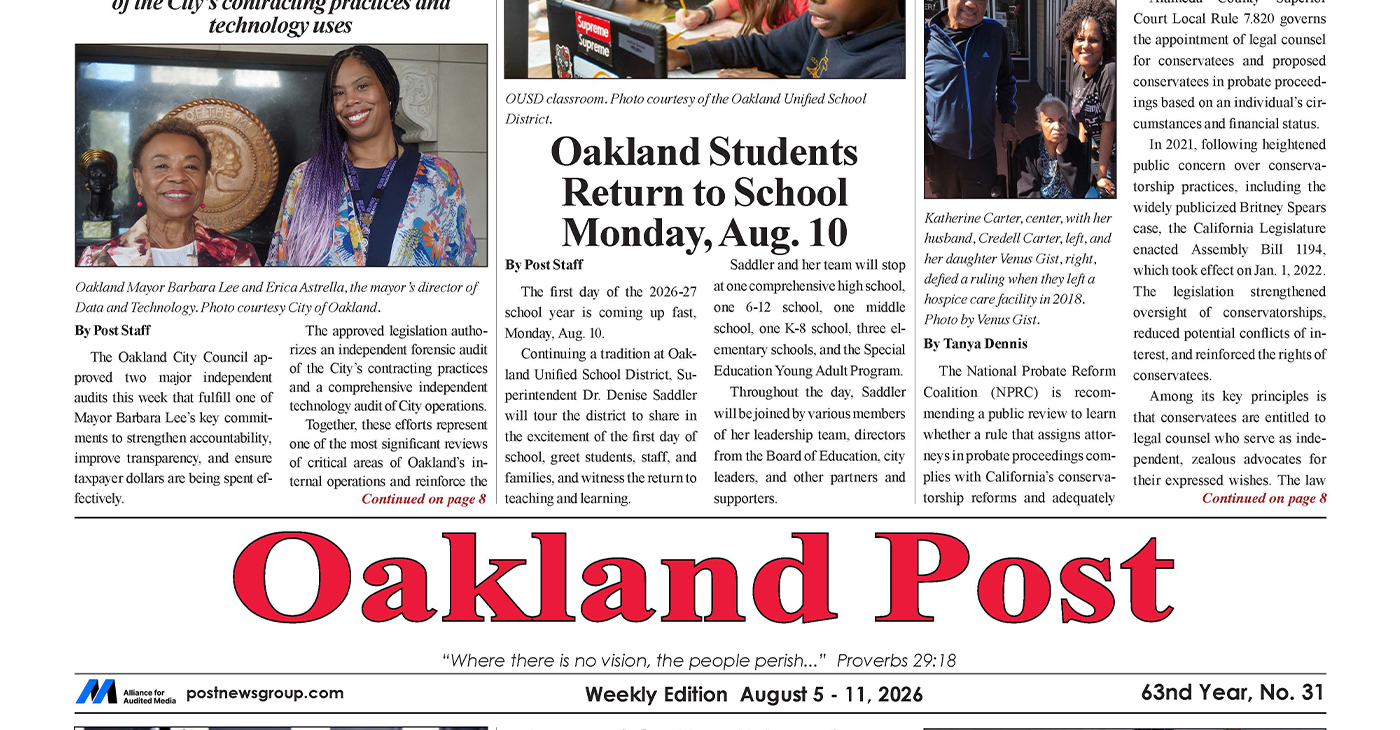
To enlarge your view of this issue, use the slider, magnifying glass icon or full page icon in the lower right corner of the browser window.
Activism
Oakland Post: Week of July 29 – August 4, 2026
The printed Weekly Edition of the Oakland Post: Week of July 29 – August 4, 2026

To enlarge your view of this issue, use the slider, magnifying glass icon or full page icon in the lower right corner of the browser window.
Activism
Oakland Post: Week of July 22 – 28, 2026
The printed Weekly Edition of the Oakland Post: Week of July 22 – 28, 2026

To enlarge your view of this issue, use the slider, magnifying glass icon or full page icon in the lower right corner of the browser window.

WORK FROM HOME
Home-based business with potential monthly income of $10K+ per month. A proven training system and website provided to maximize business effectiveness. Perfect job to earn side and primary income. Contact Lynne for more details: Lynne4npusa@gmail.com 800-334-0540


Car Wash Workers Cope with Lingering Impacts of ICE Raids

Misty Copeland Shapes Ballet’s Tomorrow

As Part of Your Back-to- School Checklist, Vaccinate

As Part of Your Back-to- School Checklist, Vaccinate

Congresswoman Simon Demands Investigation into Trump’s Abuse of Emergency Powers for Coal Export Terminal in West Oakland

OPINION: The Philippines Isn’t Foreign When Your Family Still Lives There

Asm. McKinnor’s Bill Banning Drones Above Outdoor Entertainment Events Awaits Senate Decision

California Sen. Padilla Joins Colleagues to Introduce Bill Imposing Term Limits on Supreme Court Justices

Department of Homeland Security Demands California Secretary of State Shirley N. Weber Scrub Voter Rolls

George Cook: The Inventor Who Made Fishing Smarter

Gov. Newsom Announces $109.6 Million in Funding for 278 Supportive Homes in Bakersfield, Contra Costa, Sacramento and Fresno

Rep. Kamlager Dove Demands Care, Justice for Man Shot by ICE

“The Power to See Threats Sooner”: Gov. Newsom, Safety Officials Showcase California’s Investments in Hi-Tech Wildfire Prevention

100 Black Wings’ Team Oakland Youth Athletes Heading to Taiwan for 2026 International Children’s Games

Oakland ‘Port Serves as a Powerful Engine for Good Jobs and Economic Development
Department of Homeland Security Demands California Secretary of State Shirley N. Weber Scrub Voter Rolls

Oakland Children’s Hospital Workers and Patients Rally for Pediatric Medical Care

New Judge Could Decide if Karmelo Anthony Gets a New Trial
“The Power to See Threats Sooner”: Gov. Newsom, Safety Officials Showcase California’s Investments in Hi-Tech Wildfire Prevention

Alpha Kappa Alpha Sorority, Inc. Celebrates New North Atlantic Regional Director

Surveillance Pricing Fight: State Senate Debates Bill Banning Retailers from Using AI to Set Prices Based on a Buyer’s Profile

Mount Zion MBC, Church of Jesus Christ of Latter-day Saints Partner to Bring 29,000 Meals to Alameda County
California Sen. Padilla Joins Colleagues to Introduce Bill Imposing Term Limits on Supreme Court Justices

Starting This Summer, California Car Buyers Can Get an Instant $3500 Off the Cost of Electric Vehicles

COMMENTARY: You Are Already Paying for the AI Boom

California Bill Would Let Abuse Victims Use Trauma as Legal Defense for Violent Crime

Fed Court to Decide Landmark First Amendment Case

Gov. Gavin Newsom Signs Law Streamlining Affordable Housing Rules

Oakland Celebrates $125 Million Coliseum Sale
Car Wash Workers Cope with Lingering Impacts of ICE Raids

The Conversation With Al McFarlane 6/23/26

Media Monday 6/22/26

LIVE! ASK ALMA! — TUES. 6.23.26 7PM EST

Car Buying Secrets: 4 Hidden Checks Before You Sign!

Is This 550 HP Charger Worth YOUR Money? AutoNetwork Review

Celebrating Juneteenth – Frederick Douglass on education and resistance

LIVE! — ASK ALMA! — TUES. 6.19.26 7PM EST

Hyundai Ioniq 5 Parking, Safety, and 360 View #shorts

2025 Ioniq 5 New Wiper & Powerful Performance! #shorts

Electric SUV Range: Is 259 Miles Enough? #shorts

EV Charging: How Fast Can You Charge an Electric Vehicle? #shorts

Biometric Cooling… Messaging Seats…Come on! 2025 Infiniti QX80 Autograph 4WD

Charged Up: Witness the Magic of a Fully Electric Car! #shorts

Range Rover Sport PHEV Included…: See What’s Inside This Luxury SUV! #shorts

Invisible Hood View: Perfect Parking with X-Ray Vision! #shorts
-
 Featured5 days ago
Department of Homeland Security Demands California Secretary of State Shirley N. Weber Scrub Voter Rolls
-
 Business3 weeks ago
Oakland Children’s Hospital Workers and Patients Rally for Pediatric Medical Care
-
 #NNPA BlackPress2 weeks ago
New Judge Could Decide if Karmelo Anthony Gets a New Trial
-
 Environment5 days ago
“The Power to See Threats Sooner”: Gov. Newsom, Safety Officials Showcase California’s Investments in Hi-Tech Wildfire Prevention
-
 Black History2 weeks ago
Alpha Kappa Alpha Sorority, Inc. Celebrates New North Atlantic Regional Director
-
 Business3 weeks ago
Surveillance Pricing Fight: State Senate Debates Bill Banning Retailers from Using AI to Set Prices Based on a Buyer’s Profile
-
 Business3 weeks ago
Mount Zion MBC, Church of Jesus Christ of Latter-day Saints Partner to Bring 29,000 Meals to Alameda County
-
 Featured5 days ago
California Sen. Padilla Joins Colleagues to Introduce Bill Imposing Term Limits on Supreme Court Justices
