
Bay Area
Stanley Paul Hébert, Esq., 97


Attorney Stanley P. Hébert, 97, a long-time resident of Oakland, California passed away in the early morning of Nov. 17, 2019. at St. Paul’s Towers Oakland. A life of service, leadership, and love, Stan leaves a wonderful legacy for all who knew him.
In retirement, Stan was an active member of the St. Paul’s Towers community serving many years on the residents’ council. A life member of Alpha Phi Alpha Fraternity, Inc., Sigma Pi Phi Fraternity (Alpha Gamma Boule), and the NAACP, Stan’s vast list of community, social justice, educational and professional associations include president emeritus of Bay Area Urban League, former chairman of the California Attorney General’s Advisory Commission on Community Policy Relations, Board of Regents for Holy Names College (now University), the Marcus Foster Educational Institute Board, the National Catholic Conference for Interracial Justice Board, Oakland Symphony Orchestra Advisory Board, member of the U.S. Treasury Department’s Custom Operations Advisory Committee.
Born in Baton Rouge, La., June 18, 1922, to Stanley and Elvina (Johnson) Hébert, Stan is the oldest of six siblings. Leaving Baton Rouge during the Great Depression, he lived with relatives in Milwaukee, Wis., where he was the first African-American student at Marquette University High School. His undergraduate education at the University of Wisconsin was interrupted by military service during WWII where he discovered his interest in the practice of law and completed his J.D. at Marquette University Law School in 1950.

Stan met former “Miss Fisk University” Mary Lou Usher while both were on the faculty of Southern University in Baton Rouge. The music professor and the law professor were wed on Aug. 30, 1952. Returning to Wisconsin, Stan was assistant city attorney for the City of Milwaukee followed by an appointment to the Wisconsin Public Service Commission.
Federal service followed with the family moving to Wash., D.C., in 1964 as deputy general counsel to the Department of the Navy. He served in the U.S. Navy Reserve (JAG) rising to the rank of captain. In 1969, Stan was the general counsel for the U.S. Equal Employment Opportunity Commission (EEOC) until 1972 when he was selected as vice president and legal counsel to Bank of American in California. In 1977, Stan was appointed general counsel for the Port of Oakland for over 19 years, followed by private practice of-counsel with Wendel, Rosen, Black & Dean in Oakland.
He was preceded by his wife of 63 years, Mary Lou Usher Hébert in 2016.
Stan is survived by; his brother Charles of Stockton, CA; sister-in-law Dr. Adine Ray Usher; daughter and son-in-law Luellen and Terry Eggleston; son and daughter-in-law Stanley III and Angela Hébert; son Joseph; son and daughter-in-law Jacques and Jessica; son Don Pierre; son and daughter-in-law Robert and Emiko; grandchildren Akane, Megumi, Vanessa, Shintaro, Momoko, Gauthier, Jude and nieces, nephews, cousins and many wonderful friends.
A viewing/visitation will be held on Fri., Dec. 13, 2019 ,6:00-8:00 p.m. at Corpus Christi Catholic Church, 322 St. James Dr., Piedmont, Ca. At the viewing/visitation, there will be a brief a prayer service starting at 7:00 p.m.
The following morning, Sat., Dec. 14, 2019, 10:00 a.m, a family funeral Mass will be held at Corpus Christi Catholic Church celebrated by Fr. Leo J. Edgerly, Jr. immediately followed by a private interment at The Cathedral of Christ the Light Mausoleum in Oakland, CA.
A Community Memorial and Celebration of Life will be held on Sun., Jan. 5, 2020 , at 2:00 p.m. at Holy Names University, Valley Center for Performing Arts 3500 Mountain Blvd, Oakland, CA 94619.
A reception immediately follows the memorial.

Activism
Oakland Post: Week of August 12 – 18, 2026
The printed Weekly Edition of the Oakland Post: Week of August 12 – 18, 2026

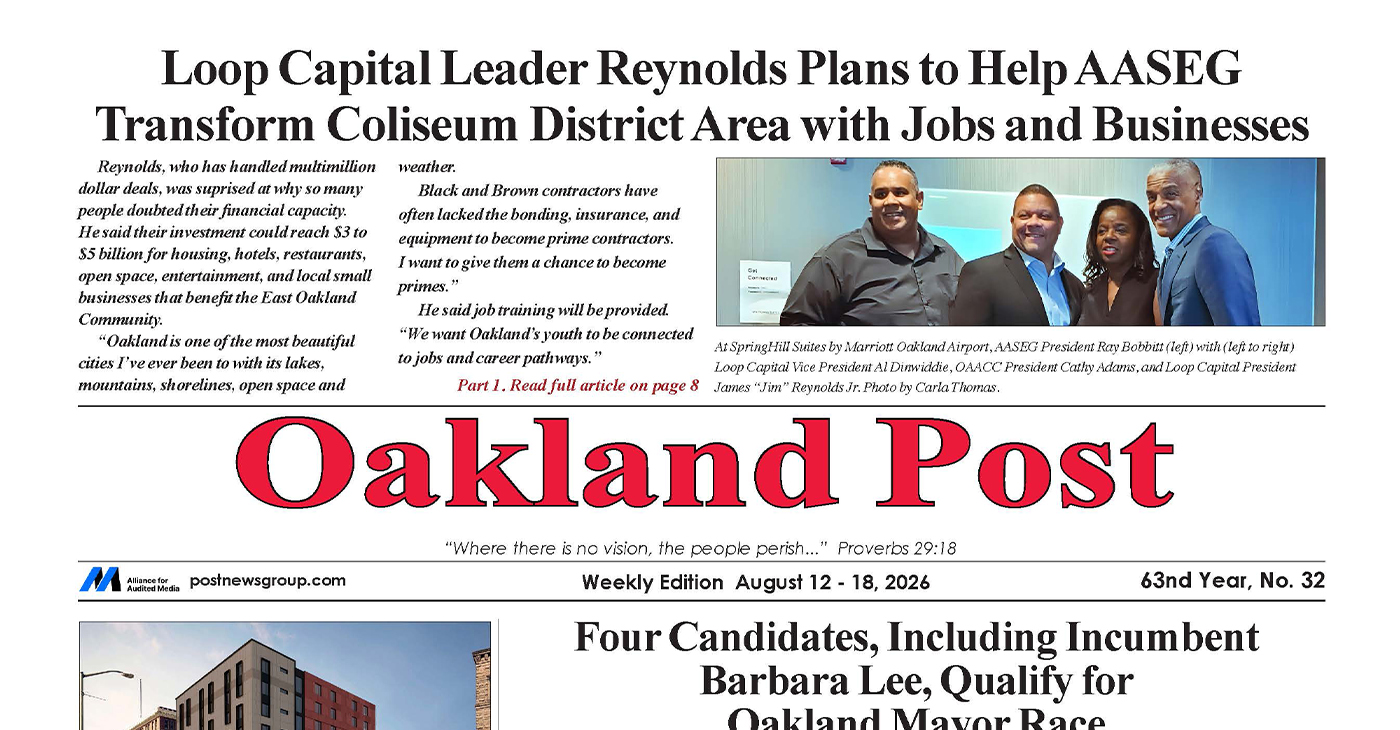
To enlarge your view of this issue, use the slider, magnifying glass icon or full page icon in the lower right corner of the browser window.

Activism
Oakland Post: Week of August 5 – 11, 2026
The printed Weekly Edition of the Oakland Post: Week of August 5 – 11, 2026
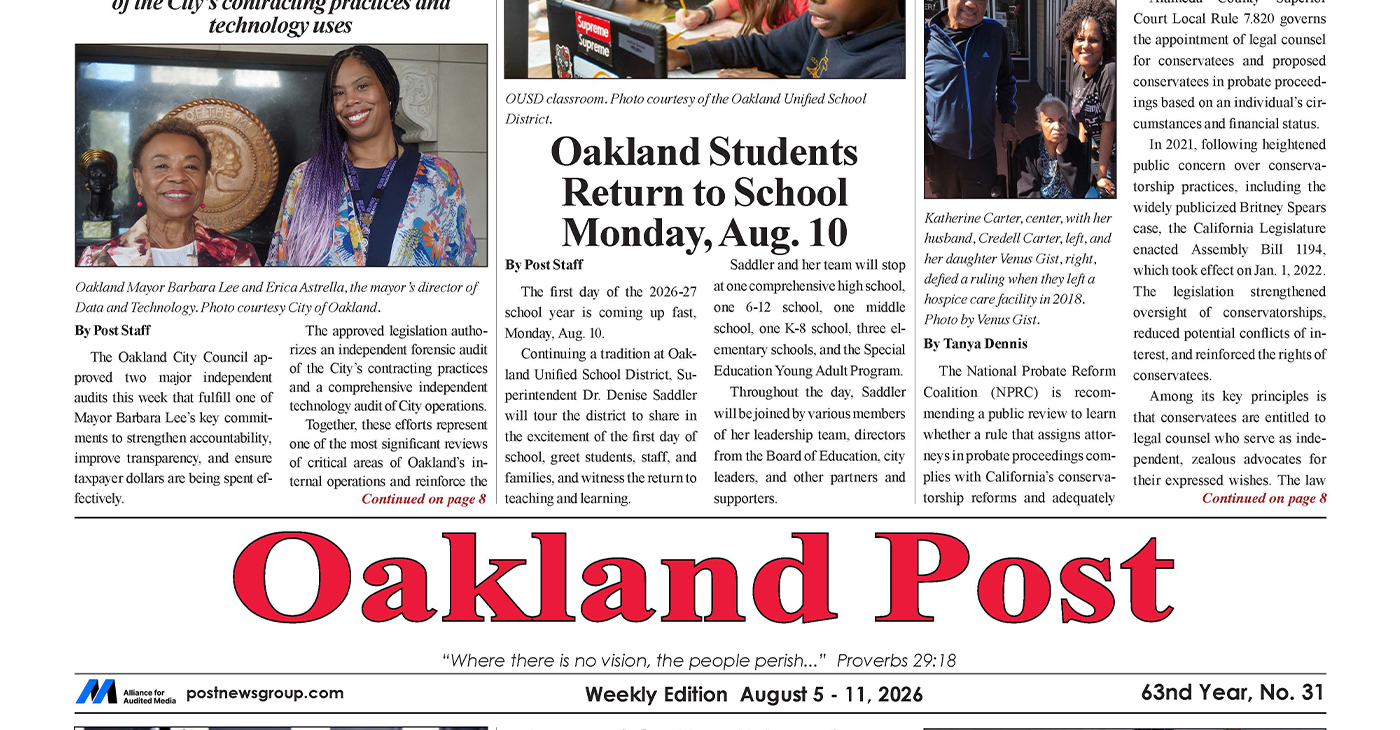
To enlarge your view of this issue, use the slider, magnifying glass icon or full page icon in the lower right corner of the browser window.
Activism
Oakland Post: Week of July 29 – August 4, 2026
The printed Weekly Edition of the Oakland Post: Week of July 29 – August 4, 2026
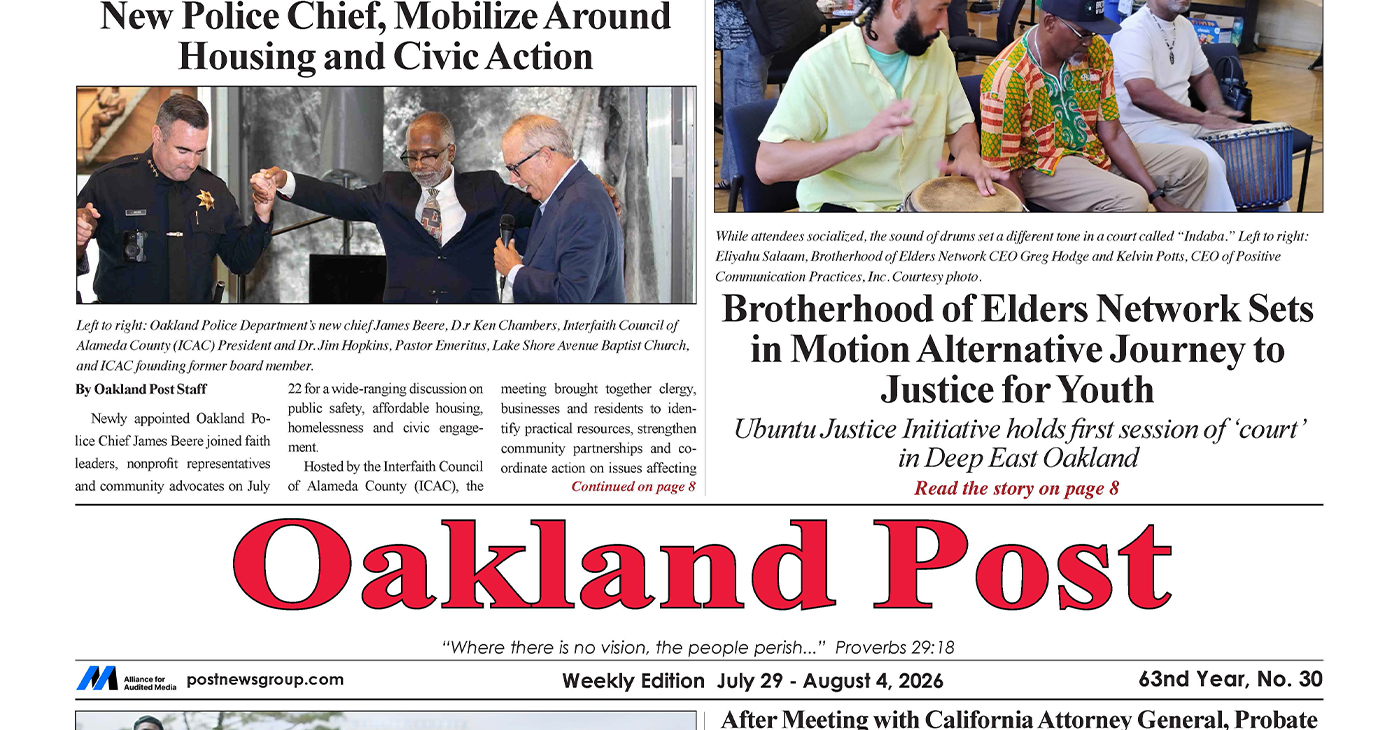
To enlarge your view of this issue, use the slider, magnifying glass icon or full page icon in the lower right corner of the browser window.

WORK FROM HOME
Home-based business with potential monthly income of $10K+ per month. A proven training system and website provided to maximize business effectiveness. Perfect job to earn side and primary income. Contact Lynne for more details: Lynne4npusa@gmail.com 800-334-0540


OPINION: 57,000 Empty Apartments and Not a Word of Apology – City Limits

Oakland Protesters Rally to Defend Haitian Immigrants and TPS

First 5 Alameda County Celebrates First Year of Measure C’s Implementation

From Palestine to Oakland: Seeds for Liberation Examines Shared Struggles for Freedom

NABJ Convention Brings Black Journalists, Civic Leaders Together in Atlanta

At Sacramento Summit, Becerra Discusses Policy; Uses “Family” Metaphor to Frame Case for National Political Unity

$5 Billion Coliseum Vision Puts Oakland Jobs, Businesses at Center

Gov. Newsom Nominates 3 Black Women Judges to Serve on State Courts of Appeal

Oakland Observes Black August with Block Parties, Film Showings, Workshops

NPRC Elder Justice Symposium Invites Community to Join Effort to Protect Alameda County Elders
Episode 4: Grow Stronger After 50
Episode 4: Grow Stronger After 50

Four Candidates, Including Incumbent Barbara Lee, Qualify for Oakland Mayor’s Race

Oakland Observes Black August with Block Parties, Film Showings, Workshops

Oakland Post: Week of August 12 – 18, 2026

Department of Homeland Security Demands California Secretary of State Shirley N. Weber Scrub Voter Rolls

New Judge Could Decide if Karmelo Anthony Gets a New Trial

Oakland Children’s Hospital Workers and Patients Rally for Pediatric Medical Care

“The Power to See Threats Sooner”: Gov. Newsom, Safety Officials Showcase California’s Investments in Hi-Tech Wildfire Prevention

Alpha Kappa Alpha Sorority, Inc. Celebrates New North Atlantic Regional Director

Surveillance Pricing Fight: State Senate Debates Bill Banning Retailers from Using AI to Set Prices Based on a Buyer’s Profile

Mount Zion MBC, Church of Jesus Christ of Latter-day Saints Partner to Bring 29,000 Meals to Alameda County

California Sen. Padilla Joins Colleagues to Introduce Bill Imposing Term Limits on Supreme Court Justices

Less Affluent School Districts, Including Sacramento City, Face Threat of State Takeover

Car Wash Workers Cope with Lingering Impacts of ICE Raids

Starting This Summer, California Car Buyers Can Get an Instant $3500 Off the Cost of Electric Vehicles

COMMENTARY: You Are Already Paying for the AI Boom

California Bill Would Let Abuse Victims Use Trauma as Legal Defense for Violent Crime

Fed Court to Decide Landmark First Amendment Case

Gov. Gavin Newsom Signs Law Streamlining Affordable Housing Rules

The Conversation With Al McFarlane 6/23/26

Media Monday 6/22/26

LIVE! ASK ALMA! — TUES. 6.23.26 7PM EST

Car Buying Secrets: 4 Hidden Checks Before You Sign!

Is This 550 HP Charger Worth YOUR Money? AutoNetwork Review

Celebrating Juneteenth – Frederick Douglass on education and resistance

LIVE! — ASK ALMA! — TUES. 6.19.26 7PM EST

Hyundai Ioniq 5 Parking, Safety, and 360 View #shorts

2025 Ioniq 5 New Wiper & Powerful Performance! #shorts

Electric SUV Range: Is 259 Miles Enough? #shorts

EV Charging: How Fast Can You Charge an Electric Vehicle? #shorts

Biometric Cooling… Messaging Seats…Come on! 2025 Infiniti QX80 Autograph 4WD

Charged Up: Witness the Magic of a Fully Electric Car! #shorts

Range Rover Sport PHEV Included…: See What’s Inside This Luxury SUV! #shorts

Invisible Hood View: Perfect Parking with X-Ray Vision! #shorts
-
 Featured2 weeks ago
Department of Homeland Security Demands California Secretary of State Shirley N. Weber Scrub Voter Rolls
-
 #NNPA BlackPress3 weeks ago
New Judge Could Decide if Karmelo Anthony Gets a New Trial
-
 Business4 weeks ago
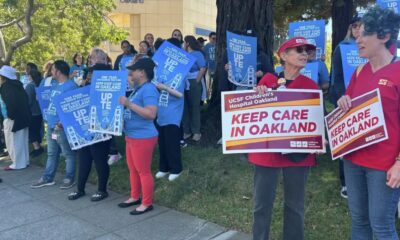
Oakland Children’s Hospital Workers and Patients Rally for Pediatric Medical Care
-
 Environment2 weeks ago
“The Power to See Threats Sooner”: Gov. Newsom, Safety Officials Showcase California’s Investments in Hi-Tech Wildfire Prevention
-
 Black History3 weeks ago
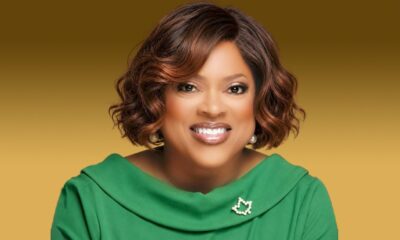
Alpha Kappa Alpha Sorority, Inc. Celebrates New North Atlantic Regional Director
-
 Business4 weeks ago
Surveillance Pricing Fight: State Senate Debates Bill Banning Retailers from Using AI to Set Prices Based on a Buyer’s Profile
-
 Business4 weeks ago
Mount Zion MBC, Church of Jesus Christ of Latter-day Saints Partner to Bring 29,000 Meals to Alameda County
-
 Featured2 weeks ago
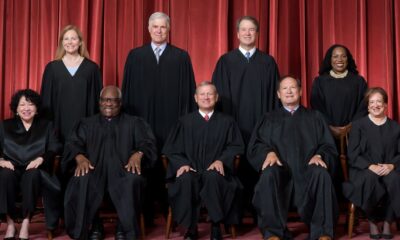
California Sen. Padilla Joins Colleagues to Introduce Bill Imposing Term Limits on Supreme Court Justices
