
Politics
Say What? Social Security Data Says 6.5M in U.S. reach Age 112


This Feb. 2005 file photo shows trays of printed social security checks, in Philadelphia, waiting to be mailed from the U.S. Treasury. (AP Photo/Bradley C. Bower, File)
Stephen Ohlemacher, ASSOCIATED PRESS
WASHINGTON (AP) — Americans are getting older, but not this old: Social Security records show that 6.5 million people in the U.S. have reached the ripe old age of 112.
In reality, only few could possibly be alive. As of last fall, there were only 42 people known to be that old in the entire world.

But Social Security does not have death records for millions of these people, with the oldest born in 1869, according to a report by the agency’s inspector general.
Only 13 of the people are still getting Social Security benefits, the report said. But for others, their Social Security numbers are still active, so a number could be used to report wages, open bank accounts, obtain credit cards or claim fraudulent tax refunds.
“That is a real problem,” said Sen. Ron Johnson, R-Wis. “When you have a fake Social Security number, that’s what allows you to fraudulently do all kinds things, claim things like the earned income tax credit or other tax benefits.”
Johnson is chairman of the Senate Committee on Homeland Security and Governmental Affairs, which plans a hearing Monday on problems with death records maintained by the Social Security Administration.
The agency said it is working to improve the accuracy of its death records. But it would be costly and time-consuming to update 6.5 million files that were generated decades ago, when the agency used paper records, said Sean Brune, a senior adviser to the agency’s deputy commissioner for budget, finance, quality and management.
“The records in this review are extremely old, decades-old, and unreliable,” Brune said.
The internal watchdog’s report does not document any fraudulent or improper payments to people using these Social Security numbers. But it raises red flags that it could be happening.
For example, nearly 67,000 of the Social Security numbers were used to report more than $3 billion in wages, tips and self-employment income from 2006 to 2011, according to the report. One Social Security number was used 613 different times. An additional 194 numbers were used at least 50 times each.
People in the country illegally often use fake or stolen Social Security numbers to get jobs and report wages, as do other people who do not want to be found by the government. Thieves use stolen Social Security numbers to claim fraudulent tax refunds.
The IRS estimated it paid out $5.8 billion in fraudulent tax refunds in 2013 because of identity theft. The head of the Justice Department’s tax division described how it’s done at a recent congressional hearing.
“The plan is frighteningly simple — steal Social Security numbers, file tax returns showing a false refund claim, and then have the refunds electronically deposited or sent to an address where the offender can access the refund checks,” said acting Assistant Attorney General Caroline Ciraolo.
In some cases, she said, false tax returns are filed using Social Security numbers of deceased taxpayers or others who are not required to file.
The Social Security Administration generates a list of dead people to help public agencies and private companies know when Social Security numbers are no longer valid for use. The list is called the Death Master File, which includes the name, Social Security number, date of birth and date of death for people who have died.
The list is widely used by employers, financial firms, credit reporting agencies and security firms. Federal agencies and state and local governments rely on it to police benefit payments.
But none of the 6.5 million people cited by the inspector general’s report was on the list. The audit analyzed records as of 2013, looking for people with birth dates before 1901.
President Franklin D. Roosevelt signed the Social Security Act in 1935, and the first old-age monthly benefit check was paid in 1940.
Many of the people cited in the inspector general’s report never received benefits, though they were assigned Social Security numbers so spouses and children could receive them, presumably after they died.
The agency says it has corrected death information in more than 200,000 records. But fixing the entire list would be costly and time-consuming because Social Security needs proof that a person is dead to add them to the death list, said Brune, the agency official.
Brune noted that the inspector general’s report did not verify that any of the 6.5 million people are actually dead. Instead, the report assumed they are dead because of their advanced age.
“We can’t post information to our records based on presumption,” Brune said. “We post information to our records based on evidence, and in this case it would be evidence of a death certificate.”
“Some of those records may not even exist,” Brune added.
Nearly all the Social Security numbers are from paper records generated before the agency started using electronic records in 1972, Brune said. Many of the records contain errors, with multiple birthdates and bits of information about different family members.
“We did transcribe paper records into the electronic system and over time that information’s been purified,” Brune said.
“But our focus right now is to make sure our data is as accurate and complete as it can be for our current program purpose,” said Brune. “Right now, we’re focused on making sure we’re paying beneficiaries properly, and that’s how we’re investing our resources at this time.”
___
Follow Stephen Ohlemacher on Twitter: http://twitter.com/stephenatap
Copyright 2015 The Associated Press. All rights reserved. This material may not be published, broadcast, rewritten or redistributed.
###





Business
OP-ED: Proposition 44 Would Put a Price on Trust
The danger in Proposition 44 is not only its 90 percent figure. It is that the meaning of “qualifying” spending will be worked out later. A clinic preparing a budget today may not know whether a navigator, health educator, transportation program, outreach worker, technology upgrade, or other patient-support service will be counted the way it expects. Yet the financial consequence of getting it wrong could be immediate.




Business
OP-ED: Proposition 40: It’s Time to Play Chess, Not Checkers
Proposition 40 would impose a one-time 5 percent tax on the wealth of Californians with more than $1 billion in assets. Most of that money would go toward health care, with the remainder supporting food assistance and education-related programs.

Activism
Oakland Post: Week of September 30 – October 6, 2026
The printed Weekly Edition of the Oakland Post: Week of September 30 – October 6, 2026

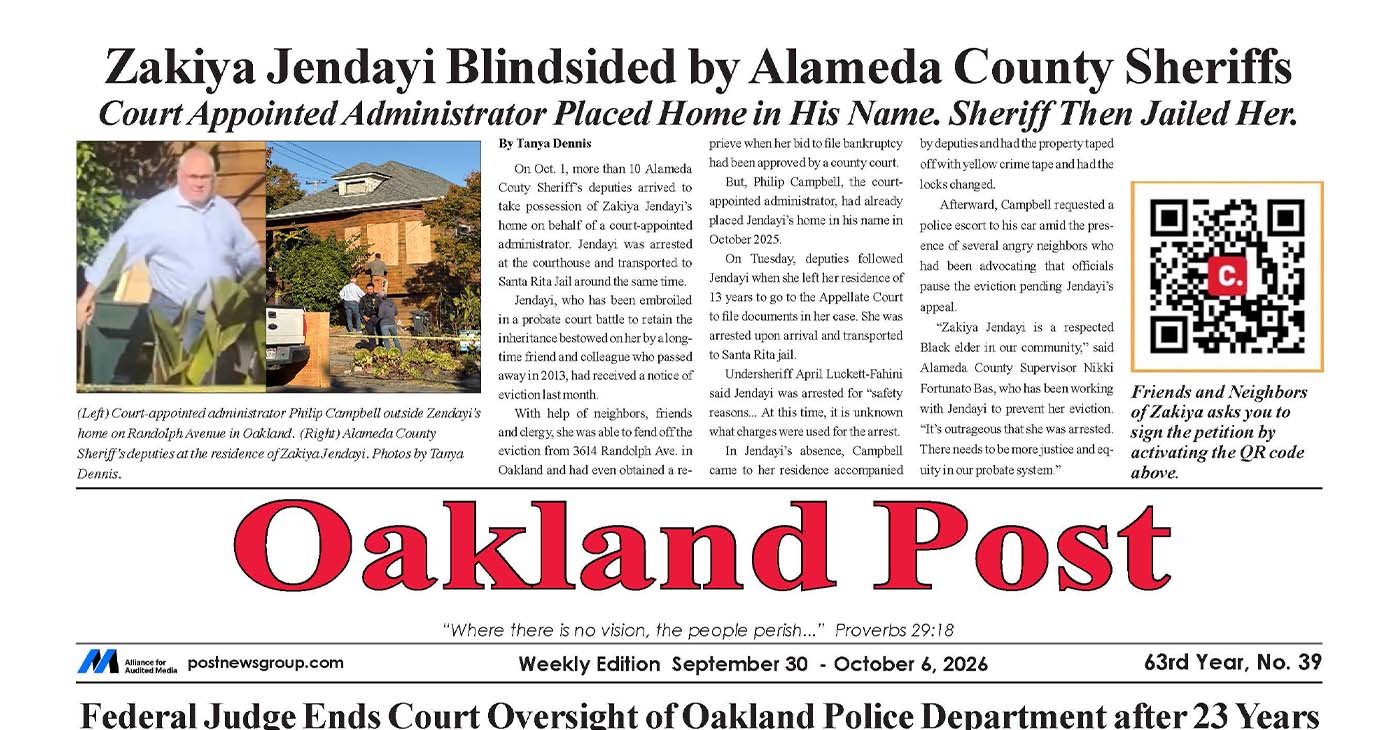
To enlarge your view of this issue, use the slider, magnifying glass icon or full page icon in the lower right corner of the browser window.




OP-ED: Proposition 44 Would Put a Price on Trust

OP-ED: Proposition 40: It’s Time to Play Chess, Not Checkers

Listening as a Lifeline: A Doula’s Witness to Black Maternal Health

New Protections for Ticket Buyers: Gov. Newsom Signs Assemblymember Isaac Bryan’s Bill

‘We Don’t Talk Trash — We Pick Up Trash!’

Zakiya Jendayi Arrested, Locked Out of Home by Sheriff’s Deputies

Oakland Post: Week of September 30 – October 6, 2026

Asm. Corey Jackson Announces Launch of 24-Hour Childcare in His District

IN MEMORIAM: The Rev. Leon “Sonny” Clark, Longtime Orange County Pastor and Community Leader, Dies at 72

Poll: Becerra Widens His Lead Over Hilton; Californians Split on Wealth Tax

From Historic Memories to New Possibilities: Oakland Celebrates Coliseum 60

County Office of Education Says OUSD Finances Are Getting Healthier, Materially Stronger

LIVE FREE Sunday Dinner Brings Faith, Fellowship and Civic Conversation to Oakland

Remembering Chauncey Bailey as Student Journalists Face Threats to Truth-Telling

BLACspace Cooperative Invites Bay Area to Experience Oakland’s Black Cultural Ecosystem Through a BLAC Map Tour + Party

Standoff for Justice: Our Homes Are Worth Fighting For

Oakland Post: Week of August 26 – September 1, 2026

Frontier Airlines’ Return to Oakland Airport Brings Flights, Jobs and Opportunity

Gubernatorial Candidate Steve Hilton Blasts California New Tire Rules; Newsom Hits Back

Chef Sharon Lee Blends Culinary Excellence, Education and Empowerment

Jackie Wright Champions Bay Area Stories, Filmmakers and Cultural Institutions

Misnamed ‘Parent’ PAC Seeks to Influence Oakland School Board Elections

Oakland Coliseum Project Opens Door for Small Businesses to Build Bigger

Gov. Newsom’s Latest Appointees Include Sacramento Advocate for Formerly Incarcerated Students; State’s New Tech Chief

Big City Mayors Ask for “Yes” Vote on Housing Bond Measure; Conservatives Say “No”

Longtime BWOPA Member Brendalyn Goodall Appointed to California Workforce Development Board

Gov. Newsom Signs Law Shielding Immigration Aid Workers From Doxing Threats

Oakland Post: Week of September 2 – 8, 2026

Secretary of State Shirley N. Weber Urges Californians to Vote Early as Voter ID Battle Intensifies

IN MEMORIAM: Dolly Parton Dead at 80 — How She Built a Legacy of Love and Earned Her Place in Black Culture

The Conversation With Al McFarlane 6/23/26

Media Monday 6/22/26

LIVE! ASK ALMA! — TUES. 6.23.26 7PM EST

Car Buying Secrets: 4 Hidden Checks Before You Sign!

Is This 550 HP Charger Worth YOUR Money? AutoNetwork Review

Celebrating Juneteenth – Frederick Douglass on education and resistance

LIVE! — ASK ALMA! — TUES. 6.19.26 7PM EST

Hyundai Ioniq 5 Parking, Safety, and 360 View #shorts

2025 Ioniq 5 New Wiper & Powerful Performance! #shorts

Electric SUV Range: Is 259 Miles Enough? #shorts

EV Charging: How Fast Can You Charge an Electric Vehicle? #shorts

Biometric Cooling… Messaging Seats…Come on! 2025 Infiniti QX80 Autograph 4WD

Charged Up: Witness the Magic of a Fully Electric Car! #shorts

Range Rover Sport PHEV Included…: See What’s Inside This Luxury SUV! #shorts

Invisible Hood View: Perfect Parking with X-Ray Vision! #shorts
-
 Community3 weeks ago
Misnamed ‘Parent’ PAC Seeks to Influence Oakland School Board Elections
-

 Activism4 weeks ago
Oakland Post: Week of September 9 – 15, 2026
-

 Community3 weeks ago
Richmond Tiny House Village Farm & Garden Set to Open Gates on Sept. 26
-

 Black History3 weeks ago
Latest Massacre in Haiti Reveals Cruelty U.S. Deportations
-

 Black History3 weeks ago
OPINION: Nolan Wells’ Death One of Several Signifying Racial Terror Lives on in U.S. South
-

 Business2 weeks ago
Mayor Lee Announces $1 Million Kaiser Permanente Grant for Pilot Program to Address Homelessness, Clean Up Public Spaces throughout Oakland
-

 Community3 weeks ago
Democratic Clubs Interview Candidates for Oakland School Board
-

 Uncategorized3 weeks ago
NBA All-Star Damian Lillard Returns Home for 15th Annual Backpack Giveaway
