
Activism
San Francisco Mid-Year Budget Cuts Leaves Office of Reparations in the Wind
In an October letter sent to department heads, Breed stated that the city is projected to face a $500 million deficit by the 2025-26 fiscal year. These budget cuts will ensure that the city can continue to invest in its top priorities. This means cutting proposed programs that have not yet started, including the Office of Reparations.

By Magaly Muñoz
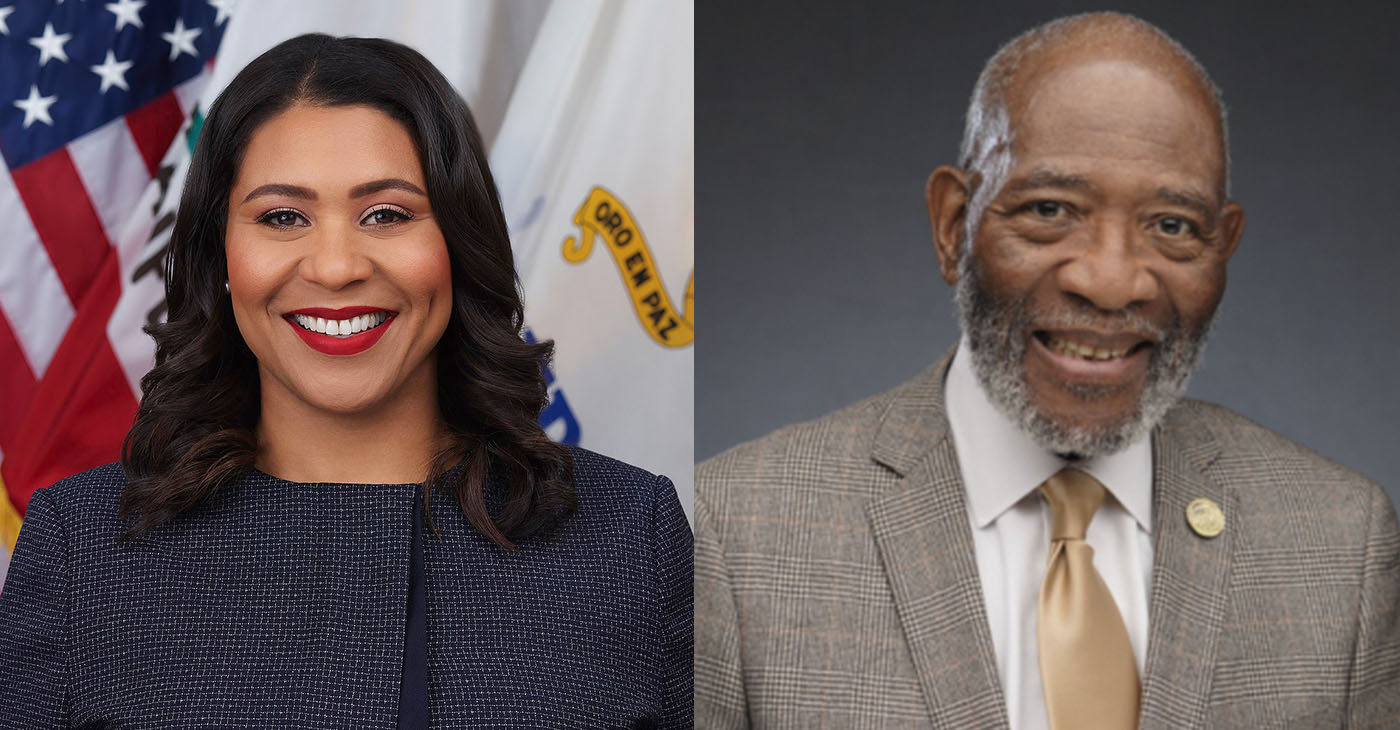
Earlier this month, San Francisco Mayor London Breed approved $75 million in mid-year budget cuts, which included $4 million that was intended for the first of its kind Office of Reparations.
The funds had originally been approved in a June Board of Supervisors meeting to establish the reparations office in city hall and fund it for two years but is now on the chopping block to conserve spending in the city is still dealing as it grapples with the severe impacts of the pandemic.
In an October letter sent to department heads, Breed stated that the city is projected to face a $500 million deficit by the 2025-26 fiscal year. These budget cuts will ensure that the city can continue to invest in its top priorities. This means cutting proposed programs that have not yet started, including the Office of Reparations.
Breed has long been criticized for her stance on the issue of reparations coming from the local level, stating her belief that any payments to individuals should be handled at the federal level.
“The Mayor also does not believe that addressing the needs of the African American community requires adding more bureaucracy and a whole new office; this work can be done with existing staffing,” said Parisa Safarzadeh, the mayor’s press secretary, in an email to the Post.

Safarzadeh explained that Breed has and will continue to uplift marginalized communities with programs like the Dreamkeeper Initiative (DKI) to address inequities in the African American community and Opportunities for All, which provides all high school students in San Francisco with a paid internship.
Reverend Amos Brown, a member of the SF African American Reparations Advisory Committee (SFAARAC), expressed that while monetary compensation doesn’t have to be distributed locally, public policies should be enacted to address the racial gap and inequities of the Black community.
“They need to move forward with deliberate speed, working with the Black community to ensure that the low-hanging fruit is delivered regarding health care services, education, economic empowerment, jobs, and restorative justice programs for those coming out of this criminal justice system. That would give us reparations,” Brown said.
The SFAARAC was formed in December 2020 to research and develop recommendations for repairing the harm done to the Black community of San Francisco.
In July, they submitted their final report of recommendations to the mayor and Board of Supervisors. The report proposed a payout of $5 million to individuals who could prove direct ancestral ties to slavery and included other recommendations aimed at improving education, health, and economic development.
Efforts to implement reparations on a national level have largely been unsuccessful. However, advocates like Kamm Howard continue pushing for a committee’s establishment as we approach an election year.
He says that the Biden administration should issue an executive order establishing a reparations committee because it would show his commitment to uplifting Black people in America, as they are the largest voter group after white voters. He needs the Black vote to win another presidential election.
In 2022, Howard founded Reparations United to provide guidance and leadership to coalitions and activists involved in the reparations movement. He also led the revisions to the federal bill H.R. 40, which seeks to establish a commission to study and develop reparation proposals for African Americans.
Howard expressed that even if individuals today claim they aren’t racist or their ancestors didn’t own slaves, everyone has to contribute to the repairs that address the generational damage inflicted on Black and African Americans.
“Everyone who benefits from the status of America and the wealth of America, all has to contribute to the remedy of unjust actions by this country,” Howard said.
He says that local and state governments also owe it to their Black citizens to acknowledge the harm that their policies and laws have done to them. All states have the power to enact change and form committees, like California has attempted to do with their state Reparations Task Force, and should be supported at every level of government.
Brown said it should not take so long to put a plan in action to give some sort of restorative justice back to the community. He points out that the fight is about much more than allocating $4 million for a department for reparations, which is an insulting number to fight about when the rightful compensation owed to African Americans is many times greater.
“It’s time for San Francisco to lead the way and respect the humanity of Black people,” Brown said.





Activism
Oakland Post: Week of August 12 – 18, 2026
The printed Weekly Edition of the Oakland Post: Week of August 12 – 18, 2026


To enlarge your view of this issue, use the slider, magnifying glass icon or full page icon in the lower right corner of the browser window.

Activism
Oakland Post: Week of August 5 – 11, 2026
The printed Weekly Edition of the Oakland Post: Week of August 5 – 11, 2026
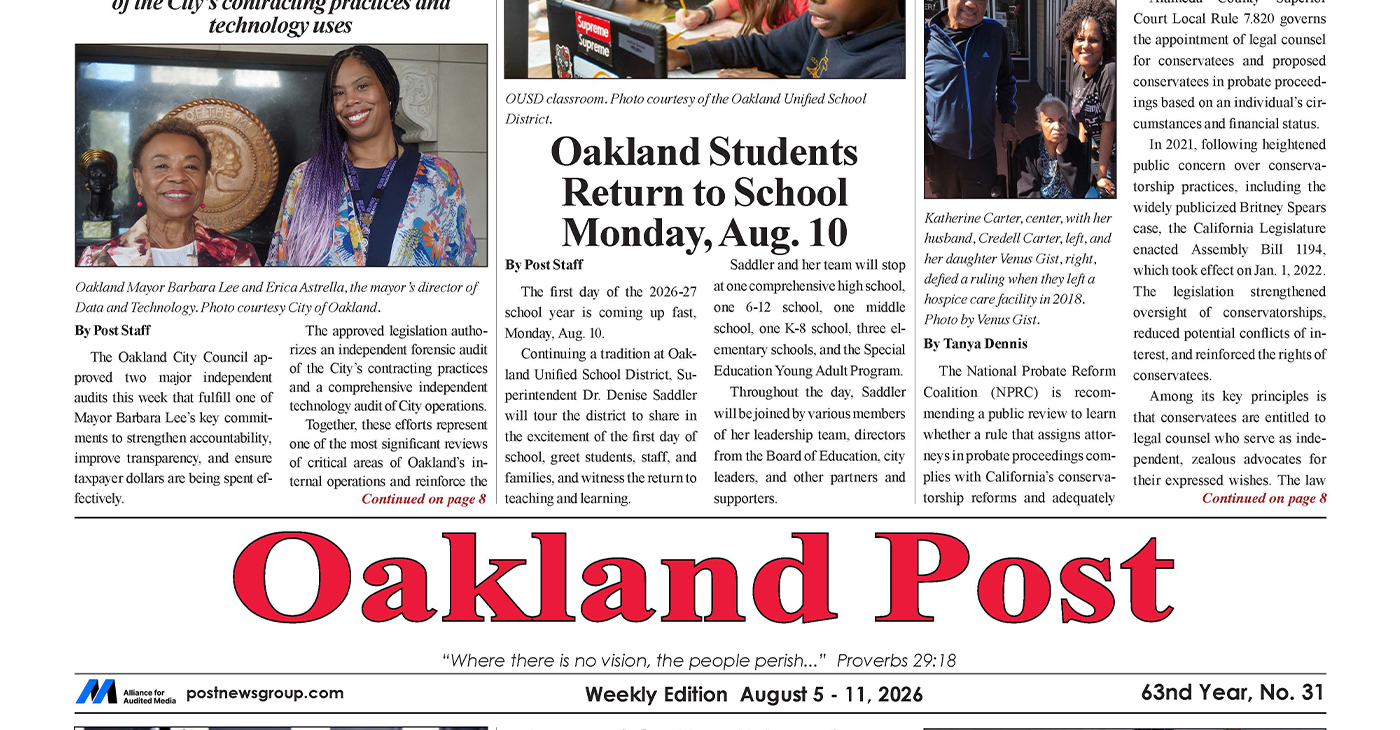
To enlarge your view of this issue, use the slider, magnifying glass icon or full page icon in the lower right corner of the browser window.
Activism
Oakland Post: Week of July 29 – August 4, 2026
The printed Weekly Edition of the Oakland Post: Week of July 29 – August 4, 2026
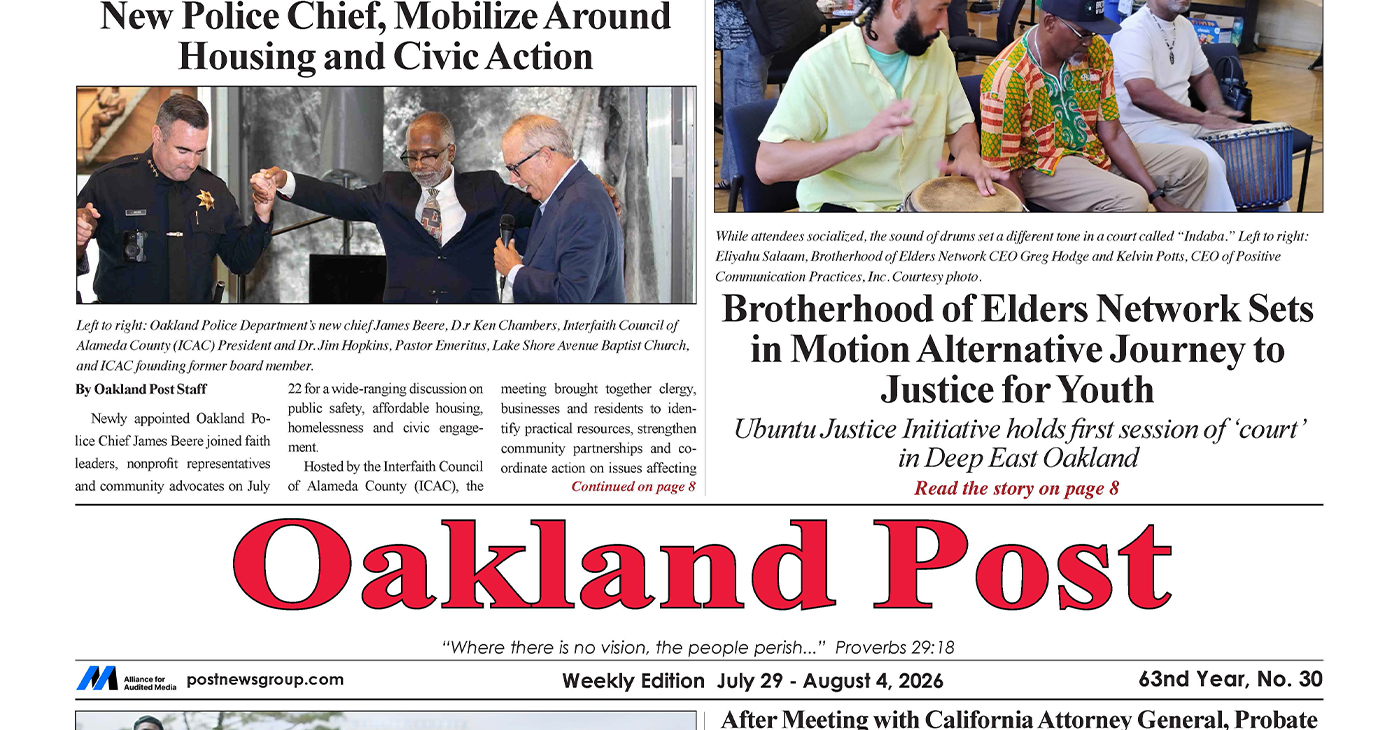
To enlarge your view of this issue, use the slider, magnifying glass icon or full page icon in the lower right corner of the browser window.

WORK FROM HOME
Home-based business with potential monthly income of $10K+ per month. A proven training system and website provided to maximize business effectiveness. Perfect job to earn side and primary income. Contact Lynne for more details: Lynne4npusa@gmail.com 800-334-0540


Four Candidates, Including Incumbent Barbara Lee, Qualify for Oakland Mayor’s Race

Oakland Observes Black August with Block Parties, Film Showings, Workshops

Oakland Post: Week of August 12 – 18, 2026

COMMENTARY: Why Local School Tax Measure G1 Will Not Be on the November Ballot

California Hispanic Chambers of Commerce Unveils: ‘Powering the Future’ Theme for 47th Annual Statewide Convention

Returning to Its Roots, the Oakland Black-Eyed Pea Festival Partners with the Freedom Farmers Market Sept. 12

Less Affluent School Districts, Including Sacramento City, Face Threat of State Takeover

From Blueprint to Breakthrough: Tackling Affordable Housing in Oakland

NPRC Scores First Advocacy Victory: David Shaw Finally Gets His Wish to ‘Go Home’

ESSAY: California Can Close Its Colorectal Cancer Gap

Car Wash Workers Cope with Lingering Impacts of ICE Raids

Misty Copeland Shapes Ballet’s Tomorrow

As Part of Your Back-to- School Checklist, Vaccinate

As Part of Your Back-to- School Checklist, Vaccinate

Congresswoman Simon Demands Investigation into Trump’s Abuse of Emergency Powers for Coal Export Terminal in West Oakland

Department of Homeland Security Demands California Secretary of State Shirley N. Weber Scrub Voter Rolls

Oakland Children’s Hospital Workers and Patients Rally for Pediatric Medical Care

New Judge Could Decide if Karmelo Anthony Gets a New Trial

“The Power to See Threats Sooner”: Gov. Newsom, Safety Officials Showcase California’s Investments in Hi-Tech Wildfire Prevention

Alpha Kappa Alpha Sorority, Inc. Celebrates New North Atlantic Regional Director

Surveillance Pricing Fight: State Senate Debates Bill Banning Retailers from Using AI to Set Prices Based on a Buyer’s Profile

Mount Zion MBC, Church of Jesus Christ of Latter-day Saints Partner to Bring 29,000 Meals to Alameda County

California Sen. Padilla Joins Colleagues to Introduce Bill Imposing Term Limits on Supreme Court Justices

Starting This Summer, California Car Buyers Can Get an Instant $3500 Off the Cost of Electric Vehicles

COMMENTARY: You Are Already Paying for the AI Boom

California Bill Would Let Abuse Victims Use Trauma as Legal Defense for Violent Crime
Less Affluent School Districts, Including Sacramento City, Face Threat of State Takeover
Car Wash Workers Cope with Lingering Impacts of ICE Raids

Fed Court to Decide Landmark First Amendment Case

Gov. Gavin Newsom Signs Law Streamlining Affordable Housing Rules

The Conversation With Al McFarlane 6/23/26

Media Monday 6/22/26

LIVE! ASK ALMA! — TUES. 6.23.26 7PM EST

Car Buying Secrets: 4 Hidden Checks Before You Sign!

Is This 550 HP Charger Worth YOUR Money? AutoNetwork Review

Celebrating Juneteenth – Frederick Douglass on education and resistance

LIVE! — ASK ALMA! — TUES. 6.19.26 7PM EST

Hyundai Ioniq 5 Parking, Safety, and 360 View #shorts

2025 Ioniq 5 New Wiper & Powerful Performance! #shorts

Electric SUV Range: Is 259 Miles Enough? #shorts

EV Charging: How Fast Can You Charge an Electric Vehicle? #shorts

Biometric Cooling… Messaging Seats…Come on! 2025 Infiniti QX80 Autograph 4WD

Charged Up: Witness the Magic of a Fully Electric Car! #shorts

Range Rover Sport PHEV Included…: See What’s Inside This Luxury SUV! #shorts

Invisible Hood View: Perfect Parking with X-Ray Vision! #shorts
-
 Featured7 days ago
Department of Homeland Security Demands California Secretary of State Shirley N. Weber Scrub Voter Rolls
-
 Business3 weeks ago
Oakland Children’s Hospital Workers and Patients Rally for Pediatric Medical Care
-
 #NNPA BlackPress2 weeks ago
New Judge Could Decide if Karmelo Anthony Gets a New Trial
-
 Environment7 days ago
“The Power to See Threats Sooner”: Gov. Newsom, Safety Officials Showcase California’s Investments in Hi-Tech Wildfire Prevention
-
 Black History2 weeks ago
Alpha Kappa Alpha Sorority, Inc. Celebrates New North Atlantic Regional Director
-
 Business3 weeks ago
Surveillance Pricing Fight: State Senate Debates Bill Banning Retailers from Using AI to Set Prices Based on a Buyer’s Profile
-
 Business3 weeks ago
Mount Zion MBC, Church of Jesus Christ of Latter-day Saints Partner to Bring 29,000 Meals to Alameda County
-
 Featured7 days ago
California Sen. Padilla Joins Colleagues to Introduce Bill Imposing Term Limits on Supreme Court Justices
