
Activism
San Francisco Is Investing Millions to Address Food Insecurity. Is Oakland Doing the Same?
There are over 350 grocery programs across San Francisco. Less than a handful in District 10, a neighborhood classified as a food desert, and includes Hunters Point, one of the lowest income areas in the city.

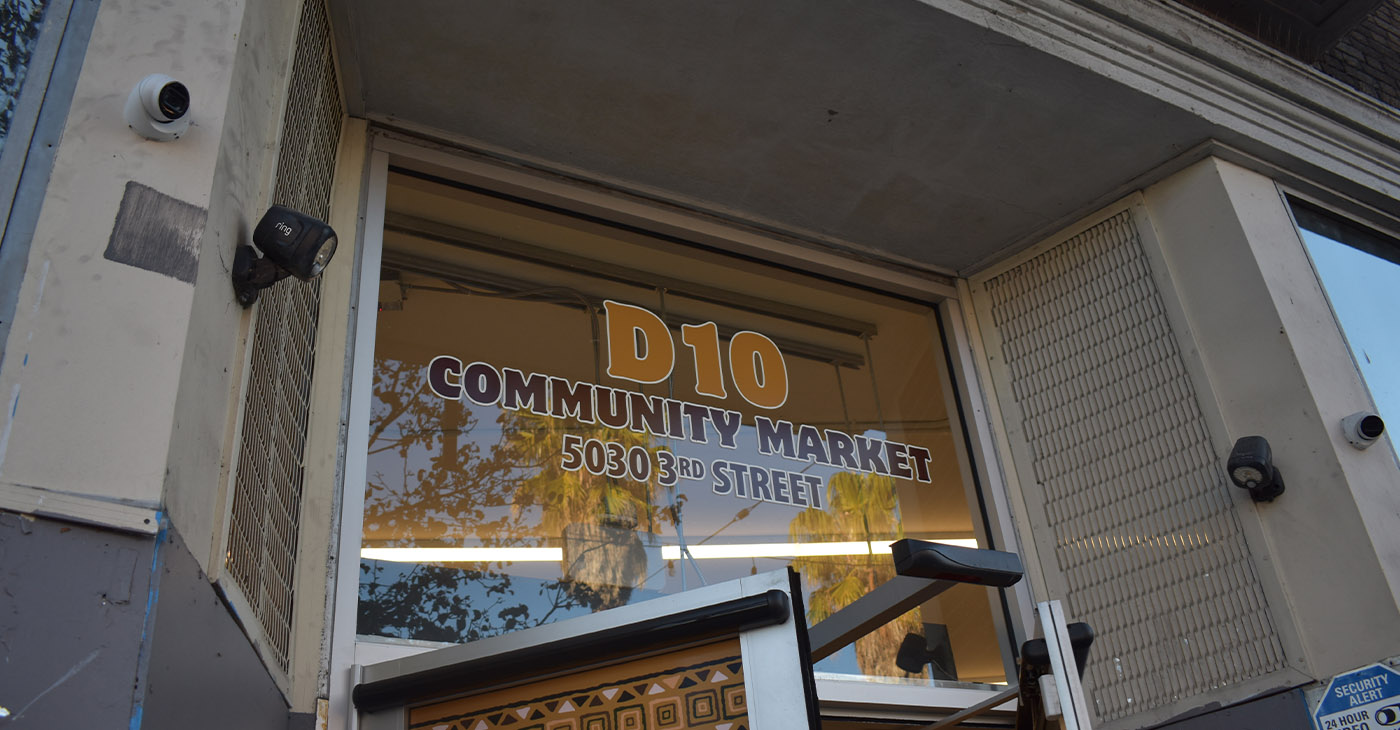
By Magaly Muñoz
On a Thursday evening in February, Marquez Boyd walked along the aisles of San Francisco’s District 10 Community Market looking for eggs and fresh produce to take home to his children. He has been trying new recipes with ingredients he previously couldn’t afford or access.
“I learned how to cook greens since they got a lot of fresh greens here,” Boyd said. “All that stuff is better and more healthy for my kids because they’re still young.”
Meals filled with fresh produce are now possible for Boyd since the District 10 market in Hunters Point opened in 2024 when Bayview Senior Services, a non-profit running the program, received a $5 million investment from the city of San Francisco.
The market is a twist on a traditional food bank, where people can often wait in long lines for pre-bagged groceries they may not need. Here, the goal is to offer people in need a more traditional grocery store setting, with a bigger range of healthy options and less shame for needing assistance.
It’s a twist that Boyd appreciated. “This set up is way better as opposed to maybe like a food bank line,” he said. “It’s easier and faster.”

Similar models exist in Santa Barbara and Tennessee.
There are over 350 grocery programs across San Francisco. Less than a handful in District 10, a neighborhood classified as a food desert, and includes Hunters Point, one of the lowest income areas in the city.
Census Bureau data show that the median income for households in the 94124 zip code, where Hunters Point is located, is just under $83,000 annually. Black households earn about $46,000, Native Hawaiian or other Pacific Islanders earn almost $41,000, and Hispanic households make just above the median income- an average of $86,000.
Located at 5030 3rd Street, the aisles are lined with fresh produce, canned goods, bread and snacks. While refrigerators and freezers in the back of the market are filled with dairy products and meat.
The best part- everything inside is free for eligible customers.
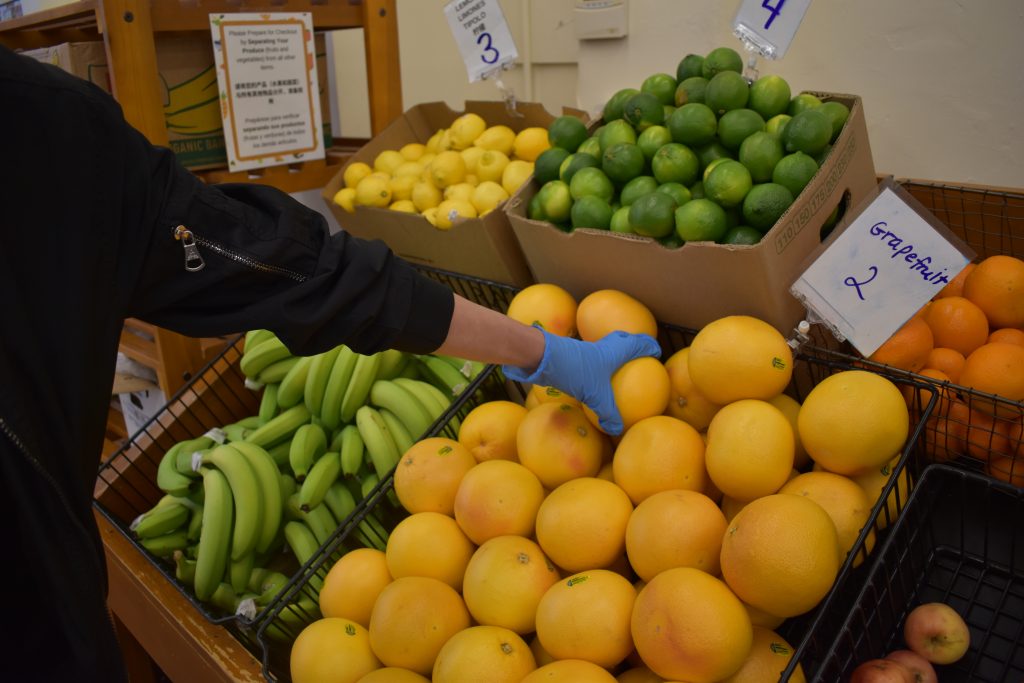
The San Francisco District 10 Community Market is stocked with fresh produce, dairy, meat and chicken, bread, and cultural food staples. Directors of the market say they pride themselves on providing healthy options for community members. Photo by Magaly Muñoz.
“The interesting thing about this market is that it’s a city-funded effort to create something besides the average food line to give more dignity and choice than is normally given to low-income people,” said Cathy Davis, executive director of Bayview Senior Services.
Davis said people feel more comfortable coming into the market because they can choose the food they want and at a time that’s convenient for them.
Boyd, a single father of two kids, recently lost his job and relied on his sister’s generosity before discovering the market. He comes to market when he gets off of work in the evening.
“It’s a lot of people in these communities that don’t get a chance to eat healthy,” Boyd said. “They don’t have the money to go to grocery stores to buy expensive stuff.”
Another shopper, Rhonda Hudson, said the market helped her meet her grandson’s diet-related health problems. She used to travel outside the neighborhood for affordable groceries, but now she no longer has to.
According to the city’s Human Services Agency, there are no plans to expand the markets in San Francisco due to budget constraints.
But Davis isn’t worried about losing the market funding.
“City leaders were on board with creating it and finding the money to put it together so I would say we didn’t have to advocate because it came through the government. Now it’s our job to keep it going to prove that it’s a pilot worth maintaining,” Davis said.
District 10 Supervisor Shamann Walton, who co-sponsored the ordinance, said that projects like the market are “essential to our neighborhoods,” where access to affordable food has been a challenge.
“Investing in local community markets helps ensure that families have reliable, healthy food options close to home, addressing food insecurity and supporting the well-being of our community regardless of income,” Walton said.
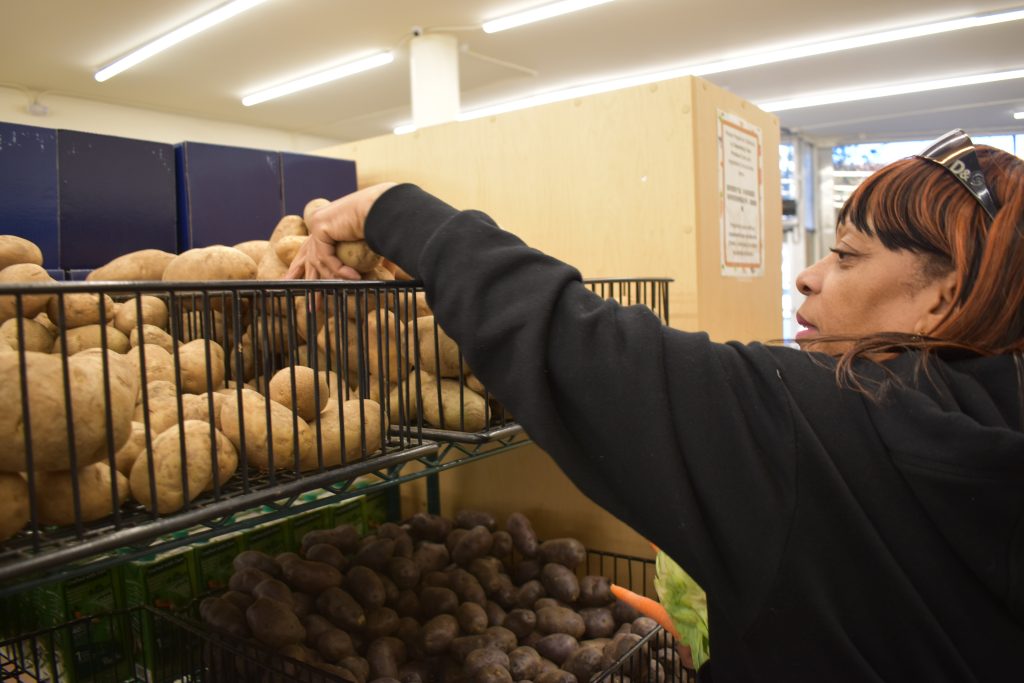
Rhonda Hudson is a shopper of the District 10 Community Market in San Francisco. The fresh produce she gets at the free grocery store program helps her grandson, who has a diet-related illness, stay healthy. Photo by Magaly Muñoz.
Why Not Oakland?
Only slightly larger than San Francisco, Oakland has over 400 food distribution sites. Oakland provides grants to nonprofit-run organizations who run grocery programs. But in recent months, the city has begun to reduce those, forcing some organizations to regroup, and making it challenging to implement a community market similar to San Francisco’s.
The Oakland Post repeatedly reached out to city and county officials for comment on the story but did not receive a response.
At several food banks across West and East Oakland, residents shared their frustrations about long lines, wilting produce, and limited food choices.
At one food bank, located at Christian Tabernacle Church, a young mother, who requested anonymity for privacy reasons, waited in the rain for over three hours for a single bag of groceries.
“I like to get here early because I get better [quality] fruits and vegetables,” she said. She added that it’s not a lot of food that she receives for her family, but it helps close the gap when her budget is tight.
Behind her, several other women waited their turn. Neither the timing of the distribution nor the location of the food bank fit their schedules, the women said, but their choices feel limited.
Only a handful of Oakland food bank sites operate throughout the day, like the San Francisco market. Most food distribution programs are sustained by Alameda County Food Bank, not by city funding. Private grants and donations also help fund the programs.
Securing city funding is increasingly challenging. Oakland faces a $130 million budget shortfall, with a projected $280 million deficit in the next biennial cycle. Citing budget concerns, the city has reduced numerous department budgets and grants. One of those cuts included slashing the longstanding SOS Meals on Wheels grant, which helped provide food to 3,000 seniors.
Charlie Deterline, executive director of Meals on Wheels, said the termination of their $150,000 annual grant could mean that Oakland residents might see a change in the amount of meals they receive. The organization has gone 19 months without funding from that grant, Deterline said, but “continued working on good faith from the city” because they were assured they would be paid out. Now, Deterline is having doubts.
The program also received a grant of more than $125,000 from the Sugar Sweetened Beverage Tax. Yet, on June 12, the city informed grant recipients that the funding could be rescinded in order to balance the budget. That ultimately happened, said Deterline.
“Oakland is by far the most expensive city for us to operate in. It is also where the greatest need is – for us to meet that need, it will take the entire community coming together,” Deterline said.
From the sugar tax, money from that measure is also not being allocated correctly as the majority of the funding has been used to fund government services, said members of the SSB tax advisory board.
The tax generates around $7 million annually. 25% to 40% of the funding goes towards grants for community based organizations instead of the 60% allocation that the SSBT advisory board recommended the city to use for health programs. The rest of the funding goes to the city, according to Oakland’s mid-cycle budget.
Advisory board member Dwayne Aikens said he’s not sure Oakland will ever renew the grants that have been cut from this tax. “I’m looking at the conditions of the city and I’m not optimistic,” Aikens said. “If they don’t have the money now, I don’t think they’ll have the money in the future.”
Aikens said the tax was “kind of a waste.” He’s heard displeasure from the community about the lack of funding into Black and Brown neighborhoods, groups who typically live in areas of Oakland that see health and income disparities.
Meanwhile, the Community Market, which reflects the diversity of the Bayview Hunters Point community, is investing in over 800 of the city’s most vulnerable households. In-store staff and directors speak the languages common to the area and the program provides a culture-of-the week selection of foods for those interested in trying something new.
Davis said it’s up to local municipalities to ensure that residents don’t go to bed hungry, and investments need to be made in order to combat the pockets of neighborhoods who are on the brink of food insecurity.
“That’s just such a core responsibility and a core goal of everyone, to make sure that people are fed and healthy. It’s not a luxury item,” Davis said. “It’s something that needs to happen, whether we’re in a budget crisis or not.”
Reporter Magaly Muñoz produced this story as part of a series as a 2024 USC Annenberg Center for Health Journalism Data Fellow and Engagement Grantee.










Activism
Oakland Post: Week of September 16 – 22, 2026
The printed Weekly Edition of the Oakland Post: Week of September 16 – 22, 2026


To enlarge your view of this issue, use the slider, magnifying glass icon or full page icon in the lower right corner of the browser window.

Activism
Oakland Post: Week of September 9 – 15, 2026
The printed Weekly Edition of the Oakland Post: Week of September 9 – 15, 2026

To enlarge your view of this issue, use the slider, magnifying glass icon or full page icon in the lower right corner of the browser window.
Activism
Oakland Post: Week of September 2 – 8, 2026
The printed Weekly Edition of the Oakland Post: Week of September 2 – 8, 2026
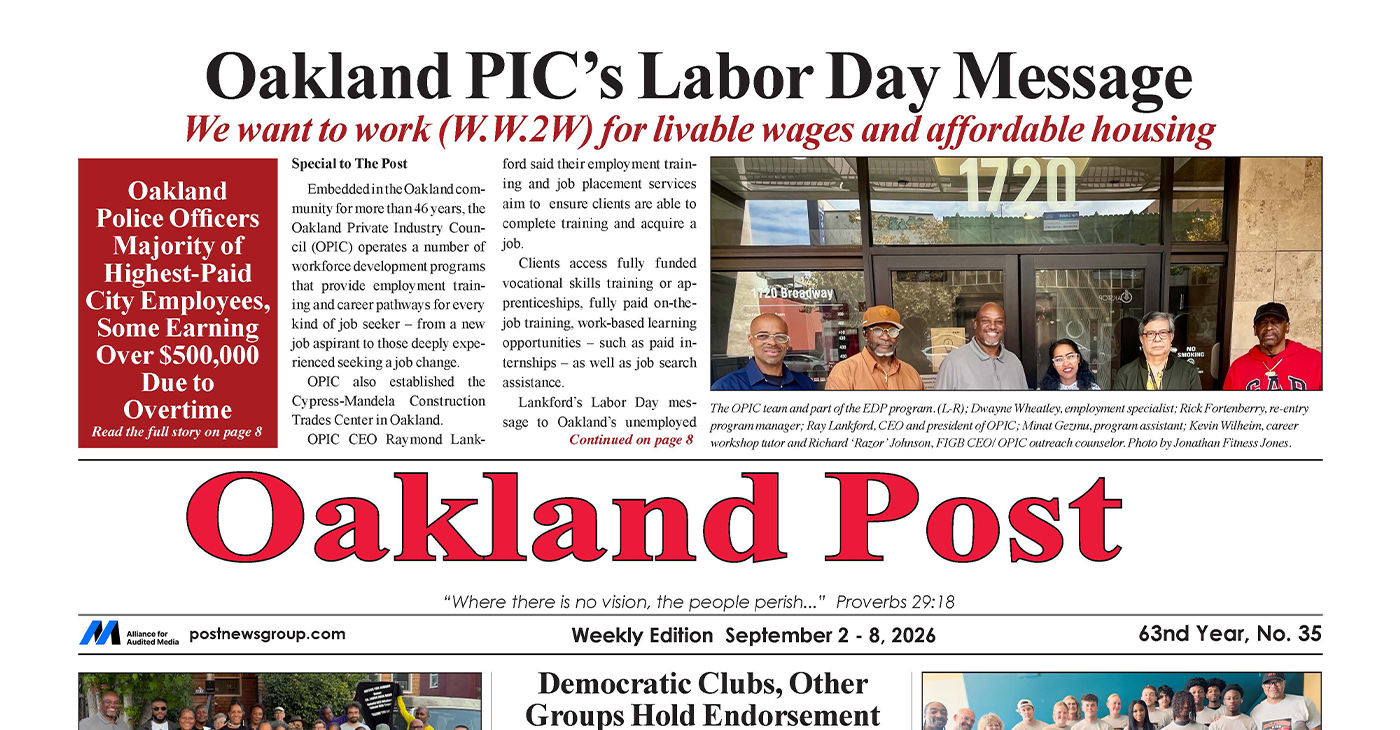
To enlarge your view of this issue, use the slider, magnifying glass icon or full page icon in the lower right corner of the browser window.



Doulas Are Helping Black California Moms Navigate Pregnancy–Even as High Mortality Rates Persist

Newsom Signs Addictive Social Media Law to Protect Kids

On Your November Ballot: Prop 38 Would Allocate $8.4 Billion to Immunology and Immunotherapy Funding

Ask California: Golden State Releases New AI Chatbot

Asm. Isaac Bryan’s Bill Banning California Police From ICE Side Jobs Reaches Newsom’s Desk

Assemblymember LaShae Sharp-Collins’s Bill Would Pause Law Enforcement’s Use of Shock Gloves Pending Study

BOOK REVIEW: ‘Laws of Solomon’ Reveals Tender Heart of Former Child Soldier

OPINION: The New American Fear – From 9-11 to AI

Passing for White, Fighting for Black America: The Courage of Walter White

Oakland People’s Arms Embargo Coalition Demands End to Military Shipments Thru Oakland

Barbara Lee Mourns Gloria Steinem, Remembers a Friendship Rooted in Equality

Event Preview: ‘Fashion v. Fascism’ – A Runway Revolution Is Coming to the Bay Area

Two Looming Threats Every Alameda County Elder Should Know About

Oakland Mayor Reads to Children at Bookout Block Party at Marcus Books Store

Tradition Comes to the Streets in 11th Annual Black-Eyed Pea Festival at the Freedom Farmers Market

Less Affluent School Districts, Including Sacramento City, Face Threat of State Takeover

ESSAY: California Can Close Its Colorectal Cancer Gap

California Hispanic Chambers of Commerce Unveils: ‘Powering the Future’ Theme for 47th Annual Statewide Convention

Four Candidates, Including Incumbent Barbara Lee, Qualify for Oakland Mayor’s Race

Oakland Post: Week of August 12 – 18, 2026

From Blueprint to Breakthrough: Tackling Affordable Housing in Oakland

Oakland Observes Black August with Block Parties, Film Showings, Workshops

COMMENTARY: Why Local School Tax Measure G1 Will Not Be on the November Ballot

Standoff for Justice: Our Homes Are Worth Fighting For

Returning to Its Roots, the Oakland Black-Eyed Pea Festival Partners with the Freedom Farmers Market Sept. 12

Oakland Post: Week of August 26 – September 1, 2026

NPRC Scores First Advocacy Victory: David Shaw Finally Gets His Wish to ‘Go Home’

Frontier Airlines’ Return to Oakland Airport Brings Flights, Jobs and Opportunity

Gubernatorial Candidate Steve Hilton Blasts California New Tire Rules; Newsom Hits Back

Chef Sharon Lee Blends Culinary Excellence, Education and Empowerment

The Conversation With Al McFarlane 6/23/26

Media Monday 6/22/26

LIVE! ASK ALMA! — TUES. 6.23.26 7PM EST

Car Buying Secrets: 4 Hidden Checks Before You Sign!

Is This 550 HP Charger Worth YOUR Money? AutoNetwork Review

Celebrating Juneteenth – Frederick Douglass on education and resistance

LIVE! — ASK ALMA! — TUES. 6.19.26 7PM EST

Hyundai Ioniq 5 Parking, Safety, and 360 View #shorts

2025 Ioniq 5 New Wiper & Powerful Performance! #shorts

Electric SUV Range: Is 259 Miles Enough? #shorts

EV Charging: How Fast Can You Charge an Electric Vehicle? #shorts

Biometric Cooling… Messaging Seats…Come on! 2025 Infiniti QX80 Autograph 4WD

Charged Up: Witness the Magic of a Fully Electric Car! #shorts

Range Rover Sport PHEV Included…: See What’s Inside This Luxury SUV! #shorts

Invisible Hood View: Perfect Parking with X-Ray Vision! #shorts
-
 Commentary4 weeks ago
Standoff for Justice: Our Homes Are Worth Fighting For
-
 Activism4 weeks ago
Oakland Post: Week of August 26 – September 1, 2026
-
 Business4 weeks ago
Frontier Airlines’ Return to Oakland Airport Brings Flights, Jobs and Opportunity
-
 Business4 weeks ago
Gubernatorial Candidate Steve Hilton Blasts California New Tire Rules; Newsom Hits Back
-
 Business4 weeks ago
Chef Sharon Lee Blends Culinary Excellence, Education and Empowerment
-

 Community4 weeks ago
Big City Mayors Ask for “Yes” Vote on Housing Bond Measure; Conservatives Say “No”
-

 Education4 weeks ago
Gov. Newsom’s Latest Appointees Include Sacramento Advocate for Formerly Incarcerated Students; State’s New Tech Chief
-

 Black History4 weeks ago
Jackie Wright Champions Bay Area Stories, Filmmakers and Cultural Institutions
