
Bay Area
San Francisco Declares Water Shortage Emergency in Response to Statewide Drought
The average San Franciscan uses 42 gallons of water per day at home—one of the lowest rates in California and less than half of the statewide average of about 90 gallons per person per day. In April, the SFPUC called upon its 1,600 irrigation customers and City departments to reduce water use and asked all customers to reduce water waste, which helped lead to an overall reduction of water use in San Francisco through November 2021.


Voluntary action calls for 10% reduction in water usage system-wide
From S.F. Mayor’s Office
Mayor London N. Breed and the San Francisco Public Utilities Commission (SFPUC) last week declared a water shortage emergency and approved measures aimed at further conserving and reducing water usage across the SFPUC’s service territory in response to exceptionally dry weather conditions that have affected the entire state over the past two years.
As a result of the emergency measure, which the SFPUC unanimously approved, San Francisco has declared a 10% reduction in water usage across its regional system.
The 10% reduction will be compared to water use from July 2019 to June 2020 and will be applied to all of the SFPUC’s 2.7 million customers, which include customers in San Francisco, Alameda, Santa Clara, and San Mateo counties. The call for voluntary water reduction will go into effect immediately.
“With California still experiencing devastating drought and the uncertainty around this rainy season, we need to make tough decisions that will ensure that our water source continues to be reliable and dependable for the future,” said Breed.
“Year after year, San Franciscans step up to conserve our most precious resource, resulting in one of the lowest water usage rates in California, and during this critical time, I know that our City will once again meet the call to reduce water use,” she said. “I applaud the SFPUC Commission for declaring a water shortage emergency and urging our customers to be mindful of their water usage.

“We are in a drought with far-reaching consequences, and it has become clear we all need to do even more to address it,” SFPUC General Manager Dennis Herrera said. “San Franciscans have been doing their part and have some of the lowest water usage in the state. This emergency water shortage declaration will help all of our customers pull together and move in the same direction. We know we can rely on each other. I’m confident that everyone will do their part so we can all get through this.”
With the declaration of the emergency water shortage, the City is poised to launch a water conservation public awareness campaign that will include the SFPUC’s outreach channels and strategically targeted paid media advertising.
The messages will be conveyed in multiple languages and will include tips and resources on actions that customers can take to reduce their water usage to help achieve the 10% reduction system-wide, such as fixing leaky toilets, installing low-flow fixtures, reducing outdoor irrigation, and receiving water usage audits from SFPUC professionals.
The average San Franciscan uses 42 gallons of water per day at home—one of the lowest rates in California and less than half of the statewide average of about 90 gallons per person per day. In April, the SFPUC called upon its 1,600 irrigation customers and City departments to reduce water use and asked all customers to reduce water waste, which helped lead to an overall reduction of water use in San Francisco through November 2021.
However, with the state continuing to experience extremely dry weather overall, the SFPUC is expanding on those efforts by declaring a water shortage emergency, which will help the agency access water reserves and resources available only during emergencies.
The SFPUC has about 360,000 acre-feet of reserve water in its water bank. An acre-foot is enough water for about two California households annually on average.
However, the State Water Board’s curtailment orders, emergency regulations issued in August 2021 that restrict diversions from the Tuolumne River watershed, effectively prevent the SFPUC from accessing that water bank.
Due to the Water Board’s curtailment orders, the SFPUC and its retail and wholesale customers are less prepared to address drought conditions moving forward.
“We need everyone to take action to preserve and stretch our limited water supplies,” SFPUC Commission President Anson Moran said. “San Franciscans and our wholesale customers have been doing a good job when it comes to being efficient with their water use. We can all do better. We look forward to working with all of our customers to further reduce water use.”
Declaring a water shortage emergency carries with it the requirement that the SFPUC institute a temporary drought surcharge for retail water and wastewater customers of up to 5% on part of their bill.
The SFPUC Commission voted to introduce the surcharge on April 1, 2022. The effect on the average residential customer’s bill is estimated to be a little over $6 per month if they made no reductions to their water use. The temporary drought surcharge will automatically end when the SFPUC Commission rescinds the water shortage emergency declaration.
Earlier this year, Governor Gavin Newsom declared a Drought Emergency for 50 of the 58 counties in California and called on all Californians to voluntarily reduce water use by 15%. The state’s ongoing drought has increased the significance of water reuse, recycling, and conservation programs, measures SFPUC has long championed.
More information is available at www.sfpuc.org/savewater.











Activism
Oakland Post: Week of September 16 – 22, 2026
The printed Weekly Edition of the Oakland Post: Week of September 16 – 22, 2026

To enlarge your view of this issue, use the slider, magnifying glass icon or full page icon in the lower right corner of the browser window.
Activism
Oakland Post: Week of September 9 – 15, 2026
The printed Weekly Edition of the Oakland Post: Week of September 9 – 15, 2026

To enlarge your view of this issue, use the slider, magnifying glass icon or full page icon in the lower right corner of the browser window.
Activism
Oakland Post: Week of September 2 – 8, 2026
The printed Weekly Edition of the Oakland Post: Week of September 2 – 8, 2026
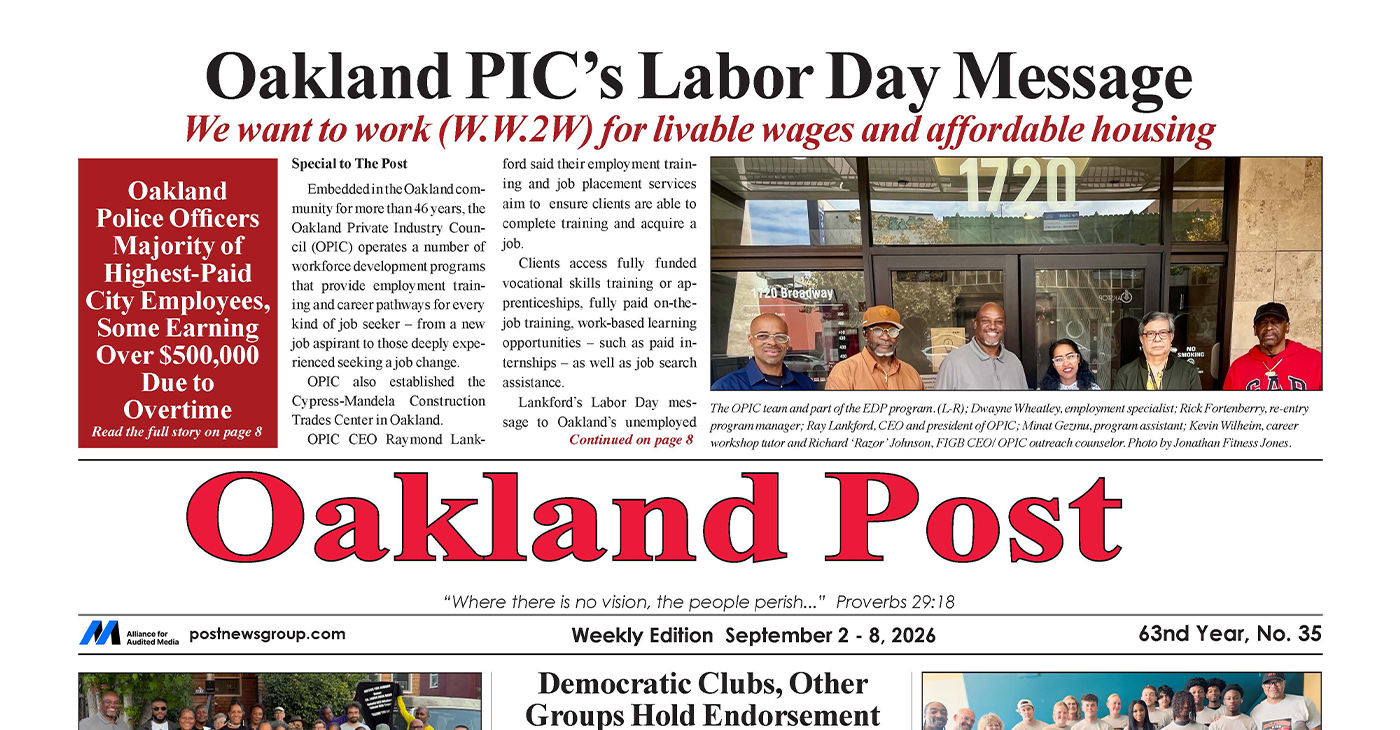
To enlarge your view of this issue, use the slider, magnifying glass icon or full page icon in the lower right corner of the browser window.



Doulas Are Helping Black California Moms Navigate Pregnancy–Even as High Mortality Rates Persist

Newsom Signs Addictive Social Media Law to Protect Kids

On Your November Ballot: Prop 38 Would Allocate $8.4 Billion to Immunology and Immunotherapy Funding

Ask California: Golden State Releases New AI Chatbot

Asm. Isaac Bryan’s Bill Banning California Police From ICE Side Jobs Reaches Newsom’s Desk

Assemblymember LaShae Sharp-Collins’s Bill Would Pause Law Enforcement’s Use of Shock Gloves Pending Study

BOOK REVIEW: ‘Laws of Solomon’ Reveals Tender Heart of Former Child Soldier

OPINION: The New American Fear – From 9-11 to AI

Passing for White, Fighting for Black America: The Courage of Walter White

Oakland People’s Arms Embargo Coalition Demands End to Military Shipments Thru Oakland

Barbara Lee Mourns Gloria Steinem, Remembers a Friendship Rooted in Equality

Event Preview: ‘Fashion v. Fascism’ – A Runway Revolution Is Coming to the Bay Area

Two Looming Threats Every Alameda County Elder Should Know About

Oakland Mayor Reads to Children at Bookout Block Party at Marcus Books Store

Tradition Comes to the Streets in 11th Annual Black-Eyed Pea Festival at the Freedom Farmers Market

Less Affluent School Districts, Including Sacramento City, Face Threat of State Takeover

ESSAY: California Can Close Its Colorectal Cancer Gap

California Hispanic Chambers of Commerce Unveils: ‘Powering the Future’ Theme for 47th Annual Statewide Convention

Four Candidates, Including Incumbent Barbara Lee, Qualify for Oakland Mayor’s Race

Oakland Post: Week of August 12 – 18, 2026

From Blueprint to Breakthrough: Tackling Affordable Housing in Oakland

Oakland Observes Black August with Block Parties, Film Showings, Workshops

COMMENTARY: Why Local School Tax Measure G1 Will Not Be on the November Ballot

Standoff for Justice: Our Homes Are Worth Fighting For

Returning to Its Roots, the Oakland Black-Eyed Pea Festival Partners with the Freedom Farmers Market Sept. 12

NPRC Scores First Advocacy Victory: David Shaw Finally Gets His Wish to ‘Go Home’

Oakland Post: Week of August 26 – September 1, 2026

Frontier Airlines’ Return to Oakland Airport Brings Flights, Jobs and Opportunity

Gubernatorial Candidate Steve Hilton Blasts California New Tire Rules; Newsom Hits Back

Chef Sharon Lee Blends Culinary Excellence, Education and Empowerment

The Conversation With Al McFarlane 6/23/26

Media Monday 6/22/26

LIVE! ASK ALMA! — TUES. 6.23.26 7PM EST

Car Buying Secrets: 4 Hidden Checks Before You Sign!

Is This 550 HP Charger Worth YOUR Money? AutoNetwork Review

Celebrating Juneteenth – Frederick Douglass on education and resistance

LIVE! — ASK ALMA! — TUES. 6.19.26 7PM EST

Hyundai Ioniq 5 Parking, Safety, and 360 View #shorts

2025 Ioniq 5 New Wiper & Powerful Performance! #shorts

Electric SUV Range: Is 259 Miles Enough? #shorts

EV Charging: How Fast Can You Charge an Electric Vehicle? #shorts

Biometric Cooling… Messaging Seats…Come on! 2025 Infiniti QX80 Autograph 4WD

Charged Up: Witness the Magic of a Fully Electric Car! #shorts

Range Rover Sport PHEV Included…: See What’s Inside This Luxury SUV! #shorts

Invisible Hood View: Perfect Parking with X-Ray Vision! #shorts
-
 Commentary4 weeks ago
Standoff for Justice: Our Homes Are Worth Fighting For
-
 Activism4 weeks ago
Oakland Post: Week of August 26 – September 1, 2026
-
 Business4 weeks ago
Frontier Airlines’ Return to Oakland Airport Brings Flights, Jobs and Opportunity
-
 Business4 weeks ago
Gubernatorial Candidate Steve Hilton Blasts California New Tire Rules; Newsom Hits Back
-
 Business4 weeks ago
Chef Sharon Lee Blends Culinary Excellence, Education and Empowerment
-

 Education4 weeks ago
Gov. Newsom’s Latest Appointees Include Sacramento Advocate for Formerly Incarcerated Students; State’s New Tech Chief
-

 Community4 weeks ago
Big City Mayors Ask for “Yes” Vote on Housing Bond Measure; Conservatives Say “No”
-

 Business4 weeks ago
Oakland Coliseum Project Opens Door for Small Businesses to Build Bigger
