
City Government
Residents Ask: Where Are the Community Benefits on Port Railway Project?

The future of Oakland as a conduit for global commerce took a big step forward recently when the Port of Oakland and Union Pacific Railroad started construction on a project to link the ongoing development at the old Oakland Army Base to the railroad’s main line.
<p>
But community activists are asking if Oakland residents are going to be part of this commercial future and if they are going to have a say in this public investment.
They want the port to sit down with them to negotiate the benefits and the impact of this project. They say the port had a few meetings with them and then stopped meeting.
“They’ve presented nothing to us –they have not given us any idea of the level of community benefits they are considering,” said Margaret Gordon of the West Oakland Environmental Indicators Project and OaklandWorks Alliance.
“We’ve given them proposals, and they have not responded to us,” Gordon said. Port officials only met with local residents three times to discuss community benefits, the last time right before the election, she said.
In addition, she said, the port never explained the development plan to the community.
As of Wednesday of this week, the port has sent a message offering to schedule a meeting in February to talk with community members.

“The Port of Oakland has never sat down and said what benefits represent their commitment to the people of Oakland,” said Brian Beveridge of the West Oakland Environmental Indicators Project and OaklandWorks.
“My question is: Why does the port continue to demand unilateral control over the community benefit discussion with West Oakland residents? What are they so afraid of?” Asked Beveridge.
In response to community complaints, the port is saying it will restart community benefits meetings after it picks a developer for the port side of the Army Base development project.
The $25 million project is financed by the Port of Oakland and the California Transportation Commission’s Trade Corridors Improvement Fund. It’s part of a $100 million port effort to significantly expand Oakland rail capacity.
A 7,400-foot lead track and the reconfiguration of adjacent tracks should be completed in October. Once finished, the port will be better positioned to receive bulk rail shipments at the former army base from Union Pacific and BNSF railroads.
The port and City of Oakland expect to transform Trans-Pacific supply chains at the 360-acre former army base logistics center. Located on the Port’s Outer Harbor, it would include warehousing, trans-load facilities and a dry-bulk cargo terminal.
“Connecting the Oakland Army Base to the national rail network is a milestone for us,” said Chris Chan, the port’s engineering director. “To be successful, we must have good rail access.”
Bulk shipments of commodities such as Midwest grain and beef could be delivered to Oakland by rail, trans-loaded into containers at the port, and then exported via Asia-bound container vessels.
According to Amy Tharpe, the port’s Director of Social Responsibility, the Port of Oakland is interested in meeting with community members who will be impacted by the Army Base project.
“The Port of Oakland is committed to developing a community benefits package for the redevelopment of the Port’s portion of the former Oakland Army Base,” said Tharpe.
“To ensure this we have to hear from the people in our community who will be impacted by the project and could benefit from it,” she said. “We’ve held several meetings that began last year with multiple key stakeholders from more than ten community groups.”
“Once a development partner is selected,” she continued, “the Port will schedule more community meetings to create a specific community benefits agreement.”





Activism
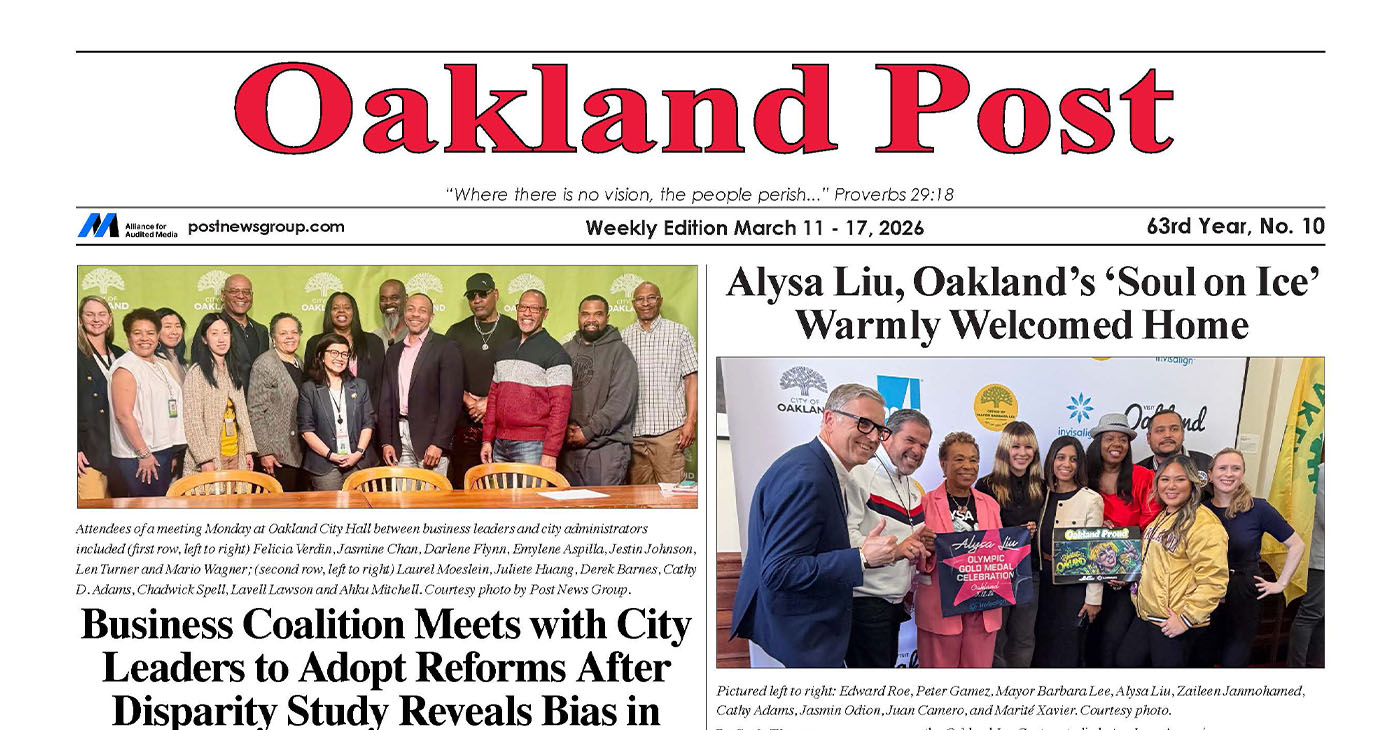
Oakland Post: Week of March 11 -17, 2026
The printed Weekly Edition of the Oakland Post: Week of March 11 – 17, 2026
To enlarge your view of this issue, use the slider, magnifying glass icon or full page icon in the lower right corner of the browser window.
Activism
Oakland Post: Week of March 4 – 10, 2026
The printed Weekly Edition of the Oakland Post: Week of March 4 – 10, 2026

To enlarge your view of this issue, use the slider, magnifying glass icon or full page icon in the lower right corner of the browser window.
Activism
Oakland Post: Week of February 25 – March 3, 2026
The printed Weekly Edition of the Oakland Post: Week of – February 25 – March 3, 2026

To enlarge your view of this issue, use the slider, magnifying glass icon or full page icon in the lower right corner of the browser window.


WORK FROM HOME
Home-based business with potential monthly income of $10K+ per month. A proven training system and website provided to maximize business effectiveness. Perfect job to earn side and primary income. Contact Lynne for more details: Lynne4npusa@gmail.com 800-334-0540


Financial Wellness and Mental Health: Managing Money Stress in College

Oakland Post: Week of March 11 -17, 2026

Women & Wealth: Tips for Navigating Your Lifelong Financial Journey

COMMENTARY: Women of Color Shape Our Past and Future

Woman’s Search for Family’s Roots Leads to Ancestor John T. Ward – A Successful Entrepreneur and Conductor on the Underground Railroad

Advocates Raise Alarm Over ICE Operation, MOU and Detention Risks in Baltimore County

Pete Buttigieg to Join Mayor Randall Woodfin for Community Town Hall in Birmingham

WATCH: Week One – NNPA’s “Leadership Matters” Video Series

Oakland Post: Week of March 4 – 10, 2026

OP-ED: NNPA Launches 2026 “Leadership Matters” Video Series

PRESS ROOM: PMG and Cranbrook Horizons-Upward Bound Launch Journey Fellowship Cohort 2

Los Angeles Summit Brings Together Leaders to Tackle Poverty and Affordability

Civil Rights TV Launches 24/7 Network Focused on Black History, Education and Equity

REVIEW: The Ultimate Hot Girl Summer Getaway: Sunseeker Resort Florida

COMMENTARY: How You Stop a Prescription Medicine is as Important as How You Start

Book Review: Books on Black History and Black Life for Kids

Community Celebrates Turner Group Construction Company as Collins Drive Becomes Turner Group Drive

California Launches Study on Mileage Tax to Potentially Replace Gas Tax as Republicans Push Back

Discrimination in City Contracts

COMMENTARY: The Biases We Don’t See — Preventing AI-Driven Inequality in Health Care

Black History Events in the East Bay

Post Newspaper Invites NNPA to Join Nationwide Probate Reform Initiative

Art of the African Diaspora Celebrates Legacy and Community at Richmond Art Center

New Bill, the RIDER Safety Act, Would Support Transit Ambassadors and Safety on Public Transit

COMMENTARY: The National Protest Must Be Accompanied with Our Votes

Oakland Post: Week of February 4 – 10, 2026

Oakland Post: Week of February 11 – 17, 2026

Dorothy Lee Bolden: Uniting Domestic Workers

After Don Lemon’s Arrest, Black Officials Raise Concerns About Independent Black Media

Reflecting on Black History Milestones in Birmingham AL

Hyundai Ioniq 5 Parking, Safety, and 360 View #shorts

2025 Ioniq 5 New Wiper & Powerful Performance! #shorts

Electric SUV Range: Is 259 Miles Enough? #shorts

EV Charging: How Fast Can You Charge an Electric Vehicle? #shorts

Biometric Cooling… Messaging Seats…Come on! 2025 Infiniti QX80 Autograph 4WD

Charged Up: Witness the Magic of a Fully Electric Car! #shorts

Range Rover Sport PHEV Included…: See What’s Inside This Luxury SUV! #shorts

Invisible Hood View: Perfect Parking with X-Ray Vision! #shorts

AI Is Reshaping Black Healthcare: Promise, Peril, and the Push for Improved Results in California

ESSAY: Technology and Medicine, a Primary Care Point of View

Sanctuary Cities

The RESISTANCE – FREEDOM NOW

STATE OF THE PEOPLE: Freddie

ECONOMIC BOYCOTT DAY!!!!!

I told You So
-
 #NNPA BlackPress4 weeks ago
Reflecting on Black History Milestones in Birmingham AL
-

 #NNPA BlackPress4 weeks ago
PRESS ROOM: NBA Hall of Fame Nominee Terry Cummings Joins 100 Black Men of DeKalb County to Launch Victory & Values Initiative
-

 #NNPA BlackPress4 weeks ago
U.S. manufacturing rebounds – how foundry services are adapting to rising demand
-

 Activism3 weeks ago
Oakland Post: Week of February 25 – March 3, 2026
-

 #NNPA BlackPress4 weeks ago
OP-ED: One Hundred Years of Black Workers Telling the Truth
-

 #NNPA BlackPress4 weeks ago
Trump’s MAGA Allies are Creating Executive Order Plan to Steal the 2026 Midterms
-

 #NNPA BlackPress4 weeks ago
Advancements in solar technology that are changing the way we power the world
-

 #NNPA BlackPress4 weeks ago
PRESS ROOM: Civil Rights TV Launches in Selma as the World’s First 24/7 Civil Rights Television Network
