
California Black Media
Reparations: Experts Compute Hundreds of Billions Owed to Black Californians
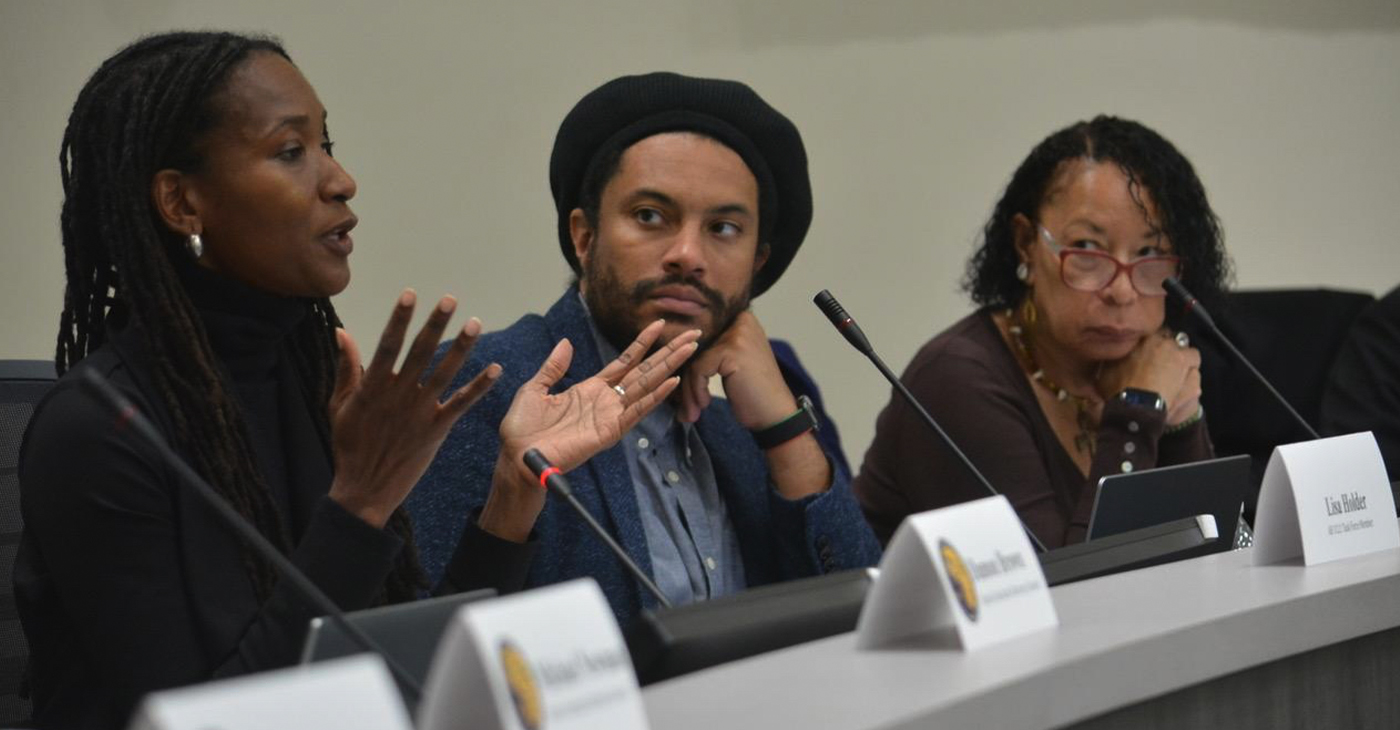
Economists advising The California Task Force to Study and Develop Reparations Proposals for African Americans have developed economic formulas that project the reparations owed to Black Californians who are descendants of people enslaved in the United States are likely to exceed $800 billion.

By Antonio Ray Harvey
California Black Media
Economists advising The California Task Force to Study and Develop Reparations Proposals for African Americans have developed economic formulas that project the reparations owed to Black Californians who are descendants of people enslaved in the United States are likely to exceed $800 billion.
Three of five harms were used in the calculations conducted by a five-member panel of economic experts: health, disproportionate housing discrimination, Black mass incarceration and over-policing are “from a long list of harms” the state “is a least partially responsible for,” said Dr. Thomas Craemer, a professor of public policy at the University of Connecticut and one of the experts involved in the assessment.
Craemer spoke last week at the task force’s 14th meeting held in Sacramento on March 29 and 30. The figures also applies to forebears who survived legal segregation, Jim Crow discrimination and other social and economic injustices.
“These are harms for which we thought that we’d have data, that’s one criterion,” said Craemer. “The other is that they are closely related to the actions of the state of California to make our estimates more defensible in the face of challenges that will undoubtedly arrive once the proposal is made public.”
The economic experts’ analysis and final recommendations for the Task Force regarding calculations of reparations and forms of compensation and restitution were presented by Craemer and Dr. William Spriggs.
Spriggs appeared remotely in front of the task force. He is the former chair of the Department of Economics at Howard University. He now serves as chief economist to the AFL-CIO.
The health harm calculations were determined by the annual loss to “Black, non-Hispanic Californians” from health disparities by computing the 7.6 year-life expectancy gap based on the Value of Statistical Life in the United States.
“That is what statisticians use to evaluate how much each individual places value on their life,” Craemer said. “We then divide the value associated with the gap by the average Black, non-Hispanic Californian expectancy of 71 years to obtain an annual estimate of the loss to Black, non-Hispanic Californians from health disparities.”
The experts use the Black non-Hispanic Californian category because they didn’t have a U.S. Census count available for Black Californians who can trace their ancestors back to slavery in the United States.
Black mass incarceration and over-policing calculations were derived from how many Black, non-Hispanic Californians were arrested for drug felonies above the population percentage during the “War on Drugs” from 1970 to 2020.
It was multiplied by the average prison term for drug offenses and by the average annual California State employee wages to arrive at the estimated total owed to Black Californians who qualify for reparation payments.
Housing discrimination was determined by calculating the average of the Black non-Hispanic Californian wage gap for 1930, 1980, 2019. The amount gave the experts the wealth disparity from all forms of housing discrimination, Craemer said.
“I should mention that what we are estimating is not reparations. What we are estimating are losses to the African American descendants of slaves in the United States,” Craemer said. “Our calculations could be used to come up with determinations of reparations but it’s not necessarily identical. The task force can go above and beyond because how some losses are framed (is) difficult to estimate. (Such as) pain and suffering.”
The last two atrocities – unjust property taken by eminent domain and devaluation of Black businesses — are not readily available in the calculation model because of lack of data, Craemer said. The 1980 amount minus the 1930 amount provides an estimate of the effect of redlining only.
Task Force chairperson and Los Angeles attorney Kamilah V. Moore said some published news headlines have put out misinformed information about the experts’ final calculations.
“The task force has yet to determine a final amount,” Moore said.
The numbers are not concrete, leaving room for the members of the task force to evaluate, modify, or eliminate any of the experts’ findings. Spriggs said the experts are still in “deliberations.”
“I think it’s improper to prejudge what precise number we may recommend, but we’re only giving you expert advice on these specific harms. The task force has full latitude to ignore it, to add it, or take into consideration addressing tangible harms,” Spriggs added.











Activism
Oakland Post: Week of March 18 – 24, 2026
The printed Weekly Edition of the Oakland Post: Week of March 18 – 24, 2026
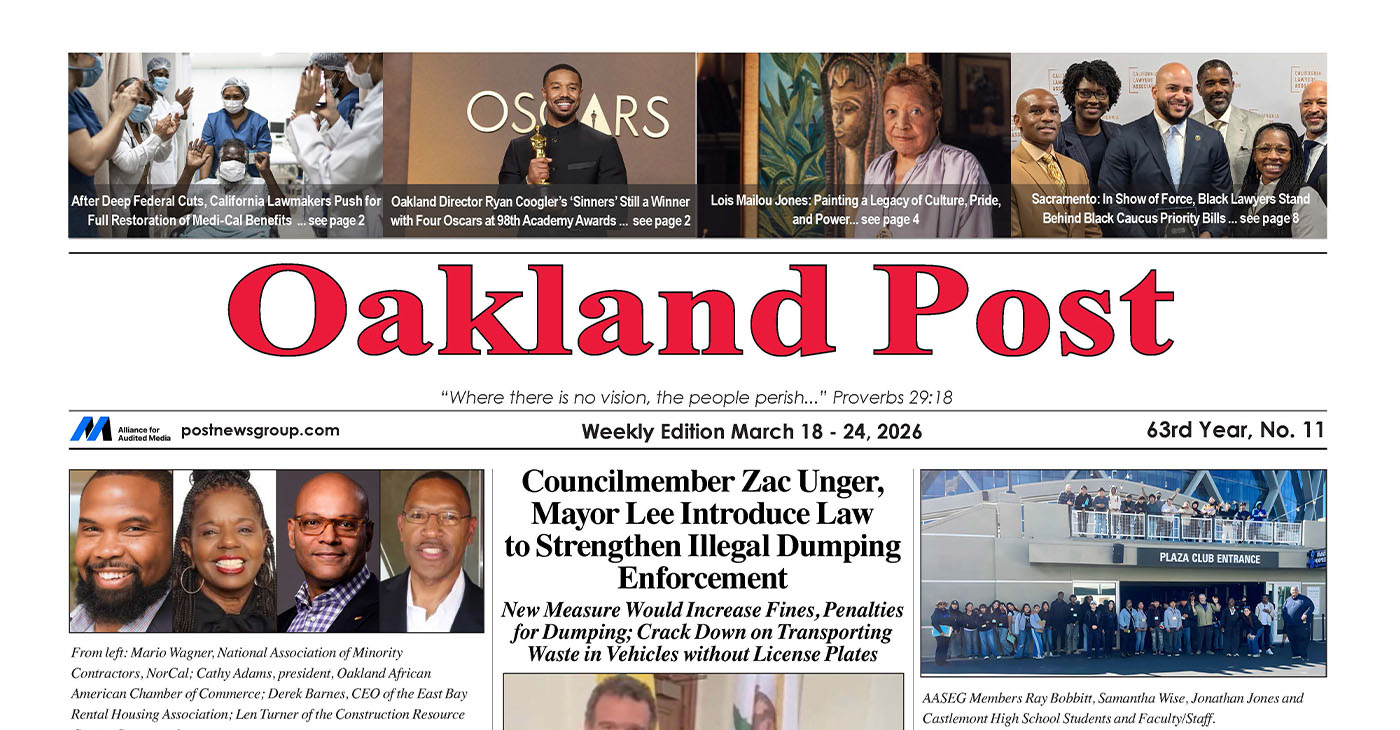
To enlarge your view of this issue, use the slider, magnifying glass icon or full page icon in the lower right corner of the browser window.
Activism
Oakland Post: Week of March 11 -17, 2026
The printed Weekly Edition of the Oakland Post: Week of March 11 – 17, 2026
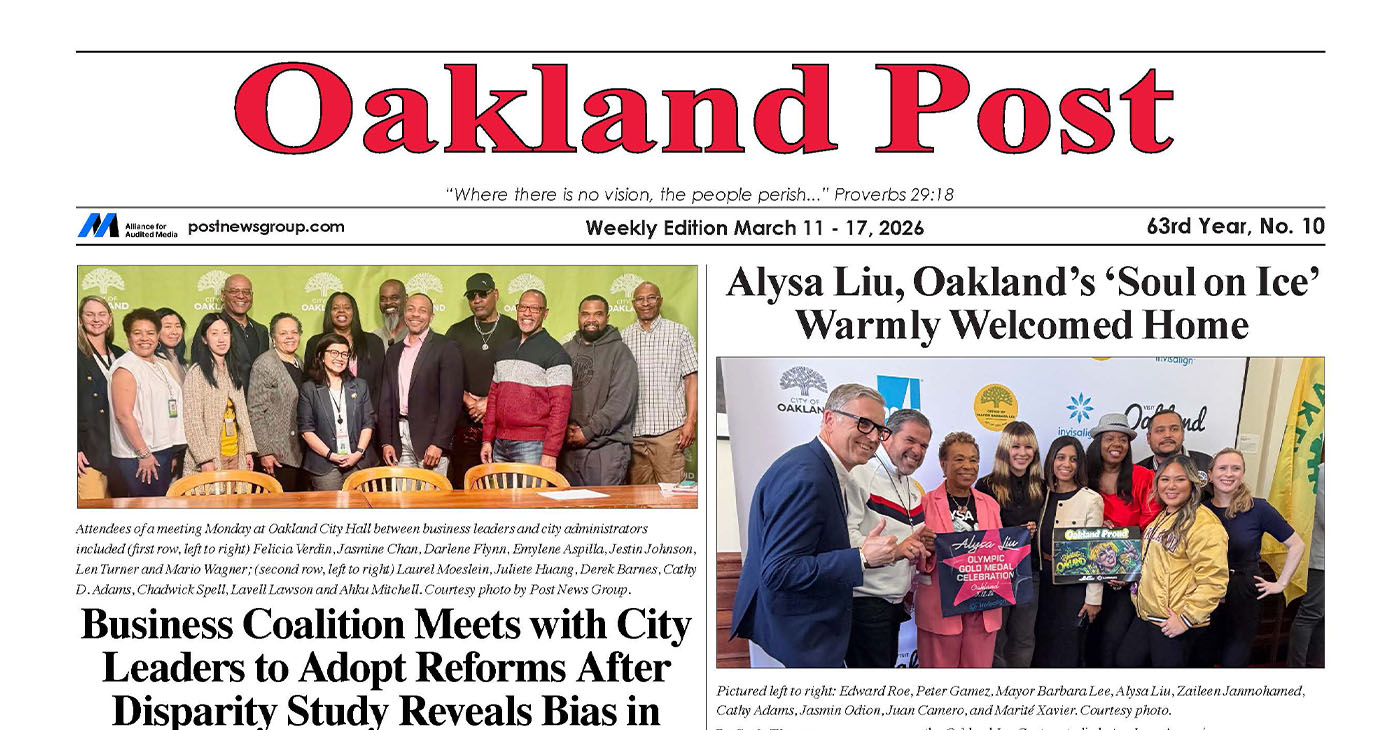
To enlarge your view of this issue, use the slider, magnifying glass icon or full page icon in the lower right corner of the browser window.
Activism
Oakland Post: Week of March 4 – 10, 2026
The printed Weekly Edition of the Oakland Post: Week of March 4 – 10, 2026

To enlarge your view of this issue, use the slider, magnifying glass icon or full page icon in the lower right corner of the browser window.

WORK FROM HOME
Home-based business with potential monthly income of $10K+ per month. A proven training system and website provided to maximize business effectiveness. Perfect job to earn side and primary income. Contact Lynne for more details: Lynne4npusa@gmail.com 800-334-0540


Black Artists in America, Installation Three Wraps at the Dixon Gallery and Gardens

Grief, Advocacy, and Education: A Counselor Reflects on Black Maternal Health

Future of Florida’s Black History Museum in Limbo

New Research Shows the Many Benefits of Early Learning

South Hampton K-8 Students Among Top 10 Finalists for Samsung’s ‘Solve for Tomorrow’ Competition

Cuba: No Negotiation with US on the President or Political System

Brooklyn Academy of Music Names Jamaican-Born Tamara McCaw as President

Trinidad & Tobego – U.S. Launches WhatsApp Channel for American Citizens in the Country

Oakland Post: Week of March 18 – 24, 2026

AI Innovation vs. Ethics and Environmental Impact

AI, Web3, and Digital Reparations

What If You Owned Your AI Agent?

Season 7, Episode 3 – January Reporter’s Roundtable 📱

Season 7, Episode 3 – January Reporter’s Roundtable

AI, Media, and Power | Part 2, Real-World Impacts and Tradeoffs

Oakland Post: Week of February 11 – 17, 2026

Reflecting on Black History Milestones in Birmingham AL

CITY OF SAN LEANDRO STATE OF CALIFORNIA PUBLIC WORKS DEPARTMENT ENGINEERING DIVISION NOTICE TO BIDDERS FOR ANNUAL STREET OVERLAY/REHABILITATION 2019-21 – PHASE III

Oakland Post: Week of February 18 – 24, 2026

PRESS ROOM: NBA Hall of Fame Nominee Terry Cummings Joins 100 Black Men of DeKalb County to Launch Victory & Values Initiative

Oakland Post: Week of February 25 – March 3, 2026

Trump’s MAGA Allies are Creating Executive Order Plan to Steal the 2026 Midterms

U.S. manufacturing rebounds – how foundry services are adapting to rising demand

OP-ED: One Hundred Years of Black Workers Telling the Truth

Advancements in solar technology that are changing the way we power the world

Chase Oakland Community Center Hosts Alley-Oop Accelerator Building Community and Opportunity for Bay Area Entrepreneurs

Poll Shows Support for Policies That Help Families Afford Child Care

Oakland Post: Week of March 4 – 10, 2026

PRESS ROOM: Civil Rights TV Launches in Selma as the World’s First 24/7 Civil Rights Television Network

Woman’s Search for Family’s Roots Leads to Ancestor John T. Ward – A Successful Entrepreneur and Conductor on the Underground Railroad

Hyundai Ioniq 5 Parking, Safety, and 360 View #shorts

2025 Ioniq 5 New Wiper & Powerful Performance! #shorts

Electric SUV Range: Is 259 Miles Enough? #shorts

EV Charging: How Fast Can You Charge an Electric Vehicle? #shorts

Biometric Cooling… Messaging Seats…Come on! 2025 Infiniti QX80 Autograph 4WD

Charged Up: Witness the Magic of a Fully Electric Car! #shorts

Range Rover Sport PHEV Included…: See What’s Inside This Luxury SUV! #shorts

Invisible Hood View: Perfect Parking with X-Ray Vision! #shorts

AI Is Reshaping Black Healthcare: Promise, Peril, and the Push for Improved Results in California

ESSAY: Technology and Medicine, a Primary Care Point of View

Sanctuary Cities

The RESISTANCE – FREEDOM NOW

STATE OF THE PEOPLE: Freddie

ECONOMIC BOYCOTT DAY!!!!!

I told You So

-
 #NNPA BlackPress4 weeks ago
Poll Shows Support for Policies That Help Families Afford Child Care
-
 Activism4 weeks ago
Oakland Post: Week of March 4 – 10, 2026
-
 #NNPA BlackPress3 weeks ago
Woman’s Search for Family’s Roots Leads to Ancestor John T. Ward – A Successful Entrepreneur and Conductor on the Underground Railroad
-

 #NNPA BlackPress4 weeks ago
OP-ED: NNPA Launches 2026 “Leadership Matters” Video Series
-

 #NNPA BlackPress3 weeks ago
Advocates Raise Alarm Over ICE Operation, MOU and Detention Risks in Baltimore County
-

 #NNPA BlackPress3 weeks ago
COMMENTARY: Women of Color Shape Our Past and Future
-

 #NNPA BlackPress3 weeks ago
Pete Buttigieg to Join Mayor Randall Woodfin for Community Town Hall in Birmingham
-
 Activism2 weeks ago
Oakland Post: Week of March 11 -17, 2026
