
Activism
Race and Health Care: New Report Shares Insights on Black Californians
EVITARUS, a Black-owned Los Angeles-based public opinion research firm, is conducting the three-phase study for CHCF. The firm has extensive experience polling California’s diverse constituencies and maintains long-standing relationships with Black-led community organizations and media.


By Antonio Ray Harvey, California Black Media
In keeping with its commitment to ending health inequities, the California Health Care Foundation (CHCF) released the first phase of a three-part study documenting how race and racism shape the health care experiences of Black Californians.
The report, “In Their Own Words: Black Californians on Racism and Health Care,” was written by health services researcher Dr. Linda Cummings. The study synthesizes hour-long interviews with 100 Black Californians conducted from June to August 2021.
According to Katherine Haynes, a senior program officer serving on CHCF’s People-Centered Care team, “The project is to understand the interactions between racism, health and healthcare.” The first phase “is in-depth interviews that are really designed to gain a deep understanding of Black Californians’ perception of racism in this state’s healthcare system and its impact on them.”
CHCF’s main objective is to advance meaningful, measurable improvements in the way the health care delivery system provides care to the people of California, specifically individuals who are financially challenged and whose needs are not well served in the healthcare system.

EVITARUS, a Black-owned Los Angeles-based public opinion research firm, is conducting the three-phase study for CHCF. The firm has extensive experience polling California’s diverse constituencies and maintains long-standing relationships with Black-led community organizations and media.
“Dr. Linda Cummings wrote the report, and we did the research. We designed the study, performed the data collection as well as the data analysis that supported Dr. Cummings and her findings,” according to Shakari Byerly, EVITARUS managing partner. “It was a thorough recruitment process and screening of those that indicated an interest in participation. The participants also received an honorarium (of $125) for their participation.”
Findings from the first phase cautioned that just having a Black physician did not automatically result in better care. Negative experiences with Black physicians and other health providers of color can be an obstacle to health care, too.
“It is the subtle, the microaggressions that happen within the health care field. So, I am resistant to get help unless I feel comfortable with the person who may or may not look like me,” a 33-year-old Black woman from the San Francisco Bay Area said. “But I also have been discriminated against a lot from Black physicians as well.”
Cummings wrote that more than half of the respondents said that, at some time in their lives, they had been unhoused, without a stable place to live, or stayed with a family member or friend because they did not have a place of their own.
Notably, the study highlighted that the participants took their health care seriously.
“The respondents really spoke about how they were taking action to pursue health, advocating for themselves in the health care system and taking steps to protect themselves from harm in the health care system,” said Haynes.
Nearly all the respondents (93%) had some form of health insurance. The majority were covered through employer-sponsored plans at 40% or Medi-Cal at 26%, the study reports.
The mix of participants also reflected the ethnic diversity of Black Californians. The majority of respondents identified as Black or African American (83%), Black and multiracial (6%), African (5%), Afro-Caribbean (4%), Afro-Latino (1%), and Black-Native American (1%), Byerly said.
“Everyone identified as Black, but we recognize that people come from different backgrounds,” Byerly said. “It supports our research design to make sure that we show a full range of our community in California.”
Byerly also shared that 62% of the participants said they have experienced “some type of discrimination” based on their background while getting healthcare for themselves. About 59% said they were treated unfairly while getting healthcare for a family member, she added.
Phase II of the ‘Listening to Black Californians’ study examines “structural issues” in the health care system gleaned from focus group discussions with Black Californians and key health care stakeholders,” Haynes said.
The third and final phase of the study will be a statewide survey of Black California residents. It will be crafted to evaluate the extent to which the Phase I and Phase II findings are represented in the general Black Californian population.
“The second phase, with 18 focus groups, was completed right before the winter holidays. The third phase, we hope, will have over 3,000 Black-Californian participants,” Hayes said. “The final report is expected in the summer of 2022.”











Activism
Oakland Post: Week of September 30 – October 6, 2026
The printed Weekly Edition of the Oakland Post: Week of September 30 – October 6, 2026

To enlarge your view of this issue, use the slider, magnifying glass icon or full page icon in the lower right corner of the browser window.
Activism
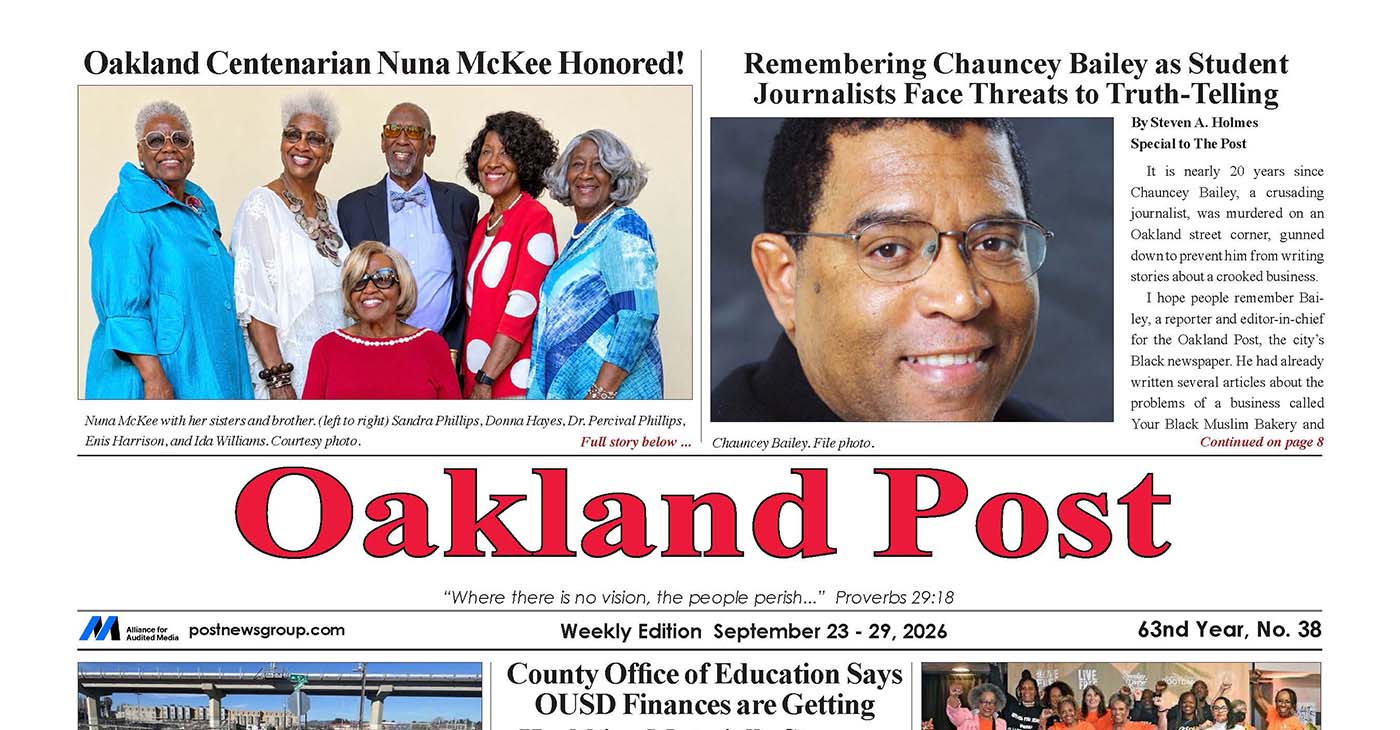
Oakland Post: Week of September 23 – 29, 2026
The printed Weekly Edition of the Oakland Post: Week of September 23 – 29, 2026
To enlarge your view of this issue, use the slider, magnifying glass icon or full page icon in the lower right corner of the browser window.
Activism
Oakland Post: Week of September 16 – 22, 2026
The printed Weekly Edition of the Oakland Post: Week of September 16 – 22, 2026
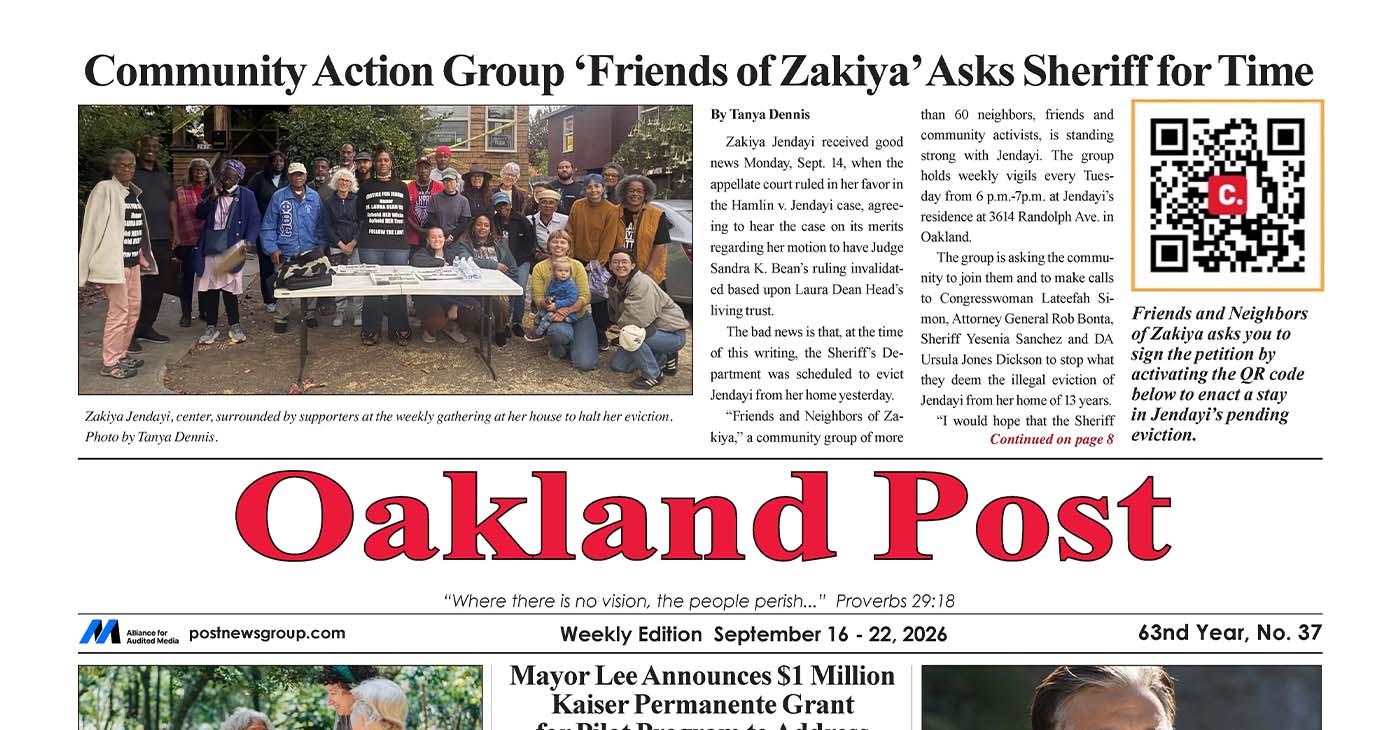
To enlarge your view of this issue, use the slider, magnifying glass icon or full page icon in the lower right corner of the browser window.



OP-ED: Proposition 44 Would Put a Price on Trust

OP-ED: Proposition 40: It’s Time to Play Chess, Not Checkers

Listening as a Lifeline: A Doula’s Witness to Black Maternal Health

New Protections for Ticket Buyers: Gov. Newsom Signs Assemblymember Isaac Bryan’s Bill

‘We Don’t Talk Trash — We Pick Up Trash!’

Zakiya Jendayi Arrested, Locked Out of Home by Sheriff’s Deputies

Oakland Post: Week of September 30 – October 6, 2026

Asm. Corey Jackson Announces Launch of 24-Hour Childcare in His District

IN MEMORIAM: The Rev. Leon “Sonny” Clark, Longtime Orange County Pastor and Community Leader, Dies at 72

Poll: Becerra Widens His Lead Over Hilton; Californians Split on Wealth Tax

From Historic Memories to New Possibilities: Oakland Celebrates Coliseum 60

County Office of Education Says OUSD Finances Are Getting Healthier, Materially Stronger

LIVE FREE Sunday Dinner Brings Faith, Fellowship and Civic Conversation to Oakland

Remembering Chauncey Bailey as Student Journalists Face Threats to Truth-Telling

BLACspace Cooperative Invites Bay Area to Experience Oakland’s Black Cultural Ecosystem Through a BLAC Map Tour + Party

Standoff for Justice: Our Homes Are Worth Fighting For

Oakland Post: Week of August 26 – September 1, 2026

Frontier Airlines’ Return to Oakland Airport Brings Flights, Jobs and Opportunity

Jackie Wright Champions Bay Area Stories, Filmmakers and Cultural Institutions

Gubernatorial Candidate Steve Hilton Blasts California New Tire Rules; Newsom Hits Back

Chef Sharon Lee Blends Culinary Excellence, Education and Empowerment

Misnamed ‘Parent’ PAC Seeks to Influence Oakland School Board Elections

Oakland Coliseum Project Opens Door for Small Businesses to Build Bigger

Big City Mayors Ask for “Yes” Vote on Housing Bond Measure; Conservatives Say “No”

Gov. Newsom’s Latest Appointees Include Sacramento Advocate for Formerly Incarcerated Students; State’s New Tech Chief

Oakland Post: Week of September 2 – 8, 2026

Longtime BWOPA Member Brendalyn Goodall Appointed to California Workforce Development Board

Gov. Newsom Signs Law Shielding Immigration Aid Workers From Doxing Threats

Secretary of State Shirley N. Weber Urges Californians to Vote Early as Voter ID Battle Intensifies

Oakland Post: Week of September 9 – 15, 2026

The Conversation With Al McFarlane 6/23/26

Media Monday 6/22/26

LIVE! ASK ALMA! — TUES. 6.23.26 7PM EST

Car Buying Secrets: 4 Hidden Checks Before You Sign!

Is This 550 HP Charger Worth YOUR Money? AutoNetwork Review

Celebrating Juneteenth – Frederick Douglass on education and resistance

LIVE! — ASK ALMA! — TUES. 6.19.26 7PM EST

Hyundai Ioniq 5 Parking, Safety, and 360 View #shorts

2025 Ioniq 5 New Wiper & Powerful Performance! #shorts

Electric SUV Range: Is 259 Miles Enough? #shorts

EV Charging: How Fast Can You Charge an Electric Vehicle? #shorts

Biometric Cooling… Messaging Seats…Come on! 2025 Infiniti QX80 Autograph 4WD

Charged Up: Witness the Magic of a Fully Electric Car! #shorts

Range Rover Sport PHEV Included…: See What’s Inside This Luxury SUV! #shorts

Invisible Hood View: Perfect Parking with X-Ray Vision! #shorts
-
 Community4 weeks ago
Misnamed ‘Parent’ PAC Seeks to Influence Oakland School Board Elections
-
 Activism4 weeks ago
Oakland Post: Week of September 9 – 15, 2026
-

 Community4 weeks ago
Richmond Tiny House Village Farm & Garden Set to Open Gates on Sept. 26
-

 Black History4 weeks ago
Latest Massacre in Haiti Reveals Cruelty U.S. Deportations
-

 Black History4 weeks ago
OPINION: Nolan Wells’ Death One of Several Signifying Racial Terror Lives on in U.S. South
-

 Business3 weeks ago
Mayor Lee Announces $1 Million Kaiser Permanente Grant for Pilot Program to Address Homelessness, Clean Up Public Spaces throughout Oakland
-

 Community4 weeks ago
Democratic Clubs Interview Candidates for Oakland School Board
-
 Economy2 weeks ago
Poll: Becerra Widens His Lead Over Hilton; Californians Split on Wealth Tax
