
Activism
Race and Health Care: New Report Shares Insights on Black Californians
EVITARUS, a Black-owned Los Angeles-based public opinion research firm, is conducting the three-phase study for CHCF. The firm has extensive experience polling California’s diverse constituencies and maintains long-standing relationships with Black-led community organizations and media.


By Antonio Ray Harvey, California Black Media
In keeping with its commitment to ending health inequities, the California Health Care Foundation (CHCF) released the first phase of a three-part study documenting how race and racism shape the health care experiences of Black Californians.
The report, “In Their Own Words: Black Californians on Racism and Health Care,” was written by health services researcher Dr. Linda Cummings. The study synthesizes hour-long interviews with 100 Black Californians conducted from June to August 2021.
According to Katherine Haynes, a senior program officer serving on CHCF’s People-Centered Care team, “The project is to understand the interactions between racism, health and healthcare.” The first phase “is in-depth interviews that are really designed to gain a deep understanding of Black Californians’ perception of racism in this state’s healthcare system and its impact on them.”
CHCF’s main objective is to advance meaningful, measurable improvements in the way the health care delivery system provides care to the people of California, specifically individuals who are financially challenged and whose needs are not well served in the healthcare system.
EVITARUS, a Black-owned Los Angeles-based public opinion research firm, is conducting the three-phase study for CHCF. The firm has extensive experience polling California’s diverse constituencies and maintains long-standing relationships with Black-led community organizations and media.
“Dr. Linda Cummings wrote the report, and we did the research. We designed the study, performed the data collection as well as the data analysis that supported Dr. Cummings and her findings,” according to Shakari Byerly, EVITARUS managing partner. “It was a thorough recruitment process and screening of those that indicated an interest in participation. The participants also received an honorarium (of $125) for their participation.”
Findings from the first phase cautioned that just having a Black physician did not automatically result in better care. Negative experiences with Black physicians and other health providers of color can be an obstacle to health care, too.
“It is the subtle, the microaggressions that happen within the health care field. So, I am resistant to get help unless I feel comfortable with the person who may or may not look like me,” a 33-year-old Black woman from the San Francisco Bay Area said. “But I also have been discriminated against a lot from Black physicians as well.”
Cummings wrote that more than half of the respondents said that, at some time in their lives, they had been unhoused, without a stable place to live, or stayed with a family member or friend because they did not have a place of their own.
Notably, the study highlighted that the participants took their health care seriously.
“The respondents really spoke about how they were taking action to pursue health, advocating for themselves in the health care system and taking steps to protect themselves from harm in the health care system,” said Haynes.
Nearly all the respondents (93%) had some form of health insurance. The majority were covered through employer-sponsored plans at 40% or Medi-Cal at 26%, the study reports.
The mix of participants also reflected the ethnic diversity of Black Californians. The majority of respondents identified as Black or African American (83%), Black and multiracial (6%), African (5%), Afro-Caribbean (4%), Afro-Latino (1%), and Black-Native American (1%), Byerly said.
“Everyone identified as Black, but we recognize that people come from different backgrounds,” Byerly said. “It supports our research design to make sure that we show a full range of our community in California.”
Byerly also shared that 62% of the participants said they have experienced “some type of discrimination” based on their background while getting healthcare for themselves. About 59% said they were treated unfairly while getting healthcare for a family member, she added.
Phase II of the ‘Listening to Black Californians’ study examines “structural issues” in the health care system gleaned from focus group discussions with Black Californians and key health care stakeholders,” Haynes said.
The third and final phase of the study will be a statewide survey of Black California residents. It will be crafted to evaluate the extent to which the Phase I and Phase II findings are represented in the general Black Californian population.
“The second phase, with 18 focus groups, was completed right before the winter holidays. The third phase, we hope, will have over 3,000 Black-Californian participants,” Hayes said. “The final report is expected in the summer of 2022.”












Activism
Oakland Post: Week of April 8 – 14, 2026
The printed Weekly Edition of the Oakland Post: Week of April 8 – 14, 2026

To enlarge your view of this issue, use the slider, magnifying glass icon or full page icon in the lower right corner of the browser window.
Activism
Oakland Post: Week of April 1 – 7, 2026
The printed Weekly Edition of the Oakland Post: Week of April 1 – 7, 2026
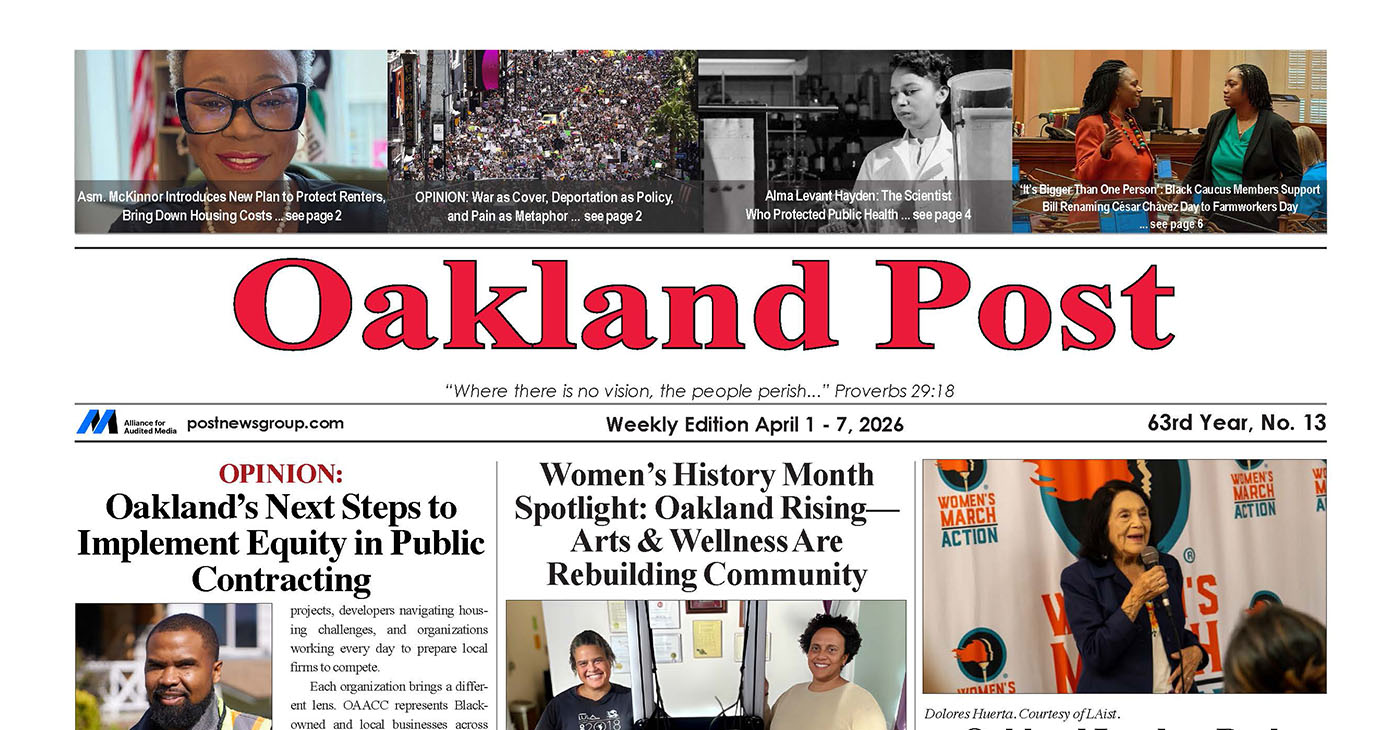
To enlarge your view of this issue, use the slider, magnifying glass icon or full page icon in the lower right corner of the browser window.
Activism
Oakland Post: Week of March 18 – 24, 2026
The printed Weekly Edition of the Oakland Post: Week of March 18 – 24, 2026

To enlarge your view of this issue, use the slider, magnifying glass icon or full page icon in the lower right corner of the browser window.


WORK FROM HOME
Home-based business with potential monthly income of $10K+ per month. A proven training system and website provided to maximize business effectiveness. Perfect job to earn side and primary income. Contact Lynne for more details: Lynne4npusa@gmail.com 800-334-0540


Oakland Post: Week of April 8 – 14, 2026

Oakland Post: Week of April 1 – 7, 2026

Black Artists in America, Installation Three Wraps at the Dixon Gallery and Gardens

Grief, Advocacy, and Education: A Counselor Reflects on Black Maternal Health

Future of Florida’s Black History Museum in Limbo

New Research Shows the Many Benefits of Early Learning

South Hampton K-8 Students Among Top 10 Finalists for Samsung’s ‘Solve for Tomorrow’ Competition

Cuba: No Negotiation with US on the President or Political System

Brooklyn Academy of Music Names Jamaican-Born Tamara McCaw as President

Trinidad & Tobego – U.S. Launches WhatsApp Channel for American Citizens in the Country

Oakland Post: Week of March 18 – 24, 2026

AI Innovation vs. Ethics and Environmental Impact

AI, Web3, and Digital Reparations

What If You Owned Your AI Agent?

Season 7, Episode 3 – January Reporter’s Roundtable 📱

Reflecting on Black History Milestones in Birmingham AL

Oakland Post: Week of February 25 – March 3, 2026

Oakland Post: Week of March 4 – 10, 2026

PRESS ROOM: NBA Hall of Fame Nominee Terry Cummings Joins 100 Black Men of DeKalb County to Launch Victory & Values Initiative

Trump’s MAGA Allies are Creating Executive Order Plan to Steal the 2026 Midterms
Oakland Post: Week of March 18 – 24, 2026

Oakland Post: Week of March 11 -17, 2026

Poll Shows Support for Policies That Help Families Afford Child Care

OP-ED: One Hundred Years of Black Workers Telling the Truth

Financial Wellness and Mental Health: Managing Money Stress in College

Woman’s Search for Family’s Roots Leads to Ancestor John T. Ward – A Successful Entrepreneur and Conductor on the Underground Railroad
New Research Shows the Many Benefits of Early Learning
Brooklyn Academy of Music Names Jamaican-Born Tamara McCaw as President
Grief, Advocacy, and Education: A Counselor Reflects on Black Maternal Health

COMMENTARY: Women of Color Shape Our Past and Future

Hyundai Ioniq 5 Parking, Safety, and 360 View #shorts

2025 Ioniq 5 New Wiper & Powerful Performance! #shorts

Electric SUV Range: Is 259 Miles Enough? #shorts

EV Charging: How Fast Can You Charge an Electric Vehicle? #shorts

Biometric Cooling… Messaging Seats…Come on! 2025 Infiniti QX80 Autograph 4WD

Charged Up: Witness the Magic of a Fully Electric Car! #shorts

Range Rover Sport PHEV Included…: See What’s Inside This Luxury SUV! #shorts

Invisible Hood View: Perfect Parking with X-Ray Vision! #shorts

AI Is Reshaping Black Healthcare: Promise, Peril, and the Push for Improved Results in California

ESSAY: Technology and Medicine, a Primary Care Point of View

Sanctuary Cities

The RESISTANCE – FREEDOM NOW

STATE OF THE PEOPLE: Freddie

ECONOMIC BOYCOTT DAY!!!!!

I told You So
-
 Activism3 weeks ago
Oakland Post: Week of March 18 – 24, 2026
-
 Activism4 weeks ago
Oakland Post: Week of March 11 -17, 2026
-
 Advice4 weeks ago
Financial Wellness and Mental Health: Managing Money Stress in College
-
 #NNPA BlackPress3 weeks ago
New Research Shows the Many Benefits of Early Learning
-
 #NNPA BlackPress3 weeks ago
Brooklyn Academy of Music Names Jamaican-Born Tamara McCaw as President
-
 #NNPA BlackPress3 weeks ago
Grief, Advocacy, and Education: A Counselor Reflects on Black Maternal Health
-
 #NNPA BlackPress3 weeks ago
Future of Florida’s Black History Museum in Limbo
-
 #NNPA BlackPress3 weeks ago
Black Artists in America, Installation Three Wraps at the Dixon Gallery and Gardens
