
Activism
Protests Surge as District Moves to Close Black and Latino Schools
This Saturday, there will be a rally for members of Oakland communities and affected school communities to fight against the closures beginning at 10 a.m. at Prescott Elementary at 920 Campbell St. in West Oakland. Prescott, which celebrated its 150th anniversary in 2019, is one of the predominately Black schools facing closure in June. The school community has pushed back against the district for years as central office administrators tried to suppress the school’s enrollment, urging families not to enroll their children at the school.


By Ken Epstein
More than 2,000 outraged teachers, parents and community members attended a Zoom school board meeting Monday evening to speak out against the closures, consolidations and mergers of 15 predominately Black and Latino schools this year and next year.

Some Oakland schools facing closure this year are (From top, clockwise): Prescott, Horace Mann, Brookfield, Westlake, La Escuelita and Grass Valley. Photos courtesy of OUSD.
The meeting lasted until 3 a.m., with hardly a speaker supporting the closures, as hundreds of speakers opposed these draconian measures, demanding that school and community voices not be ignored. The board majority, led by Board members Gary Yee and Shanthi Gonzales, may be hoping to avoid prolonged protests by rushing to a vote at a special board meeting next Tuesday, Feb. 8 to finalize the closing of the schools in June.
Only Board members VanCedric Williams and Mike Hutchinson are opposing the closures.
This week’s Board meeting may have witnessed the largest turnout at a school board meeting since 2003 when State Receiver Randy Ward took over the reins of the school district and announced he was unilaterally closing about 25 schools.

At that time, thousands filled the street in front of the administration building and packed the hallways and boardroom, forcing terrified overseers to significantly reduce the numbers of schools on the chopping block.
The affected schools are now mobilizing their communities and reaching out to broader communities in Oakland. On Tuesday, Westlake Middle School students and staff walked out and marched to the district headquarters at 1000 Broadway, where several Westlake staff had started a hunger strike. Families, teachers, and students at La Escuelita also walked out and marched to the district office.
This Saturday, there will be a rally for members of Oakland communities and affected school communities to fight against the closures beginning at 10 a.m. at Prescott Elementary at 920 Campbell St. in West Oakland.
Prescott, which celebrated its 150th anniversary in 2019, is one of the predominately Black schools facing closure in June. The school community has pushed back against the district for years as central office administrators tried to suppress the school’s enrollment, urging families not to enroll their children at the school.
The school board and the district administration, while turning a deaf ear to the community, is seeking to satisfy the demands of the Alameda County Superintendent of Schools L. Karen Monroe and state-financed nonprofit agency, Fiscal Crisis Management and Assistance Team (FCMAT), which are demanding school closures and as much as $90 million in budget cuts.
FCMAT made its position clear in a Jan. 4 letter, which was sent to the district, calling for “affirmative board action to continue planning for, and timely implementation of, a school and facility closure and consolidation plan that supports the sale or lease of surplus property.”
Some activists point out that Oakland schools are caught in a vicious cycle at the hands of the state, Monroe and FCMAT. Saying the district was in fiscal crisis, the state and its representatives moved in and took over in 2003 and since then has never left.
While some hold out hopes that officials will someday be satisfied with the endless cuts and closures the state is demanding, it appears they don’t ever plan to give up their behind-the-scenes power over Oakland schools, say school observers.
School activists are also asking how the district can achieve the elusive goal of “fiscal stability” as long as these officials are the ones running OUSD’s finances and continuously moving the goalposts of the nebulous standards of fiscal health.
Since FCMAT arrived in 2003, it has been pushing for closing schools, according to observers of the school district. At first, FCMAT did not justify closures as a way to save money. They said there was a state formula for how much real estate a district should have per student at elementary, middle school, and high school levels — and the district was not aligned with this state formula.
In this writer’s experience, the story was going around the school district administration building in 2003 that there was a plan to transform the district of 58,000 students and over 100 schools into a district that was small enough “to fit in your hands.”
That’s when the rush began to bring charter schools into Oakland, reducing the public school student population by over 13,000 and placing more than 40 charters in the city, costing the district an estimated $57 million a year.





Activism
Oakland Post: Week of March 18 – 24, 2026
The printed Weekly Edition of the Oakland Post: Week of March 18 – 24, 2026

To enlarge your view of this issue, use the slider, magnifying glass icon or full page icon in the lower right corner of the browser window.
Activism
Oakland Post: Week of March 11 -17, 2026
The printed Weekly Edition of the Oakland Post: Week of March 11 – 17, 2026
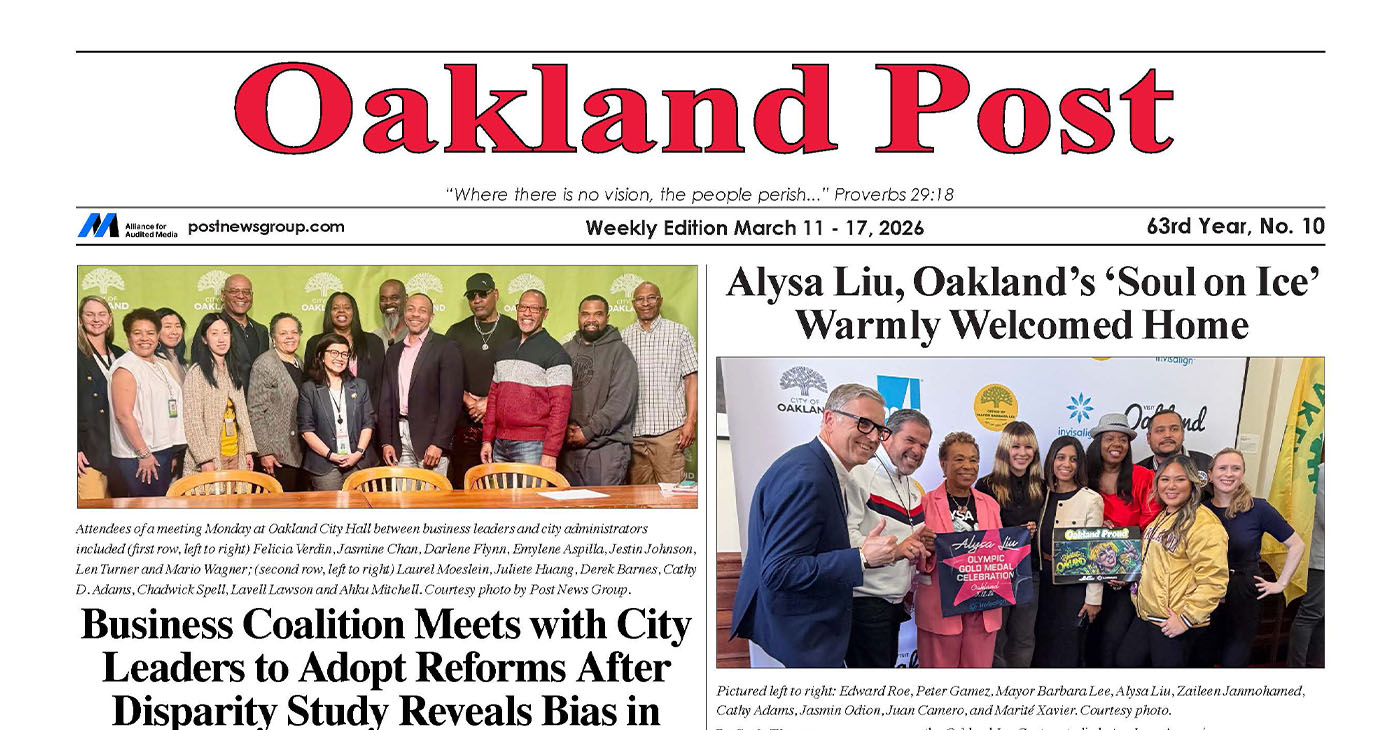
To enlarge your view of this issue, use the slider, magnifying glass icon or full page icon in the lower right corner of the browser window.
Activism
Oakland Post: Week of March 4 – 10, 2026
The printed Weekly Edition of the Oakland Post: Week of March 4 – 10, 2026

To enlarge your view of this issue, use the slider, magnifying glass icon or full page icon in the lower right corner of the browser window.

WORK FROM HOME
Home-based business with potential monthly income of $10K+ per month. A proven training system and website provided to maximize business effectiveness. Perfect job to earn side and primary income. Contact Lynne for more details: Lynne4npusa@gmail.com 800-334-0540


Black Artists in America, Installation Three Wraps at the Dixon Gallery and Gardens

Grief, Advocacy, and Education: A Counselor Reflects on Black Maternal Health

Future of Florida’s Black History Museum in Limbo

New Research Shows the Many Benefits of Early Learning

South Hampton K-8 Students Among Top 10 Finalists for Samsung’s ‘Solve for Tomorrow’ Competition

Cuba: No Negotiation with US on the President or Political System

Brooklyn Academy of Music Names Jamaican-Born Tamara McCaw as President

Trinidad & Tobego – U.S. Launches WhatsApp Channel for American Citizens in the Country

Oakland Post: Week of March 18 – 24, 2026

AI Innovation vs. Ethics and Environmental Impact

AI, Web3, and Digital Reparations

What If You Owned Your AI Agent?

Season 7, Episode 3 – January Reporter’s Roundtable 📱

Season 7, Episode 3 – January Reporter’s Roundtable

AI, Media, and Power | Part 2, Real-World Impacts and Tradeoffs

Oakland Post: Week of February 11 – 17, 2026

Reflecting on Black History Milestones in Birmingham AL

Rising Optimism Among Small And Middle Market Business Leaders Suggests Growth for California

CITY OF SAN LEANDRO STATE OF CALIFORNIA PUBLIC WORKS DEPARTMENT ENGINEERING DIVISION NOTICE TO BIDDERS FOR ANNUAL STREET OVERLAY/REHABILITATION 2019-21 – PHASE III

Oakland Post: Week of February 18 – 24, 2026

PRESS ROOM: NBA Hall of Fame Nominee Terry Cummings Joins 100 Black Men of DeKalb County to Launch Victory & Values Initiative

Oakland Post: Week of February 25 – March 3, 2026

Trump’s MAGA Allies are Creating Executive Order Plan to Steal the 2026 Midterms

U.S. manufacturing rebounds – how foundry services are adapting to rising demand

OP-ED: One Hundred Years of Black Workers Telling the Truth

Advancements in solar technology that are changing the way we power the world

Chase Oakland Community Center Hosts Alley-Oop Accelerator Building Community and Opportunity for Bay Area Entrepreneurs

Poll Shows Support for Policies That Help Families Afford Child Care

Oakland Post: Week of March 4 – 10, 2026

PRESS ROOM: Civil Rights TV Launches in Selma as the World’s First 24/7 Civil Rights Television Network

Hyundai Ioniq 5 Parking, Safety, and 360 View #shorts

2025 Ioniq 5 New Wiper & Powerful Performance! #shorts

Electric SUV Range: Is 259 Miles Enough? #shorts

EV Charging: How Fast Can You Charge an Electric Vehicle? #shorts

Biometric Cooling… Messaging Seats…Come on! 2025 Infiniti QX80 Autograph 4WD

Charged Up: Witness the Magic of a Fully Electric Car! #shorts

Range Rover Sport PHEV Included…: See What’s Inside This Luxury SUV! #shorts

Invisible Hood View: Perfect Parking with X-Ray Vision! #shorts

AI Is Reshaping Black Healthcare: Promise, Peril, and the Push for Improved Results in California

ESSAY: Technology and Medicine, a Primary Care Point of View

Sanctuary Cities

The RESISTANCE – FREEDOM NOW

STATE OF THE PEOPLE: Freddie

ECONOMIC BOYCOTT DAY!!!!!

I told You So
-
 Activism4 weeks ago
Oakland Post: Week of February 25 – March 3, 2026
-
 #NNPA BlackPress4 weeks ago
Poll Shows Support for Policies That Help Families Afford Child Care
-
 Activism3 weeks ago
Oakland Post: Week of March 4 – 10, 2026
-

 #NNPA BlackPress3 weeks ago
Woman’s Search for Family’s Roots Leads to Ancestor John T. Ward – A Successful Entrepreneur and Conductor on the Underground Railroad
-

 #NNPA BlackPress4 weeks ago
OP-ED: NNPA Launches 2026 “Leadership Matters” Video Series
-

 #NNPA BlackPress3 weeks ago
Advocates Raise Alarm Over ICE Operation, MOU and Detention Risks in Baltimore County
-

 #NNPA BlackPress3 weeks ago
COMMENTARY: Women of Color Shape Our Past and Future
-

 #NNPA BlackPress3 weeks ago
Pete Buttigieg to Join Mayor Randall Woodfin for Community Town Hall in Birmingham
