
Activism
Protests Save 7 Oakland Schools; Board Moves Ahead to Close or Merge 11 Others
Councilmember Rebecca Kaplan said the state needs to take responsibility. “Many years ago, the State of California took over control of the Oakland public schools, which they claimed was for the purpose of fixing the finances,” she said. “Sadly, the state officials controlling OUSD ran up debt, leaving the schools worse off financially. Now that California has a record-breaking budget surplus, it is all the more unjust that our youth and families should be made to suffer by cutting their schools to pay off debt that was run up by State officials.”


Oakland City Council members call for action by state leaders
By Ken Epstein
The Oakland Board of Education has backed off on closing some schools and pushed the bulk of school closings to the end of next school year in a seeming attempt to blunt the mounting protests of school closures.
Over the last week, those protests have mushroomed into school walkouts and strikes at affected schools, a hunger strike at Westlake Middle, opposition from City Council members and growing angry demands for action by Gov. Gavin Newsom and other state officials.
Passed by a 4-2 board vote Tuesday night, the final amended list of school closures and mergers includes two schools that will close this year: Parker Elementary School in East Oakland and Community Day School, which serves students who have some of the greatest educational needs. The students will be transferred to a county program 18 miles away in Hayward.
In addition to the complete closures, La Escuelita will lose its grades 6,7 and 8, and New Highland Academy will be merged with Rise Community.
Five schools will be close at the end of 2023: Korematsu Discovery Academy and Horace Mann Elementary, as well as three schools that were postponed from this year – Brookfield Elementary, Grass Valley Elementary and Carl Munck Elementary.

Hillcrest Elementary will lose grades 6, 7 and 8 at the end of next year.
Board members opposing the decision were VanCedric Williams and Mike Hutchinson. Voting in favor of the motion were Gary Yee, Shanthi Gonzales, Aimee Eng and Sam Davis. Clifford Thompson abstained.
Some of the seven schools removed from the original school closure list of schools had strong public demonstrations of school and community support. At present, the district no longer plans to close Prescott Elementary School in West Oakland.
The district also dropped plans to move and merge Westlake Middle School with West Oakland Middle School. Ralph Bunche Academy and Dewey Academy will no longer be moved to the Westlake campus.
In addition, Manzanita Community School will no longer be merged with Fruitvale Elementary School.
The Oakland Post requested a statement on the closings from OUSD but by press time had not received one.
Under state control since 2003, Oakland communities continually fought against school closings and consolidations, though nothing as massive as the current level of protests.
With the state-funded Fiscal Crisis Management and Assistance Team (FCMAT) always threatening in the background, the district has already closed about 20 schools in 19 years and is under pressure to close, sell and lease as many as 40 more.
Backing the closures, Mayor Libby Schools, who is closely aligned with charter school privatizers and real estate developers, said in a KQED television interview on February 4 that the district could stand to close as many as half of the city’s public schools, adding, “This is an opportunity to do better for our students, for our educators, our families.”
Among the protests taking place at schools in the past two weeks were a mass rally and march downtown of teachers and community groups, a parent strike at La Escuelita, a protest at Brookfield, a hunger strike and student walkouts at Westlake Middle, a mass rally against school closings at Prescott, a strike at Grass Valley and a strike and a town hall meeting at Parker.
The teachers’ union is considering a rolling strike, meaning that schools would take turns striking for a week at a time. On Monday, a union meeting overwhelmingly endorsed a strike motion.
Said Keith Brown, president of the teacher’s union, in a media statement:
“Students, families, educators, community members, the Oakland City Council and the Alameda County Board of Education all opposed (the board’s action). Teachers, parents, labor, and the community are united to stop the implementation of school closures.”
City Council members have been speaking out against the closures.
District 3 Councilmember Carroll Fife, who helped organize community support for Prescott School, urged the community to turn pain and grief into action.
“My heart breaks for the families, teachers and communities who will be immediately impacted, but for those who’ve put their bodies on the line and who’ve been organizing for the reality we want to see, this is fuel for the movement. This is our call to action,” she said.
Councilmember Rebecca Kaplan said the state needs to take responsibility.
“Many years ago, the State of California took over control of the Oakland public schools, which they claimed was for the purpose of fixing the finances,” she said. “Sadly, the state officials controlling OUSD ran up debt, leaving the schools worse off financially. Now that California has a record-breaking budget surplus, it is all the more unjust that our youth and families should be made to suffer by cutting their schools to pay off debt that was run up by State officials.”
Councilmember Sheng Thao said she was working with state leaders to find more money for Oakland schools. “Our families deserve a process that is transparent and equitable and that didn’t happen here. It’s not fair. It’s not just. And it should not stand,” she said,
Said Councilmember Nikki ‘Fortunato Bas, “Budgetary challenges should be addressed by our unprecedented state surplus and support our students’ stability — during one of the already most destabilizing periods in their lives.”














Activism
Oakland Post: Week of September 16 – 22, 2026
The printed Weekly Edition of the Oakland Post: Week of September 16 – 22, 2026

To enlarge your view of this issue, use the slider, magnifying glass icon or full page icon in the lower right corner of the browser window.
Activism
Oakland Post: Week of September 9 – 15, 2026
The printed Weekly Edition of the Oakland Post: Week of September 9 – 15, 2026

To enlarge your view of this issue, use the slider, magnifying glass icon or full page icon in the lower right corner of the browser window.
Activism
Oakland Post: Week of September 2 – 8, 2026
The printed Weekly Edition of the Oakland Post: Week of September 2 – 8, 2026
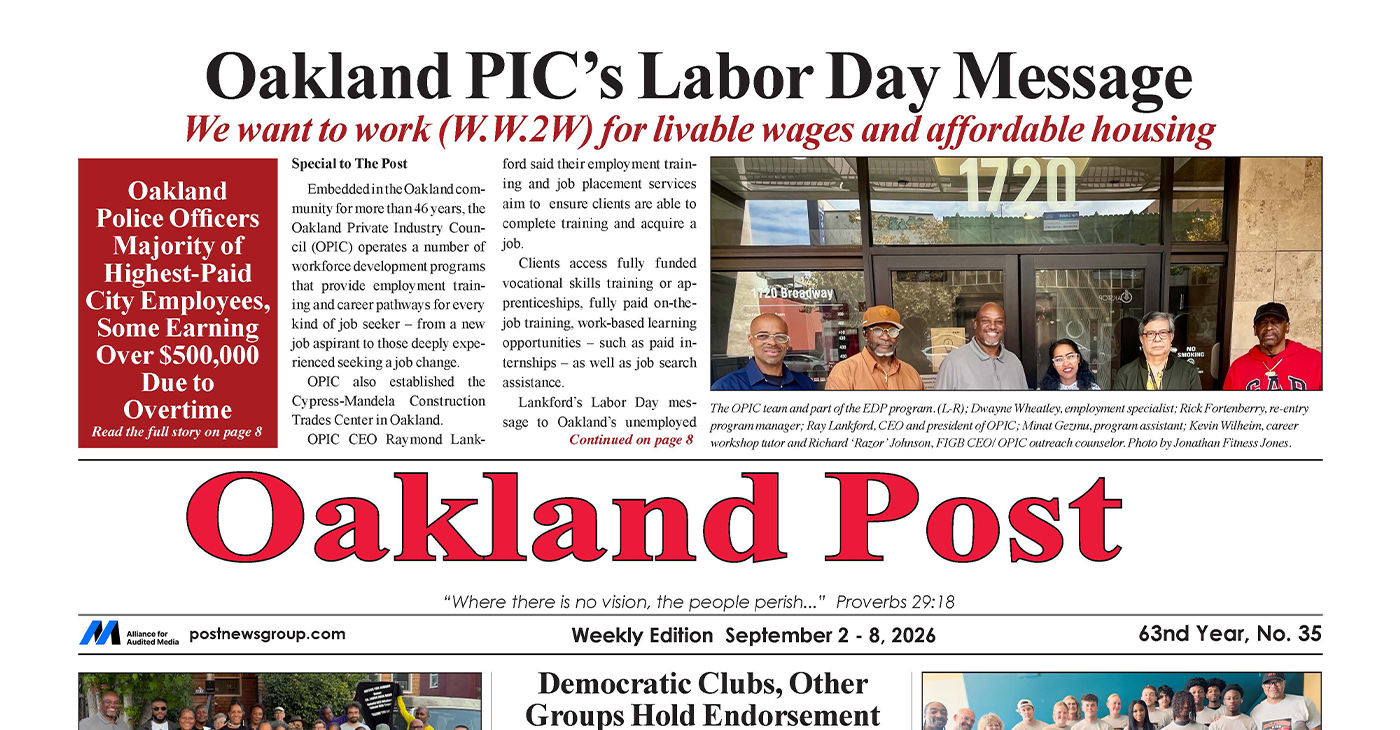
To enlarge your view of this issue, use the slider, magnifying glass icon or full page icon in the lower right corner of the browser window.



Doulas Are Helping Black California Moms Navigate Pregnancy–Even as High Mortality Rates Persist

Newsom Signs Addictive Social Media Law to Protect Kids

On Your November Ballot: Prop 38 Would Allocate $8.4 Billion to Immunology and Immunotherapy Funding

Ask California: Golden State Releases New AI Chatbot

Asm. Isaac Bryan’s Bill Banning California Police From ICE Side Jobs Reaches Newsom’s Desk

Assemblymember LaShae Sharp-Collins’s Bill Would Pause Law Enforcement’s Use of Shock Gloves Pending Study

BOOK REVIEW: ‘Laws of Solomon’ Reveals Tender Heart of Former Child Soldier

OPINION: The New American Fear – From 9-11 to AI

Passing for White, Fighting for Black America: The Courage of Walter White

Oakland People’s Arms Embargo Coalition Demands End to Military Shipments Thru Oakland

Barbara Lee Mourns Gloria Steinem, Remembers a Friendship Rooted in Equality

Event Preview: ‘Fashion v. Fascism’ – A Runway Revolution Is Coming to the Bay Area

Two Looming Threats Every Alameda County Elder Should Know About

Oakland Mayor Reads to Children at Bookout Block Party at Marcus Books Store

Tradition Comes to the Streets in 11th Annual Black-Eyed Pea Festival at the Freedom Farmers Market

Less Affluent School Districts, Including Sacramento City, Face Threat of State Takeover

ESSAY: California Can Close Its Colorectal Cancer Gap

California Hispanic Chambers of Commerce Unveils: ‘Powering the Future’ Theme for 47th Annual Statewide Convention

Four Candidates, Including Incumbent Barbara Lee, Qualify for Oakland Mayor’s Race

Oakland Post: Week of August 12 – 18, 2026

From Blueprint to Breakthrough: Tackling Affordable Housing in Oakland

Oakland Observes Black August with Block Parties, Film Showings, Workshops

COMMENTARY: Why Local School Tax Measure G1 Will Not Be on the November Ballot

Standoff for Justice: Our Homes Are Worth Fighting For

Returning to Its Roots, the Oakland Black-Eyed Pea Festival Partners with the Freedom Farmers Market Sept. 12

NPRC Scores First Advocacy Victory: David Shaw Finally Gets His Wish to ‘Go Home’

Oakland Post: Week of August 26 – September 1, 2026

Frontier Airlines’ Return to Oakland Airport Brings Flights, Jobs and Opportunity

Gubernatorial Candidate Steve Hilton Blasts California New Tire Rules; Newsom Hits Back

Chef Sharon Lee Blends Culinary Excellence, Education and Empowerment

The Conversation With Al McFarlane 6/23/26

Media Monday 6/22/26

LIVE! ASK ALMA! — TUES. 6.23.26 7PM EST

Car Buying Secrets: 4 Hidden Checks Before You Sign!

Is This 550 HP Charger Worth YOUR Money? AutoNetwork Review

Celebrating Juneteenth – Frederick Douglass on education and resistance

LIVE! — ASK ALMA! — TUES. 6.19.26 7PM EST

Hyundai Ioniq 5 Parking, Safety, and 360 View #shorts

2025 Ioniq 5 New Wiper & Powerful Performance! #shorts

Electric SUV Range: Is 259 Miles Enough? #shorts

EV Charging: How Fast Can You Charge an Electric Vehicle? #shorts

Biometric Cooling… Messaging Seats…Come on! 2025 Infiniti QX80 Autograph 4WD

Charged Up: Witness the Magic of a Fully Electric Car! #shorts

Range Rover Sport PHEV Included…: See What’s Inside This Luxury SUV! #shorts

Invisible Hood View: Perfect Parking with X-Ray Vision! #shorts
-
 Commentary4 weeks ago
Standoff for Justice: Our Homes Are Worth Fighting For
-
 Activism4 weeks ago
Oakland Post: Week of August 26 – September 1, 2026
-
 Business4 weeks ago
Frontier Airlines’ Return to Oakland Airport Brings Flights, Jobs and Opportunity
-
 Business4 weeks ago
Gubernatorial Candidate Steve Hilton Blasts California New Tire Rules; Newsom Hits Back
-
 Business4 weeks ago
Chef Sharon Lee Blends Culinary Excellence, Education and Empowerment
-

 Education4 weeks ago
Gov. Newsom’s Latest Appointees Include Sacramento Advocate for Formerly Incarcerated Students; State’s New Tech Chief
-

 Community4 weeks ago
Big City Mayors Ask for “Yes” Vote on Housing Bond Measure; Conservatives Say “No”
-

 Business4 weeks ago
Oakland Coliseum Project Opens Door for Small Businesses to Build Bigger
