
News
Programa de Inmigración permite a las familias de América Central traer a los menores en peligro a los EE.UU.

Cruz Hernández y su esposa Pabla Lobos no han visto a sus hijos desde que la pareja salió de El Salvador hace 16 años y se establecieron en Oakland.
“La verdad es que es muy difícil”, dijo Hernández en una entrevista con El Mundo. “Han sido tantos años que no veo a mis hijos. Uno de ellos era muy pequeño cuando me fui. La esperanza que tengo es poder volver a verlos”.
La familia Hernández es una de cientos de familias centroamericanas que viven en East Bay que han dejado seres queridos con el fin de buscar mejores oportunidades para sus hijos que aún viven en sus países de origen.
En los últimos años, sin embargo, países como El Salvador, Honduras y Guatemala se han convertido en lugares potencialmente mortales para ciertas poblaciones debido a la represión policial y la violencia de las pandillas generalizadas.
El International Rescue Committee (IRC) es una de las pocas agencias de reasentamiento de inmigración en el área de la bahía que trabaja con el gobierno federal para ayudar a que las familias se reúnen con los menores de edad que están siendo perseguidos en sus países de origen.
A través del programa Central American Minors (CAM), miembros de la familia que viven en los EE.UU. con los servicios de protección temporal, DACA o DAPA pueden aplicarse a traer a familiares menores de 21 años que viven en El Salvador, Honduras y Guatemala como refugiados si sus vidas están en peligro.
A principios del año, Hernández escuchó sobre el programa CAM y comenzó la aplicación para sus dos hijos a través del IRC. Él está ahora a la mitad del proceso y está a la espera de saber si sus hijos califican para el reasentamiento de refugiados.
“Hasta el momento, el proceso va bien, pero la vida de mis hijos está en peligro a causa de las pandillas en su ciudad”, dijo Hernández. “Rara vez salen de la casa, pero todavía no es suficiente.”
“Los pandilleros vienen a menudo a su casa y los amenazan si no pagan”, dijo. “También la policía es un problema. Ellos irrumpieron en la casa de mis hijos y les revolvieron todo, pensando que mis hijos eran culpables de un crimen que no cometieron”.
El caso de Hernández es uno de los cientos que el IRC ha tratado desde abril de 2015. Mientras que el proceso de solicitud es simple, el período de espera, que implica una gran cantidad de comunicación con los menores de edad, puede ser de hasta un año o más.
Hasta la fecha, el IRC ha ganado siete casos de reasentamiento.
Uno de ellos es las dos hijas de Francisco Serrano, que llegaron a San Francisco desde El Salvador a principios de junio de este año. El mes pasado, que se vieron por primera vez en 17 años.
“Nuestra situación era difícil debido a las pandillas”, dijo Serrano a El Mundo. “Una de mis hijas estudiaba en la Universidad de El Salvador y miembros de una pandilla estaban siempre acechandola.”
“No sabíamos si debíamos sacarla de la escuela porque ella siempre ha querido estudiar”, dijo Serrano. “Ella quería convertirse tanto en una maestra que seguía yendo a la escuela, mientras que en el autobús a veces las personas tratarían de robarle.”
Hernández y Serrano dijeron a El Mundo que si las familias están en situaciones similares a la de ellos, deben buscar la ayuda de las agencias de reasentamiento como el IRC.
“Sabemos que muchas familias están en esta misma situación”, dijo Hernández. “El programa CAM me ha ayudado tanto y es tan difícil tener a tus hijos tan lejos. Hay ayuda aquí para que sus hijos pueden estar aquí con ustedes”.
Para obtener más información, o si usted cree que califica, contacte con el IRC al (510) 452 – 8222. El IRC está situado en 440 W Grand Ave #500 en Oakland.









Activism
Oakland Post: Week of September 23 – 29, 2026
The printed Weekly Edition of the Oakland Post: Week of September 23 – 29, 2026

To enlarge your view of this issue, use the slider, magnifying glass icon or full page icon in the lower right corner of the browser window.
Activism
Oakland Post: Week of September 16 – 22, 2026
The printed Weekly Edition of the Oakland Post: Week of September 16 – 22, 2026

To enlarge your view of this issue, use the slider, magnifying glass icon or full page icon in the lower right corner of the browser window.
#NNPA BlackPress
NFL: Week Two Recap | Jalen Hurts did not fold; Caleb Williams exits game with injury
Philadelphia Eagles quarterback Jalen Hurts found Darius Cooper with nine seconds left for the game winning touchdown as his team beat the Tennessee Titans 24-20 in Nashville. Hurts finished the day 26/37 for 264 yards. He threw for two touchdowns and two interceptions. Prior to the final drive, the Eagles ran 25 plays for 45 […]
The post NFL: Week Two Recap | Jalen Hurts did not fold; Caleb Williams exits game with injury appeared first on BlackPressUSA.
Philadelphia Eagles quarterback Jalen Hurts found Darius Cooper with nine seconds left for the game winning touchdown as his team beat the Tennessee Titans 24-20 in Nashville. Hurts finished the day 26/37 for 264 yards. He threw for two touchdowns and two interceptions.
Prior to the final drive, the Eagles ran 25 plays for 45 yards. During the final drive Hurts went 6-8 with 61 passing yards and the touchdown. Titans defensive tackle — and team captain — Jeffery Simmons said this week that the way to defend Jalen Hurts is to make him “play quarterback.”
Hurts said to Simmons after today’s game: “You started that sh**. I had to finish it.”
Running back Saquon Barkley suffered a stinger in the first half but he ultimately finished the game. He had four carries and nine yards and one catch for eleven yards. He will get an MRI for his injury, but admitted to Cameron Wolfe of the NFL Network he was fine.
Caleb Williams leaves game against Vikings with apparent lower-body injury
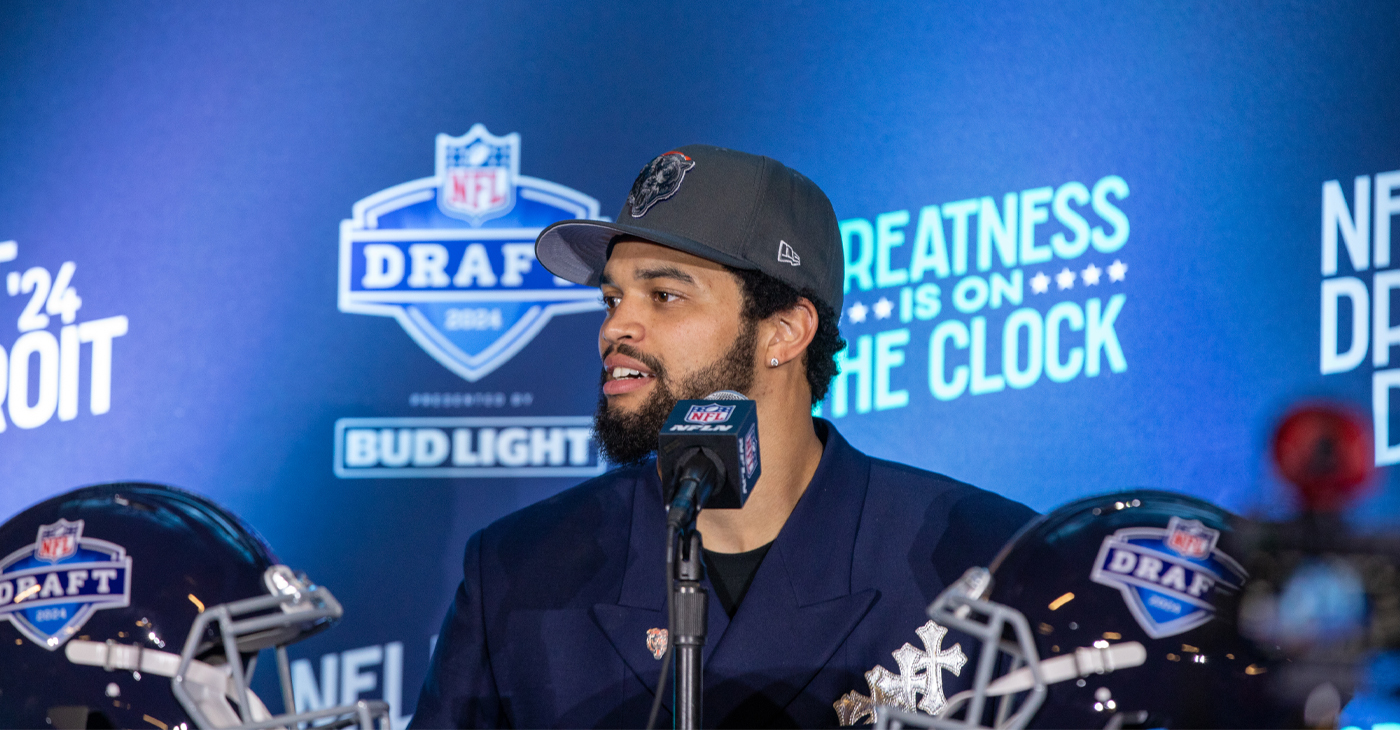
Chicago Bears quarterback Caleb Williams was helped off the field with a right leg injury with 7:42 remaining in the fourth quarter. Williams was down, writhing in pain after scrambling to his left. After departing the injury tent, Williams raised his right fist, acknowledging the crowd while expressing his frustration. Testing will commence on Monday to find out more details about his injury.

“We’ll know tomorrow,” Johnson admitted regarding Williams’ injury. “He’s in good spirits. He’s a team player.”
Williams finished the day with 138 passing yards and one interception.
“I’m actually happy it’s nothing with the knee — that was my first inclination,” Johnson said. “But, a hamstring could be pretty damaging as well. So, we’ll see. We’ll see how bad it is tomorrow and we’ll go from there.”
Bryce Young once again dominated the Falcons
Carolina Panthers quarterback Bryce Young is 5-1 against the Atlanta Falcons and is undefeated at Mercedes-Benz Stadium. Today, Young threw for 287 yards and three touchdowns as he led the Panthers to a 34-3 dismembering of the Atlanta Falcons. Georgia Tech alumnus Darren Waller caught two touchdowns and linebacker Devin Lloyd returned one of his two interceptions for a touchdown.
Cooper Rush started his second straight game for the Falcons and it did not go well. The partisan crowd voiced their displeasure after Rush completed 10/17 passes for 86 yards and two interceptions. Jack Strand entered the game for Rush prompting cheers from the Falcons fans. The rookie threw a pick-six on his first career pass attempt. Strand was the first QB to accomplish that feat since Sam Darnold in 2018 and is the first Falcons player to do that since Brett Favre in 1991. Strand finished the day with 59 passing yards and 16 rushing yards.
According to reports, quarterback Michael Penix, Jr. is expected to make his season debut this Thursday at the Green Bay Packers. His return should help the Falcons. They are the first team since the 2008 Rams to not run any plays in the red zone after the first two games to open a season.
The bright spots for the Falcons today were the Spelman College Jaguarettes performing with the Falcons cheerleaders and Florida A&M’s marching band, The Marching 100, also performed during halftime!
Jayden Daniels gets carted off after apparent arm injury
Washington Commanders quarterback Jayden Daniels appeared to injure his left elbow on the final play of the first half in his game against the Dallas Cowboys. During the play, Daniels got stepped on, braced himself for the fall, and his elbow bent the wrong way. Daniels draped a towel over his head as he exited the field on the cart.
He was later ruled out.
Daniels suffered a dislocated elbow to the same arm during week nine of last season against the Washington Commanders, which led to him being shut down for the remainder of the season.
The post NFL: Week Two Recap | Jalen Hurts did not fold; Caleb Williams exits game with injury appeared first on BlackPressUSA.



Asm. Corey Jackson Announces Launch of 24-Hour Childcare in His District

IN MEMORIAM: The Rev. Leon “Sonny” Clark, Longtime Orange County Pastor and Community Leader, Dies at 72

Poll: Becerra Widens His Lead Over Hilton; Californians Split on Wealth Tax

From Historic Memories to New Possibilities: Oakland Celebrates Coliseum 60

County Office of Education Says OUSD Finances Are Getting Healthier, Materially Stronger

LIVE FREE Sunday Dinner Brings Faith, Fellowship and Civic Conversation to Oakland

Remembering Chauncey Bailey as Student Journalists Face Threats to Truth-Telling

BLACspace Cooperative Invites Bay Area to Experience Oakland’s Black Cultural Ecosystem Through a BLAC Map Tour + Party

In Wake of Death on Doorstep, Williams Chapel Baptist Church Calls for Better Care, Funding for Unhoused

Oakland Centenarian Nuna McKee Honored!

Caribbean Nations Produce Action Plan Calling for UK Reparations Over Slavery

Oakland Post: Week of September 23 – 29, 2026

Doulas Are Helping Black California Moms Navigate Pregnancy–Even as High Mortality Rates Persist

Newsom Signs Addictive Social Media Law to Protect Kids

On Your November Ballot: Prop 38 Would Allocate $8.4 Billion to Immunology and Immunotherapy Funding

Standoff for Justice: Our Homes Are Worth Fighting For

Oakland Post: Week of August 26 – September 1, 2026

Frontier Airlines’ Return to Oakland Airport Brings Flights, Jobs and Opportunity

Gubernatorial Candidate Steve Hilton Blasts California New Tire Rules; Newsom Hits Back

Chef Sharon Lee Blends Culinary Excellence, Education and Empowerment

Jackie Wright Champions Bay Area Stories, Filmmakers and Cultural Institutions

Big City Mayors Ask for “Yes” Vote on Housing Bond Measure; Conservatives Say “No”

Oakland Coliseum Project Opens Door for Small Businesses to Build Bigger

Gov. Newsom’s Latest Appointees Include Sacramento Advocate for Formerly Incarcerated Students; State’s New Tech Chief

Misnamed ‘Parent’ PAC Seeks to Influence Oakland School Board Elections

Longtime BWOPA Member Brendalyn Goodall Appointed to California Workforce Development Board

Gov. Newsom Signs Law Shielding Immigration Aid Workers From Doxing Threats

Secretary of State Shirley N. Weber Urges Californians to Vote Early as Voter ID Battle Intensifies

From Palestine to Oakland: Seeds for Liberation Examines Shared Struggles for Freedom

IN MEMORIAM: Dolly Parton Dead at 80 — How She Built a Legacy of Love and Earned Her Place in Black Culture

The Conversation With Al McFarlane 6/23/26

Media Monday 6/22/26

LIVE! ASK ALMA! — TUES. 6.23.26 7PM EST

Car Buying Secrets: 4 Hidden Checks Before You Sign!

Is This 550 HP Charger Worth YOUR Money? AutoNetwork Review

Celebrating Juneteenth – Frederick Douglass on education and resistance

LIVE! — ASK ALMA! — TUES. 6.19.26 7PM EST

Hyundai Ioniq 5 Parking, Safety, and 360 View #shorts

2025 Ioniq 5 New Wiper & Powerful Performance! #shorts

Electric SUV Range: Is 259 Miles Enough? #shorts

EV Charging: How Fast Can You Charge an Electric Vehicle? #shorts

Biometric Cooling… Messaging Seats…Come on! 2025 Infiniti QX80 Autograph 4WD

Charged Up: Witness the Magic of a Fully Electric Car! #shorts

Range Rover Sport PHEV Included…: See What’s Inside This Luxury SUV! #shorts

Invisible Hood View: Perfect Parking with X-Ray Vision! #shorts
-
 Community2 weeks ago
Misnamed ‘Parent’ PAC Seeks to Influence Oakland School Board Elections
-

 Activism3 weeks ago
Oakland Post: Week of September 2 – 8, 2026
-

 Community2 weeks ago
Richmond Tiny House Village Farm & Garden Set to Open Gates on Sept. 26
-

 Black History2 weeks ago
OPINION: Nolan Wells’ Death One of Several Signifying Racial Terror Lives on in U.S. South
-

 Black History2 weeks ago
Latest Massacre in Haiti Reveals Cruelty U.S. Deportations
-

 Activism2 weeks ago
Oakland Post: Week of September 9 – 15, 2026
-

 Community2 weeks ago
Democratic Clubs Interview Candidates for Oakland School Board
-
 Featured2 weeks ago
‘Ready to See These Bills Become Law’: Sen. Weber’s Package of 15 Bills Advance to Gov. Newsom’s Desk
