
Activism
Prescribing Prevention: Doctors Turn to Lifestyle, Herbs and Veggies to Protect Against Chronic Illness in Black Californians


By Charlene Muhammad, California Black Media
Leibo Glover received his diabetes diagnosis at the same time he found out he needed a below-the-knee amputation.
“Minor,” thought the 63-year-old.
Glover had been self-medicating a toe injury before seeing the doctor.
But while driving from South Los Angeles to Miami on a family trip, an infection set in.
“I had it but didn’t know,” said Glover. “I was just going to come back to California, but they told me if I had left, I would have come home as a corpse,” Glover told California Black Media (CBM).
A majority of the nearly 3.5 million Californians diagnosed with diabetes have preventable Type 2 diabetes, according to researchers at the UCLA Center for Health Policy Research.
In 2023, diabetes was diagnosed in 1 in 6 adults with the lowest incomes (16.7% at 0–99% of the federal poverty line), compared to 1 in 11 adults with the highest incomes (8.9% at 300% or more of the federal poverty line). Age is a factor, too: more than 1 in 5 older adults age 65 and over (22.3%) had diabetes, about twice the rate of adults age 18–64 (8.6%).
Another study by Health Economics and Evaluation Research (HEER) mapped patients with diabetes in California who had amputations. Researchers found that patients living in low-income ZIP codes were far more likely to have had lower-limb amputations than those in higher-income ZIP codes, essentially identifying amputation “hot spots.”
At the time of Glover’s 2018 diagnosis, he was experiencing housing instability and going through financial hardships. Now, he has more stable housing and he has improved his health through lifestyle changes like eating healthier and getting more sleep.
“If the equipment is right, I can stand on my leg for hours. I can actually run, jump, dance and all of that,” said Glover, who got his diabetes under control, in part, by avoiding carbohydrates and sugars.
As chronic illnesses continue to disproportionately impact Black Californians — often leading to preventable amputations and premature deaths — a growing number of doctors and advocates are expanding their care from just treatment to including prevention. From promoting diet and lifestyle changes to cultivating community farms focused on prevention and wellness like Dr. Bill Releford’s Bloom Ranch in Acton.
Releford, a podiatrist based in Los Angeles started the 250-acre Bloom Ranch in 2023 as part of his strategy for preventive care.
“This is my assignment,” said Releford.
“Bloom Ranch has been a perfect backdrop for me to be creative and to find avant-garde ways to make fresh fruits and vegetables more accessible to food deserts in Los Angeles County,” he stated.
California produces nearly half of the nation’s fruits and vegetables, yet more than 1 in 5 Californians — about 8.8 million people — currently struggle with food insecurity, according to the California Association of Food Banks.
“Studies have shown that 75% of amputations are preventable. And African Americans have the highest amputation rate in the nation,” Releford said.
As such, Releford continued, the mortality rate associated with high-level amputation is 50%, which means “if we had 10 people that all had high level amputations, five of those would be deceased in three years.”
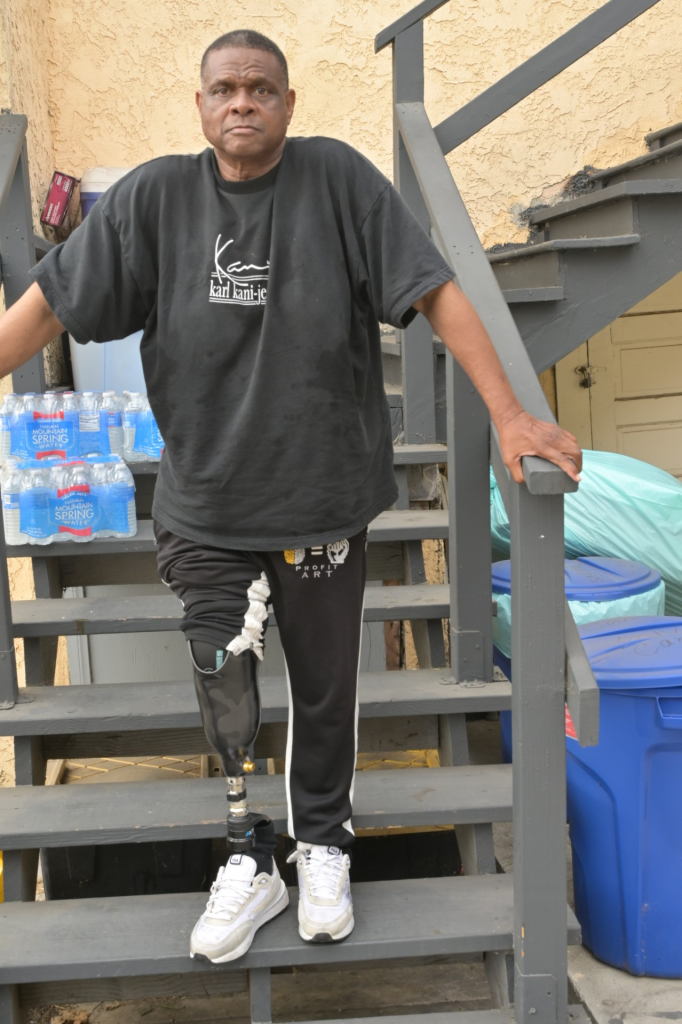
Monday, June 28, 2025. Leibo Glover at his home in Los Angeles, California. The security professional’s leg was amputated below the knee.
Releford’s ranch is the largest Black-owned farm in L.A. County. He plans to partner with UCLA and the Charles R. Drew University of Medicine and Science to develop prescriptive vegetable boxes.
“Certain vegetables and herbs can lower blood pressure naturally, like beets, turnips, dill, basil, garlic and others,” said Releford.
“Hopefully, this will inspire other farmers to take this model and replicate it across other urban areas,” Releford added.
“A lot of studies have shown that gardening has so many health benefits – being in the sun, Vitamin D,” said Releford. “The dirt has a lot of microbes that are good for your immune system. Studies have shown that people who work in the dirt have strong immune systems.”
Gardening can potentially decrease the risk of dementia, enhance cognition, reduce stress, and boost immunity, indicates research by Genoa Barrow of the University of Southern California Center for Health Journalism as part of the 2024 Ethnic Media Collaborative, Healing California.
During a recent picturesque day at Bloom Ranch, families, school children, farmers and members of The Ultimate Book Club 1998, founded by Alina Anderson, sampled and purchased fresh produce while taking photographs.
“This is huge. “All of us have families that could use this information,” said Anderson.
Doctors like Releford, who are committed to tackling the most chronic diseases impacting all their patients utilize peer-to-peer support programs with self-management training led by individuals living with chronic conditions to provide role models and support for patients, according to a recent study by the California Health Care Foundation.
“The unifying feature of these programs is that they seek to build on the strengths, knowledge, and experience that peers can offer,” the report states.
Liz Helms, CEO of the California Chronic Care Coalition, addressed state-backed prevention policy and initiatives.
“It’s in horrible shape. It needs to get so much better, especially in underserved areas, where the Black population has a whole set of different needs,” she said.
Helms, who started advocacy after being denied access to care in the early 1990s, applauded new developments in telehealth. The opportunity to choose between visiting a doctor’s office or placing a phone call makes a difference, especially if there are transportation or distance issues, or if one is too sick, she said.
Fear is one thing people, especially in the Black community, must overcome, emphasized Helms.
“I had to get over my fear of going to the doctor, of not speaking up,” continued Helms, urging patients to “understand the baseline” of their health.
“Don’t let anyone stigmatize you or tell you that you’re not good enough to get care or look down on you. Everyone has a right to good, quality, affordable, timely health care,” said Helms.
To engage Bloom Ranch for preventive care focused on wellbeing and healthy living, call (323) 388-4828 or sign up at Bloomranchofacton.com



Activism
Oakland Post: Week of September 23 – 29, 2026
The printed Weekly Edition of the Oakland Post: Week of September 23 – 29, 2026

To enlarge your view of this issue, use the slider, magnifying glass icon or full page icon in the lower right corner of the browser window.
Activism
Oakland Post: Week of September 16 – 22, 2026
The printed Weekly Edition of the Oakland Post: Week of September 16 – 22, 2026

To enlarge your view of this issue, use the slider, magnifying glass icon or full page icon in the lower right corner of the browser window.
Activism
Oakland Post: Week of September 9 – 15, 2026
The printed Weekly Edition of the Oakland Post: Week of September 9 – 15, 2026

To enlarge your view of this issue, use the slider, magnifying glass icon or full page icon in the lower right corner of the browser window.



Asm. Corey Jackson Announces Launch of 24-Hour Childcare in His District

IN MEMORIAM: The Rev. Leon “Sonny” Clark, Longtime Orange County Pastor and Community Leader, Dies at 72

Poll: Becerra Widens His Lead Over Hilton; Californians Split on Wealth Tax

From Historic Memories to New Possibilities: Oakland Celebrates Coliseum 60

County Office of Education Says OUSD Finances Are Getting Healthier, Materially Stronger

LIVE FREE Sunday Dinner Brings Faith, Fellowship and Civic Conversation to Oakland

Remembering Chauncey Bailey as Student Journalists Face Threats to Truth-Telling

BLACspace Cooperative Invites Bay Area to Experience Oakland’s Black Cultural Ecosystem Through a BLAC Map Tour + Party

In Wake of Death on Doorstep, Williams Chapel Baptist Church Calls for Better Care, Funding for Unhoused

Oakland Centenarian Nuna McKee Honored!

Caribbean Nations Produce Action Plan Calling for UK Reparations Over Slavery

Oakland Post: Week of September 23 – 29, 2026

Doulas Are Helping Black California Moms Navigate Pregnancy–Even as High Mortality Rates Persist

Newsom Signs Addictive Social Media Law to Protect Kids

On Your November Ballot: Prop 38 Would Allocate $8.4 Billion to Immunology and Immunotherapy Funding

Standoff for Justice: Our Homes Are Worth Fighting For

Oakland Post: Week of August 26 – September 1, 2026

Frontier Airlines’ Return to Oakland Airport Brings Flights, Jobs and Opportunity

Gubernatorial Candidate Steve Hilton Blasts California New Tire Rules; Newsom Hits Back

Chef Sharon Lee Blends Culinary Excellence, Education and Empowerment

Jackie Wright Champions Bay Area Stories, Filmmakers and Cultural Institutions

Big City Mayors Ask for “Yes” Vote on Housing Bond Measure; Conservatives Say “No”

Oakland Coliseum Project Opens Door for Small Businesses to Build Bigger

Gov. Newsom’s Latest Appointees Include Sacramento Advocate for Formerly Incarcerated Students; State’s New Tech Chief

Misnamed ‘Parent’ PAC Seeks to Influence Oakland School Board Elections

Longtime BWOPA Member Brendalyn Goodall Appointed to California Workforce Development Board

Gov. Newsom Signs Law Shielding Immigration Aid Workers From Doxing Threats

Secretary of State Shirley N. Weber Urges Californians to Vote Early as Voter ID Battle Intensifies

From Palestine to Oakland: Seeds for Liberation Examines Shared Struggles for Freedom

IN MEMORIAM: Dolly Parton Dead at 80 — How She Built a Legacy of Love and Earned Her Place in Black Culture

The Conversation With Al McFarlane 6/23/26

Media Monday 6/22/26

LIVE! ASK ALMA! — TUES. 6.23.26 7PM EST

Car Buying Secrets: 4 Hidden Checks Before You Sign!

Is This 550 HP Charger Worth YOUR Money? AutoNetwork Review

Celebrating Juneteenth – Frederick Douglass on education and resistance

LIVE! — ASK ALMA! — TUES. 6.19.26 7PM EST

Hyundai Ioniq 5 Parking, Safety, and 360 View #shorts

2025 Ioniq 5 New Wiper & Powerful Performance! #shorts

Electric SUV Range: Is 259 Miles Enough? #shorts

EV Charging: How Fast Can You Charge an Electric Vehicle? #shorts

Biometric Cooling… Messaging Seats…Come on! 2025 Infiniti QX80 Autograph 4WD

Charged Up: Witness the Magic of a Fully Electric Car! #shorts

Range Rover Sport PHEV Included…: See What’s Inside This Luxury SUV! #shorts

Invisible Hood View: Perfect Parking with X-Ray Vision! #shorts
-
 Community3 weeks ago
Misnamed ‘Parent’ PAC Seeks to Influence Oakland School Board Elections
-

 Activism4 weeks ago
Oakland Post: Week of September 2 – 8, 2026
-

 Community3 weeks ago
Richmond Tiny House Village Farm & Garden Set to Open Gates on Sept. 26
-

 Activism3 weeks ago
Oakland Post: Week of September 9 – 15, 2026
-

 Black History3 weeks ago
Latest Massacre in Haiti Reveals Cruelty U.S. Deportations
-

 Black History3 weeks ago
OPINION: Nolan Wells’ Death One of Several Signifying Racial Terror Lives on in U.S. South
-

 Community3 weeks ago
Democratic Clubs Interview Candidates for Oakland School Board
-

 Business2 weeks ago
Mayor Lee Announces $1 Million Kaiser Permanente Grant for Pilot Program to Address Homelessness, Clean Up Public Spaces throughout Oakland
