
City Government
Is Phil Tagami Stacking the Deck Against California Waste Solutions?

The Oakland Post has been hearing community concerns that Army Base Master Developer Phil Tagami of CCIG may have been trying to undermine the city’s new trash and recycling company – California Waste Solutions (CWS) by keeping the company waiting to move ahead with the construction of its new facility at the North Gateway of the Oakland Army Base.
CWS has already put up $600,000 to show its commitment and was supposed to take possession of the Army Base property in 2013. Now, the company is being told it will get the land in 2016, though some people close to the project says it will not be turned over until 2017 or 2018.
According to Post Publisher Paul Cobb, he has heard from many sources that, “The developer in effect is saying he can’t give CWS the North Gateway, and there seems to be s be no one in this administration that is taking control of this project. They just seem to listen to whatever Tagami says.”
Responding, Tagami sent an email to the Post, saying, “It is in all parties interest to get out of the ground as soon as possible.” Tagami’s statement is printed in full at his request on the Post’s website at postnewsgorup.com

CWS says it will take about 18 months to build its $80 million facility at the North Gateway section of the base – 27.3 acres that has been set aside for indoor recycling facilities and an additional seven acres for truck parking.
A key part of the company’s operations, the CWS facility will dedicate 200,000 square feet to process and transfer the various components of the city’s trash stream – composting, organic materials and recyclables like paper and metal. The site will also house the truck corporation and maintenance yard and become the new headquarters for CWS and its employees.
Until the CWS takes possession of its property and builds the facility, the company has arranged with East Bay Municipal District (EBMUD) to utilize some of its property.
People close to the Army Base project have suggested that Tagami and CCIG have never wanted to give any property to recyclers – Cass metals and CWS – even though the City Council voted to give them space on the base, said Cobb.
The problem, says Cobb, is economic. Tagami has been hired to be the city’s agent but is also a private businessman who will make less money if property goes to CWS.
“Any space that is turned into a warehouse is a revenue for the city and revenue for CCIG (Tagami),” he said. “When recyclers get a lease, there is no revenue for Phil – there is just rent for the city.”
“ I’m hearing that his financial interests as an individual are in conflict with the city and its overall goal,” which is to use a portion of the base property for CWS, Cass metals and OMSS, to get the recyclers and truck parking out of the West Oakland community, Cobb said.
Cobb noted that if the city had structured an arrangement with Tagami that is similar to the $1.5 million payment to the city that it required from CWS, Tagami would be paying the city for the privilege of receiving ta contract, rather than the city subsidizing him at the same time he is benefitting.
Cobb says it is in the interests of the city to turn the base property over to CWS on or before July 1, 2015, but that seems to be opposite for Tagami.





Activism
Oakland Post: Week of March 11 -17, 2026
The printed Weekly Edition of the Oakland Post: Week of March 11 – 17, 2026
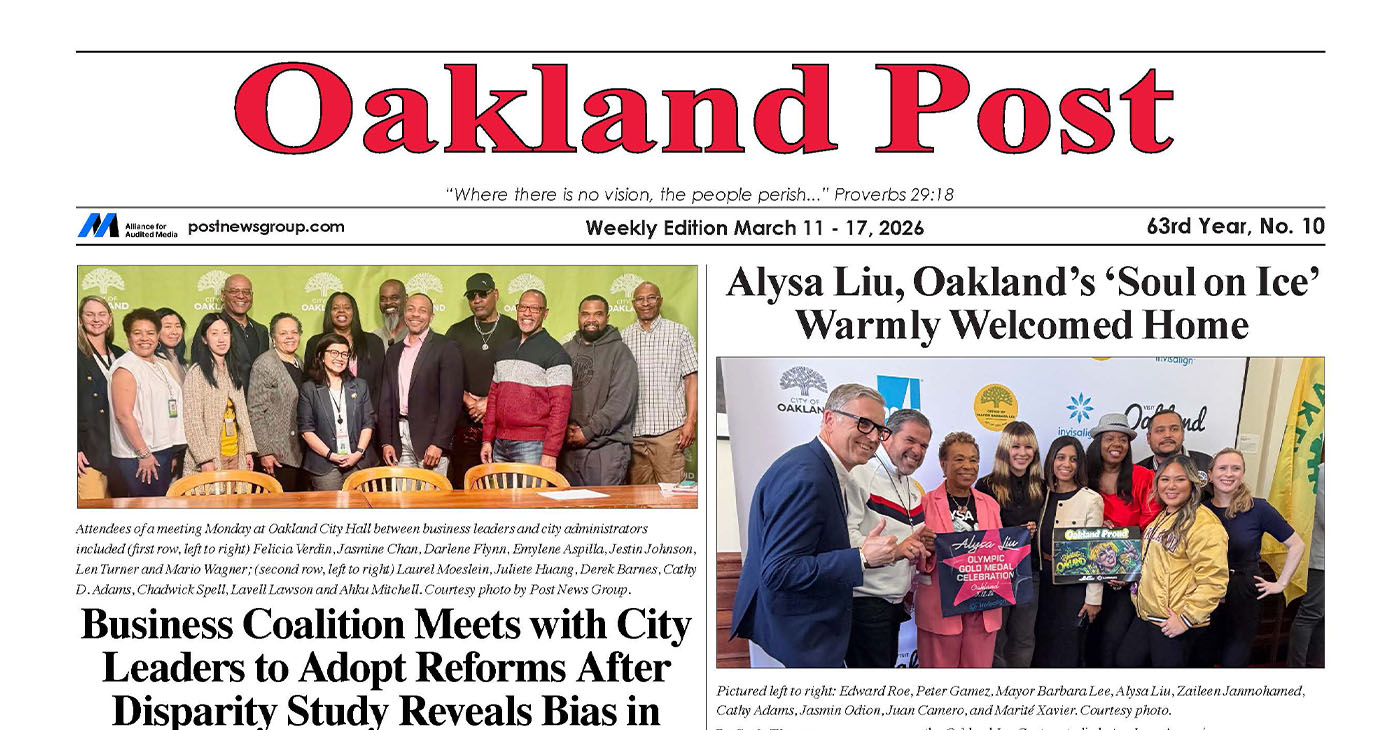
To enlarge your view of this issue, use the slider, magnifying glass icon or full page icon in the lower right corner of the browser window.
Activism
Oakland Post: Week of March 4 – 10, 2026
The printed Weekly Edition of the Oakland Post: Week of March 4 – 10, 2026

To enlarge your view of this issue, use the slider, magnifying glass icon or full page icon in the lower right corner of the browser window.
Activism
Oakland Post: Week of February 25 – March 3, 2026
The printed Weekly Edition of the Oakland Post: Week of – February 25 – March 3, 2026

To enlarge your view of this issue, use the slider, magnifying glass icon or full page icon in the lower right corner of the browser window.


WORK FROM HOME
Home-based business with potential monthly income of $10K+ per month. A proven training system and website provided to maximize business effectiveness. Perfect job to earn side and primary income. Contact Lynne for more details: Lynne4npusa@gmail.com 800-334-0540


Financial Wellness and Mental Health: Managing Money Stress in College

Oakland Post: Week of March 11 -17, 2026

Women & Wealth: Tips for Navigating Your Lifelong Financial Journey

COMMENTARY: Women of Color Shape Our Past and Future

Woman’s Search for Family’s Roots Leads to Ancestor John T. Ward – A Successful Entrepreneur and Conductor on the Underground Railroad

Advocates Raise Alarm Over ICE Operation, MOU and Detention Risks in Baltimore County

Pete Buttigieg to Join Mayor Randall Woodfin for Community Town Hall in Birmingham

WATCH: Week One – NNPA’s “Leadership Matters” Video Series

Oakland Post: Week of March 4 – 10, 2026

OP-ED: NNPA Launches 2026 “Leadership Matters” Video Series

PRESS ROOM: PMG and Cranbrook Horizons-Upward Bound Launch Journey Fellowship Cohort 2

Los Angeles Summit Brings Together Leaders to Tackle Poverty and Affordability

Civil Rights TV Launches 24/7 Network Focused on Black History, Education and Equity

REVIEW: The Ultimate Hot Girl Summer Getaway: Sunseeker Resort Florida

COMMENTARY: How You Stop a Prescription Medicine is as Important as How You Start

Book Review: Books on Black History and Black Life for Kids

Community Celebrates Turner Group Construction Company as Collins Drive Becomes Turner Group Drive

California Launches Study on Mileage Tax to Potentially Replace Gas Tax as Republicans Push Back

Discrimination in City Contracts

COMMENTARY: The Biases We Don’t See — Preventing AI-Driven Inequality in Health Care

Black History Events in the East Bay

Post Newspaper Invites NNPA to Join Nationwide Probate Reform Initiative

Art of the African Diaspora Celebrates Legacy and Community at Richmond Art Center

New Bill, the RIDER Safety Act, Would Support Transit Ambassadors and Safety on Public Transit

COMMENTARY: The National Protest Must Be Accompanied with Our Votes

Oakland Post: Week of February 4 – 10, 2026

Oakland Post: Week of February 11 – 17, 2026

Dorothy Lee Bolden: Uniting Domestic Workers

After Don Lemon’s Arrest, Black Officials Raise Concerns About Independent Black Media

Reflecting on Black History Milestones in Birmingham AL

Hyundai Ioniq 5 Parking, Safety, and 360 View #shorts

2025 Ioniq 5 New Wiper & Powerful Performance! #shorts

Electric SUV Range: Is 259 Miles Enough? #shorts

EV Charging: How Fast Can You Charge an Electric Vehicle? #shorts

Biometric Cooling… Messaging Seats…Come on! 2025 Infiniti QX80 Autograph 4WD

Charged Up: Witness the Magic of a Fully Electric Car! #shorts

Range Rover Sport PHEV Included…: See What’s Inside This Luxury SUV! #shorts

Invisible Hood View: Perfect Parking with X-Ray Vision! #shorts

AI Is Reshaping Black Healthcare: Promise, Peril, and the Push for Improved Results in California

ESSAY: Technology and Medicine, a Primary Care Point of View

Sanctuary Cities

The RESISTANCE – FREEDOM NOW

STATE OF THE PEOPLE: Freddie

ECONOMIC BOYCOTT DAY!!!!!

I told You So
-
 #NNPA BlackPress4 weeks ago
Reflecting on Black History Milestones in Birmingham AL
-
 #NNPA BlackPress4 weeks ago
PRESS ROOM: NBA Hall of Fame Nominee Terry Cummings Joins 100 Black Men of DeKalb County to Launch Victory & Values Initiative
-

 #NNPA BlackPress4 weeks ago
U.S. manufacturing rebounds – how foundry services are adapting to rising demand
-

 Activism3 weeks ago
Oakland Post: Week of February 25 – March 3, 2026
-

 #NNPA BlackPress4 weeks ago
OP-ED: One Hundred Years of Black Workers Telling the Truth
-

 #NNPA BlackPress4 weeks ago
Trump’s MAGA Allies are Creating Executive Order Plan to Steal the 2026 Midterms
-

 #NNPA BlackPress4 weeks ago
Advancements in solar technology that are changing the way we power the world
-

 #NNPA BlackPress4 weeks ago
PRESS ROOM: Civil Rights TV Launches in Selma as the World’s First 24/7 Civil Rights Television Network
