
Activism
OPINION: Lakeview Tiny Homes in Oakland Are Segregated, Critic Says
NNPA NEWSWIRE — It’s unfair to take up spaces that should be for people at the lake and give them to folks from Alameda. I’ve called into City Council many times, and I’ve also addressed Mayor Schaaf on this issue. We can’t have the administration formulate pilot programs that separate whites and Blacks. It’s also important that we take a look and make sure that there’s equality when it comes to finances that are going to each side of this community.

By Nino Parker, introduction by Zack Haber
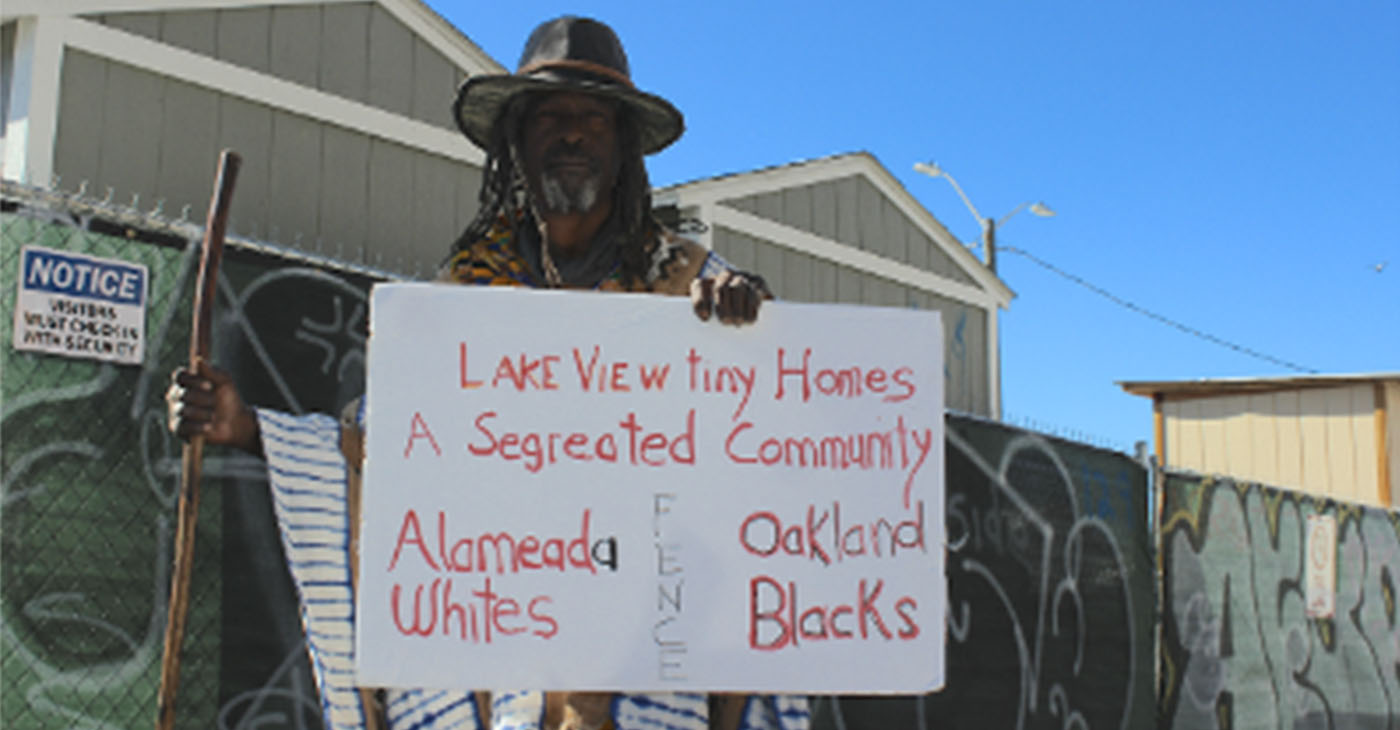
Since Nov. 16, Black Oakland residents Nino Parker and Assata Olugbala have been protesting outside The Lakeview Village, a tiny home community sitting along East 12th Street near Lake Merritt that Oakland has been using to shelter homeless people. Parker and Olugbala call it a racially segregated community.
One portion of the community is made up of people who used to live in tents, self-made homes, and vehicles at Union Point Park. Before living in the park, many of these people were evicted from homes in Alameda. After protests and negotiations with Oakland in March 2021, these people were able to secure a degree of self-governance in exchange for them agreeing to move from Union Point Park to a portion of The Lakeview Village called a “co-governed encampment.” During the site’s setup, the City of Oakland rented out hotel rooms for them. While they currently live in the same small pallet shelters as others onsite, this crew is in the process of building additional infrastructure for themselves and provides some of their own security.
People living in the other portion of Lakeview Village don’t live in a “co-governed encampment” and aren’t allowed the same degree of self-governance. They can’t build their own infrastructure and don’t have access to some of the services that those who live in the “co-governed encampment” have. The following are Parker’s words edited for readability and brevity:
My name is Nino Parker, homeless Black advocate, Bay Area. Recently, a lot of people have heard there’s been an issue at the Lakeview tiny homes. The problem is there are two neighboring communities, with a fence that separates them. One community is made of almost entirely of white people who used to live in Alameda. Of the 15 people that live there, only two are Black. That side got an advantage of having not only hotels that added up to $66,000 in bills, but they also got $350,000 in funding. On the other side of the fence, the community is mainly Black and mixed-race people from Oakland.
It’s unfair to take up spaces that should be for people at the lake and give them to folks from Alameda. I’ve called into City Council many times, and I’ve also addressed Mayor Schaaf on this issue. We can’t have the administration formulate pilot programs that separate whites and Blacks. It’s also important that we take a look and make sure that there’s equality when it comes to finances that are going to each side of this community.
What we need at this point, I think, is to take the fence down. That way we can work on a lot of the other issues in the near future here when it comes to allowing everyone access to whatever is in the tiny home community. If one portion has a kitchen, everyone should have access to a kitchen or any structures that are built there. We need to make sure that there’s equality in this program.
Our protest has been very hard. We’ve been here for over three months. The head of the LLC that had formerly been helping run the co-governed encampment assaulted me, which has damaged my hip, causing me great pain. One white resident has repeatedly stolen my signs. Some other residents, but not all of them, have verbally assaulted me and Assata. The city has stood by and done nothing. But we’re committed to make sure that this city is fair and equitable in its own services to Blacks and whites.
We don’t want programs separating two communities. That’s what this is about. I understand some of the young people here don’t understand what Jim Crow was. Jim Crow was when we had people, Black people, that sat on the back of the bus or sat in the balcony of the theater or had to go in the back door or the colored door. This reminds me of Jim Crow, but in this case it’s OakCrow.













Activism
Oakland Post: Week of September 23 – 29, 2026
The printed Weekly Edition of the Oakland Post: Week of September 23 – 29, 2026

To enlarge your view of this issue, use the slider, magnifying glass icon or full page icon in the lower right corner of the browser window.
Activism
Oakland Post: Week of September 16 – 22, 2026
The printed Weekly Edition of the Oakland Post: Week of September 16 – 22, 2026

To enlarge your view of this issue, use the slider, magnifying glass icon or full page icon in the lower right corner of the browser window.
Activism
Oakland Post: Week of September 9 – 15, 2026
The printed Weekly Edition of the Oakland Post: Week of September 9 – 15, 2026

To enlarge your view of this issue, use the slider, magnifying glass icon or full page icon in the lower right corner of the browser window.



Asm. Corey Jackson Announces Launch of 24-Hour Childcare in His District

IN MEMORIAM: The Rev. Leon “Sonny” Clark, Longtime Orange County Pastor and Community Leader, Dies at 72

Poll: Becerra Widens His Lead Over Hilton; Californians Split on Wealth Tax

From Historic Memories to New Possibilities: Oakland Celebrates Coliseum 60

County Office of Education Says OUSD Finances Are Getting Healthier, Materially Stronger

LIVE FREE Sunday Dinner Brings Faith, Fellowship and Civic Conversation to Oakland

Remembering Chauncey Bailey as Student Journalists Face Threats to Truth-Telling

BLACspace Cooperative Invites Bay Area to Experience Oakland’s Black Cultural Ecosystem Through a BLAC Map Tour + Party

In Wake of Death on Doorstep, Williams Chapel Baptist Church Calls for Better Care, Funding for Unhoused

Oakland Centenarian Nuna McKee Honored!

Caribbean Nations Produce Action Plan Calling for UK Reparations Over Slavery

Oakland Post: Week of September 23 – 29, 2026

Doulas Are Helping Black California Moms Navigate Pregnancy–Even as High Mortality Rates Persist

Newsom Signs Addictive Social Media Law to Protect Kids

On Your November Ballot: Prop 38 Would Allocate $8.4 Billion to Immunology and Immunotherapy Funding

Less Affluent School Districts, Including Sacramento City, Face Threat of State Takeover

ESSAY: California Can Close Its Colorectal Cancer Gap

California Hispanic Chambers of Commerce Unveils: ‘Powering the Future’ Theme for 47th Annual Statewide Convention

Four Candidates, Including Incumbent Barbara Lee, Qualify for Oakland Mayor’s Race

Oakland Post: Week of August 12 – 18, 2026

From Blueprint to Breakthrough: Tackling Affordable Housing in Oakland

Oakland Observes Black August with Block Parties, Film Showings, Workshops

COMMENTARY: Why Local School Tax Measure G1 Will Not Be on the November Ballot

Standoff for Justice: Our Homes Are Worth Fighting For

Returning to Its Roots, the Oakland Black-Eyed Pea Festival Partners with the Freedom Farmers Market Sept. 12

Oakland Post: Week of August 26 – September 1, 2026

NPRC Scores First Advocacy Victory: David Shaw Finally Gets His Wish to ‘Go Home’

Frontier Airlines’ Return to Oakland Airport Brings Flights, Jobs and Opportunity

Gubernatorial Candidate Steve Hilton Blasts California New Tire Rules; Newsom Hits Back

Chef Sharon Lee Blends Culinary Excellence, Education and Empowerment

The Conversation With Al McFarlane 6/23/26

Media Monday 6/22/26

LIVE! ASK ALMA! — TUES. 6.23.26 7PM EST

Car Buying Secrets: 4 Hidden Checks Before You Sign!

Is This 550 HP Charger Worth YOUR Money? AutoNetwork Review

Celebrating Juneteenth – Frederick Douglass on education and resistance

LIVE! — ASK ALMA! — TUES. 6.19.26 7PM EST

Hyundai Ioniq 5 Parking, Safety, and 360 View #shorts

2025 Ioniq 5 New Wiper & Powerful Performance! #shorts

Electric SUV Range: Is 259 Miles Enough? #shorts

EV Charging: How Fast Can You Charge an Electric Vehicle? #shorts

Biometric Cooling… Messaging Seats…Come on! 2025 Infiniti QX80 Autograph 4WD

Charged Up: Witness the Magic of a Fully Electric Car! #shorts

Range Rover Sport PHEV Included…: See What’s Inside This Luxury SUV! #shorts

Invisible Hood View: Perfect Parking with X-Ray Vision! #shorts
-
 Business4 weeks ago
Frontier Airlines’ Return to Oakland Airport Brings Flights, Jobs and Opportunity
-
 Business4 weeks ago
Gubernatorial Candidate Steve Hilton Blasts California New Tire Rules; Newsom Hits Back
-
 Business4 weeks ago
Chef Sharon Lee Blends Culinary Excellence, Education and Empowerment
-

 Black History4 weeks ago
Jackie Wright Champions Bay Area Stories, Filmmakers and Cultural Institutions
-

 Community4 weeks ago
Big City Mayors Ask for “Yes” Vote on Housing Bond Measure; Conservatives Say “No”
-

 Education4 weeks ago
Gov. Newsom’s Latest Appointees Include Sacramento Advocate for Formerly Incarcerated Students; State’s New Tech Chief
-

 Business4 weeks ago
Oakland Coliseum Project Opens Door for Small Businesses to Build Bigger
-

 Community2 weeks ago
Misnamed ‘Parent’ PAC Seeks to Influence Oakland School Board Elections
