
California Black Media
Opinion: How We Can Protect Our Communities from COVID After the Pandemic
As pastor of the First African Methodist Episcopal Church of Los Angeles (FAME), the oldest African American church in the city, I have always strived to lead my members to health and prosperity. But nothing could have prepared us for the challenges of the pandemic, which affected every aspect of our church — from how we conducted services to how we communed with people. But the church leadership and I knew it was our calling to take on COVID-19 and protect our flock.

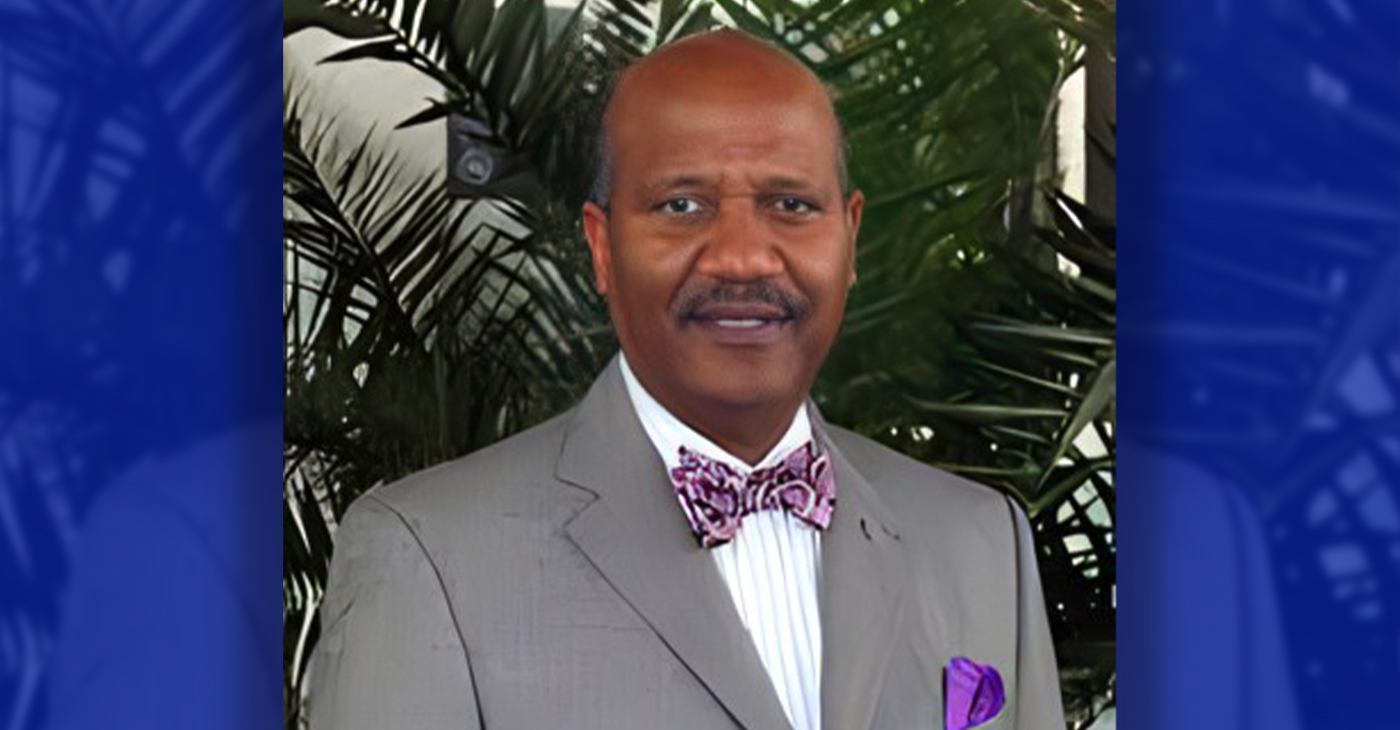
By Rev. Edgar Boyd
California Black Media
Every Sunday, I look out at the faces of my congregation, and I am grateful that we have overcome the many challenges we have faced over the past few years. At the same time, I am also reminded of all the beautiful souls we have lost to COVID-19. The pandemic has upended the lives of many in our community, and the residual effects are still being felt.
As pastor of the First African Methodist Episcopal Church of Los Angeles (FAME), the oldest African American church in the city, I have always strived to lead my members to health and prosperity.
But nothing could have prepared us for the challenges of the pandemic, which affected every aspect of our church — from how we conducted services to how we communed with people.
But the church leadership and I knew it was our calling to take on COVID-19 and protect our flock. Over the years, we have continued to learn and evolve our approaches to address the overall health, social and educational needs of our parishioners and the larger South LA community.
Although we have made it through the most difficult period of the pandemic, COVID-19 remains a threat to our loved ones, especially Black communities in California who have been disproportionately impacted by the virus.
According to the Los Angeles County Public Health Department, Black residents in Los Angeles County were twice as likely to be hospitalized with COVID-19 as white residents, and one-and-a-half times more likely to die from the virus. These disparities are unacceptable, and we must work to reduce them.
Now, with COVID-19 vaccines and treatments widely available, we have the tools we need to protect ourselves and our loved ones from serious illnesses and deaths. We can return to doing the things and seeing the people we love.
Our initial focus was to prevent COVID-19 exposure, but sometimes this was not always possible. Now, we are shifting priorities to making sure our members know what to do if they test positive.
Although they are free, widely available, and effective, COVID-19 medications have been relatively unknown within my community. We are starting to integrate initiatives to raise awareness around COVID-19 medications into our other long-standing programs to support our community members who test positive.
Scientific evidence shows that when COVID-19 medications are taken within the first week of testing positive, they can prevent serious illness, hospitalization, and death by half or more. Timing is crucial as most of the medications must be taken within the first five days to be effective.
To address these issues, we have had to overcome many barriers, one of the biggest being my community’s mistrust of the medical system due to generations of racism and mistreatment. We have worked hard to educate about COVID-19 safety and rebuild trust in the medical system.
We have also partnered with other trusted entities and organizations like the University of Southern California and Jewish congregations to share resources, materials, and knowledge to fight the COVID-19 pandemic. We have made it a priority to educate those close to us about the resources and tools available to stay safe and protect ourselves, including vaccines and treatments.
The good news is that we know what works. Our church is hosting teachable Thursdays that highlight influential medical professionals to discuss vaccination benefits, side effects, and other important information about COVID-19. Additionally, we opened a wellness center to create a welcoming and trusting environment for those in the community, operated by community members to provide necessary services that address COVID-19, such as vaccinations, testing, and education around COVID-19 medications.
We invite and welcome all Angelenos who have questions or need support to come and access these services.
Overcoming challenges that Black communities here in Los Angeles and throughout California have faced due to COVID-19 has not been easy. However, through hard work, listening to our community, and the power of prayer, we have found ways to win over the virus. After all, prayers are powerful, but even more so when paired with COVID-19 medications.
To learn more about COVID-19 medications, visit YouCanBeatIt.org.
About the Author
The Rev. Edgar Boyd is pastor of the First African Methodist Episcopal Church of Los Angeles (FAME), the oldest African American church in the city. Under his leadership, FAME is working to address the health, social and educational needs of parishioners and the surrounding community.






Activism
Oakland Post: Week of March 18 – 24, 2026
The printed Weekly Edition of the Oakland Post: Week of March 18 – 24, 2026
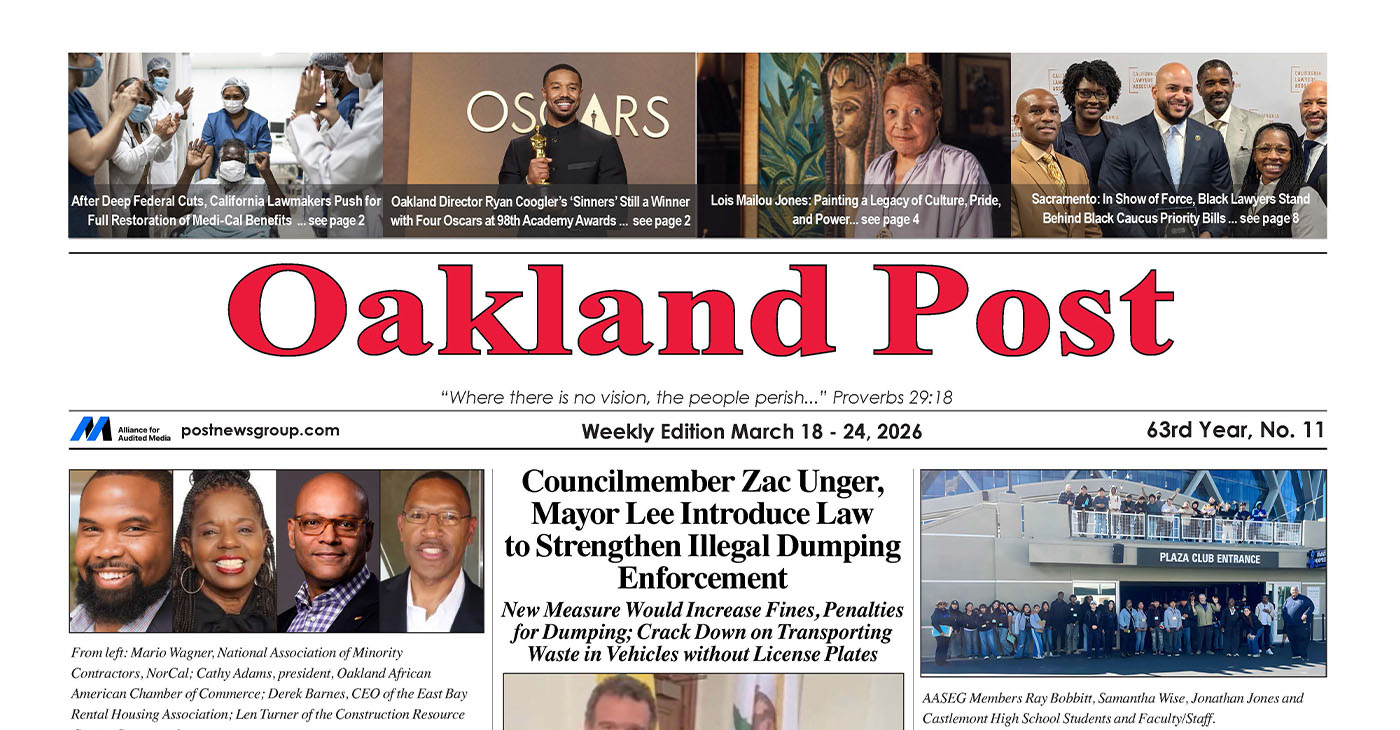
To enlarge your view of this issue, use the slider, magnifying glass icon or full page icon in the lower right corner of the browser window.
Activism
Oakland Post: Week of March 11 -17, 2026
The printed Weekly Edition of the Oakland Post: Week of March 11 – 17, 2026
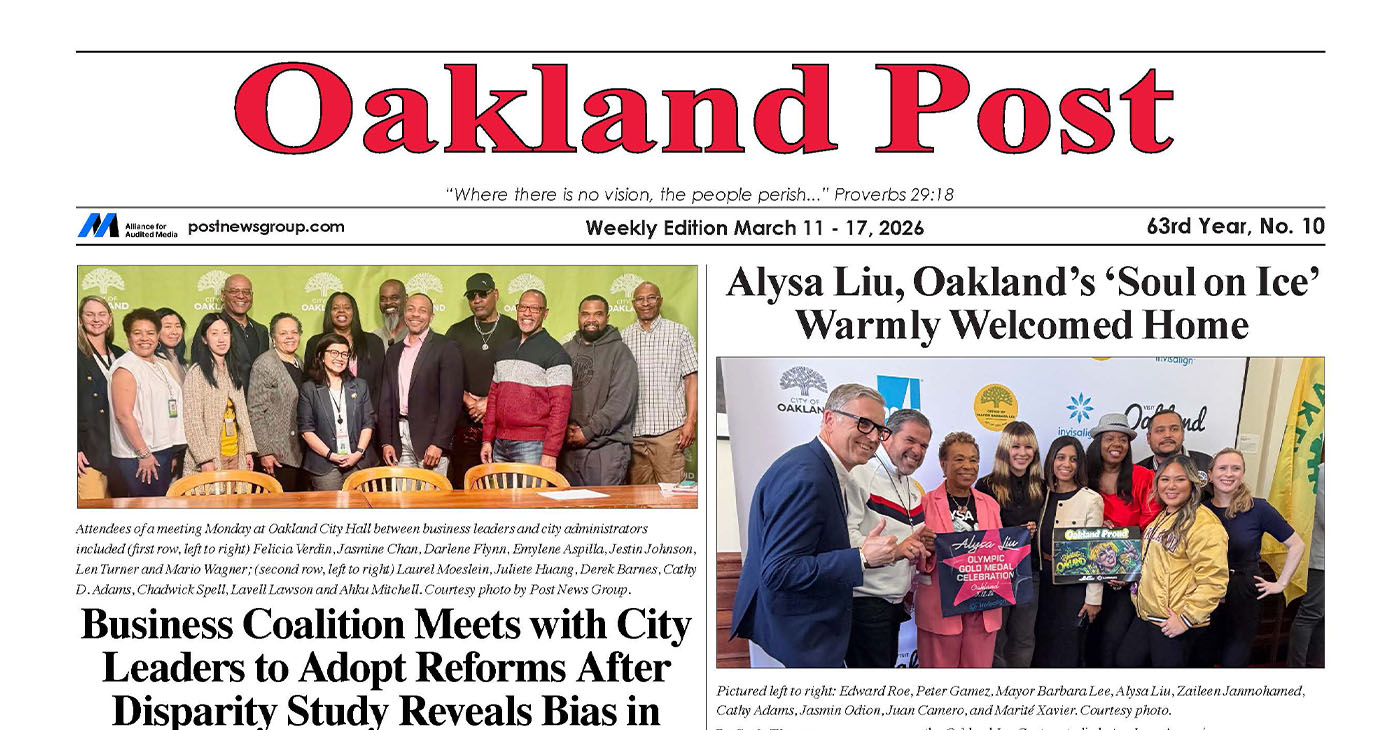
To enlarge your view of this issue, use the slider, magnifying glass icon or full page icon in the lower right corner of the browser window.
Activism
Oakland Post: Week of March 4 – 10, 2026
The printed Weekly Edition of the Oakland Post: Week of March 4 – 10, 2026
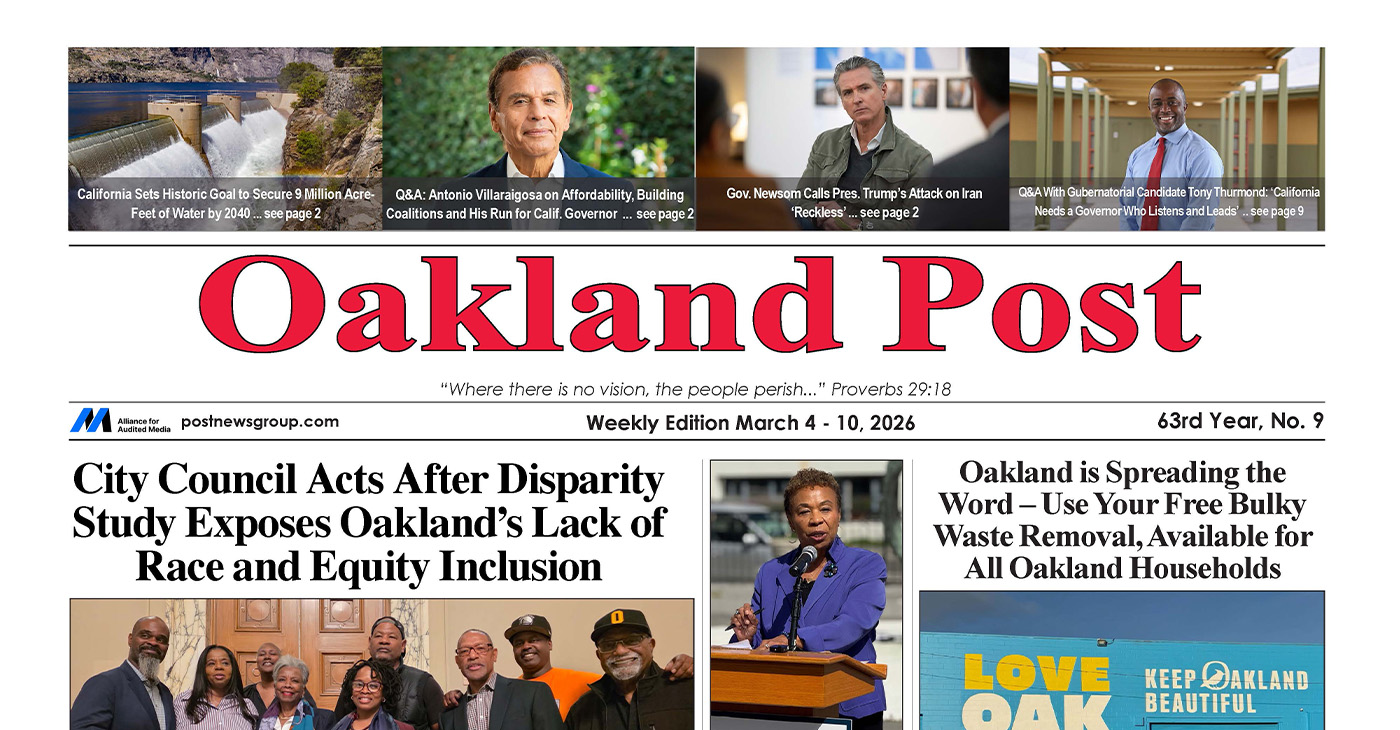
To enlarge your view of this issue, use the slider, magnifying glass icon or full page icon in the lower right corner of the browser window.


WORK FROM HOME
Home-based business with potential monthly income of $10K+ per month. A proven training system and website provided to maximize business effectiveness. Perfect job to earn side and primary income. Contact Lynne for more details: Lynne4npusa@gmail.com 800-334-0540


Black Artists in America, Installation Three Wraps at the Dixon Gallery and Gardens

Grief, Advocacy, and Education: A Counselor Reflects on Black Maternal Health

Future of Florida’s Black History Museum in Limbo

New Research Shows the Many Benefits of Early Learning

South Hampton K-8 Students Among Top 10 Finalists for Samsung’s ‘Solve for Tomorrow’ Competition

Cuba: No Negotiation with US on the President or Political System

Brooklyn Academy of Music Names Jamaican-Born Tamara McCaw as President

Trinidad & Tobego – U.S. Launches WhatsApp Channel for American Citizens in the Country

Oakland Post: Week of March 18 – 24, 2026

AI Innovation vs. Ethics and Environmental Impact

AI, Web3, and Digital Reparations

What If You Owned Your AI Agent?

Season 7, Episode 3 – January Reporter’s Roundtable 📱

Season 7, Episode 3 – January Reporter’s Roundtable

AI, Media, and Power | Part 2, Real-World Impacts and Tradeoffs

Discrimination in City Contracts

Oakland Post: Week of February 11 – 17, 2026

Reflecting on Black History Milestones in Birmingham AL

Rising Optimism Among Small And Middle Market Business Leaders Suggests Growth for California

CITY OF SAN LEANDRO STATE OF CALIFORNIA PUBLIC WORKS DEPARTMENT ENGINEERING DIVISION NOTICE TO BIDDERS FOR ANNUAL STREET OVERLAY/REHABILITATION 2019-21 – PHASE III

Oakland Post: Week of February 18 – 24, 2026

PRESS ROOM: NBA Hall of Fame Nominee Terry Cummings Joins 100 Black Men of DeKalb County to Launch Victory & Values Initiative

Oakland Post: Week of February 25 – March 3, 2026

Trump’s MAGA Allies are Creating Executive Order Plan to Steal the 2026 Midterms

U.S. manufacturing rebounds – how foundry services are adapting to rising demand

OP-ED: One Hundred Years of Black Workers Telling the Truth

Advancements in solar technology that are changing the way we power the world

Chase Oakland Community Center Hosts Alley-Oop Accelerator Building Community and Opportunity for Bay Area Entrepreneurs

Poll Shows Support for Policies That Help Families Afford Child Care

PRESS ROOM: Civil Rights TV Launches in Selma as the World’s First 24/7 Civil Rights Television Network

Hyundai Ioniq 5 Parking, Safety, and 360 View #shorts

2025 Ioniq 5 New Wiper & Powerful Performance! #shorts

Electric SUV Range: Is 259 Miles Enough? #shorts

EV Charging: How Fast Can You Charge an Electric Vehicle? #shorts

Biometric Cooling… Messaging Seats…Come on! 2025 Infiniti QX80 Autograph 4WD

Charged Up: Witness the Magic of a Fully Electric Car! #shorts

Range Rover Sport PHEV Included…: See What’s Inside This Luxury SUV! #shorts

Invisible Hood View: Perfect Parking with X-Ray Vision! #shorts

AI Is Reshaping Black Healthcare: Promise, Peril, and the Push for Improved Results in California

ESSAY: Technology and Medicine, a Primary Care Point of View

Sanctuary Cities

The RESISTANCE – FREEDOM NOW

STATE OF THE PEOPLE: Freddie

ECONOMIC BOYCOTT DAY!!!!!

I told You So
-
 #NNPA BlackPress4 weeks ago
Reflecting on Black History Milestones in Birmingham AL
-
 #NNPA BlackPress4 weeks ago
PRESS ROOM: NBA Hall of Fame Nominee Terry Cummings Joins 100 Black Men of DeKalb County to Launch Victory & Values Initiative
-
 Activism4 weeks ago
Oakland Post: Week of February 25 – March 3, 2026
-
 #NNPA BlackPress4 weeks ago
Trump’s MAGA Allies are Creating Executive Order Plan to Steal the 2026 Midterms
-
 #NNPA BlackPress4 weeks ago
Poll Shows Support for Policies That Help Families Afford Child Care
-

 Activism3 weeks ago
Oakland Post: Week of March 4 – 10, 2026
-

 #NNPA BlackPress3 weeks ago
Woman’s Search for Family’s Roots Leads to Ancestor John T. Ward – A Successful Entrepreneur and Conductor on the Underground Railroad
-

 #NNPA BlackPress3 weeks ago
OP-ED: NNPA Launches 2026 “Leadership Matters” Video Series
