
City Government
Opinion: Can These Powerful Black Leaders Join Forces to Close the Achievement Gap for Black Children?


When California Superintendent of Public Instruction Tony Thurmond announced the English language arts and math results of the California Assessment of Student Performance and Progress (CAASPP) test last month, we found out that African-American students’ scores lagged behind the much higher marks their white, Asian and Hispanic peers obtained.
Statewide, just over 40 percent of all public school students met or exceeded standards in math and 51 percent were proficient in English.
Of those numbers, only 21 percent of African-American students were proficient in math, compared with 74 percent of Asian-American students, 54 percent of white students, and 29 percent of Hispanic students. In English, only 33 percent of African-American students were proficient. Compare that with 77 percent of Asian-American students 64 percent of white students, and 41 percent of Hispanic students.
Five years ago, California adopted the CAASPP assessment tests. Each year since then, our African-American student scores have ranked at the bottom of the results of all racial subgroups in the state.
During that time, the achievement gap between Black students and their white and Asian peers has seen only marginal improvement, while getting wider between our children and their Hispanic counterparts.
What gives?

Today, our key Education Leaders in California are African American. They are State Superintendent of Public Instruction Tony Thurmond, ; President of the State Board of Education, Dr. Linda Darling-Hammond; President of the California Teachers Association, E. Toby Boyd; Board Chair, California Charter School Association, Margaret Fortune and President California School Board Association, Emma Turner .
We need these leaders to come together to propose a functioning system that will guide those working hard to achieve results for African-American students in our state.
The achievement gap between African-American and white students was first acknowledged over 50 years ago in a 1966 federal government study called the Coleman Report. The United States Congress commissioned the report after it passed the 1964 Civil Rights Act.
Since then, education researchers and practitioners have been hard at work trying to identify the causes and propose what can be done to address it. Despite decades of education reform efforts and billions of dollars spent in federal, state and local funding, the achievement gap persists.
Ronald Edmonds, the late Harvard education researcher, said 40 years ago, “We can, whenever and wherever we choose, successfully teach all children whose schooling is of interest to us. We already know more than we need to do that. Whether or not we do it must finally depend on how we feel about the fact that we haven’t so far.”
To Edmonds and education experts like him, closing the achievement gap is absolutely solvable. The fact that little progress has been made to narrow it can be attributed more to the absence of political will than to any lack of social science research on the problem.
The social factors that contribute to the achievement gap and the actions necessary to close it have been well studied, but public policymakers tend to avoid or overlook the data and recommendations that could cost them any political capital.
For example, in 2013 California revamped education funding to provide extra money for school districts with large numbers of “high-needs” students, mostly kids from poor families or foster children and “English-learners.”
The Local Control Funding Formula (LCFF) pushed expenditure decisions down from the state to local school districts because Gov. Jerry Brown and the Legislature believed that those closest to the day-to-day operation of schools were best suited to identify what their students needed and would work best for them.
However, this has proven not to be the case, particularly when it comes to the performance of Black students in California.
When the California Department of Education first introduced the new public education finance system in 2013, some lawmakers warned that the LCFF did not provide mechanisms to adequately track how local school officials would spend funds. Gov. Brown and groups representing school districts shot down attempts by legislators like Assemblymember Shirley Weber (D-San Diego) to address that concern.
This month, California State Auditor Elaine Howle announced that her office’s recent examination of LCFF spending found that the system lacked sufficient oversight and accounting controls, confirming Weber’s reservations. Realizing that there has been very little progress toward closing the achievement gap despite the state having redirected billions of dollars to help solve it, may finally force lawmakers to now consider passing the kind of legislation Weber initially proposed.
Edmonds, who was African American, made the observation that progress toward resolving the achievement gap might not happen as quickly as it could because of how hite policymakers viewed the issue. He did not question their sincerity about solving it, but was concerned about how they would approach it given biases they might have.
Working with legislators like Dr. Weber, we will begin to close the achievement gap.












Activism
Oakland Post: Week of September 30 – October 6, 2026
The printed Weekly Edition of the Oakland Post: Week of September 30 – October 6, 2026

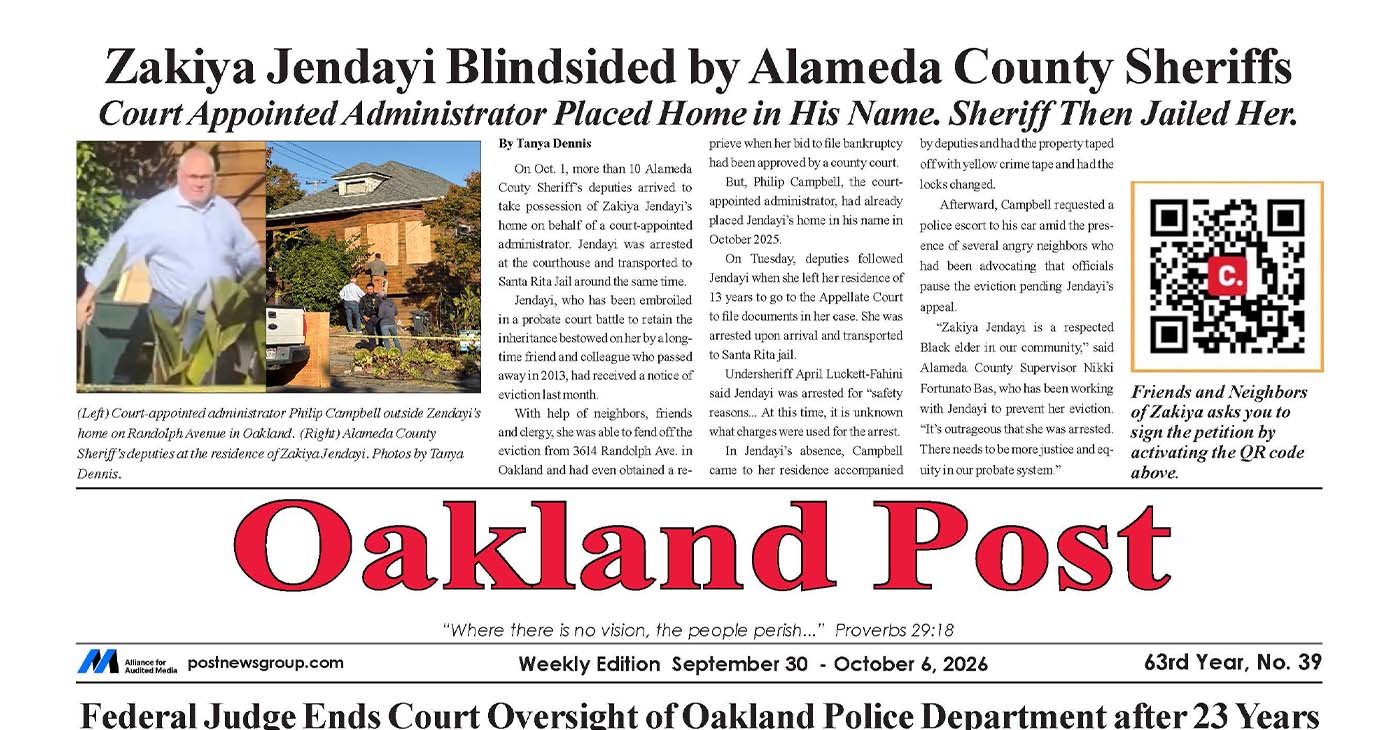
To enlarge your view of this issue, use the slider, magnifying glass icon or full page icon in the lower right corner of the browser window.

Activism
Oakland Post: Week of September 23 – 29, 2026
The printed Weekly Edition of the Oakland Post: Week of September 23 – 29, 2026

To enlarge your view of this issue, use the slider, magnifying glass icon or full page icon in the lower right corner of the browser window.

Activism
Oakland Post: Week of September 16 – 22, 2026
The printed Weekly Edition of the Oakland Post: Week of September 16 – 22, 2026

To enlarge your view of this issue, use the slider, magnifying glass icon or full page icon in the lower right corner of the browser window.



OP-ED: Proposition 44 Would Put a Price on Trust

OP-ED: Proposition 40: It’s Time to Play Chess, Not Checkers

Listening as a Lifeline: A Doula’s Witness to Black Maternal Health

New Protections for Ticket Buyers: Gov. Newsom Signs Assemblymember Isaac Bryan’s Bill

‘We Don’t Talk Trash — We Pick Up Trash!’

Zakiya Jendayi Arrested, Locked Out of Home by Sheriff’s Deputies

Oakland Post: Week of September 30 – October 6, 2026

Asm. Corey Jackson Announces Launch of 24-Hour Childcare in His District

IN MEMORIAM: The Rev. Leon “Sonny” Clark, Longtime Orange County Pastor and Community Leader, Dies at 72

Poll: Becerra Widens His Lead Over Hilton; Californians Split on Wealth Tax

From Historic Memories to New Possibilities: Oakland Celebrates Coliseum 60

County Office of Education Says OUSD Finances Are Getting Healthier, Materially Stronger

LIVE FREE Sunday Dinner Brings Faith, Fellowship and Civic Conversation to Oakland

Remembering Chauncey Bailey as Student Journalists Face Threats to Truth-Telling

BLACspace Cooperative Invites Bay Area to Experience Oakland’s Black Cultural Ecosystem Through a BLAC Map Tour + Party

Standoff for Justice: Our Homes Are Worth Fighting For

Oakland Post: Week of August 26 – September 1, 2026

Frontier Airlines’ Return to Oakland Airport Brings Flights, Jobs and Opportunity

Gubernatorial Candidate Steve Hilton Blasts California New Tire Rules; Newsom Hits Back

Chef Sharon Lee Blends Culinary Excellence, Education and Empowerment

Jackie Wright Champions Bay Area Stories, Filmmakers and Cultural Institutions

Misnamed ‘Parent’ PAC Seeks to Influence Oakland School Board Elections

Oakland Coliseum Project Opens Door for Small Businesses to Build Bigger

Big City Mayors Ask for “Yes” Vote on Housing Bond Measure; Conservatives Say “No”

Gov. Newsom’s Latest Appointees Include Sacramento Advocate for Formerly Incarcerated Students; State’s New Tech Chief

Longtime BWOPA Member Brendalyn Goodall Appointed to California Workforce Development Board

Gov. Newsom Signs Law Shielding Immigration Aid Workers From Doxing Threats

Secretary of State Shirley N. Weber Urges Californians to Vote Early as Voter ID Battle Intensifies

Oakland Post: Week of September 2 – 8, 2026

IN MEMORIAM: Dolly Parton Dead at 80 — How She Built a Legacy of Love and Earned Her Place in Black Culture

The Conversation With Al McFarlane 6/23/26

Media Monday 6/22/26

LIVE! ASK ALMA! — TUES. 6.23.26 7PM EST

Car Buying Secrets: 4 Hidden Checks Before You Sign!

Is This 550 HP Charger Worth YOUR Money? AutoNetwork Review

Celebrating Juneteenth – Frederick Douglass on education and resistance

LIVE! — ASK ALMA! — TUES. 6.19.26 7PM EST

Hyundai Ioniq 5 Parking, Safety, and 360 View #shorts

2025 Ioniq 5 New Wiper & Powerful Performance! #shorts

Electric SUV Range: Is 259 Miles Enough? #shorts

EV Charging: How Fast Can You Charge an Electric Vehicle? #shorts

Biometric Cooling… Messaging Seats…Come on! 2025 Infiniti QX80 Autograph 4WD

Charged Up: Witness the Magic of a Fully Electric Car! #shorts

Range Rover Sport PHEV Included…: See What’s Inside This Luxury SUV! #shorts

Invisible Hood View: Perfect Parking with X-Ray Vision! #shorts
-
 Community3 weeks ago
Misnamed ‘Parent’ PAC Seeks to Influence Oakland School Board Elections
-
 Activism4 weeks ago
Oakland Post: Week of September 2 – 8, 2026
-

 Activism3 weeks ago
Oakland Post: Week of September 9 – 15, 2026
-

 Community3 weeks ago
Richmond Tiny House Village Farm & Garden Set to Open Gates on Sept. 26
-

 Black History3 weeks ago
Latest Massacre in Haiti Reveals Cruelty U.S. Deportations
-

 Black History3 weeks ago
OPINION: Nolan Wells’ Death One of Several Signifying Racial Terror Lives on in U.S. South
-

 Business2 weeks ago
Mayor Lee Announces $1 Million Kaiser Permanente Grant for Pilot Program to Address Homelessness, Clean Up Public Spaces throughout Oakland
-

 Community3 weeks ago
Democratic Clubs Interview Candidates for Oakland School Board
