
#NNPA BlackPress
OP-ED: Rev. Joseph Lowery: One of the most influential leaders of the latter 20th Century
NNPA NEWSWIRE — Lowery’s enduring legacy, I believe, is that he led the SCLC back from near death, to vibrancy and noteworthy relevance, after taking over in 1977, nine years after the King assassination, following the rocky and uncertain tenure of Abernathy’s presidency. No one could be expected to replicate the charisma, dynamism, and eloquence of King.

By Deric Gilliard
It took the most life altering event of the 21st century to finally mute the importance of one of the most significant figures of the second half of the 20th century. Joseph Echols Lowery, co-founder of the Southern Christian Leadership Conference (SCLC), the direct action civil rights organization that served as the firing pin that used non-violent protest to push Congress to pass the Civil Rights Act of 1964 and coordinated movements across the nation that led to the passage of the Voting Rights Act of 1965, has finally expired. He was 98. Due to social distancing requirements from COVID-19, a public celebration of his life and legacy will be postponed until fall.
Lowery, born in Huntsville, Alabama, was one of the inner circle of preachers credited with launching the Southern Christian Leadership Conference in 1957, along with Dr. Martin Luther King Jr., Rev. Ralph David Abernathy, Rev. Fred Shuttlesworth, and Rev. C.K. Steele of Tallahassee.
Unlike the bombastic Rev. Hosea Williams, who served as King’s fiery field general, agitating and igniting movements, or Andy Young, known as the great negotiator and someone who knew how to deal with white intransigents resisting change, or Shuttlesworth, whose bravery is legendary after his home was bombed several times and he was beaten repeatedly — along with his pregnant wife, Ruby — while trying to enroll their children in school in 1957, Lowery’s legacy is more nuanced.

Primarily an administrator until the time of King’s assassination, when Lowery was chairman of the SCLC’s national board of directors, he was not known as someone who had repeatedly been battered or terrorized on the front lines in the fifties and sixties, though he did have scrapes with racist leaders. In fact, in 1979, in Decatur, Alabama, Lowery and the SCLC-led protesters, while challenging the arrest of a docile, retarded black man, Tommie Lee Lines, for allegedly raping two white women, were confronted by armed Klansmen, who shot at the non-violent protesters, including Mrs. Evelyn Lowery. She narrowly escaped a bullet through her windshield while seeking cover in the floorboard of her car.
Lowery was arrested numerous times, including while protesting our government’s support of apartheid South African regime in 1984, and challenging the dumping of toxic waste in black communities in North Carolina in 1983, along with Dr. Ben Chavis. He also led the successful integration of the bus lines in Mobile, AL before the seismic, 381-day boycott triggered by Rosa Parks in Montgomery in 1955. In 1965, King delegated him to present the movement rights’ marchers’ demands to intransigent Alabama governor and avowed segregationist George Wallace.
Lowery’s enduring legacy, I believe, is that he led the SCLC back from near death, to vibrancy and noteworthy relevance, after taking over in 1977, nine years after the King assassination, following the rocky and uncertain tenure of Abernathy’s presidency. No one could be expected to replicate the charisma, dynamism, and eloquence of King. Indeed, Abernathy never found his footing during a period when fellow SCLC insiders Young and Rev. C.T. Vivian say he tried too hard to be King, instead of himself. And even when Lowery edged out Williams for the presidency in 1977, it was a struggle to regain momentum.
Gradually, however, despite being in the midst of what King historian and Pulitzer Prize winner David Garrow deemed a “post-civil rights era,” Lowery grabbed hold of a series of critical issues and made them his and the SCLC’s own. Gun violence, voting rights, hate crimes, economic injustice, affirmative action, educational tracking, redistricting, disparities in sentencing, black-on-black violence: you name the issue, Lowery battled long-time rival Rev. Jesse Jackson for national leadership as the clarion voice speaking for black activism and justice throughout the last quarter of the 20th century. Whatever the topic, Lowery spoke to it with eloquence, precise insight and passion.
On the 25th anniversary of the King assassination, April 4, 1993, Lowery and the SCLC launched the Stop the Killing/End the Violence campaign. Urging Americans to “turn to each other, not on each other,” the campaign ultimately took tens of thousands of guns off the streets through a controversial gun buy-back program frequently supported by corporations. Along the way, he challenged Presidents Reagan, Carter, Bush 41 and 43 and Bill Clinton, who credited Lowery with being the leader who moved him to raise the black church burnings to a national state of emergency. He pointedly criticized the U.S. bombing in Kosovo and angered the SCLC’s many Jewish supporters by agreeing to meet with Palestinian leader Yasser Arafat. The Methodist minister also picketed Atlanta’s Prior Tire, over its challenge to the city’s landmark affirmative action stand and went toe-to-toe against hometown corporate giant Coca-Cola to pressure it to pull out of its investments in the from a racist South African regime. Lowery and the SCLC signed hundred million-dollar economic covenants with Publix, Shoney’s, which required they promise to hire more black managers, utilize more black vendors and place more stores in minority neighborhoods.
Rooted and grounded in voting rights and education, Lowery and the SCLC established and kept alive dozens of chapters throughout the country and the world while registering hundreds of thousands of voters throughout the years, via motor voter campaigns. Adept at working with groups focused on LGBTQ, environmental, anti-war and economic justice issues, he and the SCLC were broadly criticized as the first “mainstream” civil rights organization to actively support Min. Farrakhan’s 1995 Million Man March. First and foremost a minister of the gospel, Lowery, who refused to separate his ministry from his activism, also pastored United Methodist churches for over 40 years. Along the way, Ebony selected him as one of America’s top 15 preachers.
It would not be possible to salute the legacy of Lowery without including the laudable contributions of his wife, Evelyn. Founder of the SCLC/W.O.M.E.N., she instituted the annual Drum Major for Justice Awards, launched the Wings of Hope anti-drug initiative, introduced the annual civil rights tours throughout the south and erected monuments to honor the valiant foot soldiers who labored non-violently To Redeem the Soul of America, the SCLC’s motto. Together, they were one of America’s most influential couples of their era, and significantly improved the arc of social justice in the South.
Never resistant to go against the grain, Lowery backed the upstart, the little-known senator from Illinois, Barack Hussein Obama, against the chosen one, former Secretary of State Hillary Clinton, for the 2008 Democratic presidential nomination. Lowery did so despite the fact that most liberals, and virtually all black leaders, backed Clinton. Lowery campaigned vigorously for Obama, and in 2009, brought the fiery, controversial benediction at the conclusion of the inauguration of the nation’s first black president. Obama awarded Lowery with the Presidential Medal of Freedom, later that year.
Lowery was no King, but he never missed a payroll while reinvigorating the SCLC and ensuring that it remained a powerful force speaking truth to power during his twenty-year tenure at the helm from 1977-1997. After his time at the SCLC, he founded the Georgia Coalition for the People’s Agenda, a 501C-3 that boasts chapters and affiliates through nine states, still focusing on voter rights and registration. Farewell to the “Dean” of the civil rights movement.
Deric Gilliard is former communications for the SCLC and the author of “Living in the Shadows of A Legend: Unsung Heroes and ‘Sheroes’ who Marched with Dr. Martin Luther King, Jr.” He can be contacted at gilliardpr@gmail.com.









#NNPA BlackPress
NFL: Week Two Recap | Jalen Hurts did not fold; Caleb Williams exits game with injury
Philadelphia Eagles quarterback Jalen Hurts found Darius Cooper with nine seconds left for the game winning touchdown as his team beat the Tennessee Titans 24-20 in Nashville. Hurts finished the day 26/37 for 264 yards. He threw for two touchdowns and two interceptions. Prior to the final drive, the Eagles ran 25 plays for 45 […]
The post NFL: Week Two Recap | Jalen Hurts did not fold; Caleb Williams exits game with injury appeared first on BlackPressUSA.
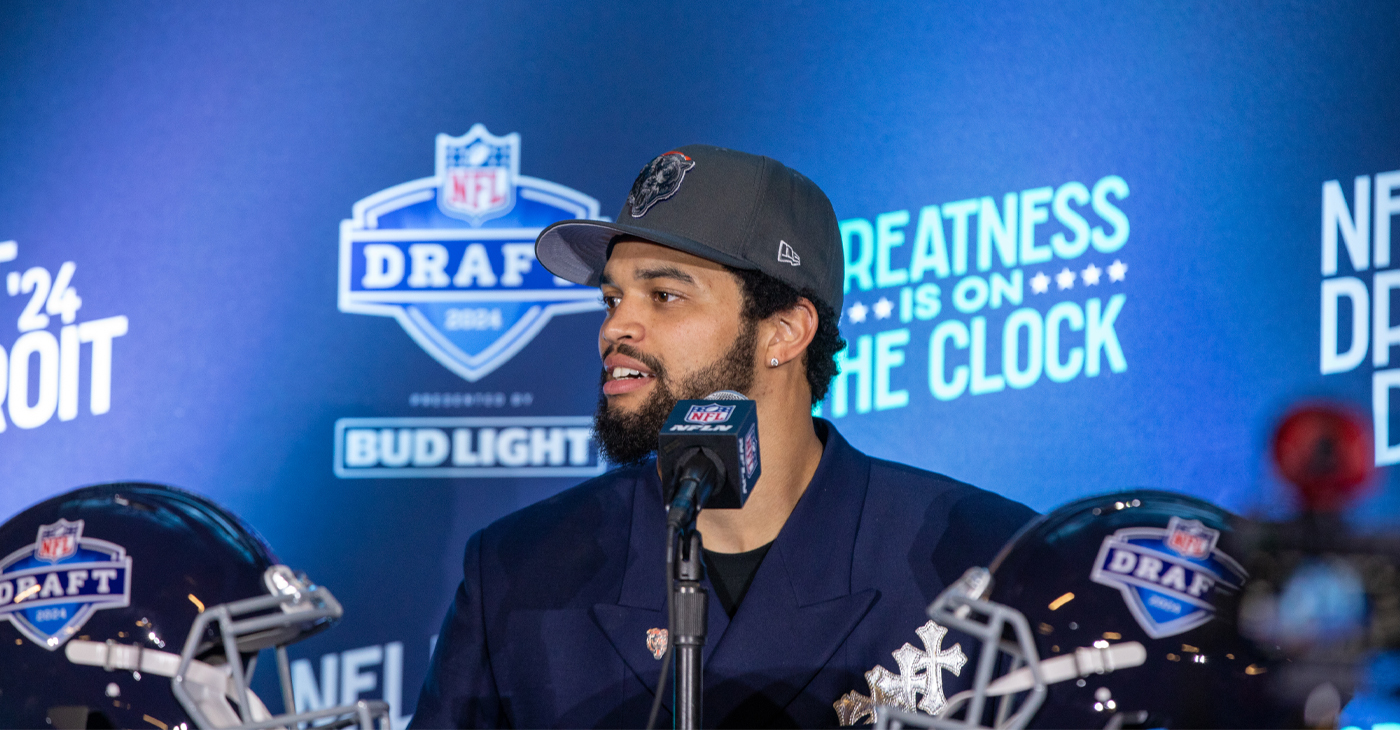
Philadelphia Eagles quarterback Jalen Hurts found Darius Cooper with nine seconds left for the game winning touchdown as his team beat the Tennessee Titans 24-20 in Nashville. Hurts finished the day 26/37 for 264 yards. He threw for two touchdowns and two interceptions.
Prior to the final drive, the Eagles ran 25 plays for 45 yards. During the final drive Hurts went 6-8 with 61 passing yards and the touchdown. Titans defensive tackle — and team captain — Jeffery Simmons said this week that the way to defend Jalen Hurts is to make him “play quarterback.”
Hurts said to Simmons after today’s game: “You started that sh**. I had to finish it.”
Running back Saquon Barkley suffered a stinger in the first half but he ultimately finished the game. He had four carries and nine yards and one catch for eleven yards. He will get an MRI for his injury, but admitted to Cameron Wolfe of the NFL Network he was fine.
Caleb Williams leaves game against Vikings with apparent lower-body injury
Chicago Bears quarterback Caleb Williams was helped off the field with a right leg injury with 7:42 remaining in the fourth quarter. Williams was down, writhing in pain after scrambling to his left. After departing the injury tent, Williams raised his right fist, acknowledging the crowd while expressing his frustration. Testing will commence on Monday to find out more details about his injury.
“We’ll know tomorrow,” Johnson admitted regarding Williams’ injury. “He’s in good spirits. He’s a team player.”
Williams finished the day with 138 passing yards and one interception.
“I’m actually happy it’s nothing with the knee — that was my first inclination,” Johnson said. “But, a hamstring could be pretty damaging as well. So, we’ll see. We’ll see how bad it is tomorrow and we’ll go from there.”
Bryce Young once again dominated the Falcons
Carolina Panthers quarterback Bryce Young is 5-1 against the Atlanta Falcons and is undefeated at Mercedes-Benz Stadium. Today, Young threw for 287 yards and three touchdowns as he led the Panthers to a 34-3 dismembering of the Atlanta Falcons. Georgia Tech alumnus Darren Waller caught two touchdowns and linebacker Devin Lloyd returned one of his two interceptions for a touchdown.
Cooper Rush started his second straight game for the Falcons and it did not go well. The partisan crowd voiced their displeasure after Rush completed 10/17 passes for 86 yards and two interceptions. Jack Strand entered the game for Rush prompting cheers from the Falcons fans. The rookie threw a pick-six on his first career pass attempt. Strand was the first QB to accomplish that feat since Sam Darnold in 2018 and is the first Falcons player to do that since Brett Favre in 1991. Strand finished the day with 59 passing yards and 16 rushing yards.
According to reports, quarterback Michael Penix, Jr. is expected to make his season debut this Thursday at the Green Bay Packers. His return should help the Falcons. They are the first team since the 2008 Rams to not run any plays in the red zone after the first two games to open a season.
The bright spots for the Falcons today were the Spelman College Jaguarettes performing with the Falcons cheerleaders and Florida A&M’s marching band, The Marching 100, also performed during halftime!
Jayden Daniels gets carted off after apparent arm injury
Washington Commanders quarterback Jayden Daniels appeared to injure his left elbow on the final play of the first half in his game against the Dallas Cowboys. During the play, Daniels got stepped on, braced himself for the fall, and his elbow bent the wrong way. Daniels draped a towel over his head as he exited the field on the cart.
He was later ruled out.
Daniels suffered a dislocated elbow to the same arm during week nine of last season against the Washington Commanders, which led to him being shut down for the remainder of the season.
The post NFL: Week Two Recap | Jalen Hurts did not fold; Caleb Williams exits game with injury appeared first on BlackPressUSA.
#NNPA BlackPress
The Complete Negotiation Framework — Every Stage, Every Tactic, Every Win
Master the complete vehicle-purchase negotiation framework with Roosevelt Gist and Roosevelt. Learn every stage, tactic, and win!
The post The Complete Negotiation Framework — Every Stage, Every Tactic, Every Win appeared first on BlackPressUSA.

Roosevelt Gist and Roosevelt deliver the complete vehicle-purchase negotiation framework in Episode 8 of The Color of Our Money Is Green. This episode covers the three foundations of every effective negotiation, the full seven-stage negotiation sequence with exact language for every stage, and five of the most common dealership tactics with the specific response each one requires.
What You Learn in This Episode:
The three foundations that make every negotiation tactic work
The complete seven-stage car-buying negotiation sequence
Exact language for every stage of the dealership conversation
Five common dealership tactics — the turnover, the four-square, the packed payment, spot delivery, and forced add-ons — and how to counter each one
Why signing preliminary paperwork isn’t the same as signing the final contract
___________________________________________________________________
“The Color of Our Money Is Green: A Buyer’s Guide to What Cars Actually Cost” — stan.store/RGist
____________________________________________________________________
AutoNetwork helps serious car shoppers inspect any new vehicle online before walking into a dealership. I’m Roosevelt — I’ve been reviewing cars and shaping digital car buying and credit union auto leasing since before YouTube car reviews existed.
You’ll find detailed walkaround reviews, POV test drives, and buyer-focused breakdowns covering comfort, space, features, and real-world value.
How to use the channel:
Watch the walkaround of the car you’re considering
Visit AutoNetwork.com for the full review
Check CouponsOffersAndDeals.com for current dealer specials
Walk in already knowing what you want — and what it should cost
 AutoNetwork.com
 CouponsOffersAndDeals.com
Affiliate disclosure: some links earn a small commission at no cost to you and help support the channel. Insta360 is one of those partners.
The post The Complete Negotiation Framework — Every Stage, Every Tactic, Every Win appeared first on BlackPressUSA.
#NNPA BlackPress
Mazda CX-90 Luxury: Heated Seats & Premium Comfort! #shorts
Stay toasty in the CX-90! Plush Nappa leather, heated/ventilated seats, and a memory-equipped heated steering wheel deliver ultimate luxury.
The post Mazda CX-90 Luxury: Heated Seats & Premium Comfort! #shorts appeared first on BlackPressUSA.

Experience ultimate comfort in the CX-90. Nappa leather, heated/ventilated seats, 8-way power adjustments, and memory settings for both front passengers. The heated steering wheel with memory tilt/telescope adds premium convenience.
 Watch the full video: https://youtu.be/EH5A4eQ4ipY
#AutoNetwork
The post Mazda CX-90 Luxury: Heated Seats & Premium Comfort! #shorts appeared first on BlackPressUSA.



Doulas Are Helping Black California Moms Navigate Pregnancy–Even as High Mortality Rates Persist

Newsom Signs Addictive Social Media Law to Protect Kids

On Your November Ballot: Prop 38 Would Allocate $8.4 Billion to Immunology and Immunotherapy Funding

Ask California: Golden State Releases New AI Chatbot

Asm. Isaac Bryan’s Bill Banning California Police From ICE Side Jobs Reaches Newsom’s Desk

Assemblymember LaShae Sharp-Collins’s Bill Would Pause Law Enforcement’s Use of Shock Gloves Pending Study

BOOK REVIEW: ‘Laws of Solomon’ Reveals Tender Heart of Former Child Soldier

OPINION: The New American Fear – From 9-11 to AI

Passing for White, Fighting for Black America: The Courage of Walter White

Oakland People’s Arms Embargo Coalition Demands End to Military Shipments Thru Oakland

Barbara Lee Mourns Gloria Steinem, Remembers a Friendship Rooted in Equality

Event Preview: ‘Fashion v. Fascism’ – A Runway Revolution Is Coming to the Bay Area

Two Looming Threats Every Alameda County Elder Should Know About

Oakland Mayor Reads to Children at Bookout Block Party at Marcus Books Store

Tradition Comes to the Streets in 11th Annual Black-Eyed Pea Festival at the Freedom Farmers Market

Less Affluent School Districts, Including Sacramento City, Face Threat of State Takeover

ESSAY: California Can Close Its Colorectal Cancer Gap

California Hispanic Chambers of Commerce Unveils: ‘Powering the Future’ Theme for 47th Annual Statewide Convention

Four Candidates, Including Incumbent Barbara Lee, Qualify for Oakland Mayor’s Race

Oakland Post: Week of August 12 – 18, 2026

From Blueprint to Breakthrough: Tackling Affordable Housing in Oakland

Oakland Observes Black August with Block Parties, Film Showings, Workshops

COMMENTARY: Why Local School Tax Measure G1 Will Not Be on the November Ballot

Standoff for Justice: Our Homes Are Worth Fighting For

Returning to Its Roots, the Oakland Black-Eyed Pea Festival Partners with the Freedom Farmers Market Sept. 12

Oakland Post: Week of August 26 – September 1, 2026

NPRC Scores First Advocacy Victory: David Shaw Finally Gets His Wish to ‘Go Home’

Frontier Airlines’ Return to Oakland Airport Brings Flights, Jobs and Opportunity

Gubernatorial Candidate Steve Hilton Blasts California New Tire Rules; Newsom Hits Back

Chef Sharon Lee Blends Culinary Excellence, Education and Empowerment

The Conversation With Al McFarlane 6/23/26

Media Monday 6/22/26

LIVE! ASK ALMA! — TUES. 6.23.26 7PM EST

Car Buying Secrets: 4 Hidden Checks Before You Sign!

Is This 550 HP Charger Worth YOUR Money? AutoNetwork Review

Celebrating Juneteenth – Frederick Douglass on education and resistance

LIVE! — ASK ALMA! — TUES. 6.19.26 7PM EST

Hyundai Ioniq 5 Parking, Safety, and 360 View #shorts

2025 Ioniq 5 New Wiper & Powerful Performance! #shorts

Electric SUV Range: Is 259 Miles Enough? #shorts

EV Charging: How Fast Can You Charge an Electric Vehicle? #shorts

Biometric Cooling… Messaging Seats…Come on! 2025 Infiniti QX80 Autograph 4WD

Charged Up: Witness the Magic of a Fully Electric Car! #shorts

Range Rover Sport PHEV Included…: See What’s Inside This Luxury SUV! #shorts

Invisible Hood View: Perfect Parking with X-Ray Vision! #shorts
-
 Commentary4 weeks ago
Standoff for Justice: Our Homes Are Worth Fighting For
-
 Activism4 weeks ago
Oakland Post: Week of August 26 – September 1, 2026
-
 Business4 weeks ago
Frontier Airlines’ Return to Oakland Airport Brings Flights, Jobs and Opportunity
-
 Business4 weeks ago
Gubernatorial Candidate Steve Hilton Blasts California New Tire Rules; Newsom Hits Back
-
 Business4 weeks ago
Chef Sharon Lee Blends Culinary Excellence, Education and Empowerment
-

 Community4 weeks ago
Big City Mayors Ask for “Yes” Vote on Housing Bond Measure; Conservatives Say “No”
-

 Black History4 weeks ago
Jackie Wright Champions Bay Area Stories, Filmmakers and Cultural Institutions
-

 Education4 weeks ago
Gov. Newsom’s Latest Appointees Include Sacramento Advocate for Formerly Incarcerated Students; State’s New Tech Chief

Pingback: Panafricanmedia Networks