
Bay Area
Oakland Black Pride Hosts Events Celebrating Black Queerness
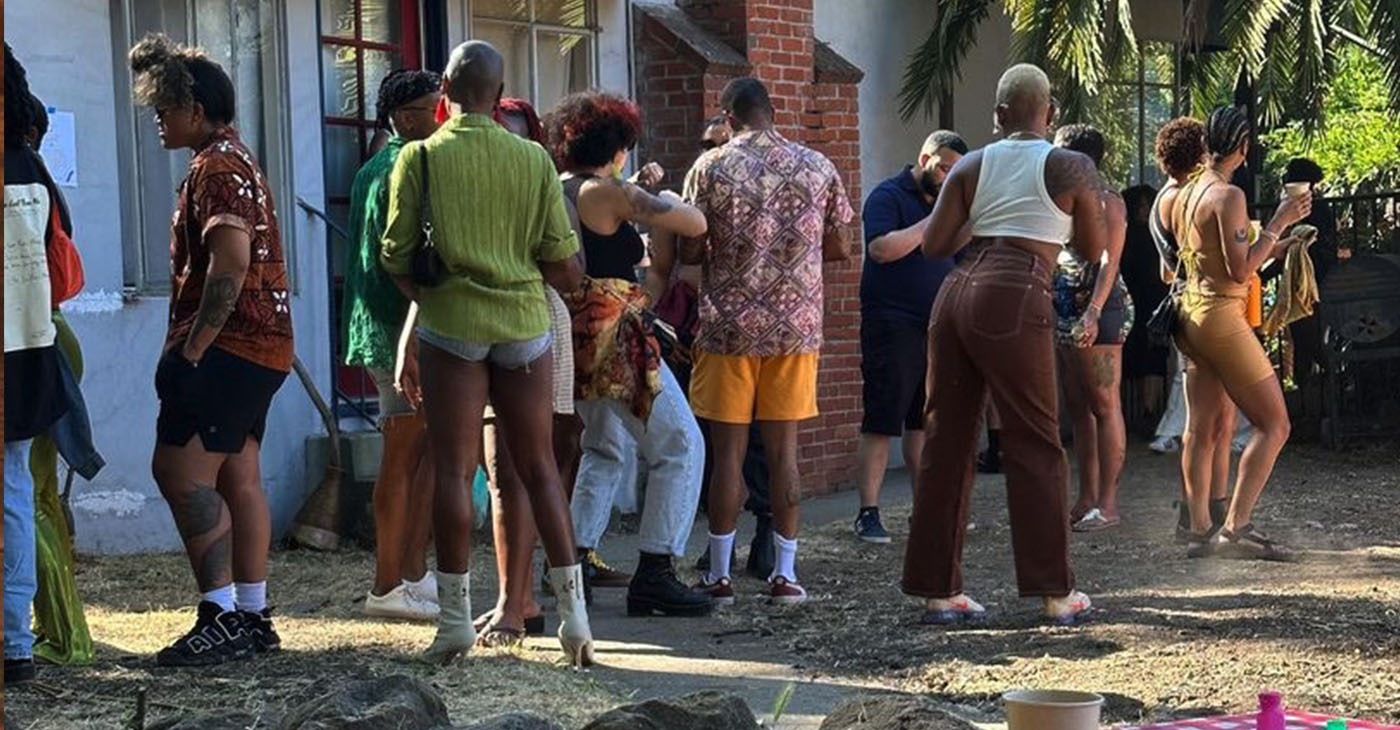
At the close of Pride Month, Oakland Black Pride held their third annual Black Pride Festival from June 28 to July 2 at various places across the city as well as online.

By Daisha Williams
Post Staff
At the close of Pride Month, Oakland Black Pride held their third annual Black Pride Festival
from June 28 to July 2 at various places across the city as well as online.
Under the leadership of founder Olawya Austin, the nonprofit is dedicated to enhancing the lives
of Black people within the LGBTQ+ community by creating spaces for them to be celebrated,
providing a break from racism, homophobia, transphobia, and/or sexism that they face in the
outside world.
Austin pointed out that Black people have been involved in the Pride movement since the very
beginning. Marsha P. Johnson, a Black woman, was one of the leading figures in the
Stonewall Riots in New York in 1969. Unfortunately, Black voices have often been
overshadowed by white in LGBTQ+ spaces, which is why spaces and organizations like Oakland Black Pride are so important.
“There’s still anti-Blackness in those spaces as well, so we have to create these things for
ourselves in order for us to get the things that we need. And that’s in the spirit of how it all
started 54 years ago and it’s exactly why it started,” said Austin.
“I think that a lot of celebrations that I see, they’ve forgotten about the roots of Pride and that’s
the difference between what our organization does and a lot of the Pride events we see around
the nation.”
This year’s Oakland Black Pride Festival consisted of eight events, each of them purposely different so there really was something for everyone.
It kicked off last Thursday night with a benefit dinner highlighting chefs who don’t have many
opportunities to climb up in the restaurant industry, a reminder for them and the guests that
people from their communities are talented, even if it isn’t showcased in the larger world.
For those 21+, there was the Queer Pub Crawl that toured four Black, queer-friendly local bars. And more suitable for younger members of the community, there was the Queer Expo which had a “Kidz Korner” and more than 50 vendors.
The expo, which Alyah Baker, an Oakland Black Pride board member, says is one of
her favorite parts of the festival brought “together several dozen different businesses from the
community and it’s an opportunity for these businesses to gain support and traction … I think it
also offers something different, a lot of Pride parties are evening events so it’s nice to see more
daytime events that are accessible for all different members of the community.”
The Expo was the first Oakland Black Pride that Mini Verna attended, and she enjoyed herself. “There’s a deep desire for space that’s just joyfully queer and comfortable and I think that’s what was created,” Verna said. “I think that’s what happens when spaces are created by BIPOC or LGBTQIA people in mind … these spaces are for cultivation, connection and pollination.”
The festival closed out July 2 with an afternoon cookout open only to members of the queer
community. Everything about the cookout signified that it was a safe space, from signage
promoting love and respect to the way people were dressed.
Aasha, one of the vendors said: “I had a friend who doesn’t usually express themself in their
queer embodiment, and they came fully decked out, like a crop top and a skirt and I was just like
‘You’re so beautiful!’”
The feeling of comfort and ease was not unique to Aasha, as many attendees appeared to have
similar experiences. Showing up in your own skin is hard and uncomfortable for a lot of people,
but the fact that so many people were able to in this space shows how well-cultivated it was.
Though several of the events of the festival cost money, organizers are working very hard to
make these spaces accessible to everyone who needs them. There are often extra tickets that are
donated by those who have the means to do so.
“No one will ever be turned away,” Austin said. “We don’t ‘gatekeep’ in such a way that will
exclude the community.”
In addition to the annual festival, Oakland Black Pride organizes events during other parts
of the year such as the Springboard Program, and the QTBIPOC (Queer, Trans, Black, and
Indigenous, People of Color) Monthly Social Circle.
Oakland Black Pride collaborates with organizations with similar missions. One is
GetSomeJoy, a creative wellness agency that focuses on mental health, grief therapy, and coping with sadness, which is incredibly useful for those navigating racism, homo/transphobia in their everyday lives or simply anyone who wants to get some joy in their lives. You can find
information about them on their website getsomejoy.com










Activism
Oakland Post: Week of September 23 – 29, 2026
The printed Weekly Edition of the Oakland Post: Week of September 23 – 29, 2026

To enlarge your view of this issue, use the slider, magnifying glass icon or full page icon in the lower right corner of the browser window.
Activism
Oakland Post: Week of September 16 – 22, 2026
The printed Weekly Edition of the Oakland Post: Week of September 16 – 22, 2026

To enlarge your view of this issue, use the slider, magnifying glass icon or full page icon in the lower right corner of the browser window.
Activism
Oakland Post: Week of September 9 – 15, 2026
The printed Weekly Edition of the Oakland Post: Week of September 9 – 15, 2026
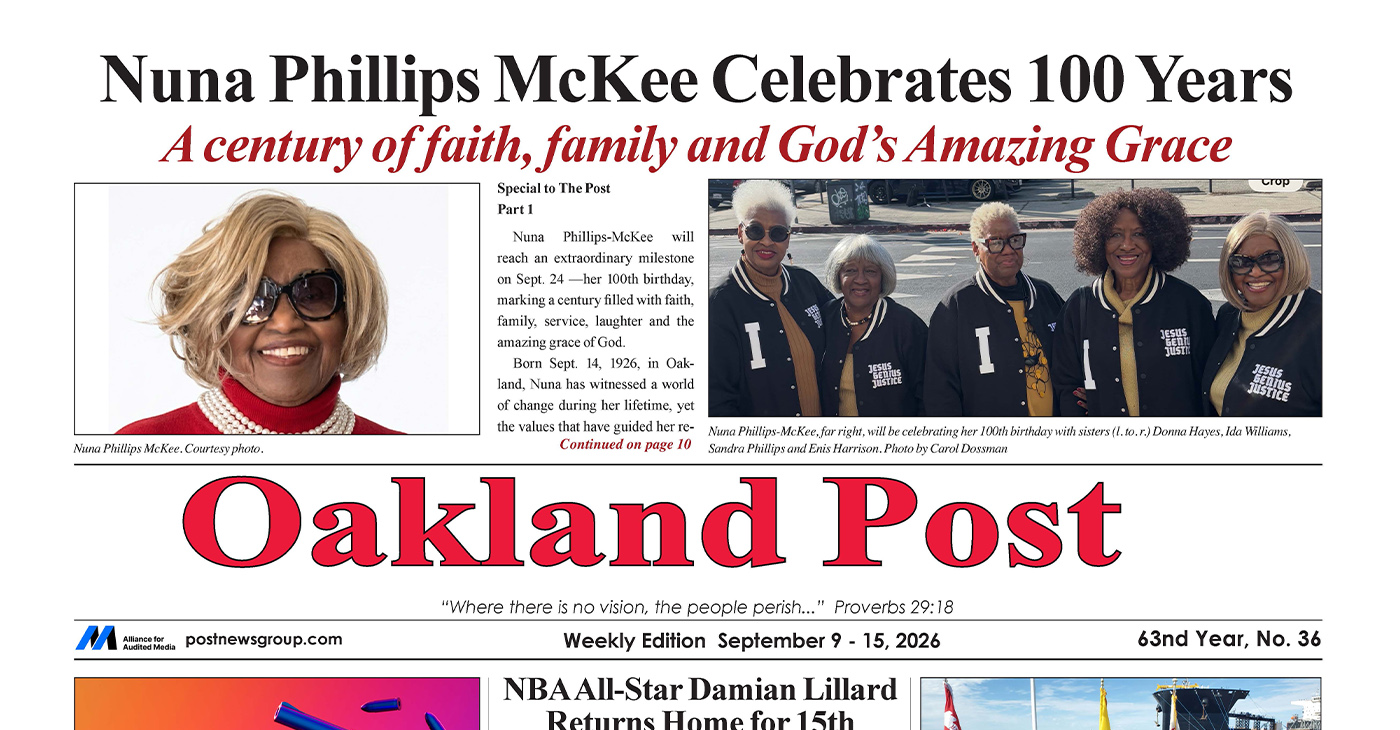
To enlarge your view of this issue, use the slider, magnifying glass icon or full page icon in the lower right corner of the browser window.



Asm. Corey Jackson Announces Launch of 24-Hour Childcare in His District

IN MEMORIAM: The Rev. Leon “Sonny” Clark, Longtime Orange County Pastor and Community Leader, Dies at 72

Poll: Becerra Widens His Lead Over Hilton; Californians Split on Wealth Tax

From Historic Memories to New Possibilities: Oakland Celebrates Coliseum 60

County Office of Education Says OUSD Finances Are Getting Healthier, Materially Stronger

LIVE FREE Sunday Dinner Brings Faith, Fellowship and Civic Conversation to Oakland

Remembering Chauncey Bailey as Student Journalists Face Threats to Truth-Telling

BLACspace Cooperative Invites Bay Area to Experience Oakland’s Black Cultural Ecosystem Through a BLAC Map Tour + Party

In Wake of Death on Doorstep, Williams Chapel Baptist Church Calls for Better Care, Funding for Unhoused

Oakland Centenarian Nuna McKee Honored!

Caribbean Nations Produce Action Plan Calling for UK Reparations Over Slavery

Oakland Post: Week of September 23 – 29, 2026

Doulas Are Helping Black California Moms Navigate Pregnancy–Even as High Mortality Rates Persist

Newsom Signs Addictive Social Media Law to Protect Kids

On Your November Ballot: Prop 38 Would Allocate $8.4 Billion to Immunology and Immunotherapy Funding

Standoff for Justice: Our Homes Are Worth Fighting For

Oakland Post: Week of August 26 – September 1, 2026

Frontier Airlines’ Return to Oakland Airport Brings Flights, Jobs and Opportunity

Gubernatorial Candidate Steve Hilton Blasts California New Tire Rules; Newsom Hits Back

Chef Sharon Lee Blends Culinary Excellence, Education and Empowerment

Jackie Wright Champions Bay Area Stories, Filmmakers and Cultural Institutions

Big City Mayors Ask for “Yes” Vote on Housing Bond Measure; Conservatives Say “No”

Oakland Coliseum Project Opens Door for Small Businesses to Build Bigger

Gov. Newsom’s Latest Appointees Include Sacramento Advocate for Formerly Incarcerated Students; State’s New Tech Chief

Misnamed ‘Parent’ PAC Seeks to Influence Oakland School Board Elections

Longtime BWOPA Member Brendalyn Goodall Appointed to California Workforce Development Board

Gov. Newsom Signs Law Shielding Immigration Aid Workers From Doxing Threats

Secretary of State Shirley N. Weber Urges Californians to Vote Early as Voter ID Battle Intensifies

From Palestine to Oakland: Seeds for Liberation Examines Shared Struggles for Freedom

IN MEMORIAM: Dolly Parton Dead at 80 — How She Built a Legacy of Love and Earned Her Place in Black Culture

The Conversation With Al McFarlane 6/23/26

Media Monday 6/22/26

LIVE! ASK ALMA! — TUES. 6.23.26 7PM EST

Car Buying Secrets: 4 Hidden Checks Before You Sign!

Is This 550 HP Charger Worth YOUR Money? AutoNetwork Review

Celebrating Juneteenth – Frederick Douglass on education and resistance

LIVE! — ASK ALMA! — TUES. 6.19.26 7PM EST

Hyundai Ioniq 5 Parking, Safety, and 360 View #shorts

2025 Ioniq 5 New Wiper & Powerful Performance! #shorts

Electric SUV Range: Is 259 Miles Enough? #shorts

EV Charging: How Fast Can You Charge an Electric Vehicle? #shorts

Biometric Cooling… Messaging Seats…Come on! 2025 Infiniti QX80 Autograph 4WD

Charged Up: Witness the Magic of a Fully Electric Car! #shorts

Range Rover Sport PHEV Included…: See What’s Inside This Luxury SUV! #shorts

Invisible Hood View: Perfect Parking with X-Ray Vision! #shorts
-
 Community3 weeks ago
Misnamed ‘Parent’ PAC Seeks to Influence Oakland School Board Elections
-

 Activism4 weeks ago
Oakland Post: Week of September 2 – 8, 2026
-

 Community3 weeks ago
Richmond Tiny House Village Farm & Garden Set to Open Gates on Sept. 26
-

 Activism3 weeks ago
Oakland Post: Week of September 9 – 15, 2026
-

 Black History3 weeks ago
Latest Massacre in Haiti Reveals Cruelty U.S. Deportations
-

 Black History3 weeks ago
OPINION: Nolan Wells’ Death One of Several Signifying Racial Terror Lives on in U.S. South
-

 Community3 weeks ago
Democratic Clubs Interview Candidates for Oakland School Board
-
 Featured3 weeks ago
‘Ready to See These Bills Become Law’: Sen. Weber’s Package of 15 Bills Advance to Gov. Newsom’s Desk
