
Activism
No Valid Reason for Failing to Condemn Hamas’ Act of Terrorism
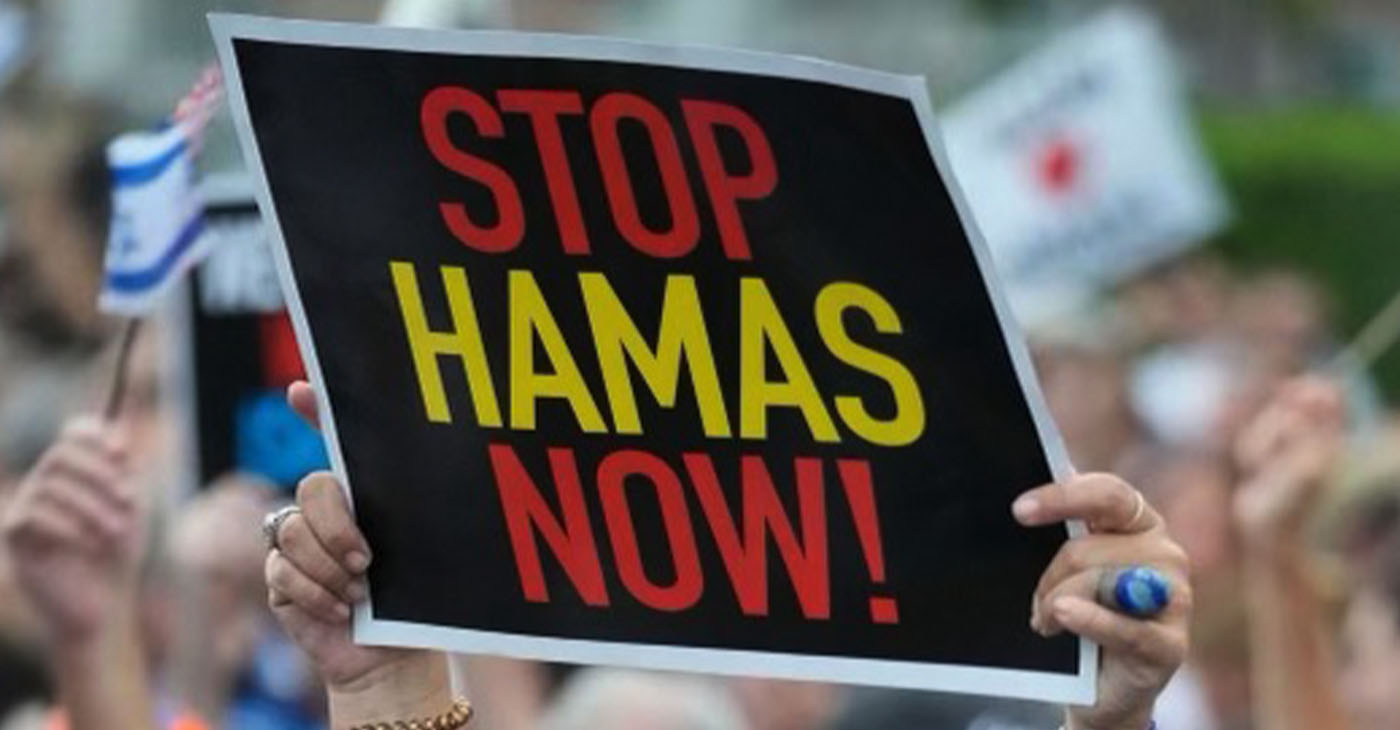
On Oct. 7, 2023, Hamas terrorists crossed the Israel-Gaza border and indiscriminately slaughtered Israeli civilians in their homes. They killed nearly 300 young people at a music festival and took at least 200 hostages including 30 children. The atrocities they committed included massacres of families, abduction of the elderly and children, burning of babies and rapes of women.

By Joe W. Bowers Jr.
California Black Media
OPINION
On Oct. 7, 2023, Hamas terrorists crossed the Israel-Gaza border and indiscriminately slaughtered Israeli civilians in their homes.
They killed nearly 300 young people at a music festival and took at least 200 hostages including 30 children. The atrocities they committed included massacres of families, abduction of the elderly and children, burning of babies and rapes of women.
The horrific surprise attack deserves universal and unequivocal condemnation. President Joe Biden called what Hamas did “an act of sheer evil” and pledged to defend the lives of Israelis and Jewish Americans.
He said, “Let there be no doubt. The United States has Israel’s back. We’ll make sure the Jewish and democratic state of Israel can defend itself today, tomorrow, as we always have.”
Hamas killed approximately 1,400 people including 32 Americans. Citizens from 40 different countries including the United Kingdom, France, Mexico, and Thailand were killed or reported missing.
Hamas fighters breached Israel’s border defenses on the final day of Sukkot while soldiers were away due to the holiday and launched attacks on 22 towns outside the Gaza Strip. This security lapse has been described as a catastrophic failure of Israel’s intelligence agencies..
Hamas is an extremist Islamist militant organization that has governed the Gaza Strip since 2007. It is recognized as an Iranian-backed terrorist group by the U.S. and the European Union and has a long history of violence against Jews and Palestinians, the latter of whom they often use as human shields.
While there have been plenty of groups who have unequivocally condemned the massacres, there are a number who haven’t, including organizations such as the Democratic Socialists of America (DSA), Black Alliance for Peace, Red Nation, and independent Black Lives Matter (BLM) chapters (excluding the national Black Lives Matter Global Network Foundation).
The DSA San Francisco chapter put out a statement on Oct. 9 that said, “Socialists support the Palestinian people’s, and all people’s, right to resist and fight for their own liberation. This weekend’s events are no different.”
Student organizations at a number of universities and colleges in California signed a solidarity statement titled “Resistance Uprising in Gaza” from Students for Justice in Palestine (SJP). The statement attributes the violence of the Hamas attack to what it refers to as Israeli apartheid and occupation.
The SJP statement written by Bears for Palestine at UC Berkeley says, “We support the resistance, we support the liberation movement, and we indisputably support the Uprising.” Essentially, these students are indirectly associating themselves with Hamas’ barbaric acts under the guise of “resistance.”
Signing the statement were 51 student organizations including those from Stanford, UC Berkeley, UCLA, UC Davis, UC San Diego, CSU Sacramento, and USC.
A statement signed by 34 Harvard student organizations said, “We, the undersigned student organizations, hold the Israeli regime entirely responsible for all unfolding violence.”
Many university leaders, where these students are enrolled, have been guilty of failing to unequivocally condemn Hamas and for inadequately addressing their students’ expressed support for Hamas.
Several Stanford faculty members, including three Nobel laureates, condemned Stanford’s administrators’ weak response to acts of terrorism and the expression of pro-Hamas sentiments by students on campus.
Israel unilaterally withdrew from Gaza in 2005. It dismantled 21 Israeli settlements in the territory and handed them over to the Palestinian Authority.
The assault by Hamas on Oct. 7 was not an ordinary clash with Israel. Hamas’ actions resulted in the deadliest single day for Jews since the Holocaust.
While there are valid reasons for protesting Israel’s treatment of Palestinians and a real reckoning with the Israeli government on its policies is long overdue, nothing justifies Hamas’ attack.
Israelis who were killed largely had nothing to do with the conditions of Palestinians in Gaza. Some of the victims weren’t even Israeli — they were just tourists.
The students blaming Israel for the atrocities committed by Hamas have faced criticism. Some groups have withdrawn their endorsements because of the backlash aimed at them. Others have doubled down on their activism. SJP held a “National Day of Resistance” on several campuses.
Several CEOs have asked Harvard to disclose a list of members from the organizations assigning responsibility to Israel to insure they do not hire any of their members. A Berkeley law professor has also urged firms not to hire his students who have publicly blamed Israel for the war.
This California Black Media report was supported in whole or in part by funding provided by the State of California, administered by the California State Library.












Activism
Oakland Post: Week of September 16 – 22, 2026
The printed Weekly Edition of the Oakland Post: Week of September 16 – 22, 2026

To enlarge your view of this issue, use the slider, magnifying glass icon or full page icon in the lower right corner of the browser window.
Activism
Oakland Post: Week of September 9 – 15, 2026
The printed Weekly Edition of the Oakland Post: Week of September 9 – 15, 2026

To enlarge your view of this issue, use the slider, magnifying glass icon or full page icon in the lower right corner of the browser window.
Activism
Oakland Post: Week of September 2 – 8, 2026
The printed Weekly Edition of the Oakland Post: Week of September 2 – 8, 2026
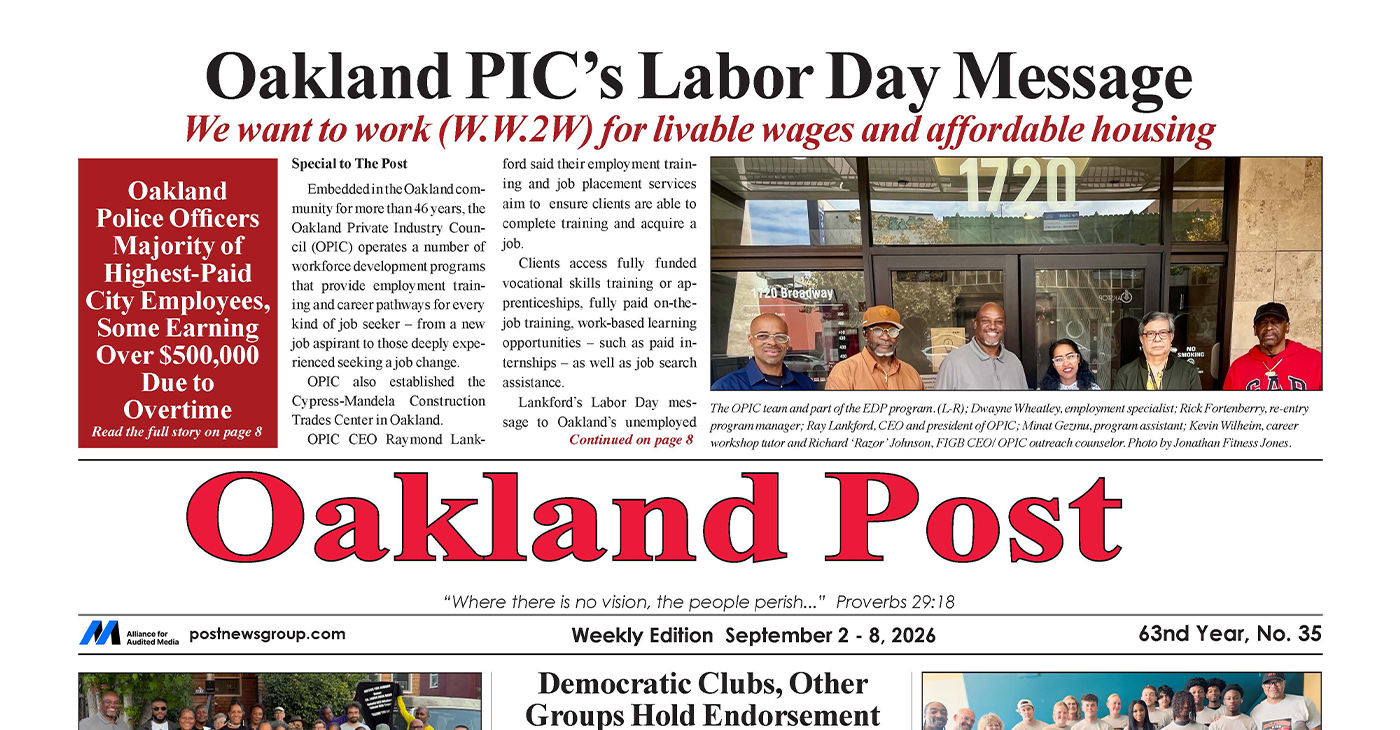
To enlarge your view of this issue, use the slider, magnifying glass icon or full page icon in the lower right corner of the browser window.



Doulas Are Helping Black California Moms Navigate Pregnancy–Even as High Mortality Rates Persist

Newsom Signs Addictive Social Media Law to Protect Kids

On Your November Ballot: Prop 38 Would Allocate $8.4 Billion to Immunology and Immunotherapy Funding

Ask California: Golden State Releases New AI Chatbot

Asm. Isaac Bryan’s Bill Banning California Police From ICE Side Jobs Reaches Newsom’s Desk

Assemblymember LaShae Sharp-Collins’s Bill Would Pause Law Enforcement’s Use of Shock Gloves Pending Study

BOOK REVIEW: ‘Laws of Solomon’ Reveals Tender Heart of Former Child Soldier

OPINION: The New American Fear – From 9-11 to AI

Passing for White, Fighting for Black America: The Courage of Walter White

Oakland People’s Arms Embargo Coalition Demands End to Military Shipments Thru Oakland

Barbara Lee Mourns Gloria Steinem, Remembers a Friendship Rooted in Equality

Event Preview: ‘Fashion v. Fascism’ – A Runway Revolution Is Coming to the Bay Area

Two Looming Threats Every Alameda County Elder Should Know About

Oakland Mayor Reads to Children at Bookout Block Party at Marcus Books Store

Tradition Comes to the Streets in 11th Annual Black-Eyed Pea Festival at the Freedom Farmers Market

Less Affluent School Districts, Including Sacramento City, Face Threat of State Takeover

ESSAY: California Can Close Its Colorectal Cancer Gap

California Hispanic Chambers of Commerce Unveils: ‘Powering the Future’ Theme for 47th Annual Statewide Convention

Four Candidates, Including Incumbent Barbara Lee, Qualify for Oakland Mayor’s Race

Oakland Post: Week of August 12 – 18, 2026

From Blueprint to Breakthrough: Tackling Affordable Housing in Oakland

Oakland Observes Black August with Block Parties, Film Showings, Workshops

COMMENTARY: Why Local School Tax Measure G1 Will Not Be on the November Ballot

Standoff for Justice: Our Homes Are Worth Fighting For

Returning to Its Roots, the Oakland Black-Eyed Pea Festival Partners with the Freedom Farmers Market Sept. 12

NPRC Scores First Advocacy Victory: David Shaw Finally Gets His Wish to ‘Go Home’

Oakland Post: Week of August 26 – September 1, 2026

Frontier Airlines’ Return to Oakland Airport Brings Flights, Jobs and Opportunity

Gubernatorial Candidate Steve Hilton Blasts California New Tire Rules; Newsom Hits Back

Chef Sharon Lee Blends Culinary Excellence, Education and Empowerment

The Conversation With Al McFarlane 6/23/26

Media Monday 6/22/26

LIVE! ASK ALMA! — TUES. 6.23.26 7PM EST

Car Buying Secrets: 4 Hidden Checks Before You Sign!

Is This 550 HP Charger Worth YOUR Money? AutoNetwork Review

Celebrating Juneteenth – Frederick Douglass on education and resistance

LIVE! — ASK ALMA! — TUES. 6.19.26 7PM EST

Hyundai Ioniq 5 Parking, Safety, and 360 View #shorts

2025 Ioniq 5 New Wiper & Powerful Performance! #shorts

Electric SUV Range: Is 259 Miles Enough? #shorts

EV Charging: How Fast Can You Charge an Electric Vehicle? #shorts

Biometric Cooling… Messaging Seats…Come on! 2025 Infiniti QX80 Autograph 4WD

Charged Up: Witness the Magic of a Fully Electric Car! #shorts

Range Rover Sport PHEV Included…: See What’s Inside This Luxury SUV! #shorts

Invisible Hood View: Perfect Parking with X-Ray Vision! #shorts
-
 Commentary4 weeks ago
Standoff for Justice: Our Homes Are Worth Fighting For
-
 Activism4 weeks ago
Oakland Post: Week of August 26 – September 1, 2026
-
 Business4 weeks ago
Frontier Airlines’ Return to Oakland Airport Brings Flights, Jobs and Opportunity
-
 Business4 weeks ago
Gubernatorial Candidate Steve Hilton Blasts California New Tire Rules; Newsom Hits Back
-
 Business4 weeks ago
Chef Sharon Lee Blends Culinary Excellence, Education and Empowerment
-

 Education4 weeks ago
Gov. Newsom’s Latest Appointees Include Sacramento Advocate for Formerly Incarcerated Students; State’s New Tech Chief
-

 Community4 weeks ago
Big City Mayors Ask for “Yes” Vote on Housing Bond Measure; Conservatives Say “No”
-

 Business4 weeks ago
Oakland Coliseum Project Opens Door for Small Businesses to Build Bigger
