Connect with us

City Government

Nikki Fortunato Bas Holds District 2 Community Meeting

Published

on

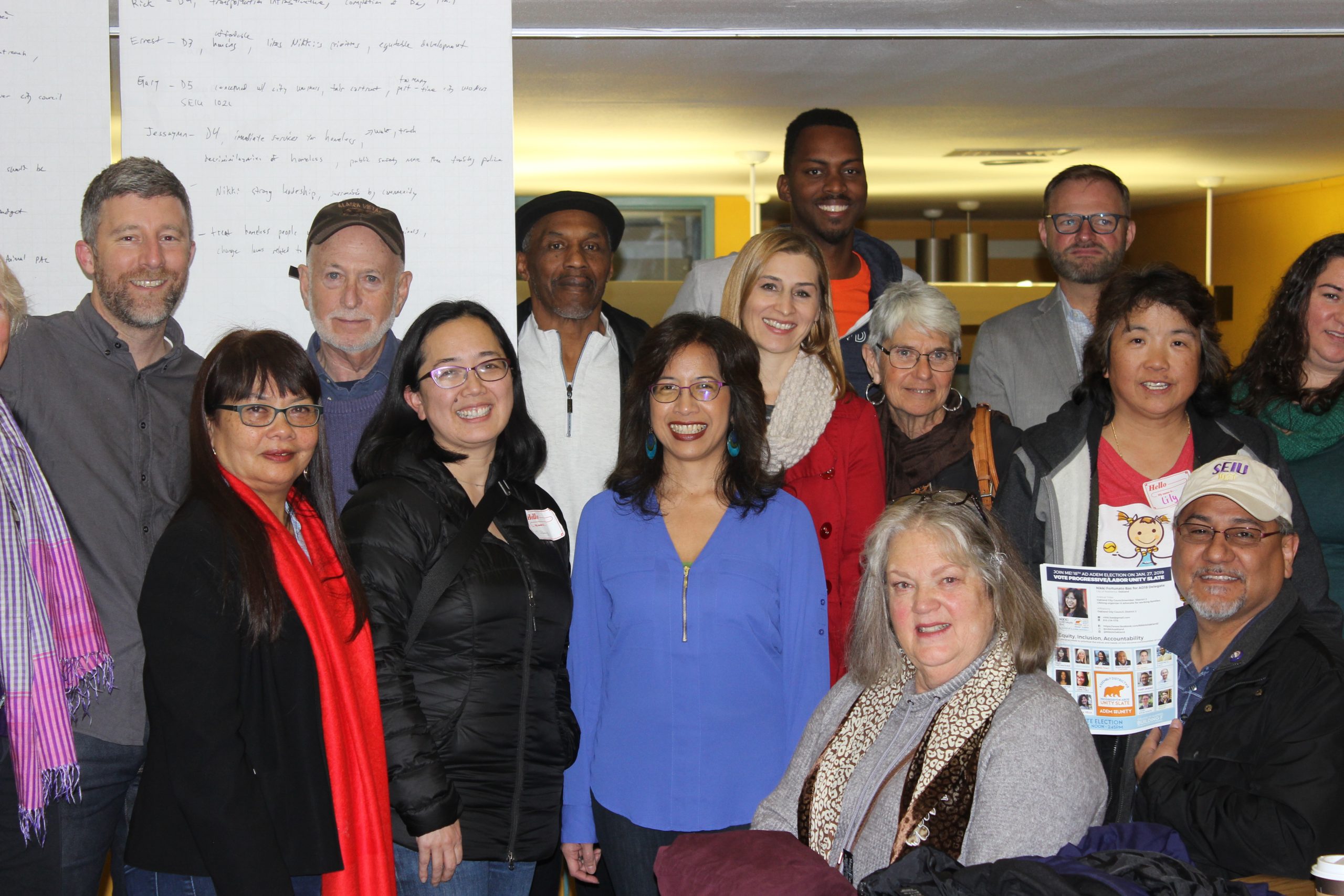
On Saturday, Jan. 5th, two days before being sworn into office, newly elected district two city council member Nikki Fortunato Bas held a lunchtime meeting both for her constitu­ents and those who live outside of her district. More than 125 people attended the event held in the cafeteria of Cleveland El­ementary School.

The meeting excited Josie Camacho, former executive director of The Alameda La­bor Council, who had never seen an Oakland city council member convene a community meeting before being sworn in. Camacho, who also worked at city hall for ten years, said “In convening this meeting, Bas ex­emplifies leadership and vision we’ve been lacking for so long.”

While former Mayor Jean Quan and former mayoral can­didate Dan Siegel were inspired to attend, the meeting also drew people like Noah Kratznelson, a lifelong Bay Area resident who had never before been involved with local electoral politics but has felt more inspired to engage since the election of Donald Trump.

“This is new to me,” said Kratznelson. “I want to meet my neighbors and get more in­volved at the local level.”

After some time for social­izing, networking, and eating, Bas got the meeting’s attend­ees attention by beginning a unity clap, a method where a clap begins slowly, gains mo­mentum, and then becomes more unified and loud as more people start clapping. She was inspired to use the clap by Filipino and Mexican workers of The United Farmworker’s Movement who used it to express solidarity across lan­guage barriers.

Bas introduced new staff members but did not speak at length about policy. She instead centered most of the event’s time around listening to concerns and ideas of Oakland residents.

“We want to be making deci­sions with you and not for you,” said Bas while addressing the meeting’s attendees. “We want to get a head start connecting with all of you, hearing about the organizations you’re in­volved in so we can partner with you.”

Bas and her team organized the events attendees into four groups based around district two neighborhoods, with one additional group for those who lived outside the district. Each group had facilitators who asked their group members a few open ended questions that were audio recorded for Bas to hear later.

Those who attended the meeting spoke about many is­sues, but the issues addressed most frequently related to homelessness and housing.

In an interview after the meeting Bas spoke of how, during her first hundred days in office, she wants to meet with city staff about issues relating to homelessness while continu­ing to meet with unsheltered residents and activists. She thinks the city could improve services for encampments of unsheltered people by increas­ing the frequency of trash pick up, and providing clean water and decent sanitation.

Bas also wants city services to be more effective for non- English who often find them difficult to access.

“Not all of our city services are in the languages that our neighbors speak,” she said.

She plans to work with city staff and residents to help non- English speaking Oakland res­idents access city services and permits.

Continue Reading
Click to comment

Leave a Reply

Your email address will not be published. Required fields are marked *

Activism

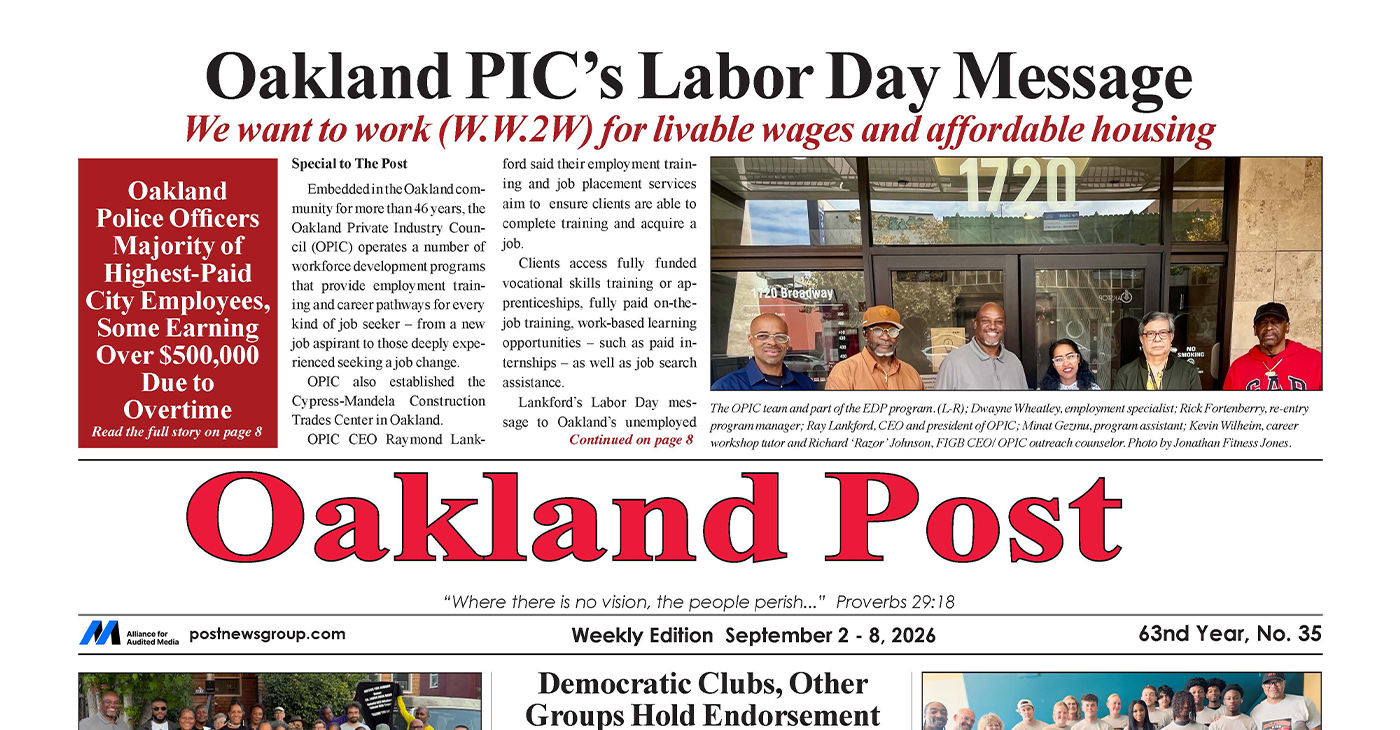
Oakland Post: Week of April 22 – 28, 2026

The printed Weekly Edition of the Oakland Post: Week of April 22 – 28, 2026

Published

on

To enlarge your view of this issue, use the slider, magnifying glass icon or full page icon in the lower right corner of the browser window.

Oakland Post

Continue Reading

Activism

Mayor Barbara Lee Proclaims April 9 as ‘100 Black Men of the Bay Area Day’

“Today, the 100th day of the year, I proclaim 100 Black Men Day,” said Mayor Barbara Lee standing with newly appointed Oakland Port Commissioner Derek Mohammad, a 100 Black Men member. “Whereas the 100 Black Men of the Bay Area has demonstrated decades of unwavering commitment to uplifting youth and strengthening families and advancing opportunity and access in Oakland and the greater Bay Area with their signature programs…the chapter has impacted thousands of young people and contributed thousands of hours of community service…”

Published

on

At D. Monaghan’s on the Hill, a resolution declaring April 9 ‘100 Black Men of the Bay Area Day’ was witnessed by (l.-r.) 100 Black Men leaders Maurice Harold, Marco T. Lindsey, Danny Lee Williams, Oakland Mayor Barbara Lee, Oakland City Council President Kevin Jenkins, Port of Oakland Commissioner Derek Mohammad, and Oakland Councilmember Janani Ramachandran. Photo by Carla Thomas.

By Carla Thomas 

When Oakland Mayor Barbara Lee announced that she would proclaim Thursday, April 9, as “100 Black Men of the Bay Area Day,” the organization’s board chairman and owner of D. Monaghan’s on the Hill, Danny Lee Williams knew he wanted to mark the historic moment with fanfare his community could share.

Standing at the podium on the patio of his restaurant in the Oakland Hills, he welcomed about 150 members of the organization and the broader community who gathered to celebrate.

“This is a special day, and we are in the midst of our Economic Empowerment week,” he said. Williams also welcomed four vendors to sell their gifts and accessories during the event free of charge.

“Today, the 100th day of the year, I proclaim 100 Black Men Day,” said Mayor Barbara Lee standing with newly appointed Oakland Port Commissioner Derek Mohammad, a 100 Black Men member. “Whereas the 100 Black Men of the Bay Area has demonstrated decades of unwavering commitment to uplifting youth and strengthening families and advancing opportunity and access in Oakland and the greater Bay Area with their signature programs…the chapter has impacted thousands of young people and contributed thousands of hours of community service…”

Lee shared how as a single parent of two boys, she was grateful to have the organization’s support in mentoring her sons.

“Today, my adult son is a member in Illinois, and I thank the organization for supporting so many Black boys.”

The idea for the proclamation originated with Oakland City Councilmember Kevin Jenkins, who praised the organization for its leadership and contributions to Oakland and the greater Bay Area.

“This work that we do would not be possible without partnerships with organizations like the 100 Black Men,” said Jenkins. “We’re saving lives, restoring communities, and giving people hope and opportunities.”

“This is Oakland,” said Mayor Lee. “This is what we’re about. It’s about new ideas, thinking outside the box and being who we are. It’s about bringing joy. This is our holiday.”

The mayor also thanked the organization for volunteering during Oakland Cleanup days.

Councilmember Janani Ramachandran added that while many complain about problems in the city, “the 100” put in the work.

“It’s hard to be in the community and do the work, but that is exactly what the 100 Black Men does,” she said.

The organization’s economic chair and associate director of Diversity Equity and Inclusion at the University of California Berkeley’s Business School, Marco T. Lindsey, shared his enthusiasm for change.

“Today is the culmination of our work and something special is happening in our organization and our city,” he said.  “We have a special opportunity to show up for our community now in ways that we haven’t had in the past. We have a mayor that supports us and it’s important that each and every one of us do our part. We all need our fingerprints on whatever we want to see in our city.”

Lindsey also expressed that if underserved youth and their parents had access to the resources needed for success, “Our youth wouldn’t be breaking windows and joining gangs if they had a pathway to earn $75k to $100k a year.”

The 100 Black Men were hosts of an Economic Empowerment Forum at McClymonds High School on April 11 educating students on entrepreneurship and financial literacy. On Sat., April 18, they will hold their fifth annual Career Expo at Contra Costa College 2600 Mission Bell Drive (G225) in San Pablo from 8 a.m. to 3 p.m. The 100 Black Men chapter of the Bay Area was established in 1988, one of the earliest in the nation.

For more information visit 100blackmenba.org

Oakland Post

Continue Reading

Activism

Building Bridges of Support: How AAPI Equity Alliance Is Strengthening California’s Anti-Hate Network

In May 2022, Patricia Roque said she and her parents were attacked after a late-night stop at a fast-food drive-thru in Southern California. After hitting their car, the other driver pulled alongside them and mocked them using a racist Asian accent. Then, he threatened to kill them. The situation escalated when the man returned while the family was waiting for police and assaulted Roque’s father, fracturing his rib and choking her mother before bystanders intervened. 

Published

on

Patricia Roque (far right) pictured with her family at a Stop Asian Hate rally after her father's assault (far left). (Courtesy of AAPI Equity Alliance)

By Edward Henderson

When Aurelle Garner stepped out of her car one summer evening and saw a group of youths marching down her street, her stomach dropped.

What had begun as slurs hurled at her and her transgender children at a local park had escalated to violent pounding on their front door. Garner said that, before that incident, local law enforcement had repeatedly minimized her reports of harassment.

It was not until she contacted the Legal Department at The LGBTQ Center Long Beach that her family finally found help.

“I don’t know where we’d be if it weren’t for their help,” Garner, who lives in Southern California, said. “They didn’t just give legal advice. They helped us navigate a system that had otherwise dismissed us.”

Aurelle Garner, who received services from The LGBTQ Center Long Beach (Sponsored by AAPI Equity Alliance) to aid her transgender children. (Courtesy of AAPI Equity Alliance)

Aurelle Garner, who received services from The LGBTQ Center Long Beach (Sponsored by AAPI Equity Alliance) to aid her transgender children. (Courtesy of AAPI Equity Alliance)

That support exists because The LGBTQ Center Long Beach does not work in isolation.

The Center partners with the AAPI Equity Alliance under California’s Stop the Hate program, a statewide coalition aimed at preventing hate and supporting survivors.

As the Los Angeles County Regional Lead, AAPI Equity Alliance works with the Center and dozens of other community-based organizations to connect people to legal aid, mental health services, and support. The programs also work in tandem with CA vs Hate, the state’s anti-hate hotline and virtual reporting system that connects people across California with organizations like the LGBTQ Center Long Beach – that provide support services

Garner’s experience illustrates the kind of harm that often falls outside the narrow legal definition of a hate crime but still leaves families traumatized and unsafe. It also shows how AAPI Equity Alliance’s leadership in the Stop the Hate ecosystem translates state funding and policy into real, on-the-ground support.

Patricia Roque (Courtesy of AAPI Equity Alliance)

Patricia Roque (Courtesy of AAPI Equity Alliance)

In May 2022, Patricia Roque said she and her parents were attacked after a late-night stop at a fast-food drive-thru in Southern California. After hitting their car, the other driver pulled alongside them and mocked them using a racist Asian accent. Then, he threatened to kill them. The situation escalated when the man returned while the family was waiting for police and assaulted Roque’s father, fracturing his rib and choking her mother before bystanders intervened.

“The police arrived long after it was over,” Roque told California Black Media (CBM). “By then, the damage was already done.”

The following day, Roque’s family was connected to the Filipino Migrant Center (FMC), a community-based organization that has received Stop the Hate funding and works within the broader AAPI Equity Alliance network. FMC provided immediate support — helping the family navigate legal options, organizing emergency financial assistance to cover medical bills and missed work, and offering emotional and community care while the criminal case unfolded.

“But the process is long and complicated. When you need help right away, that delay is a huge barrier. FMC was there immediately,”Rogue said.

The criminal case did not result in the accountability the family hoped for. But Roque said the support she received transformed her relationship to her community and to advocacy.

“Before this, I wasn’t involved in organizing at all,” she said. “Through this process, I realized my voice mattered. FMC helped turn something traumatic into a way to support others and push for change.”

Stories like Garner’s and Roque’s are part of a much larger reckoning that began at the onset of the COVID-19 pandemic, when Asian Americans and Pacific Islanders across the country experienced a surge in harassment, discrimination, and violence fueled by racist rhetoric.

Filipino Migrant Center stands in solidarity against Anti-Asian Violence (Courtesy of AAPI Equity Alliance)

Filipino Migrant Center stands in solidarity against Anti-Asian Violence (Courtesy of AAPI Equity Alliance)

In response, AAPI Equity Alliance partnered with San Francisco’s Chinese for Affirmative Action and the Asian American Studies Department at San Francisco State University to launch Stop AAPI Hate in March 2020. Since then, the project has collected more than 9,000 reports nationwide documenting incidents ranging from verbal harassment and workplace discrimination to physical assault and child bullying.

“People tend to think about hate only when it turns violent,” said Kiran Bhalla of AAPI Equity Alliance. “But there are everyday acts of discrimination that people endure constantly. Without some kind of recourse, that harm just keeps going.”

The data helped spur unprecedented action in California. In 2021, the State Legislature passed the $165.5 million Asian Pacific Islander Equity Budget, signed by Gov. Gavin Newsom. Of that total, $110 million was dedicated to victim services, education, and outreach. In August 2023, California invested an additional $40 million to expand California’s Stop the Hate program to serve a broader range of communities affected by hate and discrimination.

Today, the program supports roughly 100 nonprofit organizations statewide. As Los Angeles County Regional Lead, AAPI Equity Alliance coordinates grantees, facilitates cross-community collaboration, and helps ensure services reach those most impacted.

A recently released survey estimated that approximately 3.1 million Californians directly experienced hate, with Native Hawaiian or Pacific Islanders, Black or African Americans, and other communities of color, including Asian Americans, among those most likely to experience hate.

Black Californians, however, remain the most targeted group when it comes to reported hate crimes.

Nearly 48% of Asian American and Pacific Islander adults in California reported experiencing a hate incident in 2024, according to Stop AAPI Hate research. Most incidents were not criminal, leaving survivors with little recourse through the legal system.

That gap is precisely where AAPI Equity Alliance and its partners focus their work. The Stop the Hate framework prioritizes non-carceral responses, recognizing that policing alone often fails survivors and can further harm Black, brown, and immigrant communities.

Instead, the work centers on data and research, policy advocacy, community care, and public education. Through school-based programs, legal advocacy, emergency assistance, and survivor-centered services, the network aims to interrupt cycles of harm before they escalate.

For survivors like Garner and Roque, that support has made the difference between enduring trauma in silence and finding a path toward healing and collective power.

“When people experience hate, there’s often a profound sense of isolation,” Bhalla said. “This work helps people get back to school, back to work, back to their lives. It reminds them they’re not alone.”

Get Support After Hate:

California vs Hate is a non-emergency, multilingual hotline and online portal offering confidential support for hate crimes and incidents. Victims and witnesses can get help anonymously by calling 833-8-NO-HATE (833-866-4283), Monday to Friday, 9 a.m.–6 p.m. PT, or online at any time. Anonymous. Confidential. No Police. No ICE.This story was produced in partnership with CA vs Hate. Join them for the first-ever CA Civil Rights Summit on May 11, 2026. More information at www.cavshate.org/summit.

Oakland Post

Continue Reading

Subscribe to receive news and updates from the Oakland Post

* indicates required

CHECK OUT THE LATEST ISSUE OF THE OAKLAND POST

ADVERTISEMENT

WORK FROM HOME

Home-based business with potential monthly income of $10K+ per month. A proven training system and website provided to maximize business effectiveness. Perfect job to earn side and primary income. Contact Lynne for more details: Lynne4npusa@gmail.com 800-334-0540

Facebook

#NNPA BlackPress5 days ago

State of Preschool Yearbook Provides an Annual Snapshot of State-Funded Preschool 

#NNPA BlackPress6 days ago

Which features on the 2026 Volkswagen Golf GTI Autobahn are actually worth having?

#NNPA BlackPress6 days ago

Panoramic Roof & Rear Seats: The Ultimate EV Comfort! #shorts

#NNPA BlackPress6 days ago

Does the 2026 Volkswagen Golf GTI Autobahn actually fit your lifestyle?

#NNPA BlackPress6 days ago

Subaru EV Blends Modern Design with Unmatched Confidence & Power! #shorts

#NNPA BlackPress6 days ago

Subaru Uncharted EV: Confidence, Control, and Daily Usability for You! #shorts

#NNPA BlackPress6 days ago

VW GTI Under the Hood: Turbocharged Engine & DSG #shorts

#NNPA BlackPress6 days ago

2026 Mazda CX‑90 PHEV Premium Plus — Luxury SUV or Overpriced Plug‑In? | Walkaround Review

#NNPA BlackPress6 days ago

Why Time Is the Most Expensive Part of Car Buying | The Color of Our Money Is Green Ep5

#NNPA BlackPress6 days ago

2026 Subaru Unchartered GT: Future of Driving is HERE! #shorts

#NNPA BlackPress6 days ago

Golf GTI Digital Cockpit Pro & HUD: Your Ultimate Driving Experience #shorts

Black Leadership Council (BLC) Advocacy Day in Sacramento. BLC works to advance meaningful change through policy engagement to unlock the full potential of Black and low-income communities. Photo courtesy of PRC.
Activism1 week ago

Up to the Job: How San Francisco’s PRC Is Providing Work Opportunities That Turn Into Lasting Stability

Activism1 week ago

Oakland Post: Week of April 22 – 28, 2026

Black Leadership Council (BLC) Advocacy Day in Sacramento. BLC works to advance meaningful change through policy engagement to unlock the full potential of Black and low-income communities. Photo courtesy PRC.
Activism2 weeks ago

Up to the Job: How San Francisco’s PRC Is Providing Work Opportunities That Turn Into Lasting Stability

At D. Monaghan’s on the Hill, a resolution declaring April 9 ‘100 Black Men of the Bay Area Day’ was witnessed by (l.-r.) 100 Black Men leaders Maurice Harold, Marco T. Lindsey, Danny Lee Williams, Oakland Mayor Barbara Lee, Oakland City Council President Kevin Jenkins, Port of Oakland Commissioner Derek Mohammad, and Oakland Councilmember Janani Ramachandran. Photo by Carla Thomas.
Activism2 weeks ago

Mayor Barbara Lee Proclaims April 9 as ‘100 Black Men of the Bay Area Day’

Trending

Copyright ©2021 Post News Group, Inc. All Rights Reserved.