
Bay Area
Newsom Lays Out Pandemic Plan for Learning and Safe Schools


Governor Gavin Newsom announced July 17, 2020, his plan for learning and safe schools ahead of the 2020–2021 school year, as the California Department of Public Health (CDPH) issued a framework for when and how schools should reopen for in-person instruction.
“Learning is non-negotiable, The virus will be with us for a year or more, and school districts must provide meaningful instruction in the midst of this pandemic,” Newsom said. “In California, health data will determine when a school can be physically open – and when it must close – but learning should never stop. Students, staff, and parents all prefer in-classroom instruction, but only if it can be done safely.”
This is an edited version of the Governor’s plan, which centers on five key areas:
1. Safe in-person school will be based on local health data
The CDPH has issued updated schools guidance to determine if school districts can start in-person instruction, and will track the level of COVID-19 infection in each California county as well as the preparedness of the county health care system.
Any county that does not meet the state’s benchmarks is put on the County Monitoring List. Https://covid19.ca.gov/roadmap-counties/#track-data can tell if a particular county is on the Monitoring List and why.

Schools located in counties that are on the Monitoring List must not physically open for in-person instruction until their county has come off the Monitoring List for 14 consecutive days. Schools in counties that have not been on the Monitoring List for the prior 14 days may begin in-person instruction, following public health guidelines.
Local health officers may also grant a waiver to allow elementary schools to reopen in-person instruction if the waiver is requested by the district superintendent, in consultation with labor, parents and community-based organizations, and with the CDPH.
The school should revert to distance learning when multiple cohorts have cases or 5% of students and staff test positive within a 14-day period. Students and staff, who are exposed to the virus, should be quarantined for 14 days.
The district should revert to distance learning when 25 percent or more of its schools have been physically closed due to COVID-19 within 14 days. Closure decisions should be made in consultation with local health officers. After 14 days, school districts may return to in-person instruction with the approval of the local public health officer.
2. Strong mask requirements for anyone in the school
In the updated guidance, all staff and students in 3rd grade and above will be required to wear a mask or face covering. Students in 2nd grade and below are strongly encouraged to wear a face covering. Students should be provided a face covering if they do not have one.
3. Physical distancing requirements & other adaptations
The CDPH requires that all adults stay 6 feet from other adults and children. Students should maintain 6 feet of distance from one another as practicable. Anyone entering the school must do a health screen, and any student or staff exhibiting a fever or other symptoms will be immediately sent home. If anyone in a student or staff member’s household is sick, they should also stay home.
4. Regular testing and dedicated contact tracing for outbreaks at schools
The public health guidance recommends staff in every California school be tested for COVID-19 periodically based on local disease trends and as testing capacity allows. The Governor also announced today that the state will provide resources and technical assistance for COVID-19 investigations in school settings.
5. Rigorous distance learning
Over the course of the pandemic, most schools will likely face physical closure at some point due to COVID-19. The Legislature and Governor Newsom enacted a budget that provided $5.3 billion in additional funding to support learning, and set requirements to ensure schools provide rigorous and grade-appropriate instruction.
Under newly enacted state law, school districts are required to provide: devices and connectivity so that every child can participate in distance learning, daily live interaction for every child with teachers and other students, class assignments that are challenging and equivalent to in-person instruction, and targeted supports and interventions for English learners and special education students.






Activism
Oakland Post: Week of March 18 – 24, 2026
The printed Weekly Edition of the Oakland Post: Week of March 18 – 24, 2026


To enlarge your view of this issue, use the slider, magnifying glass icon or full page icon in the lower right corner of the browser window.

Activism
Oakland Post: Week of March 11 -17, 2026
The printed Weekly Edition of the Oakland Post: Week of March 11 – 17, 2026
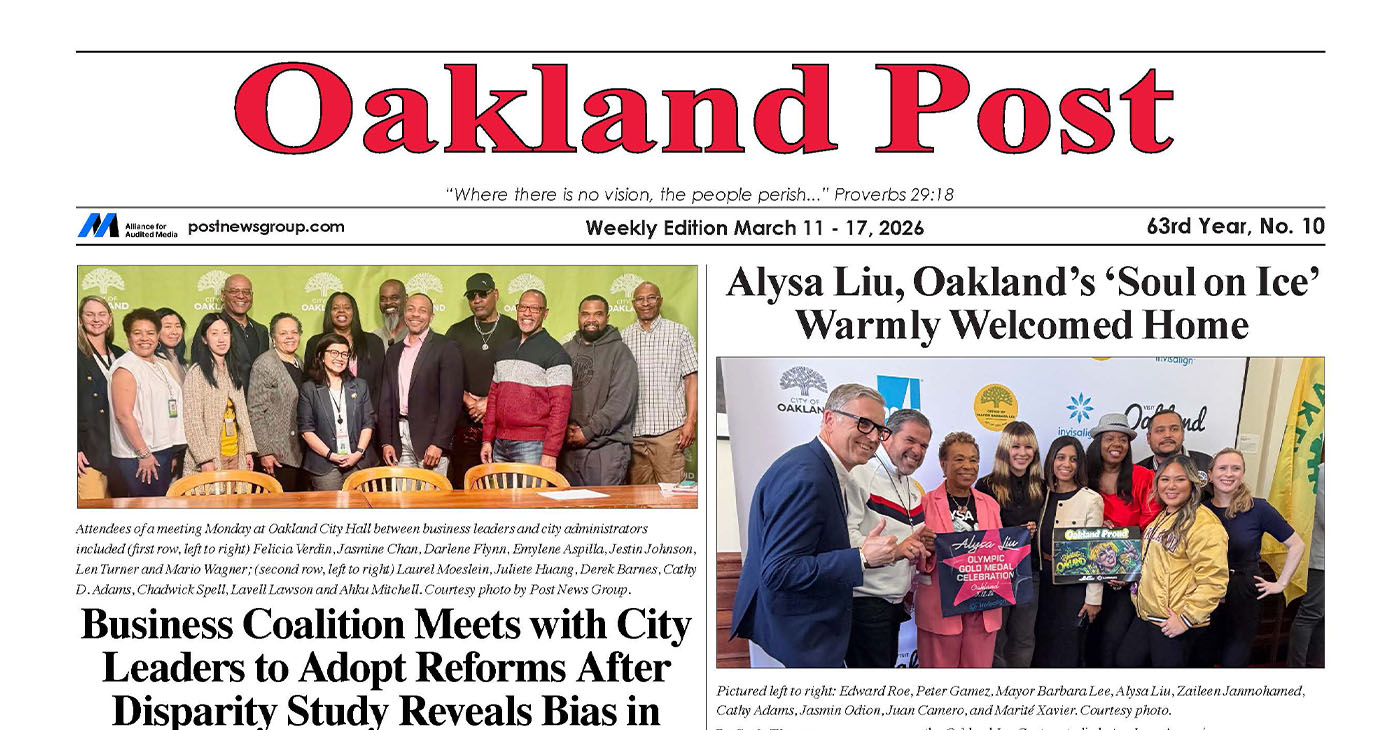
To enlarge your view of this issue, use the slider, magnifying glass icon or full page icon in the lower right corner of the browser window.
Activism
Oakland Post: Week of March 4 – 10, 2026
The printed Weekly Edition of the Oakland Post: Week of March 4 – 10, 2026

To enlarge your view of this issue, use the slider, magnifying glass icon or full page icon in the lower right corner of the browser window.

WORK FROM HOME
Home-based business with potential monthly income of $10K+ per month. A proven training system and website provided to maximize business effectiveness. Perfect job to earn side and primary income. Contact Lynne for more details: Lynne4npusa@gmail.com 800-334-0540


Black Artists in America, Installation Three Wraps at the Dixon Gallery and Gardens

Grief, Advocacy, and Education: A Counselor Reflects on Black Maternal Health

Future of Florida’s Black History Museum in Limbo

New Research Shows the Many Benefits of Early Learning

South Hampton K-8 Students Among Top 10 Finalists for Samsung’s ‘Solve for Tomorrow’ Competition

Cuba: No Negotiation with US on the President or Political System

Brooklyn Academy of Music Names Jamaican-Born Tamara McCaw as President

Trinidad & Tobego – U.S. Launches WhatsApp Channel for American Citizens in the Country

Oakland Post: Week of March 18 – 24, 2026

AI Innovation vs. Ethics and Environmental Impact

AI, Web3, and Digital Reparations

What If You Owned Your AI Agent?

Season 7, Episode 3 – January Reporter’s Roundtable 📱

Season 7, Episode 3 – January Reporter’s Roundtable

AI, Media, and Power | Part 2, Real-World Impacts and Tradeoffs

Oakland Post: Week of February 11 – 17, 2026

Reflecting on Black History Milestones in Birmingham AL

CITY OF SAN LEANDRO STATE OF CALIFORNIA PUBLIC WORKS DEPARTMENT ENGINEERING DIVISION NOTICE TO BIDDERS FOR ANNUAL STREET OVERLAY/REHABILITATION 2019-21 – PHASE III

Oakland Post: Week of February 18 – 24, 2026

PRESS ROOM: NBA Hall of Fame Nominee Terry Cummings Joins 100 Black Men of DeKalb County to Launch Victory & Values Initiative

Oakland Post: Week of February 25 – March 3, 2026

Trump’s MAGA Allies are Creating Executive Order Plan to Steal the 2026 Midterms

U.S. manufacturing rebounds – how foundry services are adapting to rising demand

OP-ED: One Hundred Years of Black Workers Telling the Truth

Chase Oakland Community Center Hosts Alley-Oop Accelerator Building Community and Opportunity for Bay Area Entrepreneurs

Advancements in solar technology that are changing the way we power the world

Poll Shows Support for Policies That Help Families Afford Child Care

Oakland Post: Week of March 4 – 10, 2026

PRESS ROOM: Civil Rights TV Launches in Selma as the World’s First 24/7 Civil Rights Television Network

Woman’s Search for Family’s Roots Leads to Ancestor John T. Ward – A Successful Entrepreneur and Conductor on the Underground Railroad

Hyundai Ioniq 5 Parking, Safety, and 360 View #shorts

2025 Ioniq 5 New Wiper & Powerful Performance! #shorts

Electric SUV Range: Is 259 Miles Enough? #shorts

EV Charging: How Fast Can You Charge an Electric Vehicle? #shorts

Biometric Cooling… Messaging Seats…Come on! 2025 Infiniti QX80 Autograph 4WD

Charged Up: Witness the Magic of a Fully Electric Car! #shorts

Range Rover Sport PHEV Included…: See What’s Inside This Luxury SUV! #shorts

Invisible Hood View: Perfect Parking with X-Ray Vision! #shorts

AI Is Reshaping Black Healthcare: Promise, Peril, and the Push for Improved Results in California

ESSAY: Technology and Medicine, a Primary Care Point of View

Sanctuary Cities

The RESISTANCE – FREEDOM NOW

STATE OF THE PEOPLE: Freddie

ECONOMIC BOYCOTT DAY!!!!!

I told You So
-
 #NNPA BlackPress4 weeks ago
Poll Shows Support for Policies That Help Families Afford Child Care
-
 Activism4 weeks ago
Oakland Post: Week of March 4 – 10, 2026
-
 #NNPA BlackPress3 weeks ago
Woman’s Search for Family’s Roots Leads to Ancestor John T. Ward – A Successful Entrepreneur and Conductor on the Underground Railroad
-

 #NNPA BlackPress4 weeks ago
OP-ED: NNPA Launches 2026 “Leadership Matters” Video Series
-

 #NNPA BlackPress3 weeks ago
Advocates Raise Alarm Over ICE Operation, MOU and Detention Risks in Baltimore County
-

 #NNPA BlackPress3 weeks ago
COMMENTARY: Women of Color Shape Our Past and Future
-

 #NNPA BlackPress3 weeks ago
Pete Buttigieg to Join Mayor Randall Woodfin for Community Town Hall in Birmingham
-

 Activism2 weeks ago
Oakland Post: Week of March 11 -17, 2026
