
Homeownership
New Cal Law Addresses Anti-Black Bias in Home Appraisal Process
“Black homeowners in predominantly White neighborhoods are getting their homes appraised for far less than their neighbors,” Holden said. “It’s just another example of how bias, whether explicit or implicit, creates inequity for Black Americans. This is redlining 2.0.”


Paul Austin and his wife Tenisha Tate, a Bay Area Black couple, were confident that the sale of their Marin City home would net them a sizeable profit. They had invested hundreds of thousands of dollars into renovations before putting it on the market.
But that process turned sour when the couple discovered alarming race-based discrimination baked into the system of home appraisals.
Austin shared that harrowing experience with the California Task Force to Study and Develop Reparation Proposals during its fourth meeting on Oct. 13.
California’s Assembly Bill (AB) 3121, signed into law in 2020, created the nine-member task force to investigate the history and costs of slavery in California and around the United States. The group is charged with studying and developing reparation proposals for African Americans and recommending appropriate ways to educate Californians about the task force’s findings.
Austin’s testimony added to the growing body of evidence that the wealth gap that exists between Black and White families in the United States was created — and has been maintained throughout history – by deep-rooted racial biases and intentional government policy at the federal, state and local levels.
“We had an appraiser come out in 2019 to appraise our home,” Austin said, talking about selling of his home, which is located five miles north of San Francisco. “She was an older White woman, and she appraised our house for just under a $1 million after we had already put in an additional $400,00 into our property. We did our homework because we should have appraised for $1.4 million. We had to fight against it.”

Austin and his wife added an additional 1,300 square feet to the home’s original 1,300 square footage, he told the Task Force
A qualified appraiser is responsible for creating a report based on a visual inspection. The property’s lot size, square footage, amenities, and number of bedrooms and bathrooms are expected to provide the basis for an unbiased valuation.
When Austin and Tate found a second appraiser, they decided to ask a White female friend to pose as the seller. This time around, they actually netted a surprisingly higher offer of $500,000 more.
When Austin and Tate’s story went viral and made headlines in news reports around the world, other Black families emerged to share disturbing stories of how they, too, were given deceptively low estimations of their homes’ values.
“We’re right at the beginning. The story is now being told,” Austin told the task force. “But within our community, we have not had the opportunity to galvanize people to start looking at their loans and appraisals and comparing them with others, and I mean White folks, to see what’s going on in this industry.”
On Sept. 28, Gov. Newsom signed Assemblymember Chris Holden’s (D-Pasadena) legislation Assembly Bill (AB) 948, which would address discrimination in the real estate appraisal process, such as the prejudicial treatment of Austin and his wife received.
“Black homeowners in predominantly White neighborhoods are getting their homes appraised for far less than their neighbors,” Holden said. “It’s just another example of how bias, whether explicit or implicit, creates inequity for Black Americans. This is redlining 2.0.”
AB 948 would require the Bureau of California Real Estate Appraisals to gather demographic information on buyers and sellers of real estate property and compile data of homeowners from protected classes who file complaints based on low appraisals. The legislation also requires appraisers to take anti-bias training when renewing their licenses.
“This bill reflects a starting point in a much-needed conversation about how discrimination is still prevalent in the home buying and selling process, and I am committed to addressing this inequity,” Holden said.
Less than one in five Black California households could afford to purchase a home valued at the statewide median-price of $659,380 in 2020, as compared to two in five White California households that could buy a home at the same price, according to the California Association Realtors (CAR).
CAR also stated in a February report that the affordability gap is “stark in expensive counties like San Francisco,” where a median-priced home of $1,650,000 was only affordable for 8% of Black households, 15% of Latinx households, and 22%of Asian households, compared to 35% of White households.
The 2019 homeownership rate in California was 63.2% for Whites, 60.2% for Asians, 44.1% for Latinx and 36.8% for Blacks, according to the Census Bureau’s American Community Survey.
Austin said that his family was part of the “second wave Great Migration” of Black people from the Deep South that settled in California around the 1940s. Many of them worked in the Sausalito shipyard in Marin County.
Many of the Black families that came to California during that period lived in government housing in Marin City while working in the naval shipyards in and around San Francisco. When World War II ended, Austin’s grandparents had enough money to purchase a home anywhere in Marin County.
“Due to redlining, they did not have that opportunity. Blacks weren’t able to buy land outside of Marin City,” he said. “If you look at Marin County, currently it’s arguably the richest county in California. The data also shows, when race counts, that Marin County, as a whole, has the largest disparities anywhere. It’s such a huge gap.”
Austin, who attended the Historical Black College and University, Texas Southern University in Houston, said that he doesn’t want to see his children or other Black Californians deal with the same types of issues.
“Just think that if we didn’t have the will to fight the appraisal company,” Austin said. “It’s the systems that have been created by White people for White people that continuously, negatively affect people that look like me. Now it’s time to take those steps and right the wrongs.”














Commentary
Community Action Group ‘Friends of Zakiya’ Ask Sheriff for Time
“Friends and Neighbors of Zakiya,” a community group of more than 60 neighbors, friends and community activists, is standing strong with Jendayi. The group holds weekly vigils every Tuesday from 6 p.m.-7p.m. at Jendayi’s residence at 3614 Randolph Ave. in Oakland.

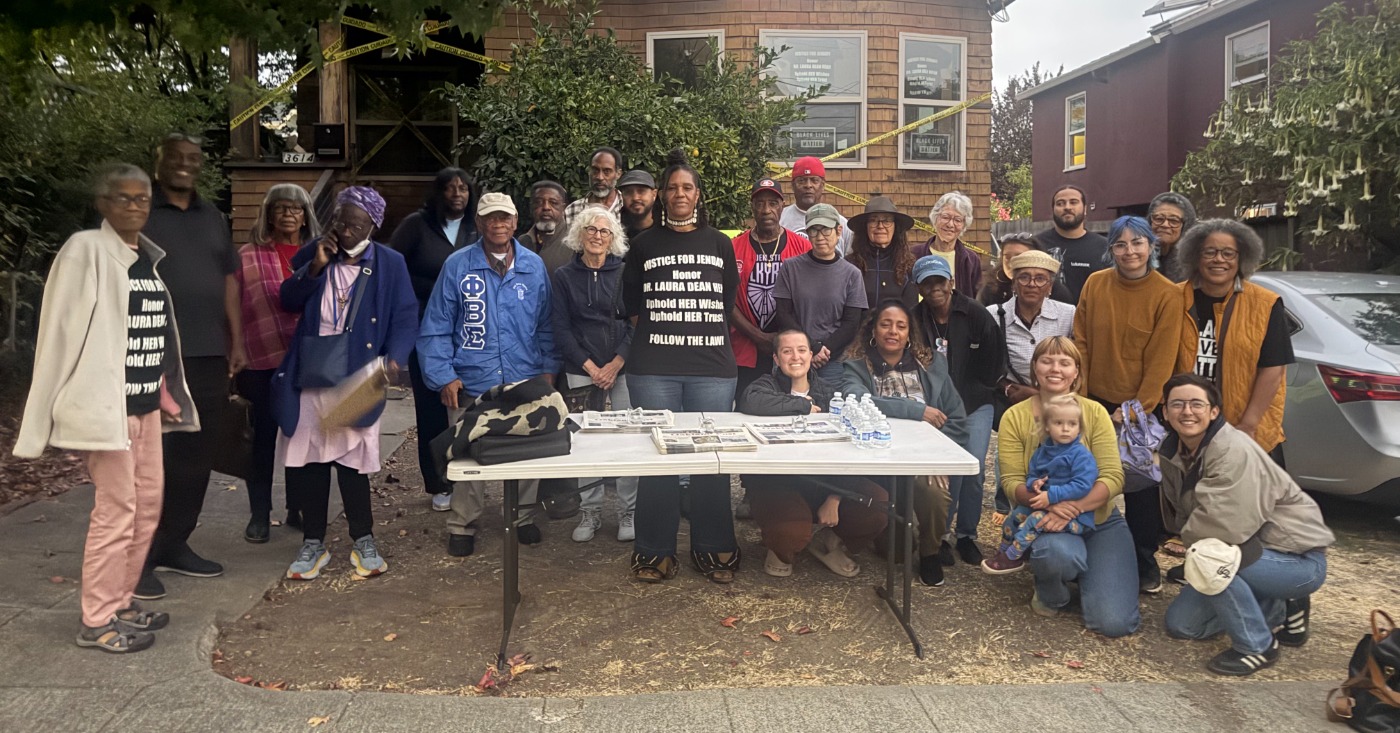
Zakiya Jendayi received good news Monday, Sept. 14, when the appellate court ruled in her favor in the Hamlin v. Jendayi case, agreeing to hear the case on its merits regarding her motion to have Judge Sandra K. Bean’s ruling invalidated based upon Laura Dean Head’s living trust.
The bad news is that, at the time of this writing, the Sheriff’s Department was scheduled to evict Jendayi from her home yesterday.
“Friends and Neighbors of Zakiya,” a community group of more than 60 neighbors, friends and community activists, is standing strong with Jendayi. The group holds weekly vigils every Tuesday from 6 p.m.-7p.m. at Jendayi’s residence at 3614 Randolph Ave. in Oakland.
The group is asking the community to join them and to make calls to Congresswoman Lateefah Simon, Attorney General Rob Bonta, Sheriff Yesenia Sanchez and DA Ursula Jones Dickson to stop what they deem the illegal eviction of Jendayi from her home of 13 years.
“I would hope that the Sheriff listens because, unlike the courts, my friends and neighbors have read the transcripts and seen for themselves the 42 findings that result in 35 false, six misleading, and one that is an error, which unbelievably the appeals court upheld.” says Jendayi. “With this new appeal, the court quite possibly will return my home to me, and so this makes no sense. The Sheriff is threatening to move forward to remove me before my appeal is heard.”
“This makes no sense,” says group member Rev. Raymond Langford. “She’s not a criminal, and she’s never had a criminal record. This situation has been horribly impactful on her physical and mental health. She’s now medically compromised due to all this stress, and all we’re asking for is time to see if the courts are in error. She should be given the opportunity for the appeal to be heard. That’s called justice, nothing more, nothing less.”.
Friends and Neighbors of Zakiya are organizing future protest actions to secure more time for Jendayi. They will be seen in front of the offices of Bonta, Simon and Sanchez, demanding that she have the opportunity for her case to be heard.
The Post is asking that the public join Friends and Neighbors of Zakiya and use the information listed to join in this fight for justice.
Friends and Neighbors of Zakiya asks you to sign the petition by activating the QR code below to enact a stay in Jendayi’s pending eviction from her home and to pursue a full and independent investigation into the ruling that invalidated Dr. Head’s trust.


Community
Richmond Tiny House Village Farm & Garden Set to Open Gates on Sept. 26
OAKLAND POST — “It’s going to be a real celebration of hope and what we can do together when we come together to do something to care for the least of us,” Hindman said. “The grand opening program is youth-led, so that will be, and the ribbon cutting will be youth-led, so it’s going to have the strong presence of young people leading, as it should.”

It takes a village to raise a village—especially when that village is made of tiny houses, big-hearted volunteers and a plan to shelter Richmond youth.
Now, after three years of planning, building and community muscle, the village is ready for its public debut.
The Richmond Tiny House Village Farm & Garden will mark its “Grand Opening” Saturday, Sept. 26 onsite at 2200 Bissell Ave. in Richmond, also accessible via 175 23rd St. The celebration will spotlight the new emergency housing community for unhoused Richmond youth ages 18 to 24, with a youth-powered program and ribbon cutting, clergy from multiple faith traditions offering prayers, an Indigenous prayer, an appearance by Richmond Mayor Eduardo Martinez, Councilmember Doria Robinson, leaders from partner organizations, food and live music by Benja Soul.
For Sally Hindman, executive director of the nonprofit Tiny Village Spirit, which is the project’s developer, the grand opening event is a public exhale after three years of planning, building, fundraising, listening and showing up.
“It’s going to be a real celebration of hope and what we can do together when we come together to do something to care for the least of us,” Hindman said. “The grand opening program is youth-led, so that will be, and the ribbon cutting will be youth-led, so it’s going to have the strong presence of young people leading, as it should.”
The vibrantly mural-decorated village will include 13 emergency housing units when complete, one of them for an on-site resident assistant. In keeping with neighborhood agreements, the project will open with about half of the homes occupied, then pause, evaluate and return to local Richmond Neighborhood Councils for input before adding six more youth the following year.
Hope Solutions will operate the village from day one, with staff including a resident assistant, a village manager/social worker and a housing navigator to help residents move toward affordable housing. Youth will be selected through Contra Costa County’s Coordinated Entry System, with a focus on Richmond young adults.
Hindman was clear about who the village is for: “This is a village that is for unhoused Richmond youth, ages 18 to 24, and it’s specifically for Richmond young people.” She added that the project is particularly concerned with young people pushed out by gentrification and displacement, including black and brown youth who grew up in Richmond, as well as LGBTQ young people who “really need our support.”
Each tiny house is designed as a small bedroom with the essentials: A Murphy bed that becomes a desk during the day, a chair, table, wardrobe and, in some designs, a closet. Shared community spaces include a kitchen/dining yurt, a living room/maker space yurt and a shared bathroom building with three private units, each containing a shower, sink and toilet.
The “Farm & Garden” part of the name is no add-on. Hindman said the garden will connect with Richmond Police Activities League’s (RPAL’s) Culinary Club, a program with a farm-to-table approach that uses produce grown on-site. The space will also offer education, picnics, volunteer opportunities and stipend/paid work for village residents, doubling as a job-training ground rooted in food, land and community.
“The farm and garden is going to play a really cool role in the project as a whole,” Hindman underscored.
If the village sounds stitched together by many hands, that is because it was. Hindman described the project as involving more than 3,000 volunteers (“probably 4,000,” she estimated, noting she had “kind of lost count”) from 83-plus organizations, schools, congregations, businesses and nonprofits.
Those partners and helpers include Tiny Village Spirit, RPAL, Hope Solutions, SOS Richmond, GRIP, USF Architecture, City of Richmond YouthWORKS, Rebuilding Together, Richmond Neighborhood Councils—including Richmore Village/Metro Square, North & East, Belding Woods, Coronado and Pullman—Richmond youth, Richmond High School students, Kennedy High School, Salesian High School, Richmond Indivisible, Reimagine Richmond, East Bay Heritage Quilters, First Congregational Church of Berkeley members, Strawberry Creek Friends Meeting, Temple Beth El, Ashby Village, NIAD, artist Jimmy Evans, Williams Sonoma and many individual volunteers, donors, congregations and private foundations.
Tiny Village Spirit raised most of the funding through individuals and private foundations, according to Hindman, who shared that similar villages funded primarily with government dollars can cost around $14 million. She said this village is expected to come in under $1 million because nearly all the labor was volunteer.
For more information about the Richmond Tiny House Village Farm & Garden, text 510-282-0396 or visit Tiny Village Spirit’s Richmond project page.
Business
From Blueprint to Breakthrough: Tackling Affordable Housing in Oakland
Mercy Housing California and JPMorganChase help neighborhoods—and residents—thrive. Finding an affordable place to live remains a challenge for many as widespread housing shortages persist across the U.S. Rising home prices and high interest rates have made homeownership inaccess

Mercy Housing California and JPMorganChase help neighborhoods—and residents—thrive.
Finding an affordable place to live remains a challenge for many as widespread housing shortages persist across the U.S. Rising home prices and high interest rates have made homeownership inaccessible to a large portion of the population. Meanwhile, as rental demand increases, the number of renters facing affordability challenges is rising.
The State of the Nation’s Housing 2025 by Harvard University’s Joint Center for Housing Studies reveals that cost burdens for renters reached another record high in 2023. Similarly, the JPMorganChase Institute reports that renter affordability is declining, forcing people to devote more of their take-home pay to housing costs. There is a growing need for affordable housing across the U.S., and that rings true here in Oakland.
To close that gap, it’s essential that all Oakland residents share in its growth, with housing options that accommodate a range of needs and budgets. For Mercy Housing California, this meant delivering a concrete solution to the local community, resulting in housing for individuals and families who otherwise might not have been able to live in the area.
For older adults living on fixed or limited incomes—including seniors who had been without a stable place to call home—The Eliza offers something that can feel out of reach in today’s housing market: a place to belong in the Oakland community where they’ve put down roots. Developed by Mercy Housing California with support from J.P. Morgan, The Eliza brings 97 new homes to seniors aged 62 and older, with 20 of those homes set aside for seniors who were formerly homeless. Here, “affordable” means rents are tied to what residents can actually pay so that a home stays within reach rather than consuming a household’s entire budget.
“As housing costs continue to rise across California, far too many older adults living on fixed incomes face the heartbreaking risk of displacement or homelessness, often for the first time later in life,” said Tiffany Bohee, President of Mercy Housing California. “Here, seniors can age in place independently, access onsite services tailored to their needs, and find a community where they can truly feel at home. Thanks to the commitment of partners like JPMorganChase, we’re helping ensure Oakland remains a place where seniors of all incomes can age with dignity, stability, and belonging.”
“We’re proud of the far-reaching impact this project will have. It reflects Mercy Housing California’s mission to uplift our communities and expands the supply of high-quality, affordable homes,” said James Vossoughi, Community Development Banking, J.P. Morgan. “Every additional housing unit matters—and increasing the number that are affordable is critical.”
A broader commitment to Oakland’s future
While The Eliza is foundational, the vibrancy of a community depends on much more. In Oakland, the firm provides banking services to more than 675,000 customers and works across sectors to expand economic opportunity. Over the last five years, JPMorganChase has invested $35 million in local nonprofit organizations, supported 61,600 small business clients and delivered financial health education to thousands of residents to broaden access to banking, financial health resources, homeownership and other wealth building tools.
“As we work with local stakeholders to expand housing options, JPMorganChase’s goal is to create inclusive economic opportunity for all,” said Dan Schrauth, Managing Director, J.P. Morgan Private Bank and Chair, Bay Area Market Leadership Team, JPMorganChase. “When our communities thrive, we all thrive.”
The journey to close the affordable housing gap continues, with industry leaders like Mercy Housing, Inc. finding a path forward to bring real solutions to the Oakland community.
Locally and nationally, this project reflects JPMorganChase’s American Dream Initiative, a commitment to scaling local housing solutions across the country—learn more at www.jpmorganchase.com/America.
You can also read more about what’s happening in the Bay Area at https://www.jpmorganchase.com/communities/sf-bay-area.



Doulas Are Helping Black California Moms Navigate Pregnancy–Even as High Mortality Rates Persist

Newsom Signs Addictive Social Media Law to Protect Kids

On Your November Ballot: Prop 38 Would Allocate $8.4 Billion to Immunology and Immunotherapy Funding

Ask California: Golden State Releases New AI Chatbot

Asm. Isaac Bryan’s Bill Banning California Police From ICE Side Jobs Reaches Newsom’s Desk

Assemblymember LaShae Sharp-Collins’s Bill Would Pause Law Enforcement’s Use of Shock Gloves Pending Study

BOOK REVIEW: ‘Laws of Solomon’ Reveals Tender Heart of Former Child Soldier

OPINION: The New American Fear – From 9-11 to AI

Passing for White, Fighting for Black America: The Courage of Walter White

Oakland People’s Arms Embargo Coalition Demands End to Military Shipments Thru Oakland

Barbara Lee Mourns Gloria Steinem, Remembers a Friendship Rooted in Equality

Event Preview: ‘Fashion v. Fascism’ – A Runway Revolution Is Coming to the Bay Area

Two Looming Threats Every Alameda County Elder Should Know About

Oakland Mayor Reads to Children at Bookout Block Party at Marcus Books Store

Tradition Comes to the Streets in 11th Annual Black-Eyed Pea Festival at the Freedom Farmers Market

Less Affluent School Districts, Including Sacramento City, Face Threat of State Takeover

ESSAY: California Can Close Its Colorectal Cancer Gap

California Hispanic Chambers of Commerce Unveils: ‘Powering the Future’ Theme for 47th Annual Statewide Convention

Four Candidates, Including Incumbent Barbara Lee, Qualify for Oakland Mayor’s Race

Oakland Post: Week of August 12 – 18, 2026

From Blueprint to Breakthrough: Tackling Affordable Housing in Oakland

Oakland Observes Black August with Block Parties, Film Showings, Workshops

COMMENTARY: Why Local School Tax Measure G1 Will Not Be on the November Ballot

Standoff for Justice: Our Homes Are Worth Fighting For

Returning to Its Roots, the Oakland Black-Eyed Pea Festival Partners with the Freedom Farmers Market Sept. 12

NPRC Scores First Advocacy Victory: David Shaw Finally Gets His Wish to ‘Go Home’

Oakland Post: Week of August 26 – September 1, 2026

Frontier Airlines’ Return to Oakland Airport Brings Flights, Jobs and Opportunity

Gubernatorial Candidate Steve Hilton Blasts California New Tire Rules; Newsom Hits Back

Chef Sharon Lee Blends Culinary Excellence, Education and Empowerment

The Conversation With Al McFarlane 6/23/26

Media Monday 6/22/26

LIVE! ASK ALMA! — TUES. 6.23.26 7PM EST

Car Buying Secrets: 4 Hidden Checks Before You Sign!

Is This 550 HP Charger Worth YOUR Money? AutoNetwork Review

Celebrating Juneteenth – Frederick Douglass on education and resistance

LIVE! — ASK ALMA! — TUES. 6.19.26 7PM EST

Hyundai Ioniq 5 Parking, Safety, and 360 View #shorts

2025 Ioniq 5 New Wiper & Powerful Performance! #shorts

Electric SUV Range: Is 259 Miles Enough? #shorts

EV Charging: How Fast Can You Charge an Electric Vehicle? #shorts

Biometric Cooling… Messaging Seats…Come on! 2025 Infiniti QX80 Autograph 4WD

Charged Up: Witness the Magic of a Fully Electric Car! #shorts

Range Rover Sport PHEV Included…: See What’s Inside This Luxury SUV! #shorts

Invisible Hood View: Perfect Parking with X-Ray Vision! #shorts
-
 Commentary4 weeks ago
Standoff for Justice: Our Homes Are Worth Fighting For
-
 Activism4 weeks ago
Oakland Post: Week of August 26 – September 1, 2026
-
 Business4 weeks ago
Frontier Airlines’ Return to Oakland Airport Brings Flights, Jobs and Opportunity
-
 Business4 weeks ago
Gubernatorial Candidate Steve Hilton Blasts California New Tire Rules; Newsom Hits Back
-
 Business4 weeks ago
Chef Sharon Lee Blends Culinary Excellence, Education and Empowerment
-

 Education4 weeks ago
Gov. Newsom’s Latest Appointees Include Sacramento Advocate for Formerly Incarcerated Students; State’s New Tech Chief
-

 Community4 weeks ago
Big City Mayors Ask for “Yes” Vote on Housing Bond Measure; Conservatives Say “No”
-

 Business4 weeks ago
Oakland Coliseum Project Opens Door for Small Businesses to Build Bigger
