
Entertainment
Molestation Claim Against Michael Jackson’s Estate Dismissed


In this March 5, 2009 file photo, US singer Michael Jackson speaks at a press conference at the London O2 Arena. A Los Angeles judge ruled on Tuesday, May 26, 2015, that choreographer Wade Robson waited too long to file a claim alleging that Jackson abused him and the allegations should be dismissed. (AP Photo/Joel Ryan, File)
ANTHONY McCARTNEY, AP Entertainment Writer
LOS ANGELES (AP) — A choreographer who accused Michael Jackson of years of molestation cannot pursue his allegations against the singer’s estate because he waited too long to file the legal action, a judge ruled.
Superior Court Judge Mitchell Beckloff wrote in his ruling Tuesday that Wade Robson’s claim is untimely and should be dismissed.
Robson had previously denied the pop superstar molested him and testified in Jackson’s defense at the singer’s criminal trial in 2005. Robson also spoke favorably about Jackson after the singer’s death in 2009.
However, Robson sued Jackson’s estate in May 2013 over the molestation allegations.
Attorneys for Robson said Jackson molested him over a seven-year period. Attorneys for Jackson’s estate have denied the allegations.
Robson’s attorney Maryann Marzano wrote in a statement that Beckloff’s ruling will be appealed, and the molestation claim will be pursued against Jackson’s business entities.
Jackson estate attorney Howard Weitzman praised the ruling and noted Robson’s previous testimony about Jackson.
“Mr. Robson testified under oath in a courtroom that Michael never did anything improper with him,” Weitzman wrote in an email.
Marzano, however, wrote that her client was incapable of filing his legal action any sooner due to psychological damage he suffered. She also noted that Beckloff’s ruling did not make any determination about whether Robson’s allegations were factual.
“We are confident that when all the facts are presented in civil court, there will be no doubt left about just what kind of sexual predator Jackson was,” Marzano wrote.
Robson was 5 when he met Jackson, and he spent the night at Neverland Ranch more than 20 times, sleeping in the singer’s bedroom on most visits, he told jurors during the trial that ended with Jackson’s acquittal.
Robson told jurors that Jackson had “absolutely not” molested him during the trial.
Robson, an Australian-born choreographer, has appeared on the Fox series “So You Think You Can Dance” and worked with Britney Spears and other stars.
Marzano argued at an April hearing that the seriousness of the claims being lodged against Jackson’s estate warranted a full evidentiary hearing.
Jackson estate attorney Jonathan Steinsapir argued that the law doesn’t allow liability for a person’s actions to transfer to their estate in perpetuity, and that Robson missed his opportunity to file a claim.
Jackson died at 50 while preparing for a series of comeback concerts dubbed “This Is It.” His estate benefits his mother and three children.
The pop singer died deeply in debt, but a posthumous bounce in the popularity of his music has generated hundreds of millions of dollars.
Robson filed one of the last major claims against Jackson’s estate, although disputes with a former business manager, another man alleging underage sexual abuse, and the IRS remain unresolved.
___
Anthony McCartney can be reached at http://twitter.com/mccartneyAP
Copyright 2015 The Associated Press. All rights reserved. This material may not be published, broadcast, rewritten or redistributed.









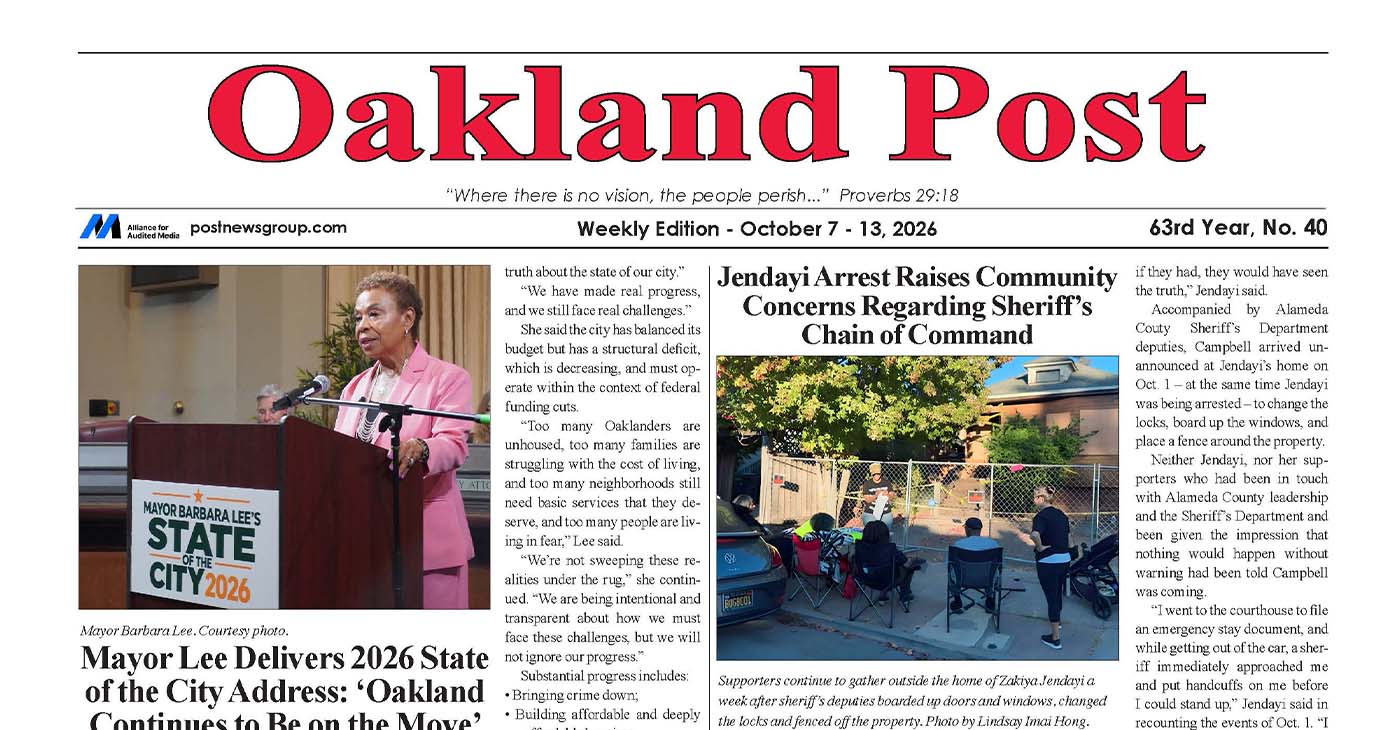
To enlarge your view of this issue, use the slider, magnifying glass icon or full page icon in the lower right corner of the browser window.

Activism
Oakland Post: Week of September 30 – October 6, 2026
The printed Weekly Edition of the Oakland Post: Week of September 30 – October 6, 2026

To enlarge your view of this issue, use the slider, magnifying glass icon or full page icon in the lower right corner of the browser window.
Business
From Historic Memories to New Possibilities: Oakland Celebrates Coliseum 60
More than 75 people gathered at Youth UpRising in East Oakland on Friday, September 18, for Coliseum 60, an event marking six decades of sports, entertainment, employment, and community memories at the Oakland-Alameda County Coliseum Complex. Held 60 years to the day after the Coliseum first opened, the celebration featured cultural performances and a mini-documentary highlighting its history. Speakers reflected on the venue’s significant role in the community and its future possibilities. Read more to learn about the individuals and stories honored during this special event.

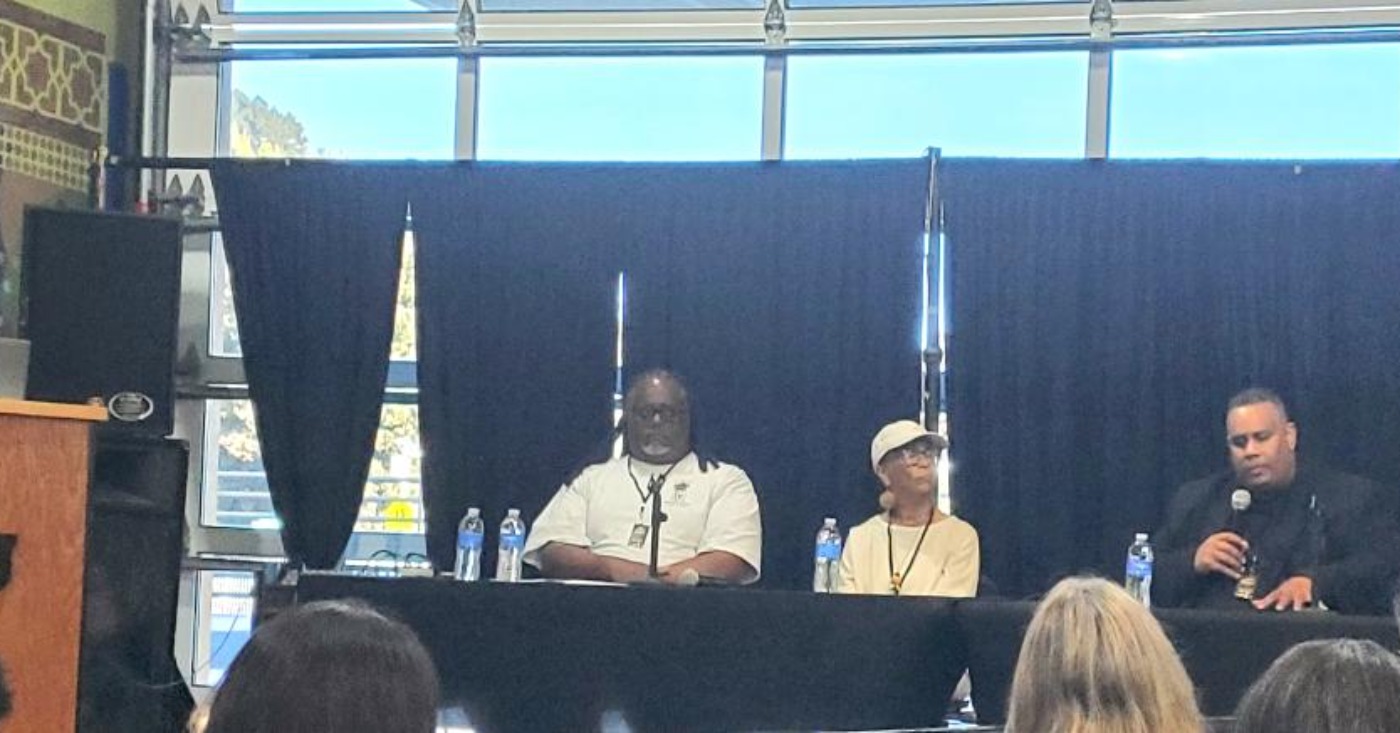
More than 75 people gathered at Youth UpRising in East Oakland on Friday, Sept. 18, for Coliseum 60, a celebration honoring six decades of sports, entertainment, employment and community memories connected to the Oakland-Alameda County Coliseum Complex.
Held 60 years to the day after the Coliseum opened, the event carried the theme, “One Community. One Legacy. One Future. Forward Together.”
The celebration opened with the national anthem performed by sisters Anese Jade, Amina Benjamin and Zaza Benjamin. Diamano Coura West African Dance Company contributed African dance and drumming, bringing movement, rhythm and cultural expression to the program.
A mini documentary highlighted the Coliseum’s sports history and its broader role as an entertainment destination. Archival material recalled performances by Prince and Tina Turner, along with memorable games featuring the Warriors, Oakland A’s and Raiders.
“The Coliseum 60 is about much more than celebrating a building or looking back at 60 years of history,” said event organizer Quixote Atkins of VillageGIVE.
“It’s about the people who made that history possible: the families, workers, athletes, artists, community leaders, fans and generations who gathered there and created memories together.”
A panel exploring that history featured author, historian and former Black Panther Party member Tareka Lewis; stagehand and union representative Keith Brown; and Ray Bobbitt, president of the African American Sports and Entertainment Group AASEG. Lewis described her family as fourth-generation Bay Area pioneers.
“My family and Black families who arrived even earlier helped build the Bay Area, grew businesses and established culture here,” Lewis said. “This should be taught in the public schools.”
Lewis recalled Oakland’s influence on sports, music and literature, from the Raiders’ beginnings at Laney College to stars such as The Pointer Sisters and Rickey Henderson who attended Oakland public schools. She also advocated for school museums, historical timelines, entrepreneurship training and investments benefiting corridors such as Bancroft Avenue and High Street.
Keith Brown, a member of Local 107 of the International Alliance of Theater and Stage Employees (IATSE) who began working at the Coliseum in 2011, remembered the Ringling Bros. and Barnum & Bailey Circus, the Ice Capades, baseball bat giveaways and Nelson Mandela’s 1990 appearance.
“The special events are amazing, but it’s the workers that make the memories real for everyone,” Brown said. “They make the magic happen at the Coliseum.”
The program recognized longtime workers, including beer-stand manager Robert Preston, who served for 40 years, and Kenyatta Gentry, who worked as a vendor for 24 years and used her earnings to purchase her first apartment. Union workers Jose Gonzales and Carmen Sandoval were also honored. Speakers emphasized that Coliseum employment provided generations of residents with union wages and benefits.
Dr. Denise Saddler, the superintendent of the Oakland Unified School District (OUSD) was also honored. Saddler shared her family’s history of working at the Coliseum.
District 7 Oakland City Councilmember Ken Houston discussed the complex ownership arrangements involving the city, county and private interests.
“This was the most complex deal of its kind in the country,” Houston said.
Prior to moving from the East Coast, Alameda County Supervisor and Coliseum Joint Powers Authority Chair Nate Miley recalled learning about Oakland through its three professional sports teams. As an elected official and public servant, Miley fought hard to keep the Golden State Warriors, Oakland As, and the Raiders, but he is hopeful for the future.
“The story is not over for the Coliseum,” Miley said. “We’re entering a new chapter.”
Bobbitt said the departure of three teams had once seemed unimaginable, but he maintained that Oakland’s future remains bright.
“Oakland is a cultural superpower worldwide,” Bobbitt said. “We’re going to write the future where we participate and drive the redevelopment.”
Bobbitt highlighted AASEG’s four-year partnership with Castlemont High School’s architecture program, which engages students in reimagining and creating redevelopment concepts for the Coliseum property. “The youth will always move us forward. They are the future.”
In closing, Atkins said, “September 18 is the celebration, but what we build together afterward is the legacy.”



Oakland Post: Week of October 7 – 13, 2026

OP-ED: Proposition 44 Would Put a Price on Trust

OP-ED: Proposition 40: It’s Time to Play Chess, Not Checkers

Listening as a Lifeline: A Doula’s Witness to Black Maternal Health

New Protections for Ticket Buyers: Gov. Newsom Signs Assemblymember Isaac Bryan’s Bill

‘We Don’t Talk Trash — We Pick Up Trash!’

Zakiya Jendayi Arrested, Locked Out of Home by Sheriff’s Deputies

Oakland Post: Week of September 30 – October 6, 2026

Asm. Corey Jackson Announces Launch of 24-Hour Childcare in His District

IN MEMORIAM: The Rev. Leon “Sonny” Clark, Longtime Orange County Pastor and Community Leader, Dies at 72

Poll: Becerra Widens His Lead Over Hilton; Californians Split on Wealth Tax

From Historic Memories to New Possibilities: Oakland Celebrates Coliseum 60

County Office of Education Says OUSD Finances Are Getting Healthier, Materially Stronger

LIVE FREE Sunday Dinner Brings Faith, Fellowship and Civic Conversation to Oakland

Remembering Chauncey Bailey as Student Journalists Face Threats to Truth-Telling

Standoff for Justice: Our Homes Are Worth Fighting For

Oakland Post: Week of August 26 – September 1, 2026

Frontier Airlines’ Return to Oakland Airport Brings Flights, Jobs and Opportunity

Jackie Wright Champions Bay Area Stories, Filmmakers and Cultural Institutions

Gubernatorial Candidate Steve Hilton Blasts California New Tire Rules; Newsom Hits Back

Chef Sharon Lee Blends Culinary Excellence, Education and Empowerment

Misnamed ‘Parent’ PAC Seeks to Influence Oakland School Board Elections

Oakland Coliseum Project Opens Door for Small Businesses to Build Bigger

Big City Mayors Ask for “Yes” Vote on Housing Bond Measure; Conservatives Say “No”

Gov. Newsom’s Latest Appointees Include Sacramento Advocate for Formerly Incarcerated Students; State’s New Tech Chief

Oakland Post: Week of September 2 – 8, 2026

Longtime BWOPA Member Brendalyn Goodall Appointed to California Workforce Development Board

Gov. Newsom Signs Law Shielding Immigration Aid Workers From Doxing Threats

Secretary of State Shirley N. Weber Urges Californians to Vote Early as Voter ID Battle Intensifies

Oakland Post: Week of September 9 – 15, 2026

The Conversation With Al McFarlane 6/23/26

Media Monday 6/22/26

LIVE! ASK ALMA! — TUES. 6.23.26 7PM EST

Car Buying Secrets: 4 Hidden Checks Before You Sign!

Is This 550 HP Charger Worth YOUR Money? AutoNetwork Review

Celebrating Juneteenth – Frederick Douglass on education and resistance

LIVE! — ASK ALMA! — TUES. 6.19.26 7PM EST

Hyundai Ioniq 5 Parking, Safety, and 360 View #shorts

2025 Ioniq 5 New Wiper & Powerful Performance! #shorts

Electric SUV Range: Is 259 Miles Enough? #shorts

EV Charging: How Fast Can You Charge an Electric Vehicle? #shorts

Biometric Cooling… Messaging Seats…Come on! 2025 Infiniti QX80 Autograph 4WD

Charged Up: Witness the Magic of a Fully Electric Car! #shorts

Range Rover Sport PHEV Included…: See What’s Inside This Luxury SUV! #shorts

Invisible Hood View: Perfect Parking with X-Ray Vision! #shorts
-
 Community4 weeks ago
Misnamed ‘Parent’ PAC Seeks to Influence Oakland School Board Elections
-
 Activism4 weeks ago
Oakland Post: Week of September 9 – 15, 2026
-

 Community4 weeks ago
Richmond Tiny House Village Farm & Garden Set to Open Gates on Sept. 26
-

 Black History4 weeks ago
Latest Massacre in Haiti Reveals Cruelty U.S. Deportations
-

 Black History4 weeks ago
OPINION: Nolan Wells’ Death One of Several Signifying Racial Terror Lives on in U.S. South
-

 Business3 weeks ago
Mayor Lee Announces $1 Million Kaiser Permanente Grant for Pilot Program to Address Homelessness, Clean Up Public Spaces throughout Oakland
-
 Economy2 weeks ago
Poll: Becerra Widens His Lead Over Hilton; Californians Split on Wealth Tax
-
 Business2 weeks ago
County Office of Education Says OUSD Finances Are Getting Healthier, Materially Stronger
Entertainment
Molestation Claim Against Michael Jackson’s Estate Dismissed
In this March 5, 2009 file photo, US singer Michael Jackson speaks at a press conference at the London O2 Arena. A Los Angeles judge ruled on Tuesday, May 26, 2015, that choreographer Wade Robson waited too long to file a claim alleging that Jackson abused him and the allegations should be dismissed. (AP Photo/Joel Ryan, File)
ANTHONY McCARTNEY, AP Entertainment Writer
LOS ANGELES (AP) — A choreographer who accused Michael Jackson of years of molestation cannot pursue his allegations against the singer’s estate because he waited too long to file the legal action, a judge ruled.
Superior Court Judge Mitchell Beckloff wrote in his ruling Tuesday that Wade Robson’s claim is untimely and should be dismissed.
Robson had previously denied the pop superstar molested him and testified in Jackson’s defense at the singer’s criminal trial in 2005. Robson also spoke favorably about Jackson after the singer’s death in 2009.
However, Robson sued Jackson’s estate in May 2013 over the molestation allegations.
Attorneys for Robson said Jackson molested him over a seven-year period. Attorneys for Jackson’s estate have denied the allegations.
Robson’s attorney Maryann Marzano wrote in a statement that Beckloff’s ruling will be appealed, and the molestation claim will be pursued against Jackson’s business entities.
Jackson estate attorney Howard Weitzman praised the ruling and noted Robson’s previous testimony about Jackson.
“Mr. Robson testified under oath in a courtroom that Michael never did anything improper with him,” Weitzman wrote in an email.
Marzano, however, wrote that her client was incapable of filing his legal action any sooner due to psychological damage he suffered. She also noted that Beckloff’s ruling did not make any determination about whether Robson’s allegations were factual.
“We are confident that when all the facts are presented in civil court, there will be no doubt left about just what kind of sexual predator Jackson was,” Marzano wrote.
Robson was 5 when he met Jackson, and he spent the night at Neverland Ranch more than 20 times, sleeping in the singer’s bedroom on most visits, he told jurors during the trial that ended with Jackson’s acquittal.
Robson told jurors that Jackson had “absolutely not” molested him during the trial.
Robson, an Australian-born choreographer, has appeared on the Fox series “So You Think You Can Dance” and worked with Britney Spears and other stars.
Marzano argued at an April hearing that the seriousness of the claims being lodged against Jackson’s estate warranted a full evidentiary hearing.
Jackson estate attorney Jonathan Steinsapir argued that the law doesn’t allow liability for a person’s actions to transfer to their estate in perpetuity, and that Robson missed his opportunity to file a claim.
Jackson died at 50 while preparing for a series of comeback concerts dubbed “This Is It.” His estate benefits his mother and three children.
The pop singer died deeply in debt, but a posthumous bounce in the popularity of his music has generated hundreds of millions of dollars.
Robson filed one of the last major claims against Jackson’s estate, although disputes with a former business manager, another man alleging underage sexual abuse, and the IRS remain unresolved.
___
Anthony McCartney can be reached at http://twitter.com/mccartneyAP
Copyright 2015 The Associated Press. All rights reserved. This material may not be published, broadcast, rewritten or redistributed.
To enlarge your view of this issue, use the slider, magnifying glass icon or full page icon in the lower right corner of the browser window.
Activism
Oakland Post: Week of September 30 – October 6, 2026
The printed Weekly Edition of the Oakland Post: Week of September 30 – October 6, 2026
To enlarge your view of this issue, use the slider, magnifying glass icon or full page icon in the lower right corner of the browser window.
Business
From Historic Memories to New Possibilities: Oakland Celebrates Coliseum 60
More than 75 people gathered at Youth UpRising in East Oakland on Friday, September 18, for Coliseum 60, an event marking six decades of sports, entertainment, employment, and community memories at the Oakland-Alameda County Coliseum Complex. Held 60 years to the day after the Coliseum first opened, the celebration featured cultural performances and a mini-documentary highlighting its history. Speakers reflected on the venue’s significant role in the community and its future possibilities. Read more to learn about the individuals and stories honored during this special event.
More than 75 people gathered at Youth UpRising in East Oakland on Friday, Sept. 18, for Coliseum 60, a celebration honoring six decades of sports, entertainment, employment and community memories connected to the Oakland-Alameda County Coliseum Complex.
Held 60 years to the day after the Coliseum opened, the event carried the theme, “One Community. One Legacy. One Future. Forward Together.”
The celebration opened with the national anthem performed by sisters Anese Jade, Amina Benjamin and Zaza Benjamin. Diamano Coura West African Dance Company contributed African dance and drumming, bringing movement, rhythm and cultural expression to the program.
A mini documentary highlighted the Coliseum’s sports history and its broader role as an entertainment destination. Archival material recalled performances by Prince and Tina Turner, along with memorable games featuring the Warriors, Oakland A’s and Raiders.
“The Coliseum 60 is about much more than celebrating a building or looking back at 60 years of history,” said event organizer Quixote Atkins of VillageGIVE.
“It’s about the people who made that history possible: the families, workers, athletes, artists, community leaders, fans and generations who gathered there and created memories together.”
A panel exploring that history featured author, historian and former Black Panther Party member Tareka Lewis; stagehand and union representative Keith Brown; and Ray Bobbitt, president of the African American Sports and Entertainment Group AASEG. Lewis described her family as fourth-generation Bay Area pioneers.
“My family and Black families who arrived even earlier helped build the Bay Area, grew businesses and established culture here,” Lewis said. “This should be taught in the public schools.”
Lewis recalled Oakland’s influence on sports, music and literature, from the Raiders’ beginnings at Laney College to stars such as The Pointer Sisters and Rickey Henderson who attended Oakland public schools. She also advocated for school museums, historical timelines, entrepreneurship training and investments benefiting corridors such as Bancroft Avenue and High Street.
Keith Brown, a member of Local 107 of the International Alliance of Theater and Stage Employees (IATSE) who began working at the Coliseum in 2011, remembered the Ringling Bros. and Barnum & Bailey Circus, the Ice Capades, baseball bat giveaways and Nelson Mandela’s 1990 appearance.
“The special events are amazing, but it’s the workers that make the memories real for everyone,” Brown said. “They make the magic happen at the Coliseum.”
The program recognized longtime workers, including beer-stand manager Robert Preston, who served for 40 years, and Kenyatta Gentry, who worked as a vendor for 24 years and used her earnings to purchase her first apartment. Union workers Jose Gonzales and Carmen Sandoval were also honored. Speakers emphasized that Coliseum employment provided generations of residents with union wages and benefits.
Dr. Denise Saddler, the superintendent of the Oakland Unified School District (OUSD) was also honored. Saddler shared her family’s history of working at the Coliseum.
District 7 Oakland City Councilmember Ken Houston discussed the complex ownership arrangements involving the city, county and private interests.
“This was the most complex deal of its kind in the country,” Houston said.
Prior to moving from the East Coast, Alameda County Supervisor and Coliseum Joint Powers Authority Chair Nate Miley recalled learning about Oakland through its three professional sports teams. As an elected official and public servant, Miley fought hard to keep the Golden State Warriors, Oakland As, and the Raiders, but he is hopeful for the future.
“The story is not over for the Coliseum,” Miley said. “We’re entering a new chapter.”
Bobbitt said the departure of three teams had once seemed unimaginable, but he maintained that Oakland’s future remains bright.
“Oakland is a cultural superpower worldwide,” Bobbitt said. “We’re going to write the future where we participate and drive the redevelopment.”
Bobbitt highlighted AASEG’s four-year partnership with Castlemont High School’s architecture program, which engages students in reimagining and creating redevelopment concepts for the Coliseum property. “The youth will always move us forward. They are the future.”
In closing, Atkins said, “September 18 is the celebration, but what we build together afterward is the legacy.”
-
Community4 weeks ago
Misnamed ‘Parent’ PAC Seeks to Influence Oakland School Board Elections
-
Activism4 weeks ago
Oakland Post: Week of September 9 – 15, 2026
-
Community4 weeks ago
Richmond Tiny House Village Farm & Garden Set to Open Gates on Sept. 26
-
Black History4 weeks ago
Latest Massacre in Haiti Reveals Cruelty U.S. Deportations
-
Black History4 weeks ago
OPINION: Nolan Wells’ Death One of Several Signifying Racial Terror Lives on in U.S. South
-
Business3 weeks ago
Mayor Lee Announces $1 Million Kaiser Permanente Grant for Pilot Program to Address Homelessness, Clean Up Public Spaces throughout Oakland
-
Economy2 weeks ago
Poll: Becerra Widens His Lead Over Hilton; Californians Split on Wealth Tax
-
Business2 weeks ago
County Office of Education Says OUSD Finances Are Getting Healthier, Materially Stronger

Leave a Reply