#NNPA BlackPress
Miami Grand Prix 2023
NNPA NEWSWIRE — The only Black man to have raced in Formula 1, British driver Lewis Hamilton, 38, has won more and been the fastest qualifier more times than any other driver, triggering racist social-media diatribes from motorsports fans used to their Nomex-clad heroes being White-only.
The post Miami Grand Prix 2023 first appeared on BlackPressUSA.

MIAMI GARDENS, FL – Chattering happily, rocking garb worn to ward off an unrelenting South Florida sun, scores of Black faithful exuberantly trudge toward their place of Sunday worship – Hard Rock Stadium, home of the NFL’s Miami Dolphins.
The 20 helmeted deities to be exalted this afternoon probably couldn’t toss a perfect spiral if their lives depended on it, and their average weight is a dinky 148 pounds. But they drive the hell out of nimble, 1,000-horsepower winged cars better than anyone on the planet, and are led by a Black high priest whose seven world championships and 103 career victories make him the hands-down G.O.A.T.
Welcome to the Formula 1 Crypto.Com Miami Grand Prix 2023, the fifth round of a traveling circus that will hit 24 global racing venues this year and is viewed as the pinnacle of motorsport. Formula 1’s irrepressible Black king, British driver Lewis Hamilton, 38, has drawn the sport’s ire for speaking truth to power, to include kneeling atop racetracks while clad in a Black Lives Matter T-shirt, to protest the police executions of George Floyd and Breonna Taylor.
The only Black man to have raced in Formula 1, Hamilton has won more and been the fastest qualifier more times than any other driver, triggering racist social-media diatribes from motorsports fans used to their Nomex-clad heroes being White-only.
The only Formula 1 icon with 103 wins and 103 pole positions, Hamilton was victimized by an inexplicable, last-second rules change during the last lap of the last race of 2021, which was held in Abu Dhabi. As a result, Hamilton, who entered Formula 1 in 2007 and currently drives for the Mercedes-AMG Petronas team, was controversially deprived of a chance to win a record-setting eighth world championship.
His otherworldly talent, off-track fashionista flair, and even his affluence (Forbes says Hamilton raked in $55 million in 2022, excluding endorsements), spurred a noticeable Black presence among the more than 270,000 fans who attended three days of Miami Grand Prix festivities May 5, 6 and 7. Easily half of the melanated faces in the crowd were crowned by baseball caps emblazoned with Mercedes’ distinctive tri-star logo.
Without Hamilton in the field, it’s doubtful there would have been pre-race pageantry featuring Venus and Serena Williams standing near the start/finish line of a twisty, makeshift 3.36-mile asphalt track winding around Hard Rock Stadium. The Williams sisters smiled appreciatively as showman LL Cool J bombastically introduced each of the contest’s 20 drivers, while will.i.am theatrically led a string orchestra providing background music.
The Miami Grand Prix is more than a contest where cars routinely hit 210 mph while traversing a 19-turn course lined by unforgiving concrete barriers. It’s part sporting event, part over-the-top party leavened with plenty of palm trees, more celebs than you can shake a stick at, blaring reggaeton and sumptuous food and drink prepared by worldclass chefs and mixologists.
Moko, a colorfully dressed native of Senegal who’s traveling to each of Formula 1’s 24 races in 2023, wouldn’t have it any other way.
“I look at Formula 1 like art, in a way,” says Moko, who idolizes Juan Manuel Fangio, a charismatic Argentinian driver who seized the world championship in 1951, 1954, 1955, 1956 and 1957, before Moko was born. “I like the duality between the machine and the human being.
“It’s hard to explain, but I’m going to give it to you the African way — it’s like you’re dancing with the woman you love, and if you don’t dance right, the woman can kill you,” Moko laughs. “And the woman is the car!”
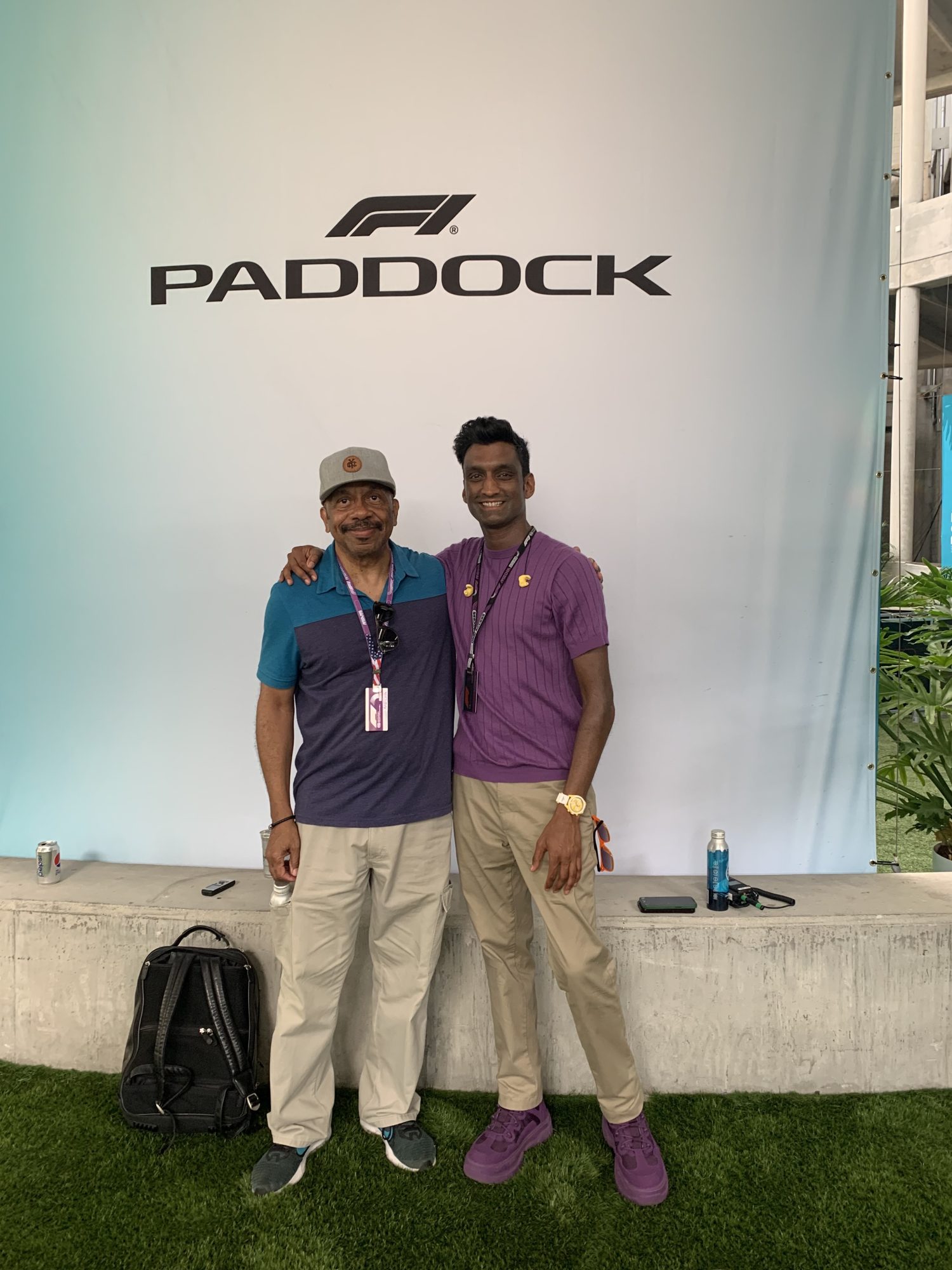

As for the financial impact of the Miami Grand Prix, where $100 earns you the privilege of strolling around the sprawling Miami International Autodrome campus for a single day, without getting a place to sit, Moko shrugs. “If you love something and you can afford it, why not?”
Unlike Moko, saxophone player Bismarck Morgan traveled only 60 miles from West Palm Beach. “I think there’s a great atmosphere here, and I think it’s important for people to come and make a decision for themselves,” Morgan says. “You get in and it’s a very wonderful and beautiful atmosphere. It’s easy to sit on the outside of something and have an opinion of it, but when you get there, it’s actually a beautiful place.
“There are plenty of people from around the world here, people of color from India, Dubai. It’s a beautiful thing, and I love the sound of race cars, I love the revving of the engines. It gets your blood flowing.”
Lewis Hamilton, who drives a W14 Mercedes-AMG road rocket propelled by a 1.6-liter, V6 engine and an electric motor hooked to a rechargeable battery, has noticed a change in the hue of Grand Prix crowds since he joined the Grand Prix circuit 16 years ago.
“For the first five or ten years or so, I didn’t see many people of color in the grandstands,” says Hamilton, whose Mercedes-AMG Petronas team has an annual budget exceeding $300 million. “There were very few people of color. It was not as diverse as I might have hoped.”
However, Hamilton is now “seeing a crowd that’s more diverse. That’s amazing to me to not be the only one there, which is nice to see. And it’s just great to be seeing that we’re tapping into those different cultures, those different communities, who perhaps once didn’t think (Formula 1 racing) was for them. “Because they didn’t see someone that looked like them in the sport, maybe.”
Just as Tiger Woods’ soul-crushing dominance drew more Black fans to golf tournaments, Lewis Hamilton’s championship-winning campaigns in 2008, 2014, 2015, 2017, 2018, 2019 and 2020 have lured new eyeballs to Formula 1.
So has the Netflix series “Formula 1: Drive to Survive,” which New England Patriots safety Adrian Phillips and his wife, pediatrician Camille Phillips, credit with attracting them to Miami Gardens to see Hamilton drive.
The couple watched Hamilton hustle his underperforming W14 Mercedes from 13th on the grid to a 6th-–place finish. Hamilton says that despite having subpar equipment this year, and finishing the Miami Grand Prix fourth in the driver standings with 56 points, compared with 119 for first-place Dutchman Max Verstappen, Hamilton will be back in 2024 and beyond.
Adrian and Camille Phillips say you can count them in, too.
The post Miami Grand Prix 2023 first appeared on BlackPressUSA.

