
Bay Area
Mayor Sheng Thao Speaks on Public Safety, Oakland-Vietnam Trade Opportunities
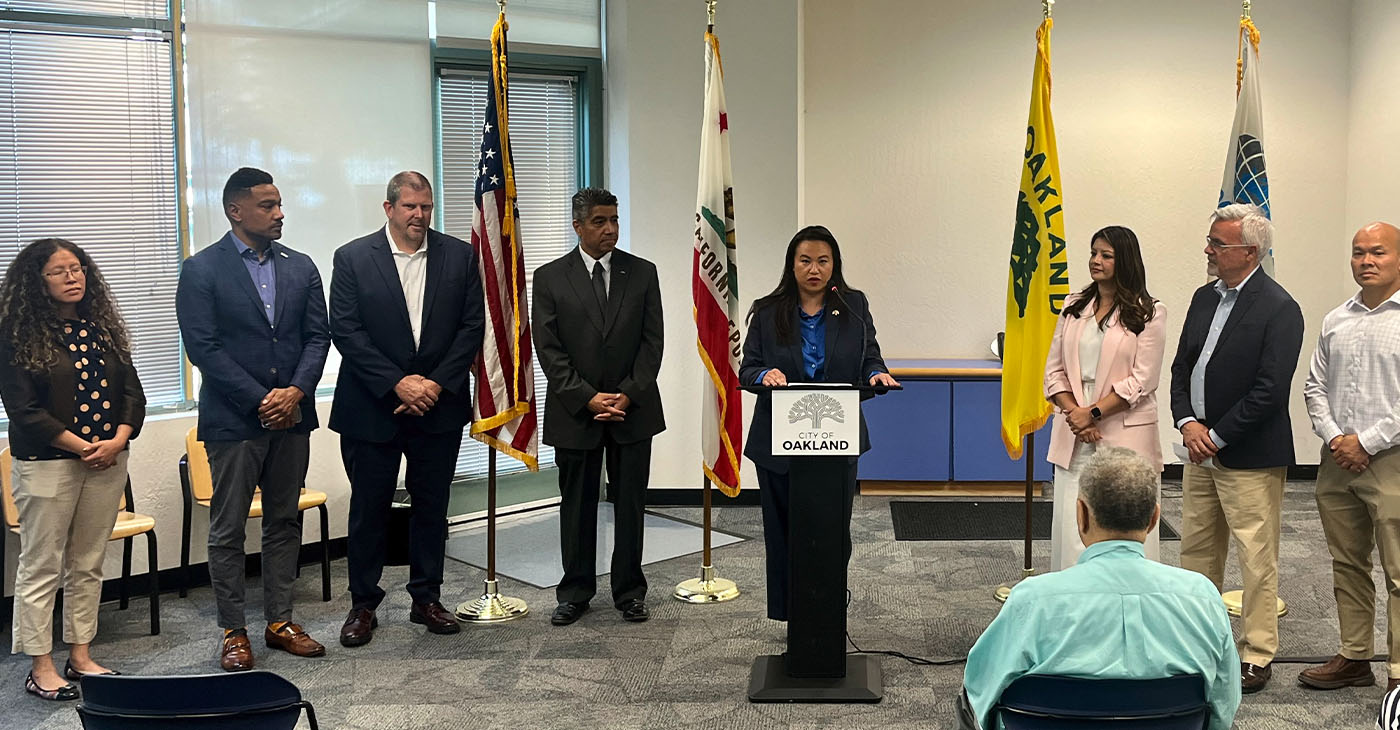
Oakland Mayor Sheng Thao, just back from a Vietnam trade mission, spoke at a press conference this week to discuss the results of her international meetings and also to address community concerns about crime in the city. She said she is “working day and night” to increase public safety: investing in violence prevention programs, seeking more funding to expand public safety resources, and collaborating with the governor to bring in the California Highway Patrol and Alameda County Sheriff’s Office.

By Ken Epstein
Oakland Mayor Sheng Thao, just back from a Vietnam trade mission, spoke at a press conference this week to discuss the results of her international meetings and also to address community concerns about crime in the city.
She said she is “working day and night” to increase public safety: investing in violence prevention programs, seeking more funding to expand public safety resources, and collaborating with the governor to bring in the California Highway Patrol and Alameda County Sheriff’s Office.
As the mayor of Oakland, she said, “I was able to call the governor directly, and this is now why we have the resources of CHP here in the City of Oakland.
Pointing out that the city now has the highest number of officers in uniform in the past three years, she said there is still work to be done to put the officers where they are needed most.
Thao also discussed the recent successful trade delegation to Vietnam, which ended Aug. 8 and included the mayor, Alameda County officials and Port of Oakland board members, and was designed to promote Oakland as a trading partner with Vietnam.
“This trip was an investment in Oakland’s future, by cultivating critical relationships that will grow our city’s economy” Thao said in a statement.
The Oakland delegation met with representatives from private industry, Long An International Port, the mayors of Hanoi, Ho Chi Minh City and Da Nang, and Prime Minister Pham Minh Chinh.
In-depth discussions with Pham focused on climate change issues, including establishing “green corridors” for all Vietnam ports and the Port of Oakland.
Other productive meetings were held with several companies, including electric vehicle manufacturer, VinFast, where discussions focused on importing their vehicles through the Port of Oakland; and airline, VietJet, which launched discussions on a possible new international route to Oakland Airport. An MOU was signed with THACO Industries, a leading manufacturer in mechanical products and technology.
Elaborating on the city’s commitment to reduce crime and make Oakland residents safer, Mayor Thao said,
“To actually catch the perpetrators, that means we have to have the manpower for that. We are talking about how we free up our officers, whether it’s ‘civilianizing’ some positions, so we can get more officers doing investigative work.”
Despite inheriting a major deficit from the previous administration, the mayor said the city’s new budget did not cut funds for violence prevention and received $1.2 million from the state to fund technology upgrades.
Specifically, she said the city is expanding Ceasefire, the Oakland Police Department’s anti-violence program, installing more license plate readers throughout the city, and working with the sheriff’s office to set up check points for intoxicated drivers.
She added, “Arguably, I would say that crimes would be even higher than it is today if I were to have cut in my budget the programs for our after-school programming, for summer programming.”
Thao emphasized that the changes will not occur overnight, but the public can expect to see progress.
“Although this is a hard moment in time – this, too, shall pass,” she said. “Because we are now in the phase of implementing. But I promise you, you will start seeing some of those results moving forward, towards next year.”
Property crime in Oakland has increased 28%, according to an ABC7 report in July. Homicides, so far, in 2023 are down 13% compared to 2022, while burglaries are up 41%. Vehicle thefts have increased 50%.
While rising crime is an issue that is frequently connected to “law and order” partisan political campaigns and is often viewed as an intensely local concern, the data points to more complex national reasons and solutions, spurred by the pandemic and other intersecting crises.
According to a report from the Brooking Institution in April, “Cities and towns of all sizes saw their murder rates increase … rising over 35% in cities with populations over 250,000; 40% percent in cities with populations of 100,000 to 250,000; and around 25% in cities with populations under 25,000.
In an article about “recent trends in violent crime,” from the Brennan Center for Justice, which opposes mass incarceration, the dramatic growth in crime across the country started during the pandemic.
“Despite politicized claims that this rise was the result of criminal justice reform in liberal-leaning jurisdictions, murders rose roughly equally in cities run by Republicans and cities run by Democrats. So-called red states actually saw some of the highest murder rates of all.
“This data makes it difficult to pin recent trends on local policy shifts and reveals the central flaw in arguments that seek to politicize a problem as complex as crime. Instead, the evidence points to broad national causes driving rising crime.”
This news story included reporting from KGO7, SF Chronicle, KRON4 and the Oakland Post.










Activism
Oakland Post: Week of September 30 – October 6, 2026
The printed Weekly Edition of the Oakland Post: Week of September 30 – October 6, 2026

To enlarge your view of this issue, use the slider, magnifying glass icon or full page icon in the lower right corner of the browser window.

Activism
Oakland Post: Week of September 23 – 29, 2026
The printed Weekly Edition of the Oakland Post: Week of September 23 – 29, 2026

To enlarge your view of this issue, use the slider, magnifying glass icon or full page icon in the lower right corner of the browser window.
Activism
Oakland Post: Week of September 16 – 22, 2026
The printed Weekly Edition of the Oakland Post: Week of September 16 – 22, 2026

To enlarge your view of this issue, use the slider, magnifying glass icon or full page icon in the lower right corner of the browser window.



OP-ED: Proposition 44 Would Put a Price on Trust

OP-ED: Proposition 40: It’s Time to Play Chess, Not Checkers

Listening as a Lifeline: A Doula’s Witness to Black Maternal Health

New Protections for Ticket Buyers: Gov. Newsom Signs Assemblymember Isaac Bryan’s Bill

‘We Don’t Talk Trash — We Pick Up Trash!’

Zakiya Jendayi Arrested, Locked Out of Home by Sheriff’s Deputies

Oakland Post: Week of September 30 – October 6, 2026

Asm. Corey Jackson Announces Launch of 24-Hour Childcare in His District

IN MEMORIAM: The Rev. Leon “Sonny” Clark, Longtime Orange County Pastor and Community Leader, Dies at 72

Poll: Becerra Widens His Lead Over Hilton; Californians Split on Wealth Tax

From Historic Memories to New Possibilities: Oakland Celebrates Coliseum 60

County Office of Education Says OUSD Finances Are Getting Healthier, Materially Stronger

LIVE FREE Sunday Dinner Brings Faith, Fellowship and Civic Conversation to Oakland

Remembering Chauncey Bailey as Student Journalists Face Threats to Truth-Telling

BLACspace Cooperative Invites Bay Area to Experience Oakland’s Black Cultural Ecosystem Through a BLAC Map Tour + Party

Standoff for Justice: Our Homes Are Worth Fighting For

Oakland Post: Week of August 26 – September 1, 2026

Frontier Airlines’ Return to Oakland Airport Brings Flights, Jobs and Opportunity

Gubernatorial Candidate Steve Hilton Blasts California New Tire Rules; Newsom Hits Back

Chef Sharon Lee Blends Culinary Excellence, Education and Empowerment

Jackie Wright Champions Bay Area Stories, Filmmakers and Cultural Institutions

Misnamed ‘Parent’ PAC Seeks to Influence Oakland School Board Elections

Oakland Coliseum Project Opens Door for Small Businesses to Build Bigger

Gov. Newsom’s Latest Appointees Include Sacramento Advocate for Formerly Incarcerated Students; State’s New Tech Chief

Big City Mayors Ask for “Yes” Vote on Housing Bond Measure; Conservatives Say “No”

Longtime BWOPA Member Brendalyn Goodall Appointed to California Workforce Development Board

Gov. Newsom Signs Law Shielding Immigration Aid Workers From Doxing Threats

Oakland Post: Week of September 2 – 8, 2026

Secretary of State Shirley N. Weber Urges Californians to Vote Early as Voter ID Battle Intensifies

IN MEMORIAM: Dolly Parton Dead at 80 — How She Built a Legacy of Love and Earned Her Place in Black Culture

The Conversation With Al McFarlane 6/23/26

Media Monday 6/22/26

LIVE! ASK ALMA! — TUES. 6.23.26 7PM EST

Car Buying Secrets: 4 Hidden Checks Before You Sign!

Is This 550 HP Charger Worth YOUR Money? AutoNetwork Review

Celebrating Juneteenth – Frederick Douglass on education and resistance

LIVE! — ASK ALMA! — TUES. 6.19.26 7PM EST

Hyundai Ioniq 5 Parking, Safety, and 360 View #shorts

2025 Ioniq 5 New Wiper & Powerful Performance! #shorts

Electric SUV Range: Is 259 Miles Enough? #shorts

EV Charging: How Fast Can You Charge an Electric Vehicle? #shorts

Biometric Cooling… Messaging Seats…Come on! 2025 Infiniti QX80 Autograph 4WD

Charged Up: Witness the Magic of a Fully Electric Car! #shorts

Range Rover Sport PHEV Included…: See What’s Inside This Luxury SUV! #shorts

Invisible Hood View: Perfect Parking with X-Ray Vision! #shorts
-
 Community3 weeks ago
Misnamed ‘Parent’ PAC Seeks to Influence Oakland School Board Elections
-

 Activism4 weeks ago
Oakland Post: Week of September 9 – 15, 2026
-

 Community3 weeks ago
Richmond Tiny House Village Farm & Garden Set to Open Gates on Sept. 26
-

 Black History3 weeks ago
Latest Massacre in Haiti Reveals Cruelty U.S. Deportations
-

 Black History3 weeks ago
OPINION: Nolan Wells’ Death One of Several Signifying Racial Terror Lives on in U.S. South
-

 Business2 weeks ago
Mayor Lee Announces $1 Million Kaiser Permanente Grant for Pilot Program to Address Homelessness, Clean Up Public Spaces throughout Oakland
-

 Community3 weeks ago
Democratic Clubs Interview Candidates for Oakland School Board
-

 Uncategorized3 weeks ago
NBA All-Star Damian Lillard Returns Home for 15th Annual Backpack Giveaway
