
Bay Area
Marin Aligns with State on Face Covering Guidelines Universal Indoor Masking Returns to All Indoor Public Spaces
Effective as of 12:01 a.m. Thursday, Dec. 30, previous local face covering exemptions carved out for indoor spaces with consistent cohorts of fully vaccinated people will no longer apply. Now, all people in Marin County, regardless of vaccination status, will be required to wear a mask in all indoor public settings, in accordance with the state-wide mandate. This includes gyms, fitness centers, office settings, employee commuter vehicles, religious gatherings, college classes, and similar settings.

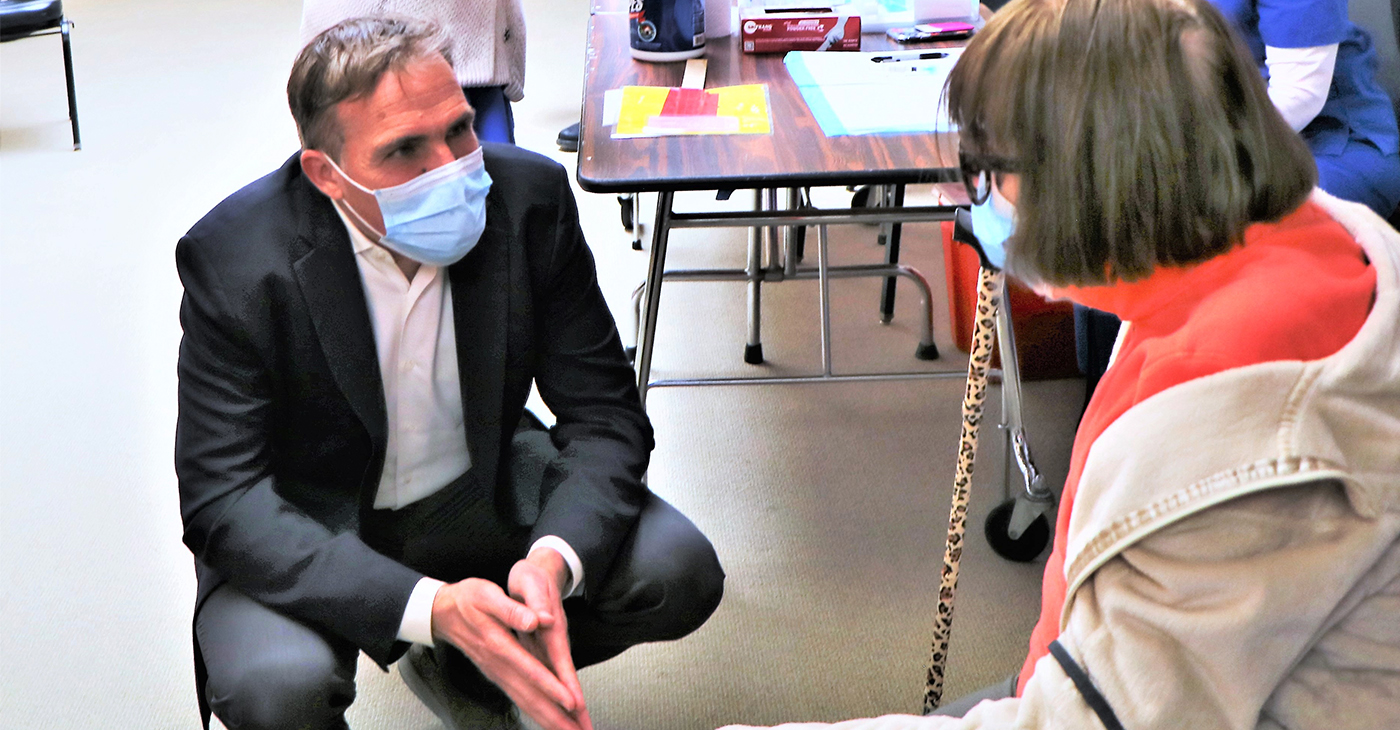
Courtesy of Marin County
With COVID-19 case rates rising rapidly, Marin County Public Health is aligning with the California Department of Public Health (CDPH) and requiring the wearing of face coverings in all indoor public places to stem the virus’ spread.
Effective as of 12:01 a.m. Thursday, Dec. 30, previous local face covering exemptions carved out for indoor spaces with consistent cohorts of fully vaccinated people will no longer apply. Now, all people in Marin County, regardless of vaccination status, will be required to wear a mask in all indoor public settings, in accordance with the state-wide mandate. This includes gyms, fitness centers, office settings, employee commuter vehicles, religious gatherings, college classes, and similar settings.
The first case of Omicron variant in Marin was identified on Dec. 17. Since then, average daily COVID-19 case counts have tripled, fueled by the highly contagious Omicron variant. On Dec. 28, 338 new cases were reported, exceeding the prior highest daily case count by more than 100 cases.
“When we see numbers like this, it’s time to respond,” said Dr. Matt Willis, Marin County Public Health Officer. “The mask exemption for certain settings was a pre-Omicron policy. This variant behaves differently, and the risk of infection in a room full of vaccinated people who are unmasked is much higher now.”

Despite rising case counts, hospitalization rates for COVID-19 infections have remained stable across Marin. That is attributed to Marin County’s very high vaccination rate: 92.1% of Marin’s population ages 5 and over have completed a COVID-19 vaccine series. Still, health authorities express concern that hospitalization rates could increase significantly in the coming days if case counts continue to rise at current rates.
CDPH’s statewide indoor mask mandate went into effect Dec. 15. At that time, Marin and other local counties were given an option to adopt a pre-existing mask order in lieu of the state’s order. Marin and five other jurisdictions — the counties of Sonoma, San Francisco, Contra Costa, Alameda, and the city of Berkeley — adopted local orders that allowed some exemptions not found in the state’s policy. The recension of the local order means Marin now falls under CDPH’s mask order, which remains in effect through at least Jan. 15, 2022.
On Dec. 28, Contra Costa County made a similar announcement, issuing a new health order that removed limited exemptions to indoor mask use.
COVID-19 vaccines, including booster doses, continue to offer the most effective protection against hospitalization and death from all variants of COVID-19 circulating in the Bay Area.
Safe, free, and effective COVID-19 vaccines are available to everyone ages 5 and up. Book an appointment or find a nearby clinic on GetVaccinatedMarin.org.
More information face coverings, local policies, and resources for businesses, including printable signs, can be found at Coronavirus.MarinHHS.org/masks.






Activism
Oakland Post: Week of September 16 – 22, 2026
The printed Weekly Edition of the Oakland Post: Week of September 16 – 22, 2026

To enlarge your view of this issue, use the slider, magnifying glass icon or full page icon in the lower right corner of the browser window.
Activism
Oakland Post: Week of September 9 – 15, 2026
The printed Weekly Edition of the Oakland Post: Week of September 9 – 15, 2026

To enlarge your view of this issue, use the slider, magnifying glass icon or full page icon in the lower right corner of the browser window.
Activism
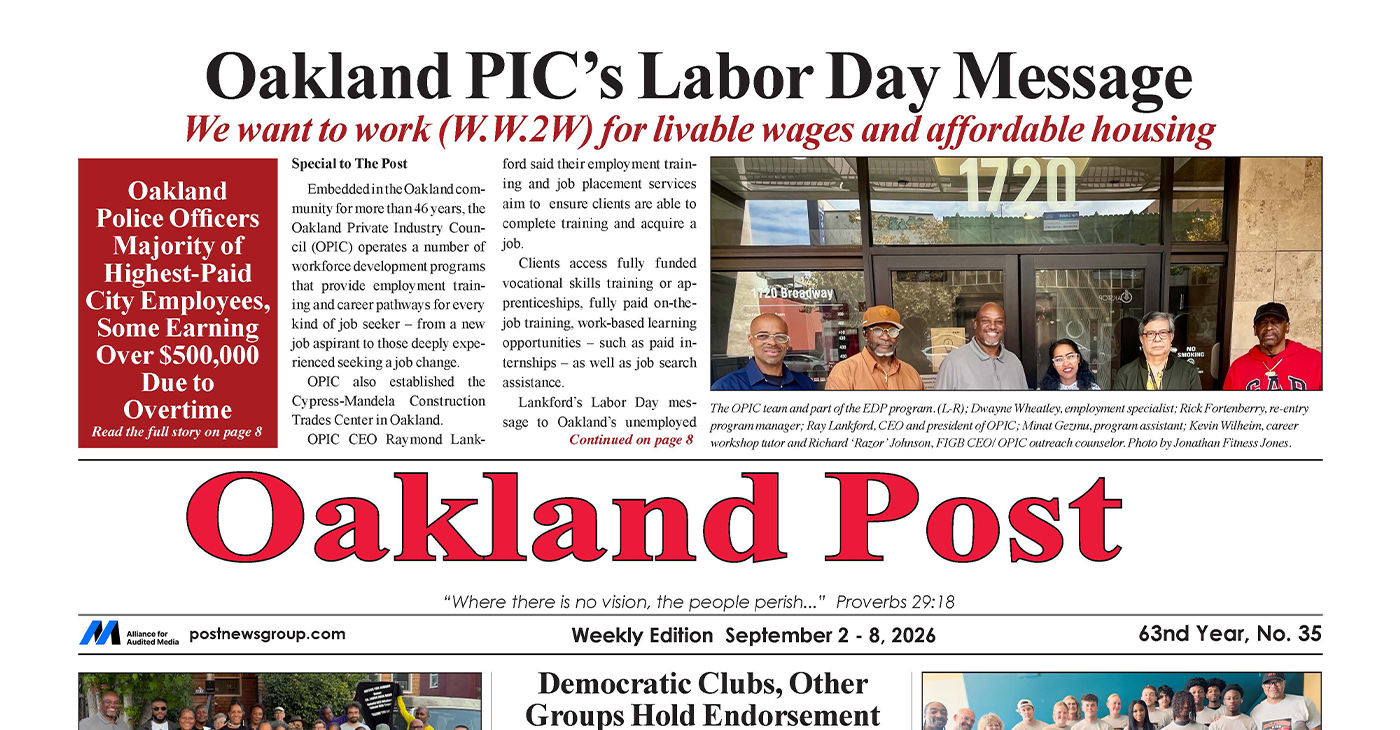
Oakland Post: Week of September 2 – 8, 2026
The printed Weekly Edition of the Oakland Post: Week of September 2 – 8, 2026
To enlarge your view of this issue, use the slider, magnifying glass icon or full page icon in the lower right corner of the browser window.



Doulas Are Helping Black California Moms Navigate Pregnancy–Even as High Mortality Rates Persist

Newsom Signs Addictive Social Media Law to Protect Kids

On Your November Ballot: Prop 38 Would Allocate $8.4 Billion to Immunology and Immunotherapy Funding

Ask California: Golden State Releases New AI Chatbot

Asm. Isaac Bryan’s Bill Banning California Police From ICE Side Jobs Reaches Newsom’s Desk

Assemblymember LaShae Sharp-Collins’s Bill Would Pause Law Enforcement’s Use of Shock Gloves Pending Study

BOOK REVIEW: ‘Laws of Solomon’ Reveals Tender Heart of Former Child Soldier

OPINION: The New American Fear – From 9-11 to AI

Passing for White, Fighting for Black America: The Courage of Walter White

Oakland People’s Arms Embargo Coalition Demands End to Military Shipments Thru Oakland

Barbara Lee Mourns Gloria Steinem, Remembers a Friendship Rooted in Equality

Event Preview: ‘Fashion v. Fascism’ – A Runway Revolution Is Coming to the Bay Area

Two Looming Threats Every Alameda County Elder Should Know About

Oakland Mayor Reads to Children at Bookout Block Party at Marcus Books Store

Tradition Comes to the Streets in 11th Annual Black-Eyed Pea Festival at the Freedom Farmers Market

Less Affluent School Districts, Including Sacramento City, Face Threat of State Takeover

ESSAY: California Can Close Its Colorectal Cancer Gap

California Hispanic Chambers of Commerce Unveils: ‘Powering the Future’ Theme for 47th Annual Statewide Convention

Four Candidates, Including Incumbent Barbara Lee, Qualify for Oakland Mayor’s Race

Oakland Post: Week of August 12 – 18, 2026

From Blueprint to Breakthrough: Tackling Affordable Housing in Oakland

Oakland Observes Black August with Block Parties, Film Showings, Workshops

COMMENTARY: Why Local School Tax Measure G1 Will Not Be on the November Ballot

Standoff for Justice: Our Homes Are Worth Fighting For

Returning to Its Roots, the Oakland Black-Eyed Pea Festival Partners with the Freedom Farmers Market Sept. 12

Oakland Post: Week of August 26 – September 1, 2026

NPRC Scores First Advocacy Victory: David Shaw Finally Gets His Wish to ‘Go Home’

Frontier Airlines’ Return to Oakland Airport Brings Flights, Jobs and Opportunity

Gubernatorial Candidate Steve Hilton Blasts California New Tire Rules; Newsom Hits Back

Chef Sharon Lee Blends Culinary Excellence, Education and Empowerment

The Conversation With Al McFarlane 6/23/26

Media Monday 6/22/26

LIVE! ASK ALMA! — TUES. 6.23.26 7PM EST

Car Buying Secrets: 4 Hidden Checks Before You Sign!

Is This 550 HP Charger Worth YOUR Money? AutoNetwork Review

Celebrating Juneteenth – Frederick Douglass on education and resistance

LIVE! — ASK ALMA! — TUES. 6.19.26 7PM EST

Hyundai Ioniq 5 Parking, Safety, and 360 View #shorts

2025 Ioniq 5 New Wiper & Powerful Performance! #shorts

Electric SUV Range: Is 259 Miles Enough? #shorts

EV Charging: How Fast Can You Charge an Electric Vehicle? #shorts

Biometric Cooling… Messaging Seats…Come on! 2025 Infiniti QX80 Autograph 4WD

Charged Up: Witness the Magic of a Fully Electric Car! #shorts

Range Rover Sport PHEV Included…: See What’s Inside This Luxury SUV! #shorts

Invisible Hood View: Perfect Parking with X-Ray Vision! #shorts
-
 Commentary4 weeks ago
Standoff for Justice: Our Homes Are Worth Fighting For
-
 Activism4 weeks ago
Oakland Post: Week of August 26 – September 1, 2026
-
 Business4 weeks ago
Frontier Airlines’ Return to Oakland Airport Brings Flights, Jobs and Opportunity
-
 Business4 weeks ago
Gubernatorial Candidate Steve Hilton Blasts California New Tire Rules; Newsom Hits Back
-
 Business4 weeks ago
Chef Sharon Lee Blends Culinary Excellence, Education and Empowerment
-

 Education4 weeks ago
Gov. Newsom’s Latest Appointees Include Sacramento Advocate for Formerly Incarcerated Students; State’s New Tech Chief
-

 Community4 weeks ago
Big City Mayors Ask for “Yes” Vote on Housing Bond Measure; Conservatives Say “No”
-

 Business4 weeks ago
Oakland Coliseum Project Opens Door for Small Businesses to Build Bigger
