
#NNPA BlackPress
LIVE State Of The People Broadcasts Marathon on How Ugly Trump’s “Big, Beautiful Bill” Really Is
During Trump’s address to Congress in January, State of the People organizers, activists and journalists stood up a 24 -hour streaming channel. As the Senate and House debate Trump’s “big, beautiful bill,” State of the People is broadcasting a marathon on its YouTube channel to fully inform the public on the devastating impact of Trump’s […]

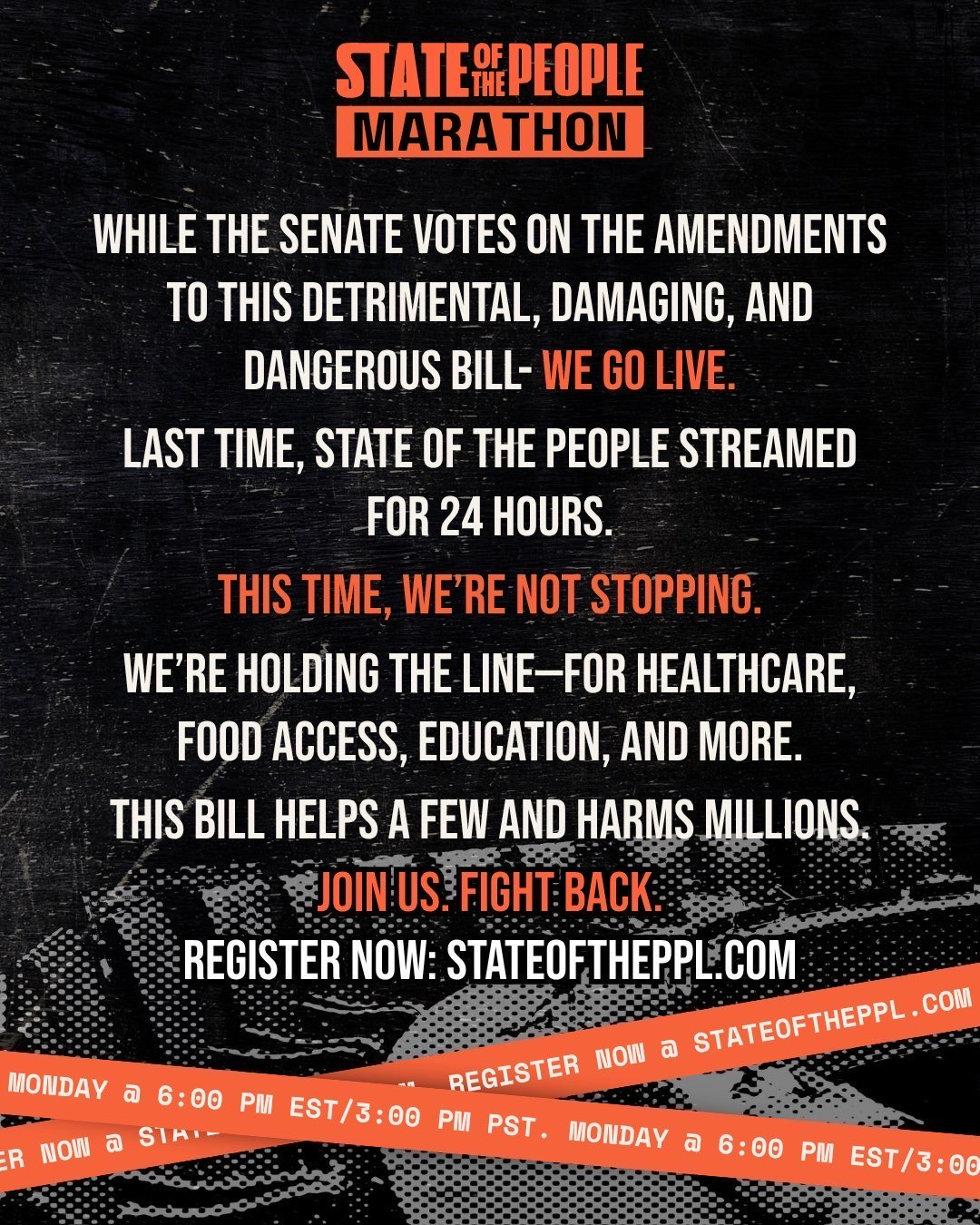
During Trump’s address to Congress in January, State of the People organizers, activists and journalists stood up a 24 -hour streaming channel. As the Senate and House debate Trump’s “big, beautiful bill,” State of the People is broadcasting a marathon on its YouTube channel to fully inform the public on the devastating impact of Trump’s bill. From State of the People, here are some ways in which the legislation will impact our communities:
Broke: Money, Jobs, Economy
- This bill cuts $1.3 trillion in food assistance and health coverage while giving the wealthy that exact amount in tax breaks.
- It adds $3.25 trillion to the national debt which will weaken our economy at a time we can’t afford it.
- Kills jobs and increases energy costs: Puts 1.75 million construction jobs at risk — with unions warning, “this stands to be the biggest job-killing bill in the history of the country”
- Puts 2 million clean energy jobs at risk and increases energy bills by hundreds of dollars across the country
- Trump and the GOP’s budget is the most regressive tax scheme in at least the last 40 years — possibly ever. The bill will “actively transfer” money from the poorest Americans into the pockets of the ultra-wealthy
- The impact of the “cuts” they are talking about is really a transfer of wealth reduce incomes among the poorest 20% of Americans by 3.8%, while increasing the incomes of the richest 20% by 3.7%
Sick: Healthcare, Medicaid, Medicare and the ACA; Veterans
- Rips away health care from over 16 million Americans through over $1 trillion in cuts to Medicaid, Medicare, and the Affordable Care Act — including the largest cut to Medicaid in American history.
- These Medicaid cuts are going to reach down into every corner of our nation’s health care system.
- Puts over 300 rural hospitals at risk of shutting down, ripping away critical, lifesaving care from hundreds of rural communities across the country.
- Seniors will lose care at home and be left with fewer nursing homes and fewer nurses.
- Kids with disabilities will lose home care.
- And never before has there been legislation so focused on denying care to eligible Americans by adding more red tape, and making it harder for anyone who relies on Medicare, Medicaid and the Affordable Care Act.
- More than 37 million children are enrolled in either Medicaid or the Children’s Health Insurance Program (CHIP), a federal program that provides affordable health insurance to pregnant mothers and children who live just above Medicaid’s poverty threshold.
- Combined, Medicaid and CHIP protect nearly half of all children in the United States, beginning with important prenatal care, covering over 40% of U.S. births as well as nearly half of all rural births, and continuing to insure millions of vulnerable children into young adulthood.
Veterans: Over 9 million veterans are enrolled in VA health care, and millions more rely on Medicaid, Medicare, or ACA coverage to fill gaps — these cuts will gut their care and overwhelm an already strained VA system.
- About 1 in 10 veterans rely on Medicaid — especially post-9/11 veterans, low-income veterans, and those living in rural areas where VA facilities are limited.
- Veterans of color, women veterans, and disabled veterans are disproportionately impacted, as they are more likely to be dual-eligible for VA and public health programs now on the chopping block.
- These cuts would force many veterans to delay care, forgo treatment, or drown in medical debt — all while funding more weapons and war.
Hungry: Taking food assistance away from our kids and communities
- 5 million Americans lose food assistance (Congressional Budget Office SNAP projections)
- Work requirements expanded to age 64 (House Republican reconciliation bill text)
- New red tape around the child tax credit, making it harder to qualify for some of the benefits like school lunch programs and SNAP
- According to the U.S. Department of Agriculture, SNAP helps pay for groceries for more than 15 million children in the U.S. (USDA)
- Could force some states to end their SNAP programs. Over the last 50 years, SNAP’s nationwide availability has largely eliminated severe hunger and malnutrition throughout the United States. This bill walks away from the long-standing, bipartisan, and national commitment to food assistance that made that possible.
Additional Impacts:
- Endangers our communities by making it easier to buy dangerous firearms and silencers
- The administration proposes a 43.6% decrease in HUD program funding, from $77.0 billion to $43.5 billion. This includes a $26.7 billion cut from federal rental assistance programs as the responsibility for rental assistance would shift to the states. The proposal also eliminates the $3.3 billion Community Development Block Grant program, designed to support community infrastructure, public facilities, and programming.
- The Department of Health and Human Services budget would be reduced by 26.2%, from $127.0 billion to $93.8 billion. Within this, a new $500 million fund would support the “Make America Healthy Again” initiative, designed to allow HHS Secretary Robert F. Kennedy Jr. to address nutrition, medication, and food and drug quality.
- A reform of the National Institutes of Health would reduce its budget by $18.0 million, requiring the closure of the National Institute on Minority and Health Disparities and the National Institute of Nursing Research. The Centers for Disease Control and Prevention budget would also drop $3.6 billion.
- Another $4.0 billion would be cut by ending the Low Income Home Energy Assistance Program operated by the Administration for Children & Families.
- Federal Emergency Management Agency (FEMA) grant programs (-$646 million)











#NNPA BlackPress
LIVE from the NMA Convention Raheem DeVaughn Says The Time Is Now: Let’s End HIV in Our Communities #2
Set against the backdrop of the NMA conference, Executive Officers from the National Medical Association, Grammy Award Winning Artist and Advocate Raheem DeVaughn, and Gilead Sciences experts, are holding today an important conversation on HIV prevention and health equity. Black women continue to be disproportionately impacted by HIV despite advances in prevention options. Today’s event […]

Set against the backdrop of the NMA conference, Executive Officers from the National Medical Association, Grammy Award Winning Artist and Advocate Raheem DeVaughn, and Gilead Sciences experts, are holding today an important conversation on HIV prevention and health equity.
Black women continue to be disproportionately impacted by HIV despite advances in prevention options. Today’s event is designed to uplift voices, explore barriers to access, and increase awareness and key updates about PrEP, a proven prevention method that remains underutilized among Black women. This timely gathering will feature voices from across health, media, and advocacy as we break stigma and center equity in HIV prevention.
Additional stats and information to know:
● Black women continue to be disproportionately affected by HIV, with Black women representing more than 50% of new HIV diagnoses among women in the U.S. in 2022, despite comprising just 13% of women in the U.S.
● Women made up only 8% of PrEP users despite representing 19% of all new HIV diagnoses in 2022.
● Gilead Sciences is increasing awareness and addressing stigma by encouraging regular HIV testing and having judgment-free conversations with your healthcare provider about prevention options, including oral PrEP and long-acting injectable PrEP options.

● PrEP is an HIV prevention medication that has been available since 2012.
● Only 1 in 3 people in the U.S. who could benefit from PrEP were prescribed a form of PrEP in 2022.
#NNPA BlackPress
TRUMP: “Washington, D.C. is Safe”
BLACKPRESSUSA NEWSWIRE — President Trump, who typically travels with a full contingent of high-level protection, insinuated that he finally felt safe enough to go to dinner in the District of Columbia. “My wife and I went out to dinner last night for the first time in four years,” said the nation’s 47th president.

By Apriil Ryan
BlackPressUSA Washington Bureau Chief and White House Correspondent
“Washington, D.C. is safe,” President Trump declared from the Oval Office today. Those words came while Trump was hosting Ukraine’s President Volodymyr Zelenskyy. During the question-and-answer session, which primarily focused on a peace deal in the Russian-Ukrainian war, Trump explained, “You did that in four days.” He was speaking of how fast the National Guard quelled the violence in what was once called Chocolate City.
The President deployed the National Guard to D.C. a week ago, to a city with reduced crime rates over the previous year. Violent crime dropped by 26%, marking the lowest level in 30 years. Homicides also fell by 11%.
President Trump, who typically travels with a full contingent of high-level protection, insinuated that he finally felt safe enough to go to dinner in the District of Columbia. “My wife and I went out to dinner last night for the first time in four years,” said the nation’s 47th president.
Trump reinforced his claim about the newly acquired safety in D.C. by relaying that a friend’s son is attending dinner in D.C., something he would not have done last year.
After the president finished his comments, a reporter/commentator in the room with close connections to Marjorie Taylor Greene jumped into the high-level conversation to affirm the president’s comments, saying, “I walked around yesterday with MTG. If you can walk around D.C. with MTG and not be attacked, this city is safe.”
That reporter was the same person who chastised President Zelenskyy months ago during his first Oval Office meeting with Trump for not wearing a business suit. Zelenskyy, a wartime President, has been clad in less formal attire to reflect the country’s current war stance against Russia.
Without any sourcing, President Trump also said, “People that haven’t gone out to dinner in Washington, D.C., in two years are going out to dinner, and the restaurants the last two days have been busier than they’ve been in a long time.”
The increase in policing in Washington, D.C. is because a 19-year-old former Doge employee was carjacked in the early hours of the morning recently.
#NNPA BlackPress
Rising Energy Costs Weigh Heaviest on Black Households
BLACKPRESSUSA NEWSWIRE — For many African American families, the cost of keeping the lights on and homes heated or cooled is not just a monthly bill — it’s a crushing financial burden.


By Stacy M. Brown
Black Press USA Senior National Correspondent
For many African American families, the cost of keeping the lights on and homes heated or cooled is not just a monthly bill — it’s a crushing financial burden.
A new national study from Binghamton University and California State University, San Bernardino, finds that Black households spend a far larger share of their income on energy compared to white households, even when income levels are the same. “We often say that African Americans suffer more, but we often blame it just on income. And the reality is, there is something more there,” study author George Homsy, associate professor at Binghamton University, wrote. “It’s not just because they tend to be poor. There is something that’s putting them at a disadvantage. I think what happened is it happens to be where they live.” The study, published in Energy Research & Social Science, analyzed 65,000 census tracts across the United States. It found that while the average American household spends about 3.2% of income on energy bills, households in the majority African American census tracts spend an average of 5.1%.
Homsy and researcher Ki Eun Kang point to the age and condition of housing stock, along with lower homeownership rates, as key drivers. Their research concludes that “energy burden is not simply a matter of income or energy cost but also race, which might be driven by place.” Older, less energy-efficient housing and high rental rates in Black communities mean residents often cannot make upgrades like improved insulation or new appliances, locking families into higher bills.
Tradeoffs and Health Risks
The consequences go beyond money. Families forced to spend 10% or more of their income on energy — what experts classify as “unmanageable” — may cut back on food, medicine, or other essentials. More than 12 million U.S. households report leaving their homes at unsafe temperatures to reduce costs, while millions more fall behind on utility bills. The health effects are severe. High energy burdens increase risks of asthma, depression, poor sleep, pneumonia, and even premature death. The issue is especially acute for African Americans, who are disproportionately exposed to housing and environmental conditions that amplify these risks.
Washington, D.C.: A Case Study
In Washington, D.C., the problem is particularly stark. A recent analysis by the Chesapeake Climate Action Network (CCAN) shows that SNAP-eligible households spend more than 20% of their income on energy bills. Across the metro area, nearly two-thirds of low-income households devote over 6% of their income to energy, and 40% face what researchers call a “severe financial strain,” paying more than 10%. Pepco, the District’s primary electricity provider, has implemented three consecutive annual rate hikes, pushing the average household bill to $114 per month as of January 2025. Shutoffs have followed — nearly 12,000 customers lost service in 2024, with disconnections doubling after a summer rate hike. Washington Gas has also sought a 12% rate increase and pushed a controversial $215 million pipeline replacement project, rebranded as “District SAFE.” The plan could ultimately cost D.C. households an additional $45,000 each over several decades, or nearly $1,000 annually added to bills.
Historical Roots
Researchers argue that these inequities are not accidental but rooted in history. The ScienceDirect study reveals that African American communities living in formerly redlined neighborhoods continue to face disadvantages today — from poor housing quality to higher climate risks. Homsy says policymakers must make targeted efforts. “It is harder to get to rental units where a lot of poor people live,” he noted. “We need to work harder to get into these communities of color.”



WORK FROM HOME
Home-based business with potential monthly income of $10K+ per month. A proven training system and website provided to maximize business effectiveness. Perfect job to earn side and primary income. Contact Lynne for more details: Lynne4npusa@gmail.com 800-334-0540


As California Hits Aging Milestone, State Releases Its Fifth Master Plan for Aging

After Don Lemon’s Arrest, Black Officials Raise Concerns About Independent Black Media

“Victory” for Voting Rights: Weber and Bonta Hail Judge’s Decision on Huntington Beach I.D. Law

Can You Afford a Mortgage but Not the Down Payment? Dream For All Offers Up to $150K

At Sac Summit, California African American Chamber of Commerce Shows Growing Clout; Lays Out Top Goals

Art of the African Diaspora Celebrates Legacy and Community at Richmond Art Center

Candidates Vying for Governor’s Seat Debate at Ruth Williams–Bayview Opera House in San Francisco

Black History Events in the East Bay

Oakland Post: Week of February 4 – 10, 2026

Medi-Cal Cares for You and Your Baby Every Step of the Way

Life Expectancy in Marin City, a Black Community, Is 15-17 Years Less than the Rest of Marin County
Rest in Peace: A.M.E. Pastor and L.A Civil Rights Icon Cecil “Chip” Murray Passes
Court Throws Out Law That Allowed Californians to Build Duplexes, Triplexes and RDUs on Their Properties
Funds for Down Payments and Credit Repair Given to Black First Time Homebuyers
Black Leadership Council Honors California’s Three Black Constitutional Officers

OP-ED: AB 1349 Puts Corporate Power Over Community

Alfred Cralle: Inventor of the Ice Cream Scoop

First 5 Alameda County Distributes Over $8 Million in First Wave of Critical Relief Funds for Historically Underpaid Caregivers

Oakland Post: Week of December 31, 2025 – January 6, 2026

Protecting California’s Black Moms and Babies: Policies and Programs Struggle to Fix Deep-Rooted Maternal Health Inequities

2025 in Review: Seven Questions for Assemblymember Lori Wilson — Advocate for Equity, the Environment, and More

Why Peace on Earth Begins with Birth, a Q&A with Midwife Nikki Helms

Big God Ministry Gives Away Toys in Marin City

2025 in Review: Seven Questions for Assemblymember Tina McKinnor, Champion of Reparations, Housing and Workers’ Rights

BOOK REVIEW: Let Me Be Real With You

2025 in Review: Seven Questions for Sen. Laura Richardson, Who Made Legislative History This Year

2025 in Review: Seven Questions for Sen. Lola Smallwood-Cuevas – an Advocate for Jobs and Justice

Jefferson County (AL) Democrats Open Qualifying for 2026 Primary Elections

COMMENTARY: With Gratitude and Praise for 2026

Skater Emmanuel Savary Sharpens Routines for the 2026 U.S. Championships

Hyundai Ioniq 5 Parking, Safety, and 360 View #shorts

2025 Ioniq 5 New Wiper & Powerful Performance! #shorts

Electric SUV Range: Is 259 Miles Enough? #shorts

EV Charging: How Fast Can You Charge an Electric Vehicle? #shorts

Biometric Cooling… Messaging Seats…Come on! 2025 Infiniti QX80 Autograph 4WD

Charged Up: Witness the Magic of a Fully Electric Car! #shorts

Range Rover Sport PHEV Included…: See What’s Inside This Luxury SUV! #shorts

Invisible Hood View: Perfect Parking with X-Ray Vision! #shorts

AI Is Reshaping Black Healthcare: Promise, Peril, and the Push for Improved Results in California

ESSAY: Technology and Medicine, a Primary Care Point of View

Sanctuary Cities

The RESISTANCE – FREEDOM NOW

STATE OF THE PEOPLE: Freddie

ECONOMIC BOYCOTT DAY!!!!!

I told You So
-
 Activism4 weeks ago
Protecting California’s Black Moms and Babies: Policies and Programs Struggle to Fix Deep-Rooted Maternal Health Inequities
-
 Activism4 weeks ago
Why Peace on Earth Begins with Birth, a Q&A with Midwife Nikki Helms
-
 #NNPA BlackPress4 weeks ago
Jefferson County (AL) Democrats Open Qualifying for 2026 Primary Elections
-
 #NNPA BlackPress4 weeks ago
COMMENTARY: With Gratitude and Praise for 2026
-
 #NNPA BlackPress4 weeks ago
Skater Emmanuel Savary Sharpens Routines for the 2026 U.S. Championships
-

 #NNPA BlackPress4 weeks ago
From Civil Rights to ICE Raids, Trump’s Unchecked Power Puts Every Community at Risk
-
#NNPA BlackPress4 weeks ago
From Civil Rights to ICE Raids, Trump’s Unchecked Power Puts Every Community at Risk
-

 #NNPA BlackPress3 weeks ago
OP-ED: The Dream Cannot be Realized Without Financial Freedom
