
Politics
Legal Weed States Have Lessons to Share


In this Tuesday, Dec. 30, 2014, photo, Cannabis City clerk John Golby, left, helps customers looking over a display case of marijuana products at the shop in Seattle. (AP Photo/Elaine Thompson)
KRISTEN WYATT, Associated Press
DENVER (AP) — Don’t worry about a federal lawsuit. But do worry about tax rates. Those are among the many lessons Colorado and Washington have to share from the front lines of America’s marijuana experiment.
LESSON ONE: DON’T BE TIMID
Public officials in the pioneering marijuana states were flat-footed when voters made pot legal.
At first waiting for a possible federal lawsuit, then trying to figure out how to monitor and tax a product that had never been fully regulated anywhere in the world, the states spent many months coming up with rules for how the drug should be grown, sold and consumed.
The delays were understandable. But they led to one of the biggest disappointments of the marijuana markets — lower-than-hoped tax collections.
LESSON TWO: DON’T GET TOO EXCITED, EITHER
Both Colorado and Washington have seen tax collections fall below some rosy projections. The effective tax rates are about 44 percent in Washington and 29 percent in Colorado, with plenty of asterisks and local variances.
The states assumed that pot users would pay a steep premium to stop using drug dealers and have clean, safe stores in which to buy their weed. But the tax rates have led to a continuing black market, undercutting the top argument for legalizing in the first place.
Months of delays for permitting and licensing meant that potential pot taxes went uncollected. And limited marijuana supply in both states has further driven up the price of legal weed.
LESSON THREE: THINK OUTSIDE THE BONG
Pot users these days aren’t using the drug the same way hippies in the 1960s did. But Colorado and Washington weren’t entirely prepared to deal with popular new forms of edible and concentrated weed.
It took more than 18 months for Washington to begin sales of edible pot.
Colorado had regulations for edible pot already in place from the medical market — but it stumbled, too, when the edibles proved a lot more popular than officials expected and many first-timers weren’t sure how much to eat.
Colorado has had to go back after the fact to tighten rules on edible pot packaging and dosing.
LESSON FOUR: THINK ABOUT THE KIDS
It’s an obvious consequence of legalization — wider availability for adults means easier access for kids.
School districts in both Colorado and Washington have reported more kids showing up at school with weed. There have been more kids treated at emergency room for marijuana ingestions, too.
Marijuana exposure isn’t fatal, but the experience so far in both states underscores the need for states to have plans for talking with minors about pot.
LESSON FIVE: THE THIN GREEN LINE
Law enforcement has a big role in reducing potential public safety effects of legalization.
States that legalize pot need a plan in place for how officers determine whether drivers are impaired by marijuana. After legalization, simply sniffing pot in a car or seeing a joint on the seat isn’t enough to haul someone to jail.
Officers also need new guidance on handling marijuana evidence, telling legal growing operations from illegal ones, and protecting new businesses may be targets for robbery because they operate with large amounts of cash (because banks are leery of assisting businesses that sell a drug that is illegal under federal law).
Copyright 2015 The Associated Press. All rights reserved. This material may not be published, broadcast, rewritten or redistributed.





Activism
Oakland Post: Week of March 18 – 24, 2026
The printed Weekly Edition of the Oakland Post: Week of March 18 – 24, 2026

To enlarge your view of this issue, use the slider, magnifying glass icon or full page icon in the lower right corner of the browser window.
Activism
Oakland Post: Week of March 11 -17, 2026
The printed Weekly Edition of the Oakland Post: Week of March 11 – 17, 2026
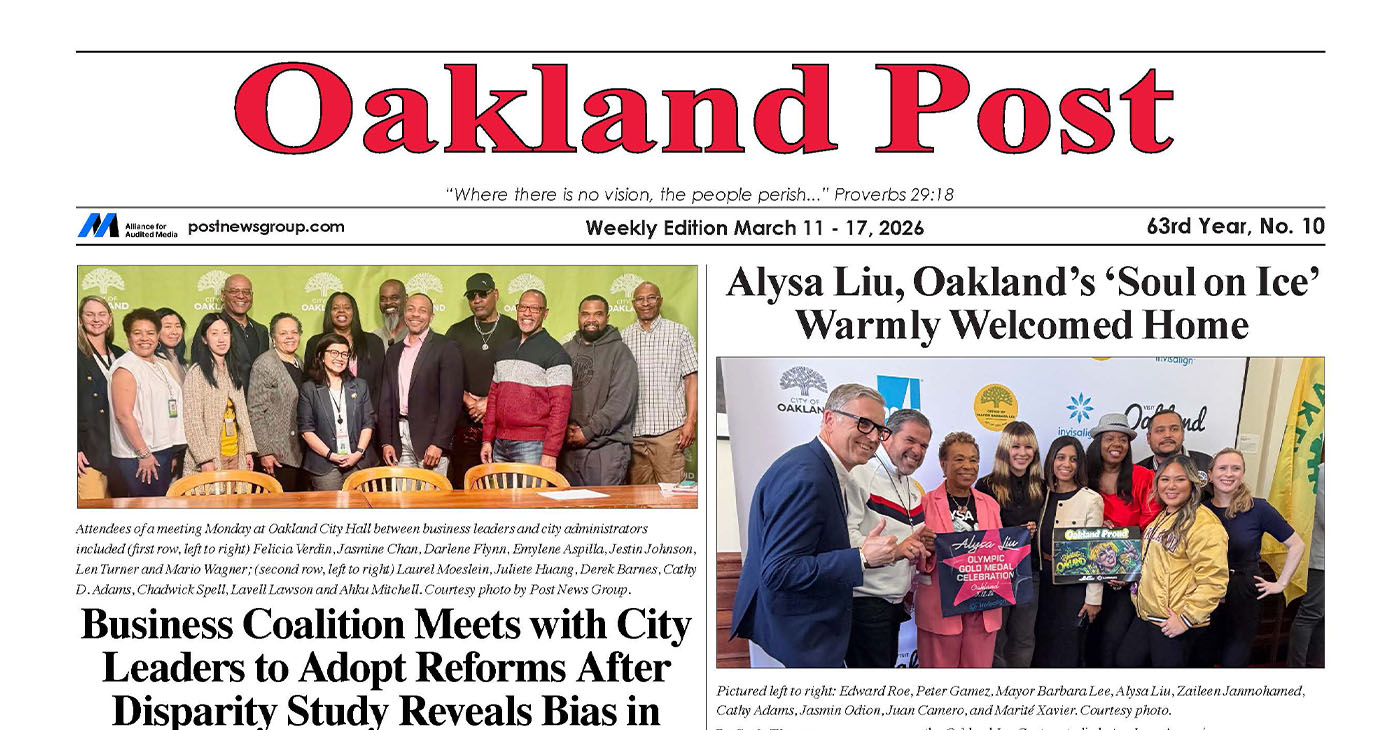
To enlarge your view of this issue, use the slider, magnifying glass icon or full page icon in the lower right corner of the browser window.
Activism
Oakland Post: Week of March 4 – 10, 2026
The printed Weekly Edition of the Oakland Post: Week of March 4 – 10, 2026

To enlarge your view of this issue, use the slider, magnifying glass icon or full page icon in the lower right corner of the browser window.


WORK FROM HOME
Home-based business with potential monthly income of $10K+ per month. A proven training system and website provided to maximize business effectiveness. Perfect job to earn side and primary income. Contact Lynne for more details: Lynne4npusa@gmail.com 800-334-0540


Black Artists in America, Installation Three Wraps at the Dixon Gallery and Gardens

Grief, Advocacy, and Education: A Counselor Reflects on Black Maternal Health

Future of Florida’s Black History Museum in Limbo

New Research Shows the Many Benefits of Early Learning

South Hampton K-8 Students Among Top 10 Finalists for Samsung’s ‘Solve for Tomorrow’ Competition

Cuba: No Negotiation with US on the President or Political System

Brooklyn Academy of Music Names Jamaican-Born Tamara McCaw as President

Trinidad & Tobego – U.S. Launches WhatsApp Channel for American Citizens in the Country

Oakland Post: Week of March 18 – 24, 2026

AI Innovation vs. Ethics and Environmental Impact

AI, Web3, and Digital Reparations

What If You Owned Your AI Agent?

Season 7, Episode 3 – January Reporter’s Roundtable 📱

Season 7, Episode 3 – January Reporter’s Roundtable

AI, Media, and Power | Part 2, Real-World Impacts and Tradeoffs

Oakland Post: Week of February 11 – 17, 2026

Reflecting on Black History Milestones in Birmingham AL

CITY OF SAN LEANDRO STATE OF CALIFORNIA PUBLIC WORKS DEPARTMENT ENGINEERING DIVISION NOTICE TO BIDDERS FOR ANNUAL STREET OVERLAY/REHABILITATION 2019-21 – PHASE III

Oakland Post: Week of February 18 – 24, 2026

PRESS ROOM: NBA Hall of Fame Nominee Terry Cummings Joins 100 Black Men of DeKalb County to Launch Victory & Values Initiative

Oakland Post: Week of February 25 – March 3, 2026

Trump’s MAGA Allies are Creating Executive Order Plan to Steal the 2026 Midterms

U.S. manufacturing rebounds – how foundry services are adapting to rising demand

OP-ED: One Hundred Years of Black Workers Telling the Truth

Advancements in solar technology that are changing the way we power the world

Chase Oakland Community Center Hosts Alley-Oop Accelerator Building Community and Opportunity for Bay Area Entrepreneurs

Poll Shows Support for Policies That Help Families Afford Child Care

Oakland Post: Week of March 4 – 10, 2026

PRESS ROOM: Civil Rights TV Launches in Selma as the World’s First 24/7 Civil Rights Television Network

Ghana Mourns a Son of the African World

Hyundai Ioniq 5 Parking, Safety, and 360 View #shorts

2025 Ioniq 5 New Wiper & Powerful Performance! #shorts

Electric SUV Range: Is 259 Miles Enough? #shorts

EV Charging: How Fast Can You Charge an Electric Vehicle? #shorts

Biometric Cooling… Messaging Seats…Come on! 2025 Infiniti QX80 Autograph 4WD

Charged Up: Witness the Magic of a Fully Electric Car! #shorts

Range Rover Sport PHEV Included…: See What’s Inside This Luxury SUV! #shorts

Invisible Hood View: Perfect Parking with X-Ray Vision! #shorts

AI Is Reshaping Black Healthcare: Promise, Peril, and the Push for Improved Results in California

ESSAY: Technology and Medicine, a Primary Care Point of View

Sanctuary Cities

The RESISTANCE – FREEDOM NOW

STATE OF THE PEOPLE: Freddie

ECONOMIC BOYCOTT DAY!!!!!

I told You So
-
 #NNPA BlackPress4 weeks ago
Poll Shows Support for Policies That Help Families Afford Child Care
-
 Activism3 weeks ago
Oakland Post: Week of March 4 – 10, 2026
-

 #NNPA BlackPress3 weeks ago
Woman’s Search for Family’s Roots Leads to Ancestor John T. Ward – A Successful Entrepreneur and Conductor on the Underground Railroad
-

 #NNPA BlackPress4 weeks ago
OP-ED: NNPA Launches 2026 “Leadership Matters” Video Series
-

 #NNPA BlackPress3 weeks ago
Advocates Raise Alarm Over ICE Operation, MOU and Detention Risks in Baltimore County
-

 #NNPA BlackPress3 weeks ago
COMMENTARY: Women of Color Shape Our Past and Future
-

 #NNPA BlackPress3 weeks ago
Pete Buttigieg to Join Mayor Randall Woodfin for Community Town Hall in Birmingham
-

 Activism2 weeks ago
Oakland Post: Week of March 11 -17, 2026
