
Politics
Lawmakers Introduce Bill to Restore Voting Rights Act


In this Dec. 22, 2014 image taken from video, U.S. Rep. John Lewis, D-Ga., discusses the historical drama “Selma” and civil rights in the United States during an interview in Atlanta. He is one of the legislators who introduced the Voting Rights Advancement Act of 2015. (AP Photo/Alex Sanz)
By Zenitha Prince
Special to the NNPA from the Afro-American Newspaper
Legislation that would retool and restore the Voting Rights Act was introduced in Congress on June 24.
Sens. Patrick Leahy (D-Vt.), Dick Durbin (D-Ill.), and Chris Coons (D-Del.) introduced the “Voting Rights Advancement Act of 2015” in the Senate. Reps. John Lewis (D-Ga.) and Terri Sewell (D-Ala.) of the Congressional Black Caucus; Congresswoman Linda Sánchez (D-Calif.), chairwoman of the Congressional Hispanic Caucus; and Congresswoman Judy Chu (D-Calif.), chairwoman of the Congressional Asian Pacific American Caucus, also introduced an identical measure in the House.
The bills were introduced on the eve of the two-year anniversary of the Supreme Court’s decision in Shelby v. Holder, which gutted essential voter protections in the VRA.
The right to vote is “precious” and “almost sacred” and the “most powerful non-violent tool” of a democracy, Lewis said in a statement.
“I think it is clear today that we have come a great distance in this country toward healing the divisions and problems among us, but we are not there yet. This legislation acknowledges that we still have much more work to do,” he said, adding, “I support this legislation and hope that this Congress will do what is right by the people of this nation and pass the voting rights legislation that restores justice, dignity, and equal access to the ballot box in America.”
Lewis is an iconic civil rights leader, who was among the activists who took part in and was beaten during the seminal march across the Edmund Pettus Bridge in Selma, Ala., a campaign that led to the passage of the VRA.
During the 50-year anniversary of the march earlier this year, President Obama noted the half-century birthday of the VRA in August and the continuing challenges to voting rights in the modern era.
“Right now, in 2015, 50 years after Selma, there are laws across this country designed to make it harder for people to vote [and] as we speak, more of such laws are being proposed,” he said. “Meanwhile, the Voting Rights Act, the culmination of so much blood, so much sweat and tears, the product of so much sacrifice in the face of wanton violence, the Voting Rights Act stands weakened, its future subject to political rancor.”
This week, the president praised lawmakers for taking up his charge to restore the voting law.
“The Administration applauds today’s efforts by Members of both the House and Senate to take up this charge to restore the promise of the Voting Rights Act to repair the damage done to this centerpiece of our democracy and honor the sacrifices made by so many who were willing to die to protect the rights it guarantees,” the White House said in a statement.
Civil rights groups have decried Congress’ two-year lag in making the changes to the VRA suggested by the Supreme Court.
“In the past two years, Congress has done nothing to repair the damage to the VRA inflicted by the U.S. Supreme Court’s Shelby decision,” said Elisabeth MacNamara, President of the League of Women Voters of the U.S. “As a result of this inaction, there has been more voter discrimination taking place at ballot boxes across the nation and we are getting dangerously close to having our first presidential election in 50 years without the critical protections once embodied in the VRA.”
Now, many are applauding the advancement of the legislation, especially since the 2016 presidential election cycle has already begun.
The measure would create a new geographic coverage formula that covers all states and is based on current conditions; allow federal courts to bail in states for preclearance; offer greater transparency in federal elections to ensure that voters are made aware of late-breaking changes in voting procedures; and allow courts to halt a questionable election law as soon as litigation begins and not after the potentially discriminatory law has already been imposed in an election cycle.
“We welcome the introduction of this crucial legislation and look forward to working with all members of Congress to rebuild a fully effective Voting Rights Act and to ensure that all Americans are protected from voting discrimination,” Tanya Clay House, public policy director for the Lawyers’ Committee for Civil Rights Under Law, said in a statement.




Activism
Oakland Post: Week of March 18 – 24, 2026
The printed Weekly Edition of the Oakland Post: Week of March 18 – 24, 2026
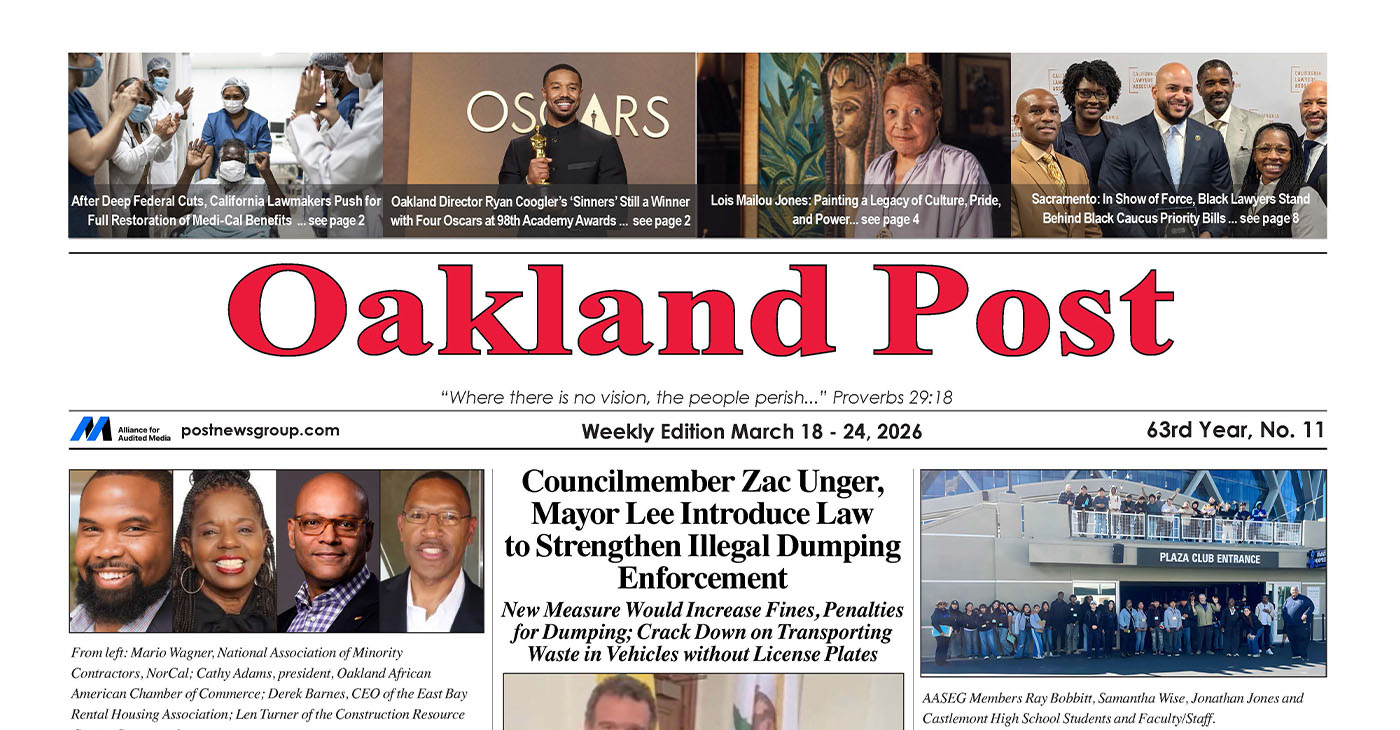
To enlarge your view of this issue, use the slider, magnifying glass icon or full page icon in the lower right corner of the browser window.
Activism
Oakland Post: Week of March 11 -17, 2026
The printed Weekly Edition of the Oakland Post: Week of March 11 – 17, 2026
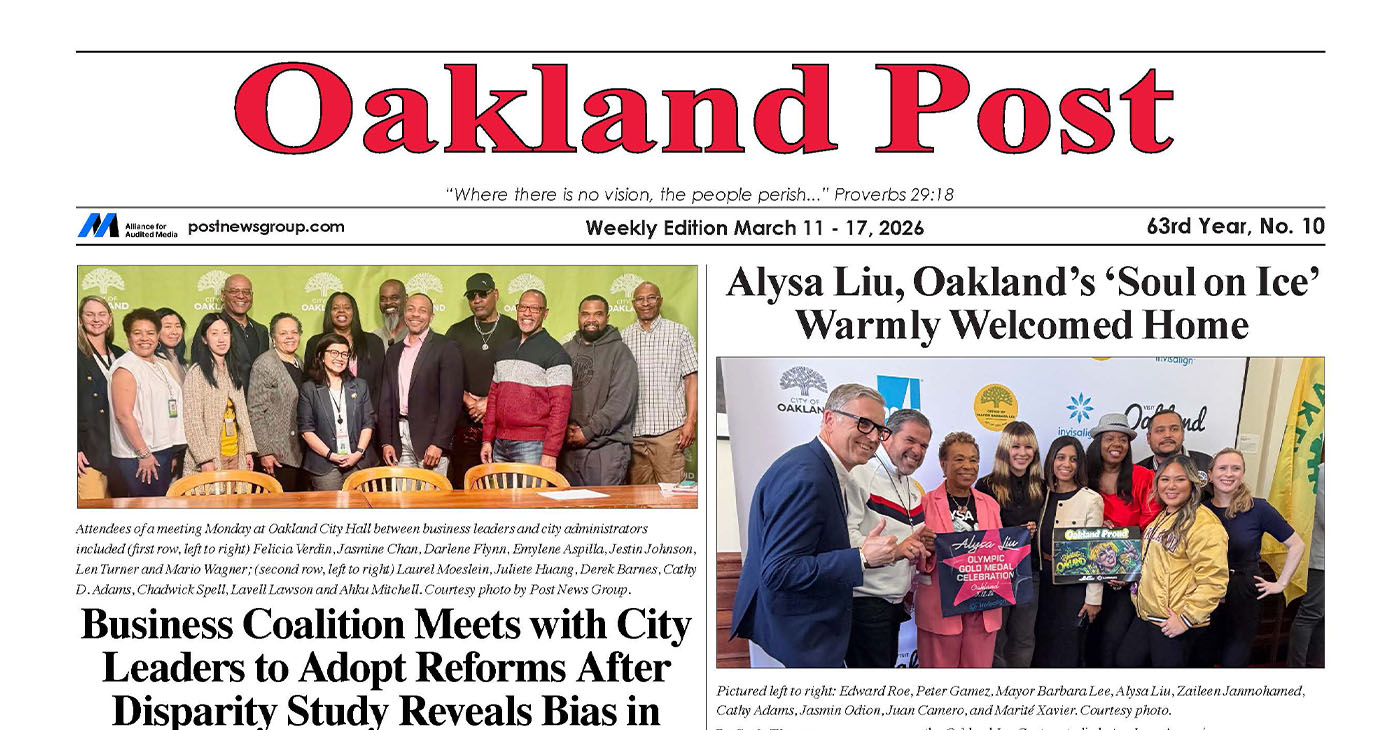
To enlarge your view of this issue, use the slider, magnifying glass icon or full page icon in the lower right corner of the browser window.
Activism
Oakland Post: Week of March 4 – 10, 2026
The printed Weekly Edition of the Oakland Post: Week of March 4 – 10, 2026

To enlarge your view of this issue, use the slider, magnifying glass icon or full page icon in the lower right corner of the browser window.

WORK FROM HOME
Home-based business with potential monthly income of $10K+ per month. A proven training system and website provided to maximize business effectiveness. Perfect job to earn side and primary income. Contact Lynne for more details: Lynne4npusa@gmail.com 800-334-0540


Black Artists in America, Installation Three Wraps at the Dixon Gallery and Gardens

Grief, Advocacy, and Education: A Counselor Reflects on Black Maternal Health

Future of Florida’s Black History Museum in Limbo

New Research Shows the Many Benefits of Early Learning

South Hampton K-8 Students Among Top 10 Finalists for Samsung’s ‘Solve for Tomorrow’ Competition

Cuba: No Negotiation with US on the President or Political System

Brooklyn Academy of Music Names Jamaican-Born Tamara McCaw as President

Trinidad & Tobego – U.S. Launches WhatsApp Channel for American Citizens in the Country

Oakland Post: Week of March 18 – 24, 2026

AI Innovation vs. Ethics and Environmental Impact

AI, Web3, and Digital Reparations

What If You Owned Your AI Agent?

Season 7, Episode 3 – January Reporter’s Roundtable 📱

Season 7, Episode 3 – January Reporter’s Roundtable

AI, Media, and Power | Part 2, Real-World Impacts and Tradeoffs

Discrimination in City Contracts

Oakland Post: Week of February 11 – 17, 2026

Reflecting on Black History Milestones in Birmingham AL

Rising Optimism Among Small And Middle Market Business Leaders Suggests Growth for California

CITY OF SAN LEANDRO STATE OF CALIFORNIA PUBLIC WORKS DEPARTMENT ENGINEERING DIVISION NOTICE TO BIDDERS FOR ANNUAL STREET OVERLAY/REHABILITATION 2019-21 – PHASE III

Oakland Post: Week of February 18 – 24, 2026

PRESS ROOM: NBA Hall of Fame Nominee Terry Cummings Joins 100 Black Men of DeKalb County to Launch Victory & Values Initiative

Oakland Post: Week of February 25 – March 3, 2026

U.S. manufacturing rebounds – how foundry services are adapting to rising demand

Trump’s MAGA Allies are Creating Executive Order Plan to Steal the 2026 Midterms

OP-ED: One Hundred Years of Black Workers Telling the Truth

Advancements in solar technology that are changing the way we power the world

Chase Oakland Community Center Hosts Alley-Oop Accelerator Building Community and Opportunity for Bay Area Entrepreneurs

Poll Shows Support for Policies That Help Families Afford Child Care

PRESS ROOM: Civil Rights TV Launches in Selma as the World’s First 24/7 Civil Rights Television Network

Hyundai Ioniq 5 Parking, Safety, and 360 View #shorts

2025 Ioniq 5 New Wiper & Powerful Performance! #shorts

Electric SUV Range: Is 259 Miles Enough? #shorts

EV Charging: How Fast Can You Charge an Electric Vehicle? #shorts

Biometric Cooling… Messaging Seats…Come on! 2025 Infiniti QX80 Autograph 4WD

Charged Up: Witness the Magic of a Fully Electric Car! #shorts

Range Rover Sport PHEV Included…: See What’s Inside This Luxury SUV! #shorts

Invisible Hood View: Perfect Parking with X-Ray Vision! #shorts

AI Is Reshaping Black Healthcare: Promise, Peril, and the Push for Improved Results in California

ESSAY: Technology and Medicine, a Primary Care Point of View

Sanctuary Cities

The RESISTANCE – FREEDOM NOW

STATE OF THE PEOPLE: Freddie

ECONOMIC BOYCOTT DAY!!!!!

I told You So
-
 #NNPA BlackPress4 weeks ago
Reflecting on Black History Milestones in Birmingham AL
-
 #NNPA BlackPress4 weeks ago
PRESS ROOM: NBA Hall of Fame Nominee Terry Cummings Joins 100 Black Men of DeKalb County to Launch Victory & Values Initiative
-
 Activism4 weeks ago
Oakland Post: Week of February 25 – March 3, 2026
-
 #NNPA BlackPress4 weeks ago
Trump’s MAGA Allies are Creating Executive Order Plan to Steal the 2026 Midterms
-
 #NNPA BlackPress4 weeks ago
Poll Shows Support for Policies That Help Families Afford Child Care
-

 Activism3 weeks ago
Oakland Post: Week of March 4 – 10, 2026
-

 #NNPA BlackPress3 weeks ago
Woman’s Search for Family’s Roots Leads to Ancestor John T. Ward – A Successful Entrepreneur and Conductor on the Underground Railroad
-

 #NNPA BlackPress3 weeks ago
OP-ED: NNPA Launches 2026 “Leadership Matters” Video Series
